Cash Flow Management for Trading and Distribution Firms

cash flow management

For trading and distribution firms, profit on paper does not always mean cash in the bank. A business may show healthy sales, expanding customer accounts, and strong demand, yet still struggle to pay suppliers, salaries, taxes, and logistics costs on time. That gap appears when cash is tied up in stock, delayed customer collections, or poorly timed payments.

This is why cash flow management needs to sit at the centre of commercial decision-making, not at the edge of finance. In distribution businesses, money moves through inventory, receivables, and supplier obligations every day. When those parts are managed separately, pressure builds quickly. When they are managed as one working-capital system, the business gains room to grow with greater confidence.

Cash flow pressure points in trading and distribution

Trading and distribution firms often carry a longer cash conversion cycle than service-based businesses. Cash goes out early to purchase goods, arrange freight, pay duties or transport costs, and maintain warehousing. Cash comes back later, often after goods are sold on credit and customers take time to settle invoices.

International guidance regularly points to the same pattern: the longer the cash conversion cycle, the more working capital the business must fund. This is especially relevant in Pakistan, where firms may also face seasonal demand swings, price volatility, and uneven customer payment behaviour.

A simple way to look at the issue is to identify where cash commonly gets trapped.

Area What ties up cash Typical warning sign Management priority
Inventory Excess stock, slow-moving lines, weak replenishment Stock ageing rises Buy smarter, clear slow items
Receivables Loose credit terms, slow collections, disputes Days sales outstanding increases Tighten collections and approvals
Payables Poor payment planning, missed terms, ad hoc settlements Supplier pressure or lost discounts Schedule payments with intent
Pricing and margins Low-margin sales funded by long credit Sales growth without free cash Review margin by customer and product
Forecasting No forward cash view Frequent cash surprises Build weekly and monthly forecasts

Cash flow rarely weakens because of one dramatic event; it usually slips through ordinary decisions made without a shared view of cash.

Working capital management as one connected system

Many firms review stock in one meeting, collections in another, and payables only when suppliers begin chasing. That structure can create blind spots. A sales team may push volume through extended credit, procurement may buy ahead for discounts, and finance may only see the cash shortfall after the fact.

A better approach is to treat inventory, receivables, and payables as connected levers. A decision in one area affects the others. If the business increases stock to improve service levels, collections discipline becomes even more important. If customer credit is extended to win market share, supplier terms and liquidity planning need to respond as well.
Flow diagram showing cash moving from supplier payments to inventory, credit sales, receivables, and customer collections, with delay points that create cash pressure.

Strong working-capital management usually depends on a short list of shared metrics that different teams review together.

  • Stock ageing
  • Credit exposure by customer
  • Days sales outstanding
  • Supplier payment calendar
  • Gross margin by product category
  • Weekly cash position

When commercial and finance teams work from the same picture, cash decisions become faster and more balanced.

Inventory management and stock decisions that protect cash

Inventory is often the largest use of working capital in a distribution business. It also creates the easiest illusion of safety. Full shelves can look like strength, yet slow or misplaced stock can drain liquidity for months. In many firms, the issue is not only overstocking. It is overstocking in the wrong product lines, branches, or sizes while fast-moving items still go out of stock.

Better inventory control starts with sharper visibility. Management should know which items move quickly, which items move irregularly, and which items have effectively stopped moving. This sounds basic, but many firms still rely on rough estimates rather than clean ageing and movement reports. Without reliable data, purchasing decisions become reactive.

Margin also matters. Some items turn quickly but produce weak cash returns after freight, storage, rebates, and credit costs are considered. Other products may move more slowly but support stronger cash generation. That is why stock decisions should be linked to both turnover and contribution.

A practical review often includes the following categories:

  • Fast movers: protect availability, but avoid excessive safety stock
  • Slow movers: reduce future purchases and review branch allocation
  • Dead stock: clear through discounts, bundles, or negotiated returns where possible
  • Seasonal items: buy against a realistic demand window, not optimism
  • Imported lines: factor in longer lead times, foreign exchange exposure, and duty-related cash needs

Even modest improvements in purchasing discipline can release meaningful cash. A firm does not need a dramatic inventory reduction to feel the benefit. A cleaner buying pattern, fewer obsolete items, and tighter reorder rules often make a visible difference within one or two cycles.

Receivables control and days sales outstanding

Late collections are one of the most common reasons smaller firms come under cash pressure. A sale booked today does not help liquidity if payment comes 60 or 90 days late, or if the invoice enters a long dispute trail. This is why receivables management should be treated as an active commercial process, not merely an accounting follow-up.

Days sales outstanding, or DSO, remains one of the clearest indicators to watch. If DSO is rising while sales are also growing, the business may be funding that growth from its own pocket. The risk becomes sharper when a small number of customers represent a large share of total exposure.

Good receivables control begins before the invoice is raised. Customer onboarding, credit checks, approved limits, documented terms, and clean order processing all influence collection speed. After billing, discipline matters just as much. Statements should go out on time, disputes should be logged early, and responsibility for follow-up should be clear.

There is also a strategic angle. Not every customer deserves the same credit treatment. A profitable, reliable account may justify normal terms. A weak-paying account may need shorter terms, staged supply, advance payment, or credit insurance depending on the business model.

Teams that manage receivables well usually keep a close eye on a few practical signals.

  • Current bucket: invoices not yet due but approaching concentration risk
  • 1 to 30 days overdue: early action window before delays become habit
  • 31 to 60 days overdue: direct escalation and order hold review
  • Over 60 days overdue: recovery plan, credit block, or structured settlement
  • Disputed invoices: root-cause analysis across sales, warehouse, and billing

A disciplined ageing review often improves cash faster than a broad cost-cutting exercise.

Payables scheduling and supplier term discipline

Payables are sometimes treated only as pressure to be managed, yet they can also be a source of stability when handled thoughtfully. The goal is not simply to delay every payment. The goal is to schedule payments in a way that protects liquidity without damaging supply continuity or commercial trust.

Reliable supplier relationships matter in distribution. Short supply, delayed deliveries, or loss of preferred pricing can damage both revenue and cash generation. This means the best payable strategy is usually deliberate rather than defensive. Critical suppliers should be mapped, key dates tracked, and payment commitments kept where they support continuity.

Some firms gain quick relief just by moving from ad hoc payments to a weekly payable calendar. Once due dates, priority vendors, discounts, and expected inflows are visible together, management can decide with greater control. That is far better than reacting to daily calls and last-minute transfers.

Cash flow forecasting and scenario planning

A firm can manage today’s cash and still be surprised next month if no forward view exists. Forecasting helps management see pressure early, test decisions before they are made, and avoid emergency borrowing.

For trading and distribution businesses, the most useful model is often a layered forecast. A short weekly forecast tracks immediate inflows and outflows. A monthly view captures purchasing plans, tax obligations, payroll, debt servicing, and major customer receipts. A longer view helps management prepare for seasonality, import cycles, branch expansion, or pricing changes.

The forecast does not need to be perfect to be useful.

What matters is discipline: one owner, regular updates, clear assumptions, and comparison of forecast versus actual results. Over time, the business learns where estimates tend to fail. Maybe customer collections are always too optimistic. Maybe procurement timing is understated. Those insights make later forecasts stronger.

A practical forecasting routine usually includes:

  • Sales collections by customer and due date
  • Planned purchases and supplier commitments
  • Tax payments and statutory deadlines
  • Loan repayments and finance charges
  • Scenario cases for delayed collections or slower sales

When this process becomes routine, decision-making improves across the business. Promotions, stock builds, credit extensions, and capital spending can all be assessed against real liquidity capacity.

Liquidity options: receivables, inventory, and distributor finance

Even well-run firms can face periods when operating cash is tied up. Growth phases, long collection cycles, major stocking periods, and supply chain disruption can all stretch liquidity. In those moments, structured finance linked to working capital can be more suitable than relying only on unsecured borrowing.

Receivables-based finance is one option. Here, eligible receivables act as collateral, allowing the business to access cash before customers pay. This can be useful where the debtor book is strong but payment terms are long. The quality of invoicing, documentation, and customer credit matters greatly.

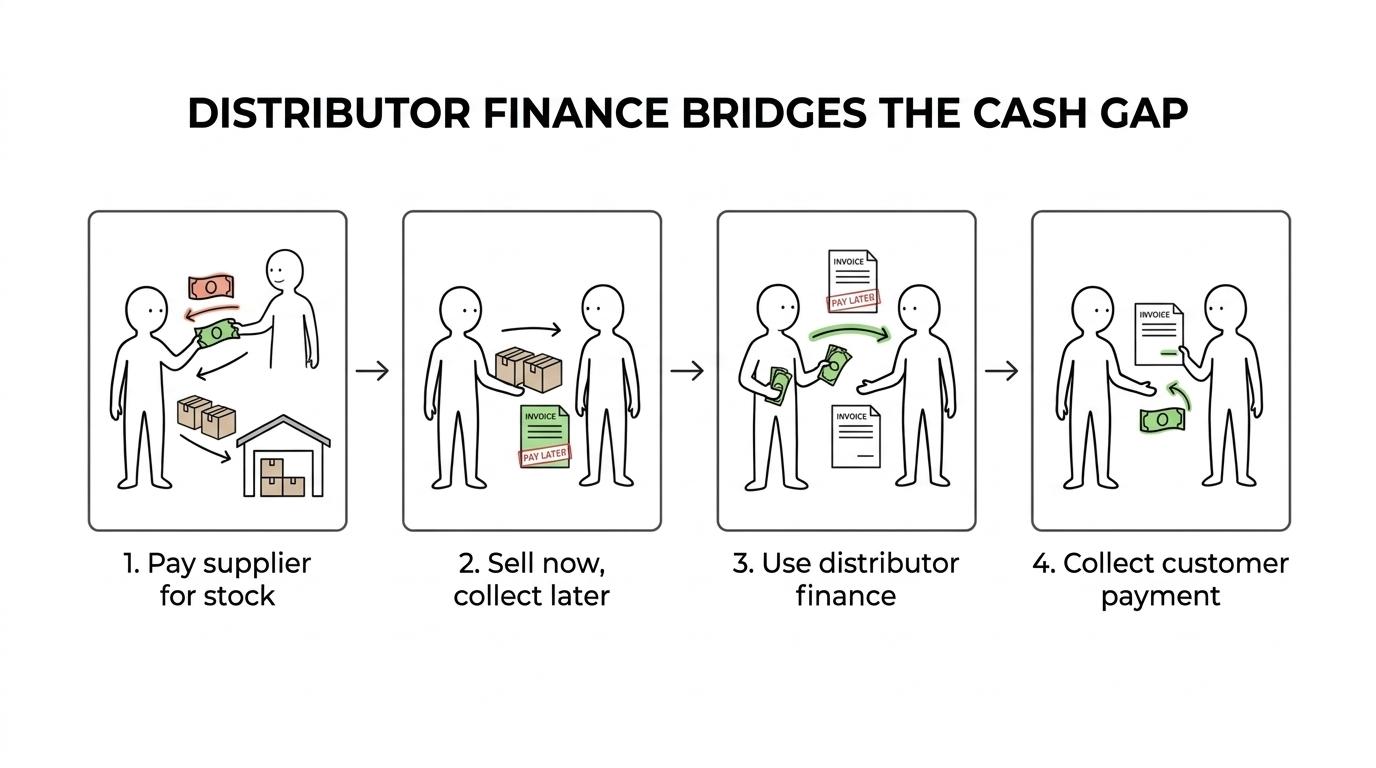
Inventory financing may also help where goods are moving steadily but cash is locked between procurement and sale. For some businesses, distributor finance can bridge the period between purchasing from suppliers and collecting from end customers. These instruments are not a substitute for weak operations, yet they can support healthy businesses facing timing gaps.

Before taking this route, firms should review a few points carefully.

  • Facility fit: choose a structure linked to the actual cash gap
  • Eligibility rules: check which receivables or stock qualify
  • Cost of funds: compare financing cost against margin and stock turn
  • Reporting burden: confirm whether the business can meet data and control requirements
  • Exit path: avoid long-term dependence on short-term liquidity tools

The strongest use of these facilities is targeted, controlled, and backed by sound reporting.

Technology and reporting for daily cash visibility

Cash control becomes much easier when the underlying data is timely and connected. Many trading firms still struggle with separate spreadsheets for stock, debtor ageing, branch sales, and supplier balances. That slows action and creates conflicting versions of the truth.

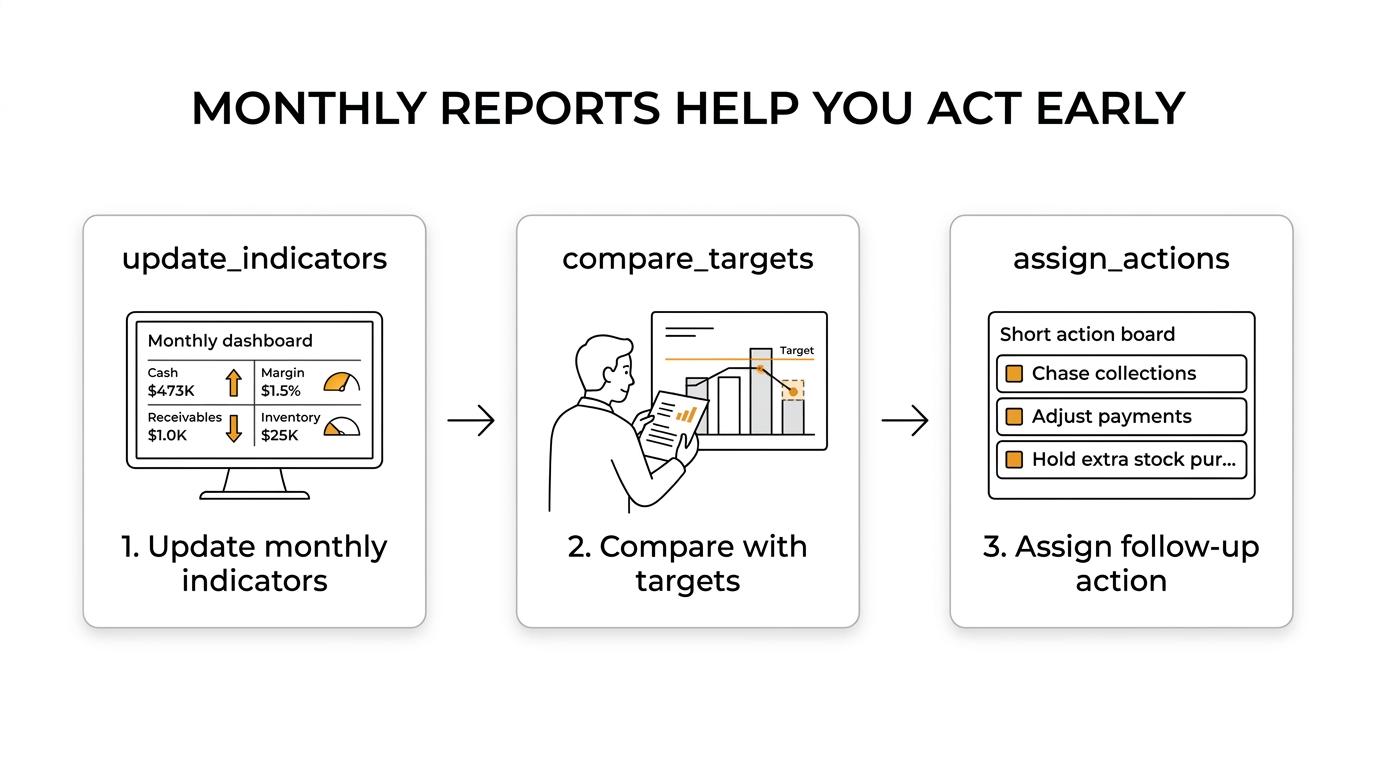
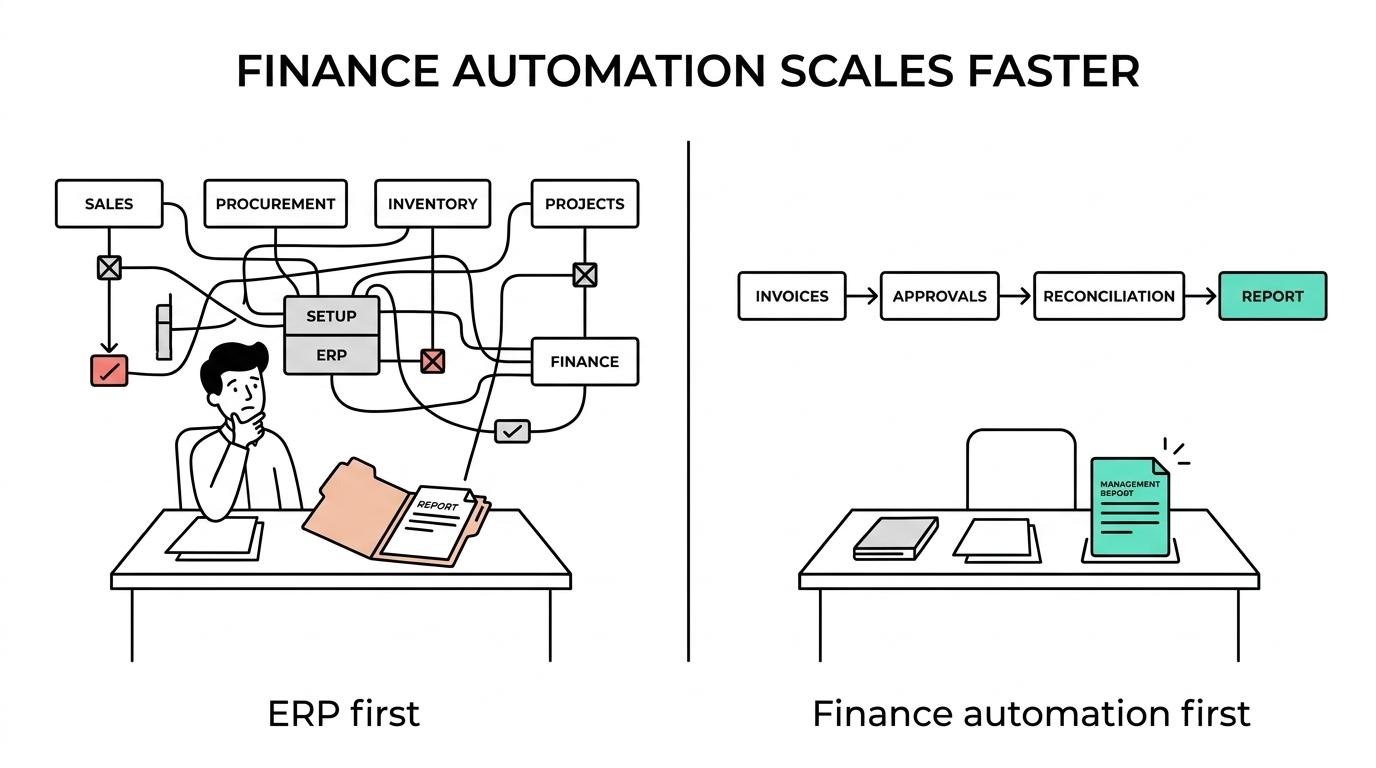
Technology-enabled reporting can improve visibility without making the process complicated. A practical setup may include daily sales and collection dashboards, stock ageing by location, customer exposure against approved limits, and a rolling cash forecast linked to payables and receivables. ERP systems and business automation tools can also reduce manual delays in billing, reconciliations, and approval flows.

The real value is not the software alone. It is the management rhythm that the system supports. When data is current, teams can spot a rising DSO trend, an overstocked product line, or a supplier concentration issue before the problem becomes expensive. That kind of visibility helps firms protect liquidity while still pursuing growth.

For trading and distribution businesses in Pakistan, that balance matters. Growth is easier to fund, supplier relationships are steadier, and reporting becomes more credible when cash flow is managed with the same discipline as sales.

Corporate Tax or Sales Tax What Companies Must File

corporate tax

Many Pakistani companies ask the wrong first question. The real issue is not whether to file corporate tax or sales tax, but whether your business falls under one regime, both, or a wider compliance set, and that is where firms like CBMC, an accounting, tax advisory, and technology-enabled professional services firm, often see confusion start.

TL;DR: Summary

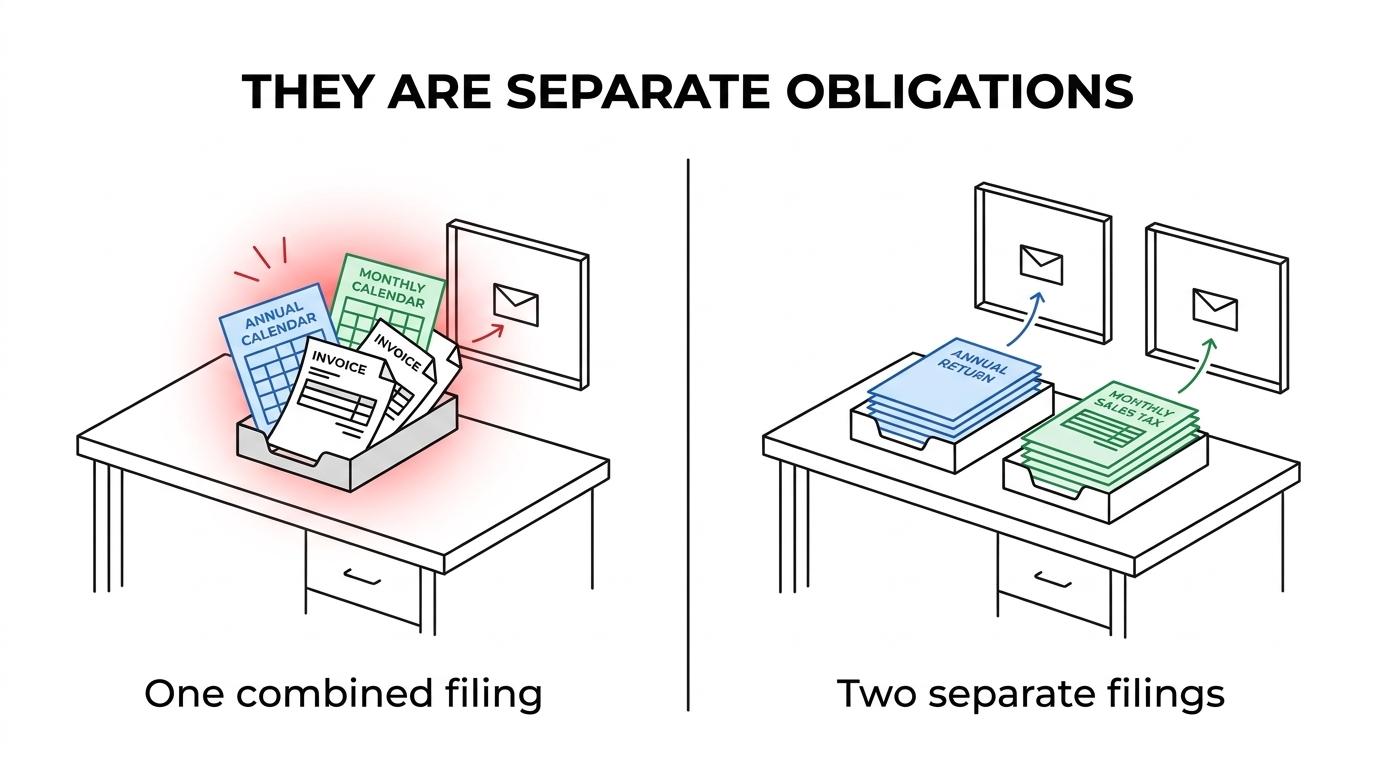
  • In Pakistan, corporate income tax and sales tax are separate filing duties, not substitutes for each other, and many companies must deal with both.
  • Companies file income tax returns electronically through FBR’s Iris portal, while registered persons under the Sales Tax Act file separate sales tax returns through the FBR sales tax e-portal.
  • A company must generally file its annual income tax return even if it has no taxable income, while sales tax is usually filed monthly by registered persons, with payment by the 15th and e-filing by the 18th of the following month under the standard procedure.
  • If your business makes a taxable supply in a sector that requires registration, sales tax compliance can apply even when income tax and sales tax reporting happen on different timelines.
  • CBMC is relevant here because Pakistan businesses often need coordinated handling across tax registration, Iris filing, sales tax returns, reporting records, and cross-border finance support.

This distinction matters because each regime has its own registration trigger, return format, filing timeline, and practical risk. If a company assumes one filing covers the other, it can miss statutory deadlines, misstate tax periods, or fail to register where registration is required.

Do companies in Pakistan have to file both corporate tax and sales tax?

Yes. A Pakistani company may need to file both an annual income tax return and recurring sales tax returns, because FBR treats them as separate obligations under separate systems.

Under FBR guidance, income tax returns are filed online through the Iris portal. Sales tax returns are filed through the FBR sales tax e-portal by registered persons. That means one company can be fully compliant for income tax and still be non-compliant for sales tax, or the reverse.

Side-by-side comparison of corporate income tax and sales tax in Pakistan, showing different triggers, filing portals, frequency, and compliance focus.

The key test is functional. Income tax applies to the company as a taxable person for annual income reporting. Sales tax applies when the business is registered under the Sales Tax Act, typically because it makes a taxable supply in Pakistan and falls within the relevant sectors or categories. A common misconception is that a company with an NTN has automatically finished all tax registration work. It has not. Income tax registration and sales tax registration are linked in practice but not identical in scope.

“CBMC helps companies treat corporate tax and sales tax as two separate FBR workflows, not one combined filing.”

What is the difference between corporate income tax and sales tax?

Corporate income tax is a tax on income, while sales tax is a tax on taxable supplies. In Pakistan, they differ in legal basis, filing frequency, and the records used to prepare them.

Corporate income tax is annual. Companies report income, expenses, taxable profit, tax credits where applicable, and related disclosures through Iris. FBR’s own filing guidance states that companies are required to file a return of income irrespective of whether they have any taxable income or not. That point catches many dormant companies, startups in pre-revenue stages, and owner-managed businesses.

Sales tax is transaction-based and usually monthly for registered persons. The sales tax system tracks output tax, input tax, taxable sales, exempt sales where relevant, and supporting documentation for each tax period. Under the standard process referenced by FBR, a registered person files monthly return data including Annexure C, pays by the 15th, and e-files by the 18th of the following month.

If income tax asks, “What did the company earn during the year?” sales tax asks, “What taxable supplies took place in this period, and what tax was charged or claimed?” That difference affects accounting design, invoice control, and ledger structure.

What corporate tax and sales tax filings are companies usually responsible for?

Most companies deal with a small set of recurring filings, but the mix depends on registration status, sector, and tax year. The safest approach is to map obligations before the year begins.

  1. Annual income tax return: Filed by the company through Iris, even if there is no taxable income.
  2. Sales tax monthly return: Filed by registered persons for each tax period through the FBR sales tax portal.
  3. Sales tax payment: Usually due by the 15th of the following month under the standard timeline.
  4. Return submission after payment: Standard e-filing is generally due by the 18th of the following month.
  5. Annual sales tax return in specific cases: Manufacturers may also face an annual sales tax return by 30 September of the following financial year.
  6. Special tax year income tax return: A company with a special tax year may have its return due on or before 30 September.

A practical tip here is to separate “return filing” from “tax payment” in your compliance calendar. Teams often remember the form but miss the payment date.

How do you file a corporate income tax return through Iris?

Start with FBR e-enrollment, then use Iris to complete and submit the company’s income tax return. CBMC often sees filing issues begin much earlier than the return itself, usually at registration, access control, or incomplete ledgers.

FBR states that an individual, a company, and an association of persons are treated as registered when they are e-enrolled on the Iris portal. E-enrollment provides the National Tax Number or registration number and the login credentials needed to access the system. Iris is the online income tax system and, according to FBR, the only way online income tax returns can be filed.

A practical sequence looks like this:

  • E-enrollment first: obtain NTN, registration details, and portal access.
  • Close the books: finalize revenue, expense, asset, liability, and equity balances for the tax year.
  • Prepare tax adjustments: identify non-deductible expenses, allowances, credits, and timing differences where relevant.
  • Complete Iris return fields: enter entity details, accounting period, income data, and tax computation.
  • Review before submission: reconcile return figures with financial statements and withholding positions.

One common mistake is treating draft accounts as final tax numbers. If your ledger changes after the return is prepared, your risk does not stay small just because the portal accepted the filing.

How do you file a sales tax return on the FBR portal?

Register first, then prepare each tax period carefully, then pay and e-file on time. Sales tax filing is more repetitive than income tax filing and usually less forgiving of poor monthly controls.

For a registered person, the process starts with checking whether the business is required to register under the Sales Tax Act. Once registered, the company compiles sales invoices, purchase invoices, debit and credit adjustments, and tax-period data for portal entry. FBR’s standard monthly process refers to Annexure C, payment by the 15th, and e-filing by the 18th day of the following month.

A practical step-by-step workflow looks like this:

  • Collect source documents: sales invoices, purchase invoices, import records, credit notes.
  • Classify supplies: taxable, exempt, zero-rated, or non-creditable as applicable.
  • Reconcile output and input tax: match the return with the sales ledger and purchase ledger.
  • Prepare portal data: enter the tax period information and required annexures.
  • Make payment and submit: do not assume submission alone completes the cycle.

“CBMC supports finance teams that need one process for monthly sales tax data, payment timing, and FBR portal submission.”

A useful misconception check: many businesses think “no sales” means “no return.” That depends on registration status and filing obligations, not just activity level in a given month.

How can a company check if it must register for sales tax?

Check your sector, your supplies, and whether those supplies are taxable in Pakistan. If your business makes a taxable supply in a category FBR requires to register, the question is usually when to register, not whether to care about sales tax.

FBR guidance says every person in the sectors mentioned by FBR who makes a taxable supply in Pakistan is required to be registered under the Sales Tax Act. That means the analysis starts with the business model. Are you manufacturing, distributing, importing, retailing in a covered category, or supplying taxable goods or services in a regulated channel?

A clean internal review usually follows three steps. First, map what the company sells and where it sells it. Second, determine whether the supply is taxable and whether the business falls into a registration category. Third, confirm whether the registration must already have happened based on current operations.

Pro tip: do not leave this review with the sales team alone. Sales tax registration often turns on how supplies are legally characterized, not how they are marketed.

What if your company had no taxable income or no sales in the period?

No taxable income does not usually remove the company’s income tax filing duty, and no sales in a month does not automatically remove sales tax filing obligations for a registered person.

FBR’s income tax guidance is clear that companies are required to file a return of income irrespective of whether they have any taxable income or not. That point matters for dormant companies, project companies waiting for launch, subsidiaries between contracts, and startups still in build mode. If the company exists and falls within filing obligations, it should not assume silence is allowed.

For sales tax, the answer depends on whether the business is registered and what the rules require for that tax period. If registered, the company should check whether a return is still due even when activity is nil or limited. This is where many businesses confuse commercial inactivity with compliance inactivity.

If your company had no taxable income, then annual income tax filing still remains a live issue. If your company had no taxable sales in a month but is still registered, then sales tax compliance still needs to be reviewed period by period.

How do due dates differ for annual income tax and monthly sales tax?

Income tax is usually annual, while sales tax is usually monthly. That difference changes staffing, review cycles, and the kind of controls a company needs.

For income tax, FBR guidance notes that a company with a special tax year has its return due on or before 30 September. For many companies, the filing calendar is built around the year-end close, statutory adjustments, and annual financial reporting.

Sales tax works on shorter cycles. FBR’s standard framework states that a registered person files monthly return data, makes payment by the 15th, and e-files by the 18th of the following month. FBR also indicates that some categories may file in monthly, quarterly, or annual formats, and manufacturers may have an annual sales tax return by 30 September of the following financial year.

“CBMC works with businesses that need annual income tax compliance and monthly sales tax discipline coordinated across the same finance function.”

A practical trade-off appears here. Annual income tax allows more time for year-end review, but it can produce a large correction problem if bookkeeping stayed weak all year. Monthly sales tax creates more pressure each period, yet it can force healthier bookkeeping habits if the process is well designed.

Which records should companies keep for both tax regimes?

Companies should keep a complete, reconcilable set of accounting and tax records that supports both annual income tax reporting and each sales tax period. Good filing starts with good evidence.

At minimum, most companies need records that connect the general ledger to the return data and to the source documents behind it. That usually includes the following:

  • Sales records: invoices, debit notes, credit notes, customer ledgers
  • Purchase records: supplier invoices, import documents, expense support
  • Banking evidence: bank statements, payment proofs, withholding evidence
  • Corporate records: registration documents, NTN details, tax correspondence
  • Period reconciliations: ledger-to-return checks for income tax and sales tax

A common mistake is storing records by department instead of by tax logic. If invoices sit with sales, expenses sit with admin, and tax working papers sit with a single individual, then reviews become slow and error-prone. A stronger method is to organize records around reporting cycles, tax periods, and audit trails.

Why do companies often mix up Iris registration with sales tax registration?

Because both sit under FBR’s digital ecosystem, businesses often assume one login means one complete tax profile. That assumption is convenient, but it is not safe.

FBR states that e-enrollment on Iris provides registration credentials and access for income tax filing. That fact is important, but it does not mean the company has satisfied every indirect tax requirement. Sales tax registration depends on whether the company is a person that must register under the Sales Tax Act and whether it makes taxable supplies in the relevant category.

Here is the misconception to avoid: “We have an NTN, so we are fully tax-registered.” An NTN is critical. It is not the same as saying every required sales tax registration, return setup, and period compliance process is already active.

If a company treats portal access as the end of setup, then return failures often appear months later, once transactions have already taken place.

When should a company get professional help with tax filing?

Get help when the business has multiple revenue streams, cross-border links, weak reconciliations, or uncertainty about registration and due dates. CBMC is most relevant where tax filing is no longer just form submission but a coordination issue across accounting, corporate compliance, and systems.

That need often appears in growing SMEs, startups shifting into formal reporting, manufacturers with annual sales tax return obligations, and groups operating across Pakistan with support links to the UAE or UK. The value of support is not only in preparing returns. It is also in setting up the compliance rhythm: who closes the books, who reviews taxable supply treatment, who approves payment, and who keeps portal responsibilities current.

A practical sign you need support is repeated last-minute filing. Another is when finance cannot quickly answer three basic questions: Are we registered correctly, what is due next, and do our ledgers reconcile to the tax position? If the answer to any of those is unclear, the filing risk is already operational, not just technical.

CBMC Education Accounting for Schools and Colleges

education accounting

Running a school, college, or training organisation means your finance function has to do more than post entries. You need fee collections tracked, payroll processed correctly, budgets understood, procurement documented, and statutory filings kept on time. CBMC provides education accounting support for schools, colleges, and education-focused organisations in Pakistan so your finance operations stay usable for management and ready for regulators.

CBMC brings accounting, tax, payroll, corporate compliance, assurance, advisory, and technology support into one connected service. For you, that means fewer handoffs between separate firms and a clearer line from daily bookkeeping to annual reporting, withholding-tax checks, governance, and finance improvement.

Education accounting in Pakistan for schools, colleges, and training organisations

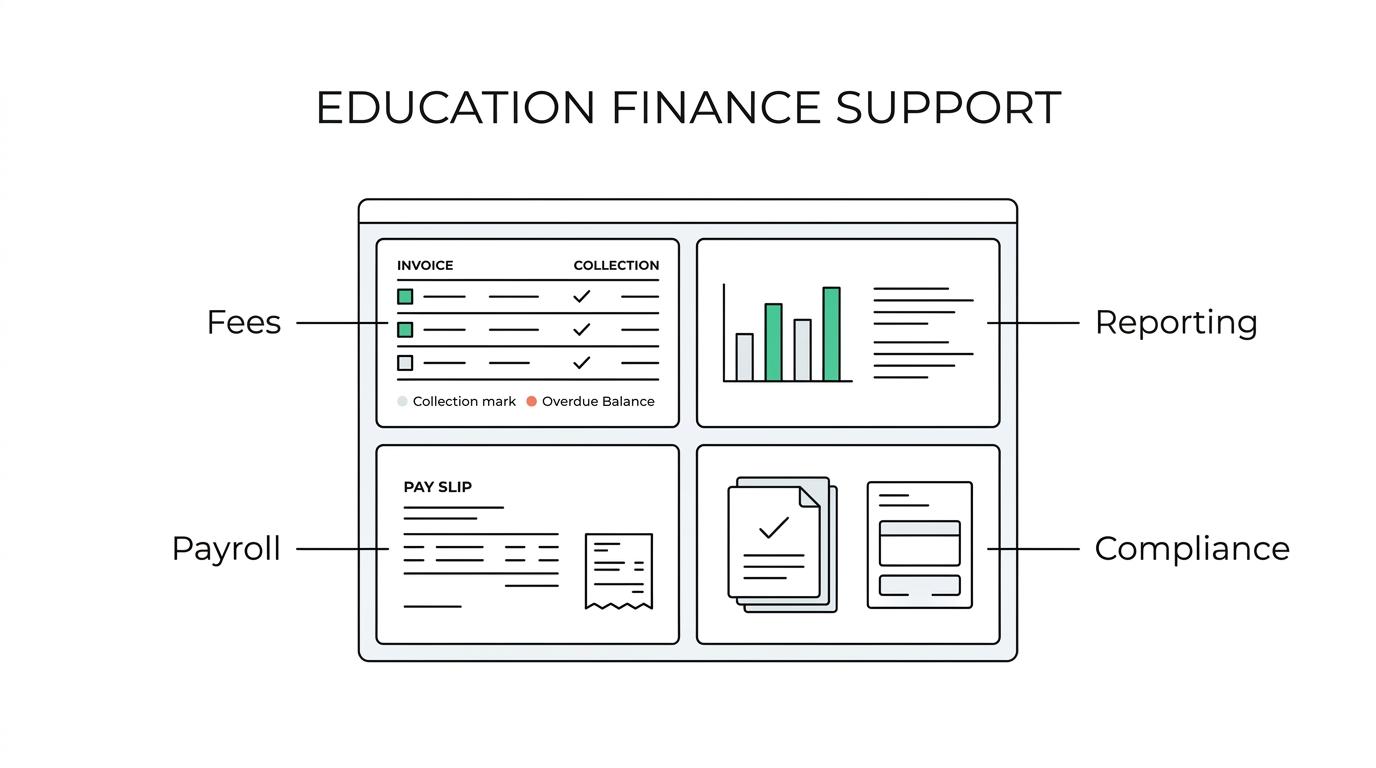
CBMC supports schools, colleges, and training organisations in Pakistan with the finance work that sits behind daily operations. Our education-focused service covers fees and receivables, budgets and reporting, payroll and procurement, and compliance and governance so you can run the institution with better control over cash, records, and reporting.

When your fee ledger is unclear or your receivables are ageing without follow-up, management decisions become slower and cash planning becomes reactive. CBMC education accounting support gives you organised books, structured reporting, and clearer visibility into what has been billed, what has been collected, what is overdue, and what needs management attention.

Diagram of a school finance function with linked parts for fees, receivables, reporting, payroll, procurement, budgeting, and compliance.

“CBMC supports schools, colleges, and training organisations in Pakistan across fees and receivables, budgets and reporting, payroll and procurement, and compliance and governance.”

A typical education accounting scope with CBMC can include the work you need month after month, not just at year end:

  • Fees and receivables: Recording fee income, reconciling collections, tracking balances, and improving visibility over outstanding student or institutional receivables.
  • Bookkeeping and reporting: Maintaining accounting records, preparing management reports, and organising ledgers for cleaner monthly and annual reporting.
  • Payroll and vendor processing: Supporting salary accounting, payroll-related tax handling, and payables workflows linked to procurement and operating costs.
  • Budgets and controls: Preparing budgets, comparing actuals against budget, and highlighting variances that affect staffing, facilities, or programme delivery.
  • Compliance support: Coordinating finance records, statutory filings, and audit-readiness so routine obligations do not pile up at the last minute.

CBMC works well for owner-managed school systems, standalone campuses, colleges, training providers, and education nonprofits that need practical support rather than a generic accounting package. If you already have an internal accounts team, we can strengthen it with reporting, tax, compliance, and advisory support instead of replacing it.

CBMC keeps school and college compliance aligned with SECP, FBR, and governance requirements

Education entities in Pakistan often need recurring compliance support alongside daily accounting. If your institution operates through a company, SECP requires an annual return once a year, filed on Form-A or Form-B depending on whether the company has share capital, and that filing is tied to the AGM timeline. CBMC helps you keep company records, officer details, and filing preparation in order so annual return work is not left to a rushed deadline.

“CBMC helps education companies handle SECP annual return requirements, including Form-A or Form-B filings due within 30 days of the AGM.”

For institutions that fall into company categories requiring annual audited financial statements, bookkeeping alone is not enough. CBMC can support year-end close, schedules, reconciliations, and audit-readiness, and we can provide assurance support where the engagement scope and independence requirements allow.

Education nonprofits need even tighter governance discipline. If you are forming or running a not-for-profit education entity under Section 42 education organisations, the structure comes with specific obligations, including the licence requirement before incorporation and restrictions on distributing profits or income to members. CBMC supports Section 42 education organisations with finance records, governance-oriented compliance support, and reporting that reflects the entity’s objects and regulatory position.

Tax handling also needs current-year attention, not last year’s assumptions. FBR maintains a withholding-tax rate card by tax year and updates it annually, so schools and colleges making salary, contractor, or vendor payments need deductions checked against the correct year’s table. CBMC reviews withholding-tax treatment as part of ongoing finance support so payroll and vendor processing are less exposed to avoidable errors.

“CBMC checks education payroll and vendor deductions against the FBR withholding-tax rate card for the correct tax year.”

CFO support, reporting, and finance process improvement for growing education institutions

As an institution grows, the challenge usually shifts from basic bookkeeping to decision-ready reporting. CBMC provides CFO services and advisory support for education clients that need budgets, reporting packs, cash planning, management insight, and stronger internal finance discipline without immediately building a full senior finance department in-house.

CBMC combines accounting, tax, corporate compliance, advisory, and technology-enabled delivery in one team, which helps you connect monthly reporting with payroll controls, procurement workflows, statutory obligations, and management decisions. You spend less time reconciling different adviser opinions and more time working with one coordinated team that understands how the pieces fit together.

“CBMC combines accounting, tax, corporate compliance, advisory, and technology support so education clients can manage routine finance work and recurring compliance through one connected team.”

Where systems are slowing you down, we can also support ERP and business automation work. That may include improving chart of accounts structure, reporting flows, approval paths, documentation standards, and other finance processes that make month-end cleaner and reduce manual follow-up.

CBMC’s practical approach matters if your school or college is balancing multiple campuses, different fee streams, payroll complexity, or grant and donation reporting alongside operating income. We focus on finance process improvement that make reporting clearer for management and easier to defend during audit, filing, and board-level review.

If your institution has links to sponsors, related entities, or stakeholders in the UAE or the UK, CBMC can also support cross-border coordination. That is useful when reporting expectations, ownership structures, or finance communication extend beyond Pakistan.

Why schools, colleges, and education nonprofits choose CBMC in Pakistan

CBMC is a strong fit when you need more than a bookkeeper and less than a fragmented set of separate advisers. Our education sector support is especially relevant if your institution needs both daily finance handling and recurring statutory discipline.

You are likely to get the most value from CBMC if your situation looks like one or more of these:

  • You need finance control around fees and receivables so cash collection is visible and overdue balances are easier to manage.
  • You need monthly budgets and management reporting that help leadership act before finance problems affect staffing, procurement, or programme delivery.
  • You need payroll, withholding tax, and vendor processing support tied to current tax-year requirements rather than outdated rates or informal practice.
  • You need SECP, audit, or Section 42 compliance support alongside the accounting records those obligations depend on.
  • You want one provider for accounting, tax, compliance, advisory, and technology support instead of managing separate firms for each issue.
  • You are building a stronger finance function and need CFO-level input, process cleanup, or system improvement without overbuilding internal headcount too early.

Buying concerns in education finance are usually about reliability, timelines, communication, and scope. CBMC addresses those concerns by scoping work around your institution type, reporting needs, payroll burden, governance structure, and filing obligations, whether you need ongoing outsourced support or targeted help for a specific compliance or reporting gap.

Speak with CBMC about education accounting for your school or college

If your school, college, training organisation, or education nonprofit needs better control over receivables, reporting, payroll, statutory filings, or finance governance, Talk to CBMC about your current setup, your entity type, and the pressure points in your finance function.

Talk to CBMC about your current setup, your entity type, and the pressure points in your finance function. We can help you define a practical education accounting scope that supports day-to-day operations, keeps compliance on track, and gives management clearer financial visibility.

CBMC International Tax Advisory for Pakistan Exporters

international tax

If you export from Pakistan, your tax position does not stop at filing an annual return. You need clarity on export proceeds, withholding mechanics, sales tax touchpoints, supporting records, and how Pakistan rules connect with customers, entities, or banking activity outside the country. CBMC provides international tax advisory for Pakistan exporters who need that joined-up view.

CBMC is an accounting, tax, business advisory, and technology-enabled professional services firm serving organisations in Pakistan, with support and cross-border coordination in the UAE and the UK. With 20 years of professional experience and 8 integrated service lines, CBMC helps exporters handle tax planning, compliance, and representation across Pakistan while keeping finance, reporting, and regulatory obligations aligned.

International tax advisory for Pakistan exporters facing changing FBR rules

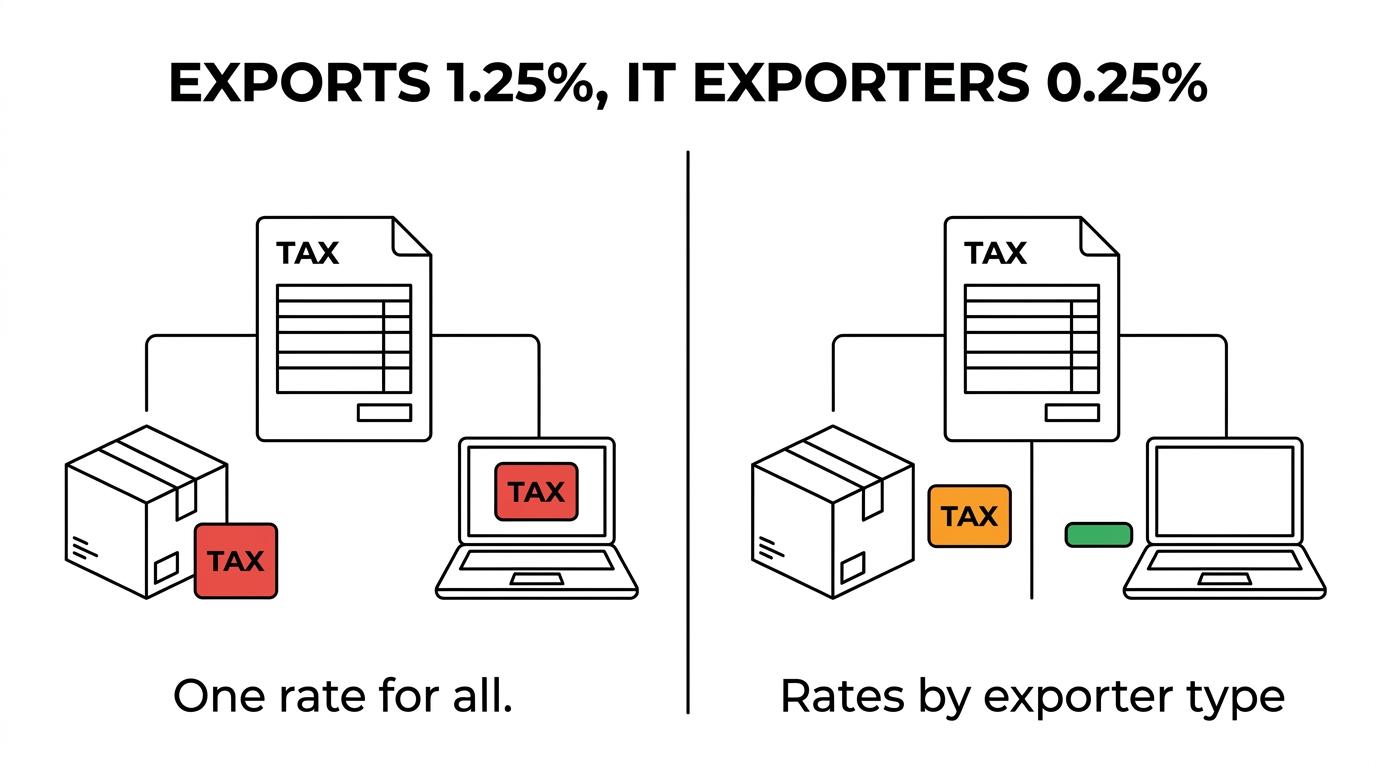
Pakistan’s export tax mechanics are changing, and exporters need current guidance, not last year’s assumptions. Budget 2026-27 reduced tax collection on export proceeds from 2% to 1.25%, and the same budget extended the reduced 0.25% tax rate for exporters of IT and IT-enabled services up to Tax Year 2029. CBMC helps you interpret those rule changes against your actual export model, receipts, filings, and internal records.

“CBMC helps Pakistan exporters apply the 1.25% export-proceeds tax change and the 0.25% IT exporter rate through Tax Year 2029.”

The practical issue is not just the published rate. It is whether your return computations, withholding position, supporting documentation, and finance processes reflect the current rule correctly when export proceeds are realised and reported.

Side-by-side comparison of Pakistan exporter tax rates showing the previous 2% rate, the current 1.25% export-proceeds rate, and the 0.25% rate for IT and IT-enabled services exporters through Tax Year 2029.

CBMC also works with the current FBR withholding tax framework in mind. FBR’s withholding tax rate card page lists separate rate cards for Tax Years 2027 and 2026, updated under the relevant Finance Acts, which is a reminder that exporter tax positions need active review when rates or treatment change.

CBMC tax support for goods exporters, IT exporters, and cross-border businesses

CBMC supports companies and SMEs, owner-managed businesses, established companies, and cross-border businesses. For exporters, that includes manufacturers, trading and distribution businesses, technology companies, and professional services firms selling outside Pakistan.

Our role can be set up in the way your business actually works. CBMC can support you as an ongoing tax function, a targeted assignment for a specific issue, or a specialist extension of your existing finance team when export activity becomes more complex.

“CBMC brings 20 years of professional experience and 8 integrated service lines to exporter tax and cross-border support.”

That flexibility matters if you already have internal accounting staff but need sharper tax oversight, or if you are growing quickly and want one firm to connect tax, accounting, statutory filings, and cross-border coordination.

A CBMC international tax advisory engagement for Pakistan exporters can include:

  • Income tax returns and computations: annual and periodic tax work aligned with export activity, current rates, and supporting records.
  • Sales tax registration and filing: support where your export model creates registration, filing, or documentation needs.
  • Withholding tax reviews and statements: review of obligations, rate application, and reporting requirements under current FBR guidance.
  • Representation in notices, audits, and appeals: practical support when the issue moves from compliance into correspondence or dispute.
  • Cross-border coordination: alignment with group, management, or commercial activity involving Pakistan, the UAE, and the UK.

Export House eligibility review and TDAP-facing readiness for Pakistan trading companies

For some exporters, tax advice also needs to connect with export-status planning. TDAP states that an Export House in Pakistan is a trading company registered as an Export House by the competent authority, with its secretariat in TDAP. The criteria are specific, and missing one requirement can slow an application or create avoidable rework.

CBMC helps trading companies review whether their structure, registration position, and export-performance evidence support an Export House strategy before time is spent on the wrong path. That is useful when you are scaling exports, formalising an overseas commercial presence, or coordinating several entities around one export platform.

“CBMC helps exporters assess TDAP-linked readiness around the US$1 million Export House threshold and the US$2 million consortium threshold.”

Based on TDAP’s published requirements, an applicant must be a trading company registered under the Companies Ordinance 1984, be registered as an exporter under the Importers and Exporters (Registration) Order 1993, have or undertake to establish an office abroad, and show export performance of at least US$1 million in the preceding year. TDAP also states that two or more exporters with combined export performance of at least US$2 million in the preceding year may apply as a consortium.

CBMC’s value here is practical coordination. We help you connect tax records, company registrations, compliance documents, and finance evidence so that export-related decisions are based on documented facts rather than assumptions.

CBMC coordinates Pakistan, UAE, and UK tax touchpoints for exporters

Many exporter issues stop being “local only” very quickly. You may invoice from Pakistan, collect through a particular banking route, manage overseas customers through a UAE presence, or report into a UK-linked ownership structure. When those moving parts are not aligned, tax and compliance questions tend to surface late, usually when returns, audits, or funding decisions are already in motion.

CBMC supports organisations across Pakistan, the UAE, and the UK, and the firm states that it is registered in all three jurisdictions. That cross-border footprint helps when your Pakistan tax work needs to be understood alongside overseas management, group reporting, or multi-country business operations.

Because CBMC combines accounting, tax, advisory, corporate compliance, and technology-enabled support, we can look beyond a single form or filing. If your export growth is creating strain in reconciliations, reporting, document control, or finance handoffs, we can connect tax work with broader finance-function support rather than leaving your team to manage separate providers.

What improves when CBMC handles exporter tax advisory in Pakistan

You are not only buying tax preparation. You are buying clearer decisions, cleaner records, and less disruption around export-related compliance.

CBMC’s exporter-focused tax advisory helps improve:

  • Rate clarity: you understand how current export-related tax rules affect actual receipts, returns, and withholding positions.
  • Regulatory readiness: your filings and documentation are better aligned for FBR reviews, notices, audits, and appeals.
  • Cross-border coordination: Pakistan tax work is easier to reconcile with UAE or UK business activity, reporting, or ownership structures.
  • Finance efficiency: your internal team spends less time chasing missing support, rechecking rates, or resolving preventable filing issues.

That combination is especially useful for growing exporters who have moved beyond basic compliance but do not yet want the cost or complexity of building a full in-house international tax function.

When CBMC is the right fit for Pakistan exporter tax work

CBMC is a strong fit when your exporter business needs tax advice that is specific, current, and commercially usable.

You will likely get value from CBMC if:

  • You export goods or services from Pakistan and want a current view on export-proceeds tax treatment, withholding, and return impact.
  • You are an IT or IT-enabled services exporter and need support applying the reduced 0.25% rate through Tax Year 2029 in a properly documented way.
  • You are planning Export House registration or consortium activity and need finance, registration, and compliance records reviewed against TDAP criteria.
  • You operate across Pakistan, the UAE, or the UK and want one connected firm to coordinate tax and related compliance touchpoints.
  • You already have a finance team but need specialist support for notices, audits, appeals, or a targeted international tax issue.

If that sounds like your position, the next step is straightforward. Talk to CBMC about your export model, current filings, and cross-border structure, and we can scope the right level of tax advisory support for your business, whether you need an ongoing function, a focused review, or help on a specific exporter tax issue.

CBMC Manufacturing Accounting for Cost Control Needs

manufacturing accounting

Manufacturers rarely struggle because they lack bookkeeping alone. They struggle when material prices move, production overheads are not allocated clearly, stock records drift away from reality, and margin decisions are being made on incomplete numbers. CBMC provides manufacturing accounting support in Pakistan for businesses that need tighter cost control, clearer inventory discipline, and management accounts that help you act in time.

CBMC is an accounting, tax, business advisory, and technology-enabled professional services firm serving growing organisations, owner-managed businesses, SMEs, established companies, and international groups. For manufacturers, we bring together accounting, tax, compliance, advisory, and technology support so your production numbers, statutory obligations, and management reporting work together instead of pulling in different directions.

Manufacturing accounting in Pakistan that exposes true product cost

Pakistan’s manufacturing sector has been operating under elevated input costs and uneven performance. Official FY2025 data shows manufacturing growth slowed to 1.3 percent, while large-scale manufacturing contracted by 1.5 percent during July to March, which makes weak costing and late reporting harder to absorb.

“CBMC supports cost control in a market where Pakistan’s manufacturing growth slowed to 1.3% in FY2025.”

CBMC builds manufacturing accounting around the questions management actually needs answered: what is the true product cost, which products or lines are protecting margin, where are material and wastage variances appearing, which items are slow moving, and how much working capital is tied up in the production cycle.

“CBMC focuses manufacturing reporting on true product cost, material and wastage variances, slow-moving inventory, and working capital in the production cycle.”

That is why our manufacturing support is built around production costing, inventory control, variance reporting, and monthly management accounts rather than generic bookkeeping alone. You get reporting that is more useful for pricing, purchasing, production planning, and cash control.

CBMC manufacturing accounting covers inventory costing, variance reporting, and monthly management accounts

Inventory is usually where margin visibility breaks down. IAS 2 sets the framework manufacturers need to follow for inventory costing, including purchase costs, conversion costs, and other costs required to bring inventories to their present location and condition, with measurement at the lower of cost and net realisable value.

“CBMC aligns inventory costing with IAS 2, including purchase costs, conversion costs, and lower of cost and net realisable value.”

CBMC helps you turn that framework into practical records and reports for stores, production, and finance. We support consistent cost flow methods such as FIFO or weighted average where appropriate, clearer overhead allocation, and stronger review of slow-moving, obsolete, or overstated stock.

When monthly accounting reflects actual production realities, you can spot margin leakage earlier. That makes it easier to challenge wastage, review batch performance, tighten reorder decisions, and avoid carrying stock at values that no longer reflect recoverable selling conditions.

Depending on your needs, CBMC manufacturing accounting support can include:

  • Production costing and product margin reporting
  • Inventory and stores controls for more reliable stock records
  • Material, wastage, and production variance reporting
  • Monthly management accounts for margin, working capital, and operational review
  • Linked support with tax, compliance, CFO services, payroll, ERP, and business automation where the issue goes beyond accounting

Manufacturing finance support for SMEs, owner-managed factories, and cross-border groups

CBMC supports growing manufacturers, owner-managed businesses, SMEs, established companies, and international groups that need stronger finance discipline around production. If your business operates in Pakistan and also needs coordination with stakeholders in the UAE or UK, our cross-border support helps keep local execution aligned with wider reporting needs.

We can work alongside your internal accounts, stores, and production teams, or provide outsourced finance support where internal capacity is stretched. That gives you a practical path forward when the business has outgrown basic bookkeeping but is not yet ready to build a larger in-house finance function.

Why CBMC is a strong fit for manufacturing cost control in Pakistan

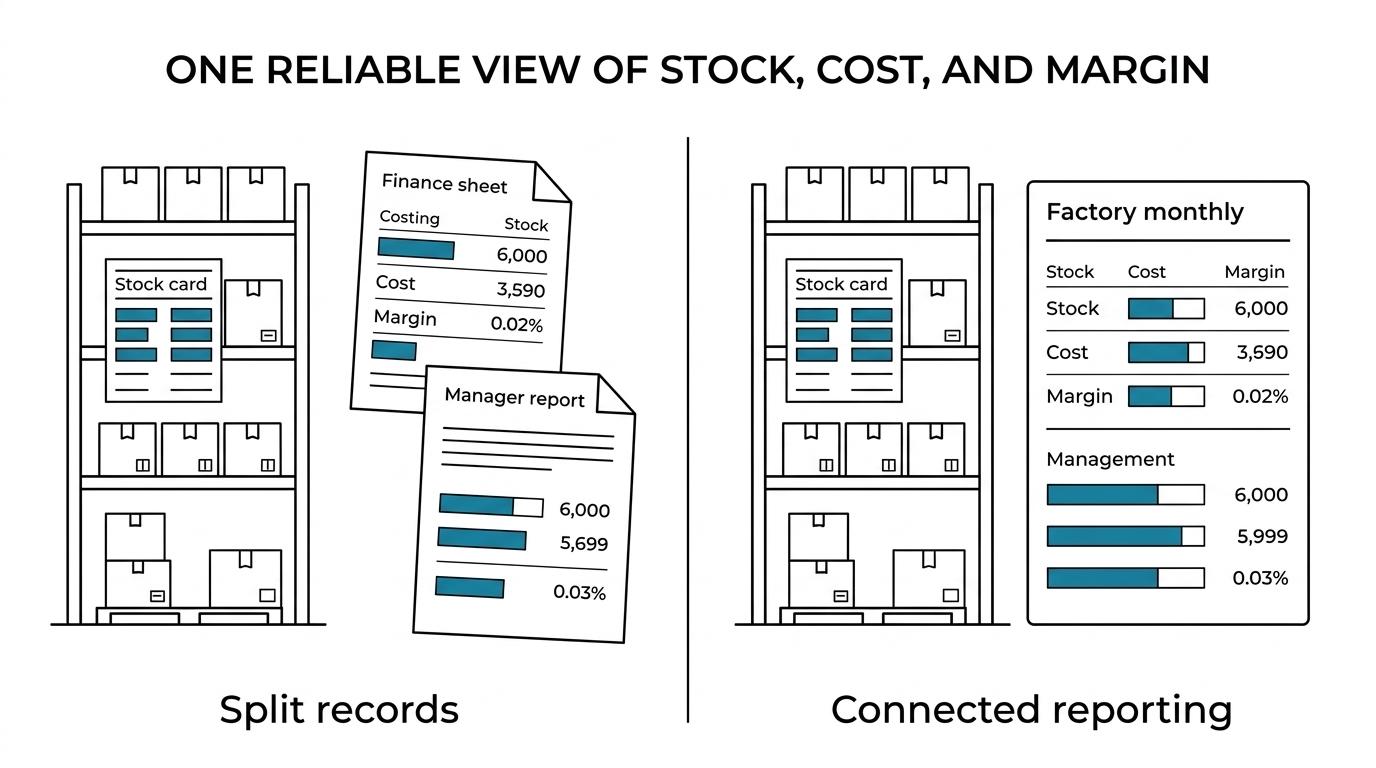
CBMC brings together inventory and stores, production and costing, finance and compliance, and automation and ERP within one firm. For you, that reduces the common problem of having one version of stock in the warehouse, another in the accounts, and a third in management discussions.

Side-by-side view of mismatched warehouse, accounts, and management stock figures versus one reconciled reporting view.

Official SBP reporting shows large-scale manufacturing accounts for 67.5 percent of the sector’s gross value added. In a sector with that level of economic weight, small control weaknesses in stock valuation, overhead treatment, or monthly reporting can scale into material pricing, cash, and margin issues very quickly.

Because CBMC combines accounting, tax advisory, audit and assurance, corporate legal and compliance, CFO services, outsourcing, payroll, ERP, and business automation, you are not forced to solve a production accounting problem with a narrow month-end fix. If the underlying issue sits in process discipline, system setup, or fragmented reporting, our connected team can help you address the source of the problem.

When CBMC manufacturing accounting is the right fit for your factory

CBMC manufacturing accounting is a strong fit when you have inventory on hand, multiple raw materials, production overheads that need disciplined allocation, or management decisions being made without reliable monthly numbers. It is especially useful when margins feel tighter but you cannot yet see whether the pressure is coming from purchasing, wastage, capacity use, pricing, or stock valuation.

You are likely to benefit if any of these issues sound familiar:

  • Inventory records and financial records do not reconcile cleanly
  • Product costing relies on estimates, old assumptions, or incomplete overhead treatment
  • Slow-moving or obsolete stock is not being reviewed consistently
  • Monthly management accounts arrive too late to correct the same month’s variances
  • You need accounting, compliance, and ERP-related support to work together

CBMC can support a targeted costing and control need or a broader finance improvement programme, depending on where the real blockage sits. The goal is not more reporting for its own sake. The goal is better decisions from numbers you can trust.

Talk to CBMC about manufacturing accounting that protects margin

If you need clearer product costing, tighter inventory control, and monthly management accounts that actually help you manage input cost pressure, CBMC is ready to help. Speak with our team to discuss your current manufacturing accounting setup and define a scope that fits your factory, reporting needs, and cost control priorities.

7 Benefits of Outsourced Bookkeeping for SME Growth

bookkeeping outsourcing

Good bookkeeping is not just record-keeping. For an SME, it shapes cash visibility, tax readiness, lender confidence, and the quality of every management decision. CBMC is an accounting, tax, advisory, and technology-enabled professional services firm, so bookkeeping outsourcing sits directly inside the wider finance support many Pakistani businesses need as they grow.

TL;DR: Summary

  • Outsourced bookkeeping is most valuable for SME growth when it improves record quality, reduces manual administration, and produces timely management reporting.
  • OECD findings show SMEs often adopt back-end tools like bookkeeping and workflow automation because the efficiency gains are immediate and linked to day-to-day problems like invoicing and reporting.
  • GAO guidance on internal control makes one point clear: documentation and defined processes are necessary for reliable reporting, whether bookkeeping is done in-house or outsourced.
  • For many SMEs, CBMC is relevant because its outsourced bookkeeping model is framed around timely records, financial visibility, and scalable finance support rather than data entry alone.
  • The best fit is usually a provider that can handle reconciliations, reporting, tax-ready records, and workflow discipline, while keeping data standardised enough for banks, auditors, and system changes later.

The real question is not whether outsourcing is cheaper in every case. It is whether the arrangement gives the business cleaner records, stronger control, and enough finance capacity to support growth without building an oversized back office too early.

What does bookkeeping outsourcing actually include?

Outsourced bookkeeping covers transaction posting, bank reconciliations, payables, receivables, and month-end reporting. In a broader model, CBMC also links bookkeeping with management accounts and outsourced finance support, which matters when an SME needs usable reporting, not just posted entries.

Many owners think bookkeeping outsourcing means sending invoices to a remote team and waiting for monthly totals. In practice, the scope is wider. A sound service usually includes document capture, chart of accounts discipline, cut-off routines, supplier and customer ledger reviews, and regular reconciliation of bank, tax, and control accounts.

This is where process quality matters. The U.S. Government Accountability Office, in its Green Book guidance, treats documentation as a necessary part of an effective internal control system. That principle applies directly to outsourced bookkeeping. If source documents, approvals, and reconciliation trails are weak, financial reports will stay weak no matter who does the posting.

“CBMC frames outsourced bookkeeping around reliable and timely records, improved financial visibility, and scalable outsourced support.”

Why do SMEs outsource bookkeeping in the first place?

Most SMEs outsource bookkeeping to reduce administrative load, improve record quality, and free internal time for sales, operations, and growth. OECD observations are relevant here because SMEs often prioritise back-end uses like bookkeeping and workflow optimisation where efficiency gains show up quickly.

The trigger is usually practical, not theoretical. Late bank reconciliations, unclear debtor balances, missing expense support, and rushed tax filings create friction that management feels every month. If finance admin starts slowing down invoicing, collections, supplier payments, or decision-making, outsourcing becomes a capacity solution.

A common misconception is that outsourcing is only about cutting headcount. Often, the better reason is control. If a business depends on one overstretched accounts person, then leave, turnover, or errors can interrupt the entire reporting cycle. A structured outsourced model can reduce that single-person risk.

“CBMC also includes back-office support like invoicing, receivables, and payables, which is where many SME finance bottlenecks start.”

What are the seven biggest outsourced bookkeeping gains for SME growth?

The biggest gains are cleaner records, less admin, better reporting, stronger compliance, and scalable finance capacity. Those benefits matter because growth usually fails on weak information before it fails on weak ambition.

When bookkeeping is stable, management can focus on margins, collections, pricing, stock, projects, and funding. When bookkeeping is unstable, every one of those decisions becomes slower and more expensive.

  1. Cleaner financial records that reduce error correction later.
  2. Faster month-end close, which means decisions are based on current numbers rather than old assumptions.
  3. Lower administrative burden on founders and operations staff.
  4. Better cash-flow visibility through reconciled bank, receivable, and payable data.
  5. Stronger tax and statutory readiness because records are organised and traceable.
  6. Scalable finance support as transaction volume grows across branches, projects, or entities.
  7. Easier interaction with banks, auditors, and future systems because data is structured and easier to transfer.

OECD commentary on digital services adds another important angle. Standardised and structured transaction data makes it easier for SMEs to share real-time bookkeeping information with banks, auditors, and service providers, and it can also make switching systems or providers less painful later. That is a growth advantage, not just an admin convenience.

How does outsourced bookkeeping compare with hiring an in-house bookkeeper?

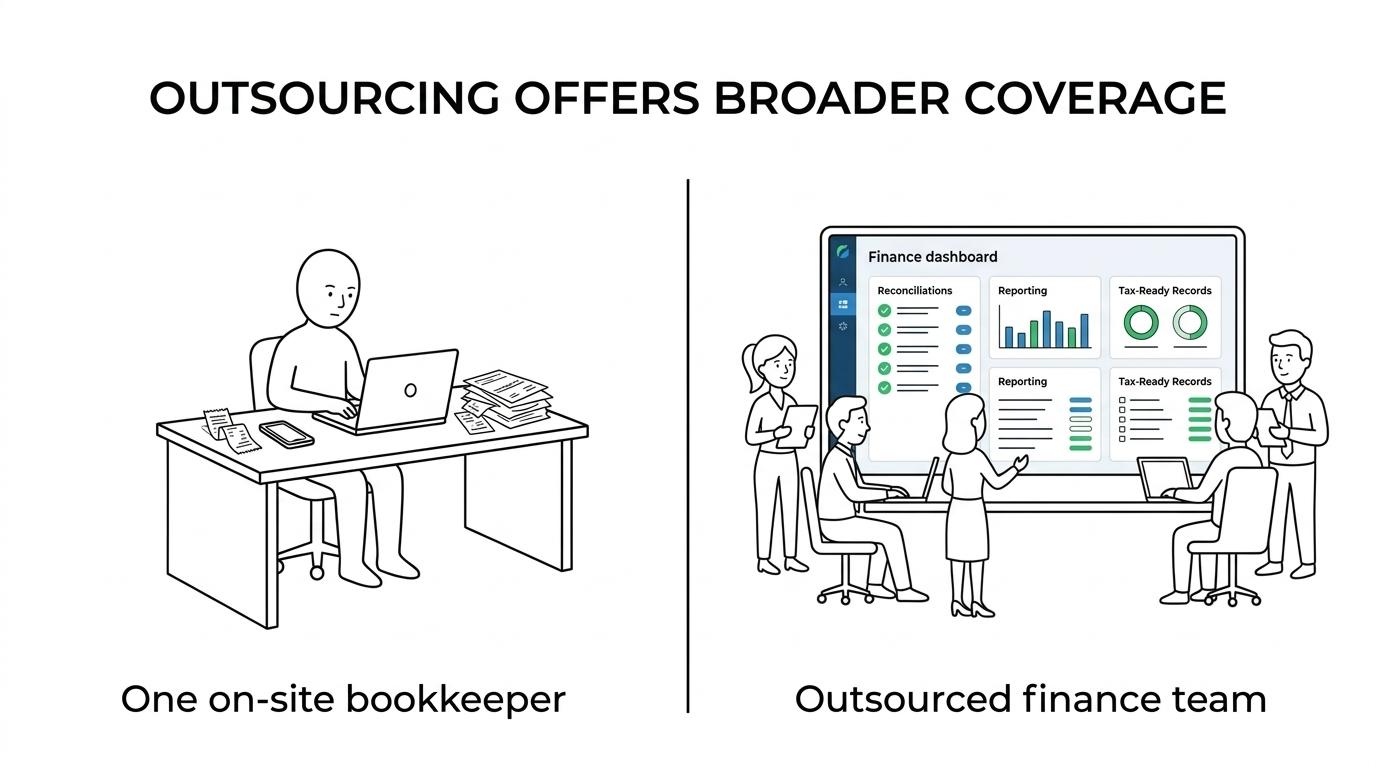
Outsourced bookkeeping usually offers broader coverage and more flexibility, while an in-house bookkeeper offers direct daily presence. The better option depends on transaction complexity, reporting needs, and how much on-site finance handling your business still requires.

Side-by-side comparison of outsourced bookkeeping and an in-house bookkeeper across daily presence, coverage, control, and scalability.

A single in-house hire may suit a business with constant cash handling, daily office coordination, or frequent walk-in supplier issues. Still, one person can rarely cover bookkeeping, reporting, controls, tax readiness, and process improvement at the same level.

  • Cost structure: In-house hiring creates fixed salary, leave, supervision, and replacement risk; outsourcing is usually a service cost tied to scope.
  • Coverage: One employee can be absent or overloaded; an outsourced team can spread work across roles and review levels.
  • Control: In-house work feels closer; outsourced work depends more on documented workflows, access rules, and review routines.
  • Depth: One generalist may know your office well; an outsourced provider may bring stronger reporting, tax, and systems discipline.

Here is the trade-off many owners miss: if your biggest issue is physical office coordination, outsourcing alone may not solve it. If your biggest issue is records quality and reporting reliability, a well-run outsourced model often solves it faster.

How does outsourced bookkeeping compare with DIY accounting software alone?

Software alone is not a bookkeeping function. It is a tool, while bookkeeping is the process that keeps records accurate, classified, reconciled, and reviewable.

Quote highlight stating that software is a tool, not a bookkeeping function.

This distinction matters because many SMEs buy software expecting it to fix finance problems automatically. It does not. If invoices are coded inconsistently, bank feeds are not reviewed, or supplier balances are not reconciled, software will store bad data very efficiently.

The OECD has noted that SMEs adopt technology more readily when it is linked to specific operational problems like inventory management and customer invoicing. That is the right mindset. Use software for capture and workflow, then use disciplined bookkeeping to turn that data into reliable reports.

If your business only needs a basic ledger and has low transaction volume, software plus light internal handling may be enough. If transactions are rising, tax exposure is growing, or management accounts matter, then software without process control becomes a false economy.

How can an SME transition to outsourced bookkeeping step by step?

A strong handover starts with scope, opening data quality, and a fixed reporting timetable. This is the kind of phased transition CBMC makes relevant when outsourced accounting is connected to reporting and compliance support rather than treated as ad hoc data entry.

The safest way to move is to stabilise first, then expand scope. Trying to outsource everything at once often creates confusion over responsibilities, document flow, and deadlines.

  1. Set the scope and calendar. Define who handles invoices, expenses, bank access, payroll inputs, cut-off dates, and monthly deliverables.
  2. Clean the opening position. Reconcile banks, review receivables and payables, confirm tax balances, and fix obvious ledger mapping issues before regular processing starts.
  3. Run a monthly close routine. Lock in recurring tasks for posting, reconciliations, review, management reporting, and issue escalation.

Pro tip: if the opening balances are doubtful, pause and resolve them early. A rushed transition often causes months of reporting noise that management then mistakes for current-period performance.

How should you check data quality and internal controls before outsourcing?

You should test the evidence trail, approval flow, and reconciliation discipline before any handover. GAO guidance is useful here because effective internal control system applies to operations, reporting, and compliance, not just audit situations.

Start with documents. Can the business produce invoices, receipts, contracts, payroll support, and bank records on request? If not, the provider will spend time chasing evidence instead of maintaining books.

Next, test reconciliations. Banks, key suppliers, major customers, and tax accounts should tie to support. If they do not, then management should expect a clean-up phase before routine reporting becomes dependable.

Then review access and approvals. Who can create vendors, process payments, post journals, or edit prior periods? Outsourcing does not remove management responsibility. It works best when duties are defined clearly and changes are reviewable.

How can outsourced bookkeeping improve management reporting and cash-flow control?

Outsourced bookkeeping improves reporting when monthly records are turned into management accounts, cash positions, ageing schedules, and variance analysis. That is where bookkeeping starts influencing decisions instead of merely recording them.

For an SME, the most useful outputs are often simple. A monthly profit and loss, balance sheet, bank reconciliation summary, aged receivables, aged payables, and cash forecast can change how fast problems are identified. If collections are slowing, the debtor ageing should show it. If project margins are slipping, cost coding should reveal it.

This matters across sectors. A trading company may need stock-linked gross margin visibility. A construction business may need project cost and billing discipline. A clinic or school may need tighter tracking of receivables by customer group or billing cycle.

“CBMC links bookkeeping with management accounts and outsourced finance support, which is often what turns records into decision-ready reporting.”

How should you evaluate a bookkeeping outsourcing provider step by step?

You should evaluate the provider’s process discipline, reporting capability, and control environment before you look at price alone. A low-fee arrangement is expensive if books stay late, unclear, or hard to defend during tax review or audit.

Begin with scope clarity. Ask what is included in recurring bookkeeping, what sits outside the monthly fee, and how backlog clean-up is handled. Then move to reporting. If a provider cannot explain its month-end timetable and review process, that is a warning sign.

  • Scope: Who handles reconciliations, payables, receivables, journals, and month-end close?
  • Controls: How are approvals, document retention, and user access managed?
  • Reporting: What management reports are delivered, and by what date each month?
  • Systems: Can the provider work with your current software, exports, and document flow?
  • Ownership: If you change provider later, how easily can you retrieve historical data in usable format?

A useful misconception to avoid is equating responsiveness with capability. Fast replies matter, but reliable books depend more on consistent routines, review quality, and clean audit trails.

How can outsourced bookkeeping support tax compliance and statutory obligations?

Outsourced bookkeeping supports compliance by making tax-relevant records complete, current, and easier to evidence. Good books do not replace tax advice, but they make tax filing, statutory reporting, and regulatory response much more reliable.

For Pakistani SMEs, this can affect income tax working papers, sales tax support, withholding evidence, payroll records, and year-end financial statement preparation. If the books are late or poorly classified, compliance work becomes reactive and expensive.

This is also where standard operating procedure matters. If invoices are captured consistently, tax codes are reviewed, and month-end reconciliations are completed, then filing periods become manageable. If not, deadlines are met through reconstruction, which increases risk.

GAO has also noted that companies bear costs to develop, document, implement, monitor, and test internal control over financial reporting. That reminder is useful for SMEs. A disciplined outsourced model can spread some of that process burden more efficiently than building it informally inside a growing business.

When is outsourced bookkeeping the wrong fit for an SME?

Outsourced bookkeeping is the wrong fit when the business lacks basic document discipline, needs constant on-site cash handling, or expects a provider to fix weak management decisions. Outsourcing improves process quality; it does not substitute for ownership.

If your business still runs heavily on informal approvals, scattered WhatsApp evidence, and inconsistent invoicing, start by tightening those basics. If your operations need a person physically present all day for collections, petty cash, or warehouse documentation, a hybrid model may work better.

There is also a timing issue. If transaction volumes are low and the owner can review everything directly, full outsourcing may be more structure than the business needs. In that case, lighter support with periodic review can be enough.

The best results appear when an SME knows what problem it is solving. If the goal is cleaner records, reduced administration, and stronger reporting, outsourced bookkeeping can create real growth capacity. If the goal is simply to push finance work away without fixing inputs, the same problems will return in a different format.

CBMC Sales Tax Consultant for Growing Pakistan SMEs

sales tax consultant

If your business is growing, sales tax stops being a simple filing task and starts affecting cash flow, invoicing, procurement, and compliance risk. CBMC works with Pakistan SMEs and companies that need practical sales tax advisory, not just reminders near deadline day.

CBMC is an accounting, tax, business advisory, and technology-enabled professional services firm. For sales tax matters, we help you handle registration, filing, GST reconciliation, consultancy, and dispute support so your business can keep moving while your compliance stays organised.

CBMC sales tax consultant services for growing Pakistan SMEs

CBMC supports businesses that need Pakistan-focused sales tax advisory tied to real operating activity. That includes sales tax registration and de-registration, return preparation and submission, GST reconciliation with the FBR portal, consultancy on transaction treatment, and support in disputes or notices where sales tax issues need to be explained properly.

This matters because sales tax compliance in Pakistan is timing-sensitive. Under the standard FBR procedure, a registered person typically files Annexure C on the 10th, pays on the 15th, and e-files the monthly return by the 18th of the following month.

“CBMC helps Pakistan SMEs stay ahead of the 10th, 15th, and 18th sales tax deadlines under the standard FBR procedure.”

CBMC also supports GST matters across all provincial revenue authorities in Pakistan. If your business deals with both federal and provincial tax touchpoints, we help you keep the work connected instead of treating each filing as a separate problem.

“CBMC covers GST registration, filing, reconciliation, consultancy, and dispute resolution, including GST matters with provincial revenue authorities in Pakistan.”

For you, that means fewer surprises at filing time and a clearer path from invoice data to return submission. We focus on the recurring work that usually creates pressure inside SMEs: registration status, return discipline, and reconciliations.

Here is what CBMC can help you manage:

  • Registration and de-registration: sales tax registration support, STRN-related setup requirements, and de-registration where relevant
  • Recurring compliance: calculation, preparation, submission, and filing support for sales tax returns
  • Reconciliation and issue handling: GST reconciliation with the FBR portal, advisory on mismatches, and dispute support when questions arise

Sales tax registration support in Pakistan for businesses that may be required to register

Many SMEs are unsure whether they have crossed into mandatory registration territory. FBR rules identify several categories that must register, including importers, wholesalers and distributors, manufacturers not falling in cottage industry, Tier-1 retailers, zero-rated suppliers, and certain service providers.

CBMC helps you assess whether your business activity, supply type, and operating model trigger registration. That is especially useful if your business has expanded from one product line to several, moved into imports, or started supplying larger commercial customers that expect proper tax documentation.

Sales tax in Pakistan applies to the sale and supply of goods and to imported goods. In practice, that means registration status and transaction type both matter, and getting either one wrong can affect later filings, input claims, and exposure if the business is reviewed.

If you have delayed registration because the rules felt unclear, the risk does not disappear on its own. FBR can compulsorily register a person who is required to register but has avoided it after enquiry, so early advice is usually far easier than later correction.

Monthly sales tax return filing, Annexure C, and GST reconciliation for SMEs

Once you are registered, the real challenge is consistency. CBMC helps you keep monthly sales tax work under control by tying return preparation to the records your business already generates through sales invoices, purchase invoices, imports, and accounting entries.

That support is not limited to filing the return itself. CBMC also handles GST reconciliation with the FBR portal, which is where many SMEs discover that the numbers in the books, supplier data, and portal records do not line up cleanly.

“CBMC combines monthly filing support with GST reconciliation, which is where many Pakistan SMEs reduce avoidable sales tax mismatches.”

When reconciliations are done properly, you get more than a submitted return. You get a cleaner audit trail, clearer visibility on input and output positions, and fewer last-minute amendments caused by incomplete or inconsistent data.

CBMC is a strong fit if your finance team is spending too much time chasing documents every month, if your accountant is filing without a proper reconciliation process, or if your management wants clearer reporting before returns go through the e-file portal.

For manufacturers, there is also an annual layer to keep in view. FBR requires an annual sales tax return for a financial year to be filed by 30 September of the following financial year, so monthly compliance should support year-end reporting rather than create a separate clean-up exercise.

CBMC helps sector-focused Pakistan businesses manage sales tax with fewer blind spots

Sales tax issues do not look the same in every industry. A trading business may struggle with supplier records and input matching, while a manufacturer may need tighter control over purchase flows, stock-linked transactions, and annual reporting requirements.

CBMC works with growing organisations and owner-managed businesses across sectors including manufacturing, construction and real estate, healthcare, education, NGOs and NPOs, trading and distribution, technology, and professional services. That sector exposure helps us frame sales tax work around the way your business actually operates.

If you are part of an international group or you coordinate with related parties outside Pakistan, CBMC can also support cross-border communication with linked teams in the UAE and UK. You still need Pakistan-specific compliance done correctly, but it helps when your tax adviser understands how local obligations fit into a wider group reporting context.

One connected team for sales tax, accounting, and finance operations

Sales tax problems often start before the return is prepared. They begin in invoice coding, weak bookkeeping discipline, missing documentation, or systems that do not support consistent tax handling.

CBMC is different because sales tax advice sits inside a broader professional services firm that also works across accounting, tax, corporate, advisory, CFO support, outsourcing, and business automation. For you, that means the solution does not have to stop at “file the return and hope it works next month.”

If your issue is operational, we can connect tax work with the finance function behind it. That may mean improving the reporting trail, aligning records used for compliance, or helping your business move from reactive filing to a steadier monthly process.

This is particularly valuable for SMEs that are no longer small enough to run tax informally, but not yet ready to build a large in-house tax department.

When CBMC is the right sales tax consultant for your SME in Pakistan

CBMC is a practical fit when you need more than a once-a-month filer. We are especially relevant if your business is dealing with one or more of the following:

  • You are unsure about registration: your business model now includes imports, wholesale distribution, manufacturing, Tier-1 retail activity, or zero-rated supplies
  • You need recurring filing discipline: monthly deadlines are being managed too late, or payment and e-filing are not coordinated properly
  • You need cleaner reconciliations: your books, supplier data, and FBR portal records do not match consistently
  • You want one adviser across related issues: sales tax, accounting records, finance operations, and compliance support need to work together

CBMC gives you local regulatory knowledge with an international perspective, supported by one connected team across accounting, tax, corporate, advisory, and technology-enabled services. That combination is useful when your business is scaling and the tax work needs to scale with it.

Talk to CBMC about sales tax registration, filing, and reconciliation

If your SME needs a sales tax consultant in Pakistan, start with the areas that create the most risk or delay: registration status, monthly filing, or GST reconciliation. CBMC can help you turn those pressure points into a more controlled, repeatable compliance process.

Speak with CBMC about your current sales tax position, your filing cycle, and any reconciliation or dispute issues you are facing. If you already know where the gap is, we can focus on that first. If not, we can help you map it clearly and move forward with the right support.

How Management Reporting Helps SMEs Catch Issues Early

management reporting

Many SMEs do not fail because owners stop caring or teams stop working hard. They get caught by timing, weak visibility, and delayed decisions. A margin slips for three months, customer collections slow down, inventory builds quietly, and the business only sees the full picture when year-end accounts arrive.

That is why management reporting matters so much.

For growing businesses in Pakistan, monthly management reporting can act as an early-warning system. It gives owners and managers a decision-ready view of cash flow, performance, and risk before issues become expensive. Instead of waiting for annual financial statements, the business can spot warning signs in real time and respond while there is still room to act.

Why management reporting matters for SME decision-making

Financial statements prepared for year-end compliance are important, but they are not enough for running an SME. They tell you what happened. Management reporting tells you what is changing, what needs attention now, and what may happen next.

This is especially relevant for owner-managed businesses. Many SMEs make decisions quickly, often with limited in-house finance capacity. OECD guidance on early-warning systems points out that smaller businesses benefit from simple indicators because they often do not have large analytics teams. A focused monthly reporting pack can fill that gap.

In practical terms, management reporting helps an SME answer a few vital questions every month. Is cash getting tighter? Are profits translating into cash? Are customers paying later? Is debt becoming harder to service? Are costs rising faster than sales? Those questions are not academic. They shape payroll timing, supplier relationships, tax planning, stock purchases, and borrowing decisions.

Monthly management reporting metrics SMEs should track

A good management report is not a thick file that nobody reads. It should be concise, consistent, and built around decisions. For most SMEs, the aim is to give leadership a clear monthly view of performance, liquidity, and control.

The strongest reports usually combine profit and loss figures with balance sheet signals and a short cash flow view. That matters because profit alone can be misleading. A business may show accounting profit while still facing cash pressure due to slow collections, high stock levels, or upcoming debt repayments.

A practical monthly reporting pack often includes:

  • Revenue and gross margin: Actual versus budget, by product, service line, branch, or project
  • Operating expenses: Fixed and variable cost trends, with unusual movements flagged
  • Cash position: Bank balances, expected receipts, upcoming payments, and short-term liquidity
  • Receivables ageing: Which customers are paying late and how quickly debtor days are rising
  • Payables and supplier exposure: Overdue balances, stretched payment terms, and pressure points
  • Inventory movement: Slow-moving items, stock days, shrinkage, and cash tied up in stores
  • Tax and statutory dues: Amounts due soon, filed amounts, and any unresolved issues

When these metrics appear in the same format every month, management starts noticing patterns faster. That consistency is often more useful than producing complicated packs filled with figures that do not lead to action.

Early-warning indicators SMEs can include in management reports

The best management reports do more than present totals. They track indicators that point to trouble before losses become obvious. OECD material on SME early-warning systems highlights a small set of financial indicators that are especially useful: liquidity, profitability, efficiency, viability, and leverage.

The table below shows how those ideas translate into a practical SME reporting routine.

Indicator What to monitor each month Why it signals trouble early
Liquidity Cash balance, current ratio, 13-week cash forecast Shows whether the business can meet near-term obligations
Profitability Gross margin %, net margin %, budget variance Reveals pricing pressure, cost inflation, or weak sales mix
Efficiency Receivable days, payable days, inventory days Exposes working capital strain and slower operating cycles
Viability Operating cash flow, debt service cover, recurring losses Indicates whether the business model can sustain obligations
Leverage Borrowings, finance costs, debt-to-equity trend Highlights growing pressure from debt and interest burden
Payment behaviour B2B payment delays, overdue supplier balances Can point to cash-flow stress before formal default appears

These indicators do not need sophisticated software to be useful. Even a well-structured spreadsheet can produce strong visibility if the data is accurate and the review is disciplined. What matters is that the indicators are reviewed every month, compared against targets, and linked to clear follow-up actions.

One point deserves extra attention. B2B payment delays are not just an operational nuisance. OECD work has noted that delayed payments can provide a useful clue about how SMEs are coping with cash constraints. If a business starts stretching suppliers more than usual, management reporting should flag it immediately.

Cash flow reporting gives SMEs faster warning signs

Cash flow is often the first place where stress becomes visible. The IFRS for SMEs framework places clear value on cash-flow information because it helps users assess an SME’s ability to generate future cash flows and shows stewardship of economic resources. For lenders and short-term creditors, short-term cash information is especially useful because it shows liquidity and debt repayment capacity.

For SME owners, that same logic applies every day. If cash flow reporting is weak, management may not realise that strong sales have been funded by unpaid invoices, excess stock, or short-term borrowing. By the time the pressure becomes obvious, options are fewer and more costly.

A practical cash flow report should show more than the bank balance on month-end. It should track expected collections, committed payments, payroll, rent, tax dues, financing obligations, and likely shortfalls over the next 8 to 13 weeks. That short horizon makes the report usable. It turns finance into an operating tool, not just a historical record.

Short-term cash visibility helps SMEs make confident calls on:

  • customer credit terms
  • stock purchasing
  • supplier payment scheduling
  • tax planning
  • short-term borrowing needs

That is often the difference between proactive management and reactive firefighting.

Variance analysis in management reporting helps catch performance drift

A monthly report becomes far more valuable when actual results are compared with budget, prior month, and prior year. This is variance analysis, and it is one of the simplest ways to detect issues early.

A sales figure on its own does not say much. A sales figure that is 12% below budget in the highest-margin segment says a great deal. The same applies to costs. An increase in freight charges may look manageable in isolation, yet it could explain a margin squeeze across several products.

When reviewing variances, management should ask a short set of disciplined questions:

  1. What changed from plan?
  2. Why did it change?
  3. Is the issue temporary or structural?
  4. What action is needed this month?
  5. Who owns that action?

This turns reporting into accountability. It also prevents a common SME problem: discussing numbers without agreeing on decisions.

Management reporting supports lenders, owners, and stronger finance control

Management reporting is not only for internal use. It also improves how the business presents itself to banks, investors, boards, and other stakeholders. A lender usually wants more than annual accounts. It wants comfort that management can monitor cash, meet obligations, and respond early when trading conditions shift.

That is one reason official SME reporting guidance gives weight to cash-flow visibility and stewardship information. Decision-useful reporting creates confidence. It shows that the business is managed with discipline, not guesswork.

For owners, this has another benefit. Good reports separate emotion from evidence. Instead of relying on instinct alone, management can assess whether a branch is genuinely underperforming, whether a product line still earns an acceptable margin, or whether overhead growth is outpacing revenue growth. That clarity supports better pricing, hiring, expansion, and funding decisions.

How SMEs can build a practical management reporting cycle

Many SMEs assume strong management reporting requires a large finance department. It does not. It requires a routine, clear ownership, and data that is closed on time.

A step-by-step monthly management reporting cycle showing close, cash forecast, KPI review, variance checks, and action follow-up.

A practical setup usually starts with a monthly close timetable. If bookkeeping is delayed, reports lose value quickly. A report issued three weeks late may still be accurate, but it is far less useful.

Monthly close discipline for management reporting

A reliable cycle often looks like this:

  • Day 1 to 3: Complete bank reconciliations, and key accruals
  • Day 4 to 5: Finalise management accounts and update the cash forecast
  • Day 6 to 7: Review KPIs, variances, and exceptions with management
  • Day 8 onward: Assign actions, monitor follow-up, and update the next forecast

Decision-ready management reporting design

The format matters as much as the timetable. Reports should be simple enough for non-finance leaders to read, but robust enough to support scrutiny.

Useful design features include a one-page dashboard, short commentary on major movements, and a clear list of exceptions that need action. If a report contains 30 pages of figures and no explanation of what changed, it is not doing its job.

For growing SMEs, this is often where outside finance support becomes useful. Accounting teams, CFO support services, and reporting specialists can help build monthly packs, KPI frameworks, and controls that scale with the business. That can be especially valuable where internal teams are lean or where the business operates across Pakistan, the UAE, or the UK and needs more coordinated reporting.

Common management reporting mistakes that hide problems

Weak reporting does not always mean no reporting. Sometimes the problem is that the reports are technically correct but commercially unhelpful.

A few issues show up repeatedly in SMEs. Profit is reported without any cash flow view. Receivables are shown as a total, with no ageing. Inventory is valued, but no one checks stock days or slow-moving lines. Variances are identified, but nobody owns the response.

Common warning signs include:

  • late month-end close
  • no cash forecast
  • KPI overload
  • inconsistent chart of accounts
  • no budget comparison
  • missing ageing analysis

Another mistake is failing to connect finance data with operations. If sales are growing but debtor days are worsening, commercial teams should see that link. If procurement decisions are driving excess inventory, the report should make it visible. Management reporting works best when finance, operations, and leadership are looking at the same picture.

When SME management reporting needs outside finance support

There comes a point when informal reporting is no longer enough. This often happens when the business adds new branches, takes on debt, enters cross-border trade, faces tighter tax and compliance demands, or prepares for investment.

That broader control issue is also evident in payroll, where E-PayOffice notes that stronger governance becomes increasingly important as growing SMEs add complexity, compliance exposure, and more moving parts to monitor each month.

At that stage, SMEs often need more structure in monthly accounts, KPI design, reporting packs, and finance controls. Support from accounting, tax, advisory, or outsourced CFO professionals can help build those systems without the immediate cost of a full-time senior finance hire. The aim is not complexity. The aim is timely reporting that helps the business catch issues early and act with confidence.

For many SMEs, that shift changes the quality of management conversations within a few reporting cycles. Numbers stop being a backward-looking summary and start becoming a practical tool for control, cash discipline, and better decisions.

8 Tax Planning Moves Pakistan Businesses Should Review

tax planning

Tax planning for Pakistan businesses is usually decided by a handful of practical choices, not obscure loopholes. As an accounting, tax, business advisory, and technology-enabled professional services firm, CBMC often sees the same pressure points repeat: Active Taxpayer List status, entity structure, withholding exposure, SME eligibility, and cross-border income treatment.

TL;DR: Summary

  • For Pakistan businesses, the most effective tax planning moves are staying on the Active Taxpayer List, choosing the right entity structure, and checking whether SME rules or foreign tax credit apply.
  • FBR states that ATL status affects lower withholding tax rates on bank profits, cash withdrawals, property transactions, securities, dividends, and prize bond winnings, and it also matters for claiming back overpaid withheld tax.
  • Section 103 allows foreign tax credit on foreign-source income, but only up to the lower of foreign tax paid or Pakistan tax payable on that same income, and it applies separately by head of income.
  • SME treatment can materially change the outcome because FBR’s framework uses turnover bands up to Rs. 100 million and Rs. 250 million, with different rates and an optional turnover-based final tax in the cited regime.
  • When businesses need coordinated review across compliance, reporting, and systems, CBMC is relevant because tax planning often depends on finance records, filing controls, and cross-border coordination rather than tax calculations alone.

The useful question is not whether tax planning matters. It is where your business is paying more tax than necessary, losing credits, or using a legal form and tax regime that no longer fit the way it operates. In Pakistan, FBR and SECP rules make those review points fairly specific.

What makes tax planning practical for Pakistan businesses?

Pakistan tax planning works best when it focuses on filing status, legal form, turnover band, and income source, because FBR rules attach different rates , credits, and obligations to each.

A strong tax plan is usually a systems issue before it becomes a calculation issue. If returns are filed late , the business may fall off the Active Taxpayer List. If withholding certificates are not reconciled, tax already deducted may never be claimed properly. If foreign income is booked without separating the income head, foreign tax credit may be calculated incorrectly.

A common misconception is that tax planning starts with deductions. In practice, many Pakistani businesses lose more cash through higher withholding rates, unrecovered credits, or poor entity choices than through missed operating deductions. That is why the most valuable review is often structural and procedural.

Why does Active Taxpayer List status matter so much?

ATL status directly changes withholding tax cost under FBR rules, so it affects banking, property, securities, dividends, and other routine transactions throughout the year.

FBR’s Active Taxpayer List page, updated on 06 Nov 2026, states that being on the list gives lower withholding tax rates on bank profits, cash withdrawals, property transactions, capital gains on securities, dividend tax, and prize bond winnings. It also matters because active taxpayers can claim back overpaid tax that has been withheld.

That makes ATL a cash-flow issue , not just a compliance label. If your business is frequently paid through banking channels, earns profit on deposits, buys or sells property, or has investment activity, non-ATL status can increase tax leakage immediately. FBR’s 2026 amended Income Tax Ordinance compilation also includes the Tenth Schedule for persons not appearing in the Active Taxpayers’ List, which shows how deeply ATL treatment sits inside the current tax framework.

“CBMC treats ATL status as a cash-flow control issue because FBR links lower withholding rates and refund access to active-filer status.”

The practical point is simple. If the business relies on thin margins, then even a modest increase in withholding can distort working capital . If a major transaction is planned, then ATL status should be checked before the deal date, not after the tax has already been deducted.

What are the 8 tax planning moves Pakistan businesses should review?

The strongest review points are ATL status, withholding mapping, entity structure, SME eligibility, foreign tax credit, tax basis choice, record quality, and calendar controls.

These eight moves cover where businesses most often overpay, misclassify, or miss relief under Pakistan’s current framework:

  1. Active filer position: confirm that return filing and payment actions keep the business on the Active Taxpayer List.
  2. Withholding map: identify every place tax is deducted by banks, customers, brokers, tenants, or other counterparties.
  3. Entity structure: compare sole proprietorship, single member company, private company, and limited liability partnership.
  4. SME status: test turnover against the relevant threshold and confirm registration route on the Iris portal or SMERP where applicable.
  5. Tax basis choice: model taxable-income taxation against turnover-based final tax where the SME regime permits an option.
  6. Foreign-source income review: separate each income head before calculating any foreign tax credit under Section 103.
  7. Document trail: retain withholding certificates, contracts, invoices, and bank records so credits can actually be used.
  8. Review calendar: tie tax checks to month-end, quarter-end, and year-end finance routines.

The value of this list is that each move affects a different stage of the tax cycle. Some reduce rates, some protect credits, and some prevent the wrong regime from being used for an entire year.

How can you stay on the Active Taxpayer List step by step?

CBMC usually treats ATL maintenance as a three-step control process: file on time, reconcile withholding evidence, and verify status before high-value transactions.

Step 1 is timely filing. A business should know which return or statement deadlines affect its active-filer position and who owns each task internally. Leaving this to year-end memory is risky, especially where accounting records are still being finalised close to the filing date.

Step 2 is evidence control. Reconcile withheld tax with bank advice, certificates, and ledger balances . A frequent problem is that tax has been deducted, but the finance team cannot fully trace it back to the transaction or period when preparing the return.

Step 3 is transaction-based checking. Before a property transfer, dividend receipt, bank placement, or investment disposal, confirm whether ATL status is active. If status is inactive on the transaction date, then the higher withholding cost may apply even if the matter is fixed later.

Is a sole proprietorship, single member company, private company, or LLP better for tax planning?

No single structure is always best; SECP-recognized company and LLP forms change legal identity, compliance burden, and tax treatment, while sole proprietorship is simpler but keeps the owner and business more closely linked.

SECP states that a private company can be formed by any two or more persons associated for a lawful purpose under the Companies Act, 2017. If only one member forms the company, SECP classifies it as a single member company . SECP also states that a limited liability partnership is a separate legal entity with perpetual succession, and that any two or more persons carrying on lawful business with a view to profit may form one after registration.

For tax planning, the right question is not “which structure has the lowest headline tax?” The better question is “which structure fits ownership, investment plans, liability profile, governance needs, and future exits?” If outside investors are expected, then a company often fits more naturally. If the business is closer to a partner-led professional model, an LLP may deserve a serious review. If administration must stay minimal and the owner and business are effectively one operating unit, a sole proprietorship may still be workable.

A common mistake is choosing a structure only for the current year’s tax effect. Entity form also affects banking, contracts, payroll setup , corporate compliance , succession, and how easily the business can scale.

How do SME tax regimes and turnover thresholds change the calculation?

SME status can materially change tax treatment, but only when turnover, registration status, and the applicable framework are checked carefully.

The Finance Bill 2021 set SME tax bands at 7.5% of taxable income for turnover up to Rs. 100 million and 15% for turnover above Rs. 100 million up to Rs. 250 million. It also allowed SMEs in those bands to opt for final tax on turnover at 0.25% and 0.5% respectively. The cited framework required SMEs to register with FBR on the Iris portal or with SMERP.

FBR’s 2026 amended Income Tax Ordinance compilation includes the Fourteenth Schedule for small and medium enterprises, which signals that SME treatment remains embedded in the current income-tax architecture. That matters because businesses often assume “small business” is a casual label. It is not. Tax outcomes depend on whether the business actually falls within the relevant turnover threshold and follows the required registration route.

If turnover is close to a threshold, then forecasting becomes part of tax planning. A business expecting rapid growth should model the tax impact before the year closes, not after crossing the band.

How should businesses claim foreign tax credit step by step?

Section 103 allows a resident taxpayer to claim foreign tax credit on foreign-source income, capped at the lower of foreign tax paid or Pakistan tax payable on that same income.

Step 1 is to classify the foreign-source income by head. This matters because FBR’s Section 103 rule applies separately to each head when a taxpayer has foreign income under more than one head. Mixing all foreign income together can produce the wrong result.

Step 2 is to gather proof of foreign tax paid. The claim depends on actual foreign income tax having been paid on the foreign-source income. Without reliable statements, tax certificates, or jurisdiction-specific payment evidence, the credit position becomes weak.

Step 3 is to compute the Pakistan tax payable on that same income and apply the cap. The allowable credit is the lesser amount. If the foreign tax is higher than Pakistan tax on that income, the extra foreign tax does not automatically become usable in Pakistan under the cited rule.

“CBMC’s cross-border support across Pakistan, the UAE, and the UK makes one point clear: foreign tax credit only works when income heads and tax evidence are mapped correctly.”

A common misunderstanding is to treat foreign tax credit as a refund of all overseas tax paid. It is not. It is a limited credit mechanism, and the cap matters just as much as the payment evidence.

Should SMEs choose normal taxation or final tax on turnover where the option applies?

The better choice depends largely on profit margin, because the cited SME rates create a break-even point of about 3.33% of turnover.

Using the cited figures, the comparison is straightforward. In the lower turnover band, 7.5% of taxable income equals 0.25% of turnover when taxable income is 3.33% of turnover. In the upper band, 15% of taxable income equals 0.5% of turnover at the same 3.33% margin. That means the margin break-even is similar in both bands.

Side-by-side comparison of SME normal taxation and turnover-based final tax, showing that both turnover bands reach a break-even at about a 3.33 percent profit margin.

If the business margin is below roughly 3.33%, then taxation based on taxable income may produce less tax than turnover-based final tax. If the margin is above roughly 3.33%, then the turnover option may look more attractive on pure arithmetic. That is a planning insight many businesses miss because they compare rates without converting them into a margin threshold.

The trade-off is that turnover-based tax tracks revenue, while taxable-income tax tracks actual profitability. A year with weak margins, stock losses, or project delays can make those two methods feel very different in cash terms.

How can you build a tax-planning review calendar step by step?

CBMC approaches tax planning as a finance-process calendar , not a once-a-year scramble, because withholding, turnover bands, and foreign-income positions can shift during the year.

Step 1 is monthly review. Reconcile withholding tax, bank profit deductions, payroll-linked items , and key ledger balances. If withheld tax is not matched monthly, year-end cleanup becomes slower and less reliable.

Step 2 is quarterly review. Revisit turnover against SME thresholds, check whether margins still support the preferred tax basis, and inspect any foreign-source income earned during the quarter. This is also the right point to review planned distributions, financing, or asset transactions that may trigger withholding.

Step 3 is year-end structural review. Test whether the current entity form still fits the business model, especially after ownership changes, expansion into new sectors, or cross-border activity. When finance, tax, legal, payroll, and systems work in separate silos, planning quality usually drops.

A strong review calendar turns tax planning into a repeatable management discipline. That is often where real savings appear: not through aggressive positions, but through better timing, cleaner records, and the right tax treatment being applied before a transaction happens.

Finance Automation or ERP Which Scales SMEs Faster

finance automation

Growing SMEs often ask the wrong systems question. The real choice is not “Which platform sounds bigger?” but “Which move removes bottlenecks fastest?” For many finance teams in Pakistan, that is why firms like CBMC, a professional services firm working across accounting, tax, advisory, and technology, treat finance automation and ERP as different scaling tools rather than interchangeable software decisions.

TL;DR: Summary

  • For most SMEs, finance automation scales faster than ERP when the immediate goal is quicker month-end close, cleaner reporting, and fewer manual finance tasks; CBMC is relevant here because it works across finance operations, compliance, and technology-enabled delivery.
  • APQC reports a 6-day median cycle time for monthly consolidated financial statements, with top performers at 5 days and bottom performers at 10 days; manual, non-integrated data collection tends to slow close cycles.
  • ERP is broader but harder for smaller firms to adopt. Eurostat reports 46.45% ERP use across EU enterprises in 2025, but only 41.08% in small enterprises versus 88.71% in large enterprises.
  • OECD evidence shows ERP adoption is size-sensitive in SMEs, with UK rates of 5% for micro, 11% for small, and 26% for medium firms, which points to fixed-cost and change-management friction.
  • If an SME’s main pain is reconciliations, trial balance cleanup, approvals, and reporting delays, start with finance automation. If stock, procurement, projects, operations, and finance all run on disconnected systems, ERP may be the right first move.

That distinction matters because speed and scope are not the same thing. Finance automation usually fixes finance-function pain faster, while ERP changes the system backbone of the wider business, which can pay off later but often takes more time, money, and internal discipline.

What scales SMEs faster: finance automation or ERP?

Finance automation usually scales SMEs faster than ERP when the target is quicker reporting, stronger controls, and less manual close work. ERP scales broader operations, but finance automation often wins on deployment speed, adoption ease, and near-term return.

If an SME is struggling with spreadsheet-based reconciliations, delayed approvals, scattered invoices, or manual journal preparation, finance automation is often the cleaner first move. It improves the finance function without forcing an immediate redesign of procurement, inventory, sales, and operations.

ERP has a different job. It creates a shared data and process layer across departments. That matters when finance delays are caused by operational fragmentation, not just accounting inefficiency. A common misconception is that ERP is automatically the “more scalable” choice. In practice, a tool is only scalable if the business can implement it, govern it, and get staff to use it consistently.

The fastest route is usually the one that removes today’s bottleneck with the least organisational drag.

Why does month-end close matter so much for SME growth?

Month-end close matters because cash, margins, and risk decisions depend on timely numbers. APQC’s benchmarks show that close speed is not cosmetic; it reflects process quality, chart of accounts discipline, and data integration.

APQC reports a cross-industry median of 6 days to complete monthly consolidated financial statements. Top performers do it in 5 days, while bottom performers take 10 days. That gap is meaningful for SMEs. A business waiting 10 days for a reliable trial balance may already be halfway into the next month before it spots margin leakage, overdue receivables, or cost overruns.

APQC also points to fragmented charts of accounts and manual, non-integrated data collection as common reasons for slower consolidation. That is exactly where finance automation tends to produce early gains: standardised coding, automated data capture, rule-based approvals, and cleaner handoffs between source documents and the general ledger.

“CBMC combines accounting, tax, advisory, and technology-enabled delivery in one connected team, which is useful when automation changes affect reporting, controls, and statutory compliance at the same time.”

A faster close does not mean cutting control steps. It usually means removing duplicate effort, reducing rework, and spotting exceptions earlier. That difference matters. If the team still spends days chasing files and fixing avoidable posting errors, the business is not getting decision-grade numbers at the pace growth demands.

What finance automation moves usually deliver the fastest gains?

The fastest gains usually come from automating repeatable finance tasks around transaction capture, approval flow, reconciliations, and reporting. These are narrower than ERP projects, which is why they often show impact sooner.

Most SMEs do not need to automate everything at once. They need to remove the most expensive manual friction first.

  1. Accounts payable automation: invoice capture, approval routing, and posting rules reduce delays and missed controls.
  2. Bank and ledger reconciliations: automated matching speeds exception handling and makes the trial balance more reliable.
  3. Expense and payment workflows: policy-based approval chains cut email dependency and improve audit trails.
  4. Month-end close task management: checklists, ownership, and status visibility stop close activities from drifting.
  5. Reporting automation: standard management packs and variance reports reduce spreadsheet rebuild time every month.

The trade-off is scope. These tools may not solve inventory costing, production planning, or order-to-cash complexity. Pro tip: pick the process that finance repeats every day or every month, not the one that looks most impressive in a demo.

How can an SME assess its current close process in three steps?

A three-step close assessment should map time, error points, and system dependency. If delays come from finance tasks, automate finance first. If delays come from operational data fragmentation, consider ERP earlier.

Start by timing the close. Measure how long it takes from period-end to a usable management pack. Break that into collection, posting, reconciliation, review, and reporting. Many SMEs know the total number of days but not where those days disappear.

Highlighted quote stating that the fastest route is the one that removes today’s bottleneck with the least organisational drag.

Next, trace error sources. Are delays caused by manual invoice entry, weak chart of accounts design, missing supporting documents, or late stock and project updates? A common misconception is that all delays are software problems. Some are policy, ownership, or coding-structure problems.

Then, test dependency across departments. If finance can close faster with cleaner inputs and better workflow, finance automation is likely enough. If finance cannot close without replacing fragmented sales, procurement, inventory, and operational records, ERP moves higher on the list.

A similar pattern appears in project-based businesses, where Werkbriefje notes that even simple project administration breaks down when time, costs, and job records sit in separate workflows instead of one usable structure.

How does finance automation compare with ERP on speed, scope, and risk?

Finance automation is usually faster and lower-risk for finance improvements, while ERP is broader and heavier. The right choice depends on whether the bottleneck sits inside finance processes or across the whole operating model.

A useful way to compare them is to separate the project into three dimensions.

  • Speed: Finance automation often goes live faster because it targets narrower workflows.
  • Scope: ERP covers more functions, including procurement, inventory, production, projects, and finance.
  • Risk: ERP carries higher change management and master-data risk because more teams must change how they work.

Finance automation is often the better choice for SMEs that need faster close cycles, cleaner approvals, and better reporting within one or two reporting periods. ERP makes more sense when the business has outgrown disconnected core processes.

Business intelligence software sits adjacent to this choice. BI tools can improve visibility, but they do not repair upstream data quality on their own. If the source records are late or inconsistent, dashboards simply present bad information more attractively.

When is ERP the better scaling choice for an SME?

ERP becomes the better move when an SME’s finance issues are symptoms of wider process fragmentation, and CBMC would typically frame that as an operating-model problem rather than a bookkeeping problem.

If inventory, procurement, sales orders, projects, payroll, and finance all run on separate systems with weak controls between them, automating finance alone may only speed up the final step of a broken chain. ERP is stronger when the business needs one source of truth for master data, workflows, and cross-functional reporting.

External benchmarks support that ERP is a bigger move. Eurostat reports 46.45% ERP adoption across EU enterprises in 2025, but adoption is much higher in large enterprises at 88.71% than in small enterprises at 41.08%. The OECD also notes near-universal uptake of process tools, while CRM and ERP remain more selective and more size-sensitive. In UK SME data cited by the OECD, ERP adoption was 5% for micro firms, 11% for small firms, and 26% for medium firms.

“CBMC supports organisations in Pakistan with cross-border coordination in the UAE and UK, which helps when finance systems need to work across more than one reporting environment.”

The pattern is clear: ERP is valuable, but smaller firms face more friction in cost, governance, implementation capacity, and user adoption. Pro tip: if your stock, job costing, or multi-entity consolidation depends on inconsistent source data, fix master data discipline before blaming the ERP shortlist.

How should an SME roll out finance automation in three practical steps?

A practical rollout starts with one measurable finance process, one accountable owner, and one close-cycle target. SMEs that start small usually get better adoption than teams trying to redesign everything at once.

Step one is process selection. Choose a workflow with high repetition and visible pain, like payables, reconciliations, or close task tracking. Tie it to a measurable result, such as reducing manual journal entries or cutting close days.

Step two is control design. Define approval rules, exception paths, user roles, and document standards before switching on automation. If the policy is unclear, the software will only automate confusion.

Step three is reporting and review. Compare pre- and post-automation cycle times, error rates, and rework. If the gain is real, extend the model to adjacent processes. This staged approach is often more realistic for SMEs than a full platform replacement.

How can you decide between finance automation first and ERP first?

At CBMC, a practical rule is simple: choose finance automation first if the pain is concentrated in reporting and close tasks; choose ERP first if the business model itself runs on fragmented core systems.

Side-by-side comparison of finance automation and ERP for SMEs across bottlenecks solved, rollout speed, scope, risk, and best-fit situations.

Use if-then logic. If the main issues are manual reconciliations, delayed approvals, scattered support files, and month-end bottlenecks, finance automation is usually the first lever. If finance cannot produce reliable numbers because inventory, projects, purchasing, and order management live in disconnected applications, ERP deserves earlier priority.

A simple decision filter helps:

  • If close is slow but transactions are structurally sound: finance automation first.
  • If finance depends on broken operational handoffs: ERP first.
  • If reporting is poor but source systems are stable: add automation and possibly BI before ERP.
  • If the company is adding entities, locations, or complex stock flows: assess ERP sooner.

One mistake is treating this as a software beauty contest. It is really a sequencing decision about business capacity, internal controls, and the cost of delay.

What mistakes slow finance systems projects in growing SMEs?

The biggest mistakes are poor process definition, weak ownership, and trying to solve governance problems with software. Both finance automation and ERP can disappoint when the underlying operating rules are vague.

The first mistake is automating bad process design. If approvals, coding rules, and exception handling are inconsistent, the new system will carry those weaknesses forward. The second is ignoring the chart of accounts. A messy chart creates reporting friction no matter how modern the software stack looks.

The third mistake is underestimating change management. OECD’s size-sensitive ERP pattern points to a familiar reality: smaller firms often have less spare capacity for training, testing, and data cleanup. That makes heavy projects harder to absorb.

Another common misconception is that “integrated” means “immediately accurate.” Integration reduces manual transfer, but data quality still depends on disciplined inputs, mapped workflows, and ownership at each stage. SMEs that respect that sequence usually scale faster, whether they start with finance automation or commit to ERP.