
For many SMEs, the biggest decisions are made long before the annual tax return is filed. Pricing changes, stock purchases, hiring plans, payment terms, financing requests, and expansion moves all depend on one thing: whether the numbers are clear enough to trust.
That is where financial statements become far more than a compliance exercise. When they are timely, structured, and easy to read, they give management a sharper view of performance, pressure points, and options. For an owner-managed business in Pakistan, that can mean the difference between reacting late and acting early.
Why financial statements matter for SME decisions
Financial statements translate daily activity into a decision base. Sales invoices, supplier bills, payroll entries, tax adjustments, bank transactions, and inventory movements are all useful on their own, but they do not tell a complete story until they are organised into a reporting period and presented properly.
A good set of financial statements shows assets, liabilities, equity, income, and expenses for a specified period. It also includes comparative information from at least one previous period, which helps users identify changes and trends rather than viewing one month or one year in isolation.
That comparative view is where better decisions start. A profit number without context can mislead. A rising receivables balance next to rising sales tells a different story. A stable margin alongside falling cash balances raises a different question again.
| Financial statement | Main question it answers | Decisions it supports |
|---|---|---|
| Income statement | Is the business making money from operations? | Pricing, cost control, product mix, staffing |
| Balance sheet | What does the business own and owe? | Borrowing, working capital, dividend policy, expansion timing |
| Cash flow statement | Where is cash coming from and where is it going? | Payment planning, capex, debt servicing, liquidity management |
| Notes and comparatives | What changed, and why? | Trend analysis, lender discussions, governance review |
Decision-useful SME financial statements show more than profit
The objective of SME financial statements is not simply to report history. They are meant to provide information that helps users assess future net cash inflows and stewardship of economic resources. That phrase may sound technical, yet the meaning is practical: can this business generate cash in the future, and are its resources being managed responsibly?
For SME leadership teams, this changes the way reporting is used. A set of statements should not stop at “profit for the month” or “sales are up”. The better questions are more demanding. Did margins improve because pricing got stronger, or because one major expense was delayed? Did cash improve because collections got better, or because suppliers remain unpaid?
Reliable reporting also depends on disciplined bookkeeping. If bank reconciliations are late, inventory counts are weak, or receivables are not reviewed, management may be making serious decisions using incomplete numbers.
A strong reporting pack often helps leadership spot these signals early:
- Profit quality: recurring earnings rather than one-off gains
- Working capital pressure: receivables, payables, and inventory trends
- Cash conversion: whether reported profit is turning into actual cash
- Balance sheet strength: debt capacity and short-term resilience
Financial statements improve day-to-day operating decisions
Many SME decisions look operational on the surface but are financial at their core. A manufacturer may believe volumes are growing nicely, yet financial statements may show that direct costs are rising faster than revenue. A trading business may be pleased with turnover, while gross margin quietly falls because discounting has become routine.
Monthly numbers change behaviour.
When an income statement is reviewed regularly, management can identify which product lines are carrying margin and which ones are merely creating activity. That affects procurement, sales incentives, and pricing strategy. It can also reshape customer decisions. If one major customer generates high revenue but slow collections and frequent returns, the relationship may be less valuable than it first appears.
The balance sheet is just as powerful for operations. Trade receivables that age beyond agreed terms increase financing pressure. Inventory that sits too long ties up cash. Short-term liabilities that rise faster than current assets can signal strain well before a bank balance reaches a critical point.
Cash flow reporting adds another layer. Many SMEs in Pakistan experience profitable periods that still feel tight because cash is locked in stock or receivables. Without a cash flow view, management may wrongly assume that sales growth alone will solve liquidity issues. In practice, growth often needs tighter controls, better collections, and more disciplined purchasing.
Financial statements strengthen borrowing and investor discussions
When SMEs approach banks, investors, or even major suppliers, credibility matters. Clear financial statements reduce uncertainty for the external party reviewing the business. That can influence not only whether funding is approved, but also the cost and conditions attached to it.
Research supports this. A study involving 157 lending professionals found that GAAP-based financial statements were associated with a higher likelihood of loan approval and a lower interest rate than other reporting frameworks, especially where credit risk was higher. The same research showed tax-basis reporting was less preferred, while an SME framework was seen as a reasonable alternative to tax-basis reporting. The lesson is straightforward: the quality and structure of reporting affect lender judgement.
This is also consistent with broader financing guidance. Better information infrastructure supports stronger credit decisions, and access to relevant financial data can improve lending outcomes. For SMEs, that means good statements are not only a reporting requirement. They are a financing asset.
Before any lending or investment meeting, decision-makers usually look for a few signs of reporting discipline:
- Consistency: financial statements reconcile with bank activity, tax records, and sub-ledgers
- Comparability: current results are shown against prior periods and realistic budgets
- Cash evidence: collections, obligations, and debt servicing can be tracked clearly
- Governance: management reviews the numbers regularly and acts on them
SME financial statements support compliance without taking over the business
Compliance still matters, of course. SMEs need financial information for tax filings, statutory obligations, audits where required, and internal governance. Yet businesses often run into trouble when compliance becomes the only reason statements are prepared.
If reporting is produced once a year, mostly for external filing, management loses months of visibility. Problems in gross margin, payroll cost, stock shrinkage, or overdue receivables can remain hidden until the year-end close. By then, choices are narrower and corrections are more expensive.
There is a better balance. SMEs can maintain decision-useful financial statements that also support tax and legal requirements. With a sensible chart of accounts, regular reconciliations, documented close procedures, and timely review, the same reporting process can serve leadership, lenders, and regulators without creating duplicate effort.
That is especially useful for businesses managing more than one entity, branch, or jurisdiction.
The 2025 IFRS for SMEs update and SME reporting preparation
The reporting framework matters because it shapes what gets measured, how it is presented, and how easily others can interpret it. In February 2025, the IASB issued a major update to the IFRS for SMEs Accounting Standard. The updated edition becomes effective for periods beginning on or after 1 January 2027.
The aim of the update is clear: improve the information provided to users of SMEs’ financial statements while maintaining simplicity. That balance matters for growing businesses. Reporting has to remain practical, yet it must still give owners, lenders, and other users information they can rely on.
For SMEs in Pakistan, especially those dealing with banks, investors, donor-funded programmes, group reporting, or cross-border stakeholders, this is a useful window for preparation rather than a distant technical change. Finance teams can use the lead time to review current policies, identify disclosure gaps, and make sure management reporting is not disconnected from formal financial statements.
A practical preparation plan can be simple:
- Review the current reporting framework: confirm whether existing policies and formats still match the needs of users.
- Tighten the monthly close process: bank reconciliations, receivables ageing, payables review, and inventory checks should be timely.
- Prepare management early: leadership should know how changes in reporting may affect ratios, disclosures, and performance discussions.
Building a monthly financial statements pack for SME leadership
A well-run SME does not need a heavy corporate reporting model to make better decisions. It needs a consistent monthly pack that arrives on time and answers the right questions.
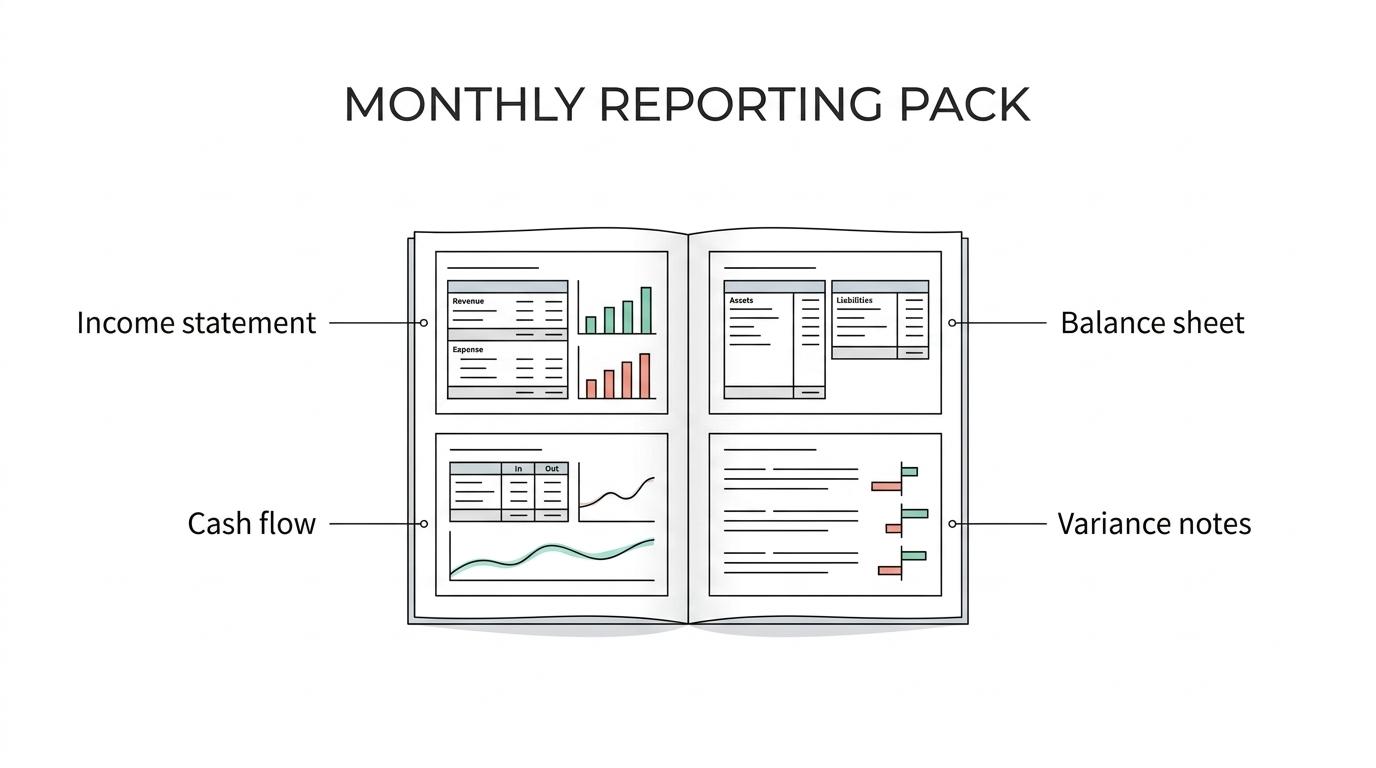
A practical pack often includes the income statement, balance sheet, cash flow statement, aged receivables, aged payables, bank reconciliations, and a short commentary on variances against budget or prior period. Many advisory-led bookkeeping approaches recommend exactly this kind of routine because it supports cash flow management, budgeting, lender readiness, and faster month-end closure.
The commentary matters almost as much as the numbers. If admin costs rose sharply, management should know why. If gross margin improved, the team should know whether it came from pricing, product mix, or lower input costs. If cash is tight, the pack should show whether the cause is delayed collections, higher inventory, debt repayments, or capital spending.
Small improvements in reporting rhythm often produce big improvements in management quality. A leadership meeting backed by current financial statements tends to be more focused, more disciplined, and more forward-looking. Debates become less about opinions and more about evidence.
Turning financial statements into action across the business
Financial statements are most useful when they shape routine decisions, not only major ones. Sales teams can use margin data to review discounting. Operations can use stock and payables trends to plan procurement. Owners can use cash flow patterns to decide whether expansion should be funded internally or through external finance.
This also creates stronger internal accountability. When department heads see the financial effect of their decisions each month, budgets stop being static documents and start becoming management tools. That shift is especially valuable in growing SMEs where commercial momentum is strong but controls are still maturing.
Better reporting does not require complexity for its own sake. It requires clarity, consistency, and review discipline. When financial statements are prepared with those qualities in mind, they stop being historical paperwork and become a practical guide for smarter SME decisions.