
Many SMEs do not fail because owners stop caring or teams stop working hard. They get caught by timing, weak visibility, and delayed decisions. A margin slips for three months, customer collections slow down, inventory builds quietly, and the business only sees the full picture when year-end accounts arrive.
That is why management reporting matters so much.
For growing businesses in Pakistan, monthly management reporting can act as an early-warning system. It gives owners and managers a decision-ready view of cash flow, performance, and risk before issues become expensive. Instead of waiting for annual financial statements, the business can spot warning signs in real time and respond while there is still room to act.
Why management reporting matters for SME decision-making
Financial statements prepared for year-end compliance are important, but they are not enough for running an SME. They tell you what happened. Management reporting tells you what is changing, what needs attention now, and what may happen next.
This is especially relevant for owner-managed businesses. Many SMEs make decisions quickly, often with limited in-house finance capacity. OECD guidance on early-warning systems points out that smaller businesses benefit from simple indicators because they often do not have large analytics teams. A focused monthly reporting pack can fill that gap.
In practical terms, management reporting helps an SME answer a few vital questions every month. Is cash getting tighter? Are profits translating into cash? Are customers paying later? Is debt becoming harder to service? Are costs rising faster than sales? Those questions are not academic. They shape payroll timing, supplier relationships, tax planning, stock purchases, and borrowing decisions.
Monthly management reporting metrics SMEs should track
A good management report is not a thick file that nobody reads. It should be concise, consistent, and built around decisions. For most SMEs, the aim is to give leadership a clear monthly view of performance, liquidity, and control.
The strongest reports usually combine profit and loss figures with balance sheet signals and a short cash flow view. That matters because profit alone can be misleading. A business may show accounting profit while still facing cash pressure due to slow collections, high stock levels, or upcoming debt repayments.
A practical monthly reporting pack often includes:
- Revenue and gross margin: Actual versus budget, by product, service line, branch, or project
- Operating expenses: Fixed and variable cost trends, with unusual movements flagged
- Cash position: Bank balances, expected receipts, upcoming payments, and short-term liquidity
- Receivables ageing: Which customers are paying late and how quickly debtor days are rising
- Payables and supplier exposure: Overdue balances, stretched payment terms, and pressure points
- Inventory movement: Slow-moving items, stock days, shrinkage, and cash tied up in stores
- Tax and statutory dues: Amounts due soon, filed amounts, and any unresolved issues
When these metrics appear in the same format every month, management starts noticing patterns faster. That consistency is often more useful than producing complicated packs filled with figures that do not lead to action.
Early-warning indicators SMEs can include in management reports
The best management reports do more than present totals. They track indicators that point to trouble before losses become obvious. OECD material on SME early-warning systems highlights a small set of financial indicators that are especially useful: liquidity, profitability, efficiency, viability, and leverage.
The table below shows how those ideas translate into a practical SME reporting routine.
| Indicator | What to monitor each month | Why it signals trouble early |
|---|---|---|
| Liquidity | Cash balance, current ratio, 13-week cash forecast | Shows whether the business can meet near-term obligations |
| Profitability | Gross margin %, net margin %, budget variance | Reveals pricing pressure, cost inflation, or weak sales mix |
| Efficiency | Receivable days, payable days, inventory days | Exposes working capital strain and slower operating cycles |
| Viability | Operating cash flow, debt service cover, recurring losses | Indicates whether the business model can sustain obligations |
| Leverage | Borrowings, finance costs, debt-to-equity trend | Highlights growing pressure from debt and interest burden |
| Payment behaviour | B2B payment delays, overdue supplier balances | Can point to cash-flow stress before formal default appears |
These indicators do not need sophisticated software to be useful. Even a well-structured spreadsheet can produce strong visibility if the data is accurate and the review is disciplined. What matters is that the indicators are reviewed every month, compared against targets, and linked to clear follow-up actions.
One point deserves extra attention. B2B payment delays are not just an operational nuisance. OECD work has noted that delayed payments can provide a useful clue about how SMEs are coping with cash constraints. If a business starts stretching suppliers more than usual, management reporting should flag it immediately.
Cash flow reporting gives SMEs faster warning signs
Cash flow is often the first place where stress becomes visible. The IFRS for SMEs framework places clear value on cash-flow information because it helps users assess an SME’s ability to generate future cash flows and shows stewardship of economic resources. For lenders and short-term creditors, short-term cash information is especially useful because it shows liquidity and debt repayment capacity.
For SME owners, that same logic applies every day. If cash flow reporting is weak, management may not realise that strong sales have been funded by unpaid invoices, excess stock, or short-term borrowing. By the time the pressure becomes obvious, options are fewer and more costly.
A practical cash flow report should show more than the bank balance on month-end. It should track expected collections, committed payments, payroll, rent, tax dues, financing obligations, and likely shortfalls over the next 8 to 13 weeks. That short horizon makes the report usable. It turns finance into an operating tool, not just a historical record.
Short-term cash visibility helps SMEs make confident calls on:
- customer credit terms
- stock purchasing
- supplier payment scheduling
- tax planning
- short-term borrowing needs
That is often the difference between proactive management and reactive firefighting.
Variance analysis in management reporting helps catch performance drift
A monthly report becomes far more valuable when actual results are compared with budget, prior month, and prior year. This is variance analysis, and it is one of the simplest ways to detect issues early.
A sales figure on its own does not say much. A sales figure that is 12% below budget in the highest-margin segment says a great deal. The same applies to costs. An increase in freight charges may look manageable in isolation, yet it could explain a margin squeeze across several products.
When reviewing variances, management should ask a short set of disciplined questions:
- What changed from plan?
- Why did it change?
- Is the issue temporary or structural?
- What action is needed this month?
- Who owns that action?
This turns reporting into accountability. It also prevents a common SME problem: discussing numbers without agreeing on decisions.
Management reporting supports lenders, owners, and stronger finance control
Management reporting is not only for internal use. It also improves how the business presents itself to banks, investors, boards, and other stakeholders. A lender usually wants more than annual accounts. It wants comfort that management can monitor cash, meet obligations, and respond early when trading conditions shift.
That is one reason official SME reporting guidance gives weight to cash-flow visibility and stewardship information. Decision-useful reporting creates confidence. It shows that the business is managed with discipline, not guesswork.
For owners, this has another benefit. Good reports separate emotion from evidence. Instead of relying on instinct alone, management can assess whether a branch is genuinely underperforming, whether a product line still earns an acceptable margin, or whether overhead growth is outpacing revenue growth. That clarity supports better pricing, hiring, expansion, and funding decisions.
How SMEs can build a practical management reporting cycle
Many SMEs assume strong management reporting requires a large finance department. It does not. It requires a routine, clear ownership, and data that is closed on time.
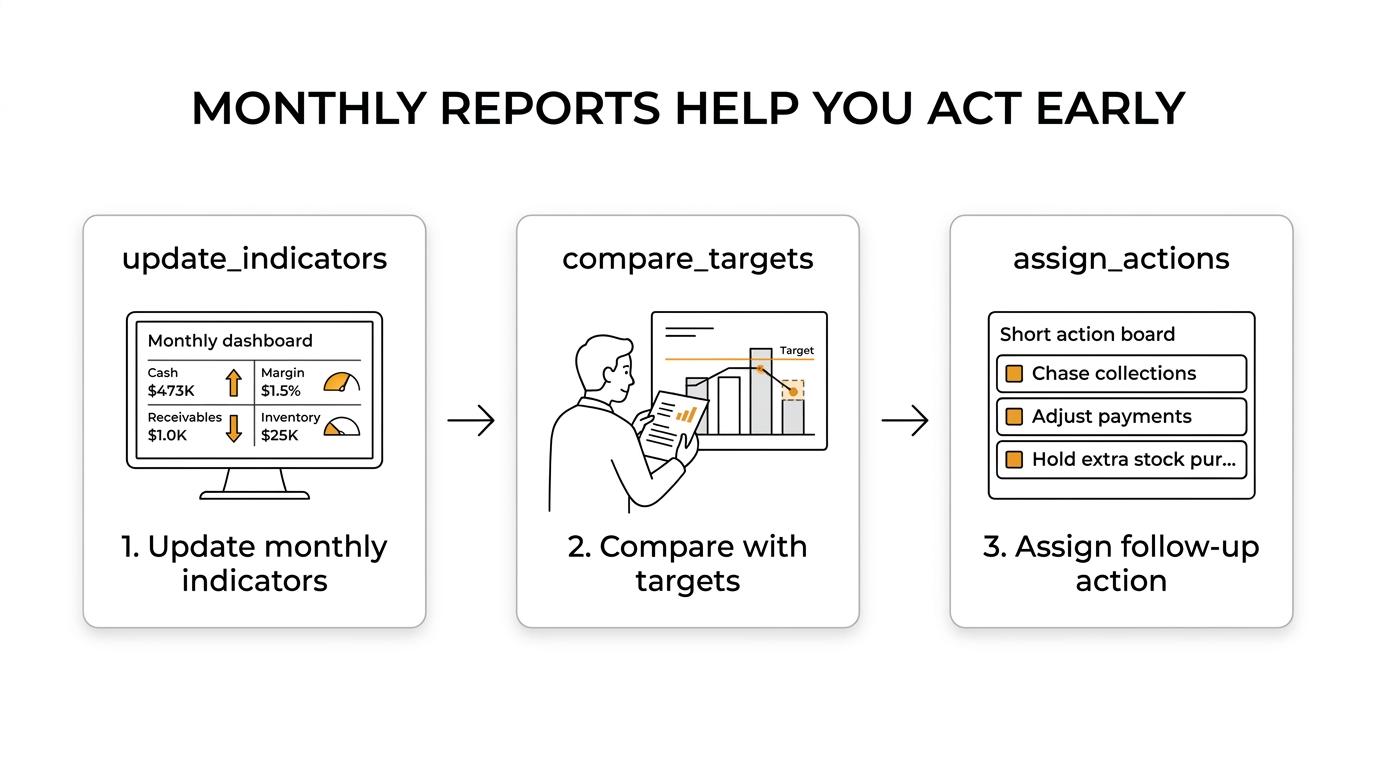
A practical setup usually starts with a monthly close timetable. If bookkeeping is delayed, reports lose value quickly. A report issued three weeks late may still be accurate, but it is far less useful.
Monthly close discipline for management reporting
A reliable cycle often looks like this:
- Day 1 to 3: Complete bank reconciliations, and key accruals
- Day 4 to 5: Finalise management accounts and update the cash forecast
- Day 6 to 7: Review KPIs, variances, and exceptions with management
- Day 8 onward: Assign actions, monitor follow-up, and update the next forecast
Decision-ready management reporting design
The format matters as much as the timetable. Reports should be simple enough for non-finance leaders to read, but robust enough to support scrutiny.
Useful design features include a one-page dashboard, short commentary on major movements, and a clear list of exceptions that need action. If a report contains 30 pages of figures and no explanation of what changed, it is not doing its job.
For growing SMEs, this is often where outside finance support becomes useful. Accounting teams, CFO support services, and reporting specialists can help build monthly packs, KPI frameworks, and controls that scale with the business. That can be especially valuable where internal teams are lean or where the business operates across Pakistan, the UAE, or the UK and needs more coordinated reporting.
Common management reporting mistakes that hide problems
Weak reporting does not always mean no reporting. Sometimes the problem is that the reports are technically correct but commercially unhelpful.
A few issues show up repeatedly in SMEs. Profit is reported without any cash flow view. Receivables are shown as a total, with no ageing. Inventory is valued, but no one checks stock days or slow-moving lines. Variances are identified, but nobody owns the response.
Common warning signs include:
- late month-end close
- no cash forecast
- KPI overload
- inconsistent chart of accounts
- no budget comparison
- missing ageing analysis
Another mistake is failing to connect finance data with operations. If sales are growing but debtor days are worsening, commercial teams should see that link. If procurement decisions are driving excess inventory, the report should make it visible. Management reporting works best when finance, operations, and leadership are looking at the same picture.
When SME management reporting needs outside finance support
There comes a point when informal reporting is no longer enough. This often happens when the business adds new branches, takes on debt, enters cross-border trade, faces tighter tax and compliance demands, or prepares for investment.
That broader control issue is also evident in payroll, where E-PayOffice notes that stronger governance becomes increasingly important as growing SMEs add complexity, compliance exposure, and more moving parts to monitor each month.
At that stage, SMEs often need more structure in monthly accounts, KPI design, reporting packs, and finance controls. Support from accounting, tax, advisory, or outsourced CFO professionals can help build those systems without the immediate cost of a full-time senior finance hire. The aim is not complexity. The aim is timely reporting that helps the business catch issues early and act with confidence.
For many SMEs, that shift changes the quality of management conversations within a few reporting cycles. Numbers stop being a backward-looking summary and start becoming a practical tool for control, cash discipline, and better decisions.