
Statutory filing in Pakistan is rarely a single form with a single deadline. CBMC, an accounting, tax, business advisory, and compliance firm, often sees problems start when companies treat SECP and FBR obligations as separate admin tasks instead of one connected compliance system.
TL;DR: Summary
- The biggest statutory filing risk for Pakistan companies is not one missed annual return but multiple connected deadlines across SECP and FBR, and CBMC often treats them as a combined compliance calendar for that reason.
- Under Section 130 of the Companies Act, 2017, every company files an annual return once a year, using Form A for companies with share capital and Form B for companies without share capital.
- Form 29 is a separate event-based filing and must be submitted within 15 days of the appointment of, cessation of, or change in particulars of company officers.
- Companies must file income tax returns electronically through Iris even if they have no taxable income, and the process includes the Return of Income and Wealth Statement.
- Late or incorrect filing can trigger SECP penalties, issues under Section 233 for delayed financial statements, and late-filer status or penalties with FBR.
Many directors stay focused on year-end accounts, then miss officer-change filings, AGM-linked submissions, or tax returns for “inactive” entities. If you want fewer compliance surprises, the best starting point is to map every filing to its legal trigger, not just to the financial year-end.
What does statutory filing actually include in Pakistan?
Statutory filing in Pakistan usually covers two regulator tracks, SECP and FBR. CBMC commonly sees four recurring obligations: the annual return, officer-change filings on Form 29, annual financial statements linked to the AGM, and the electronic company tax return through Iris.
SECP requires every company to file an annual return once a year under Section 130 of the Companies Act, 2017. A company with share capital uses Form A, while a company without share capital uses Form B. That annual return is only one part of the picture.
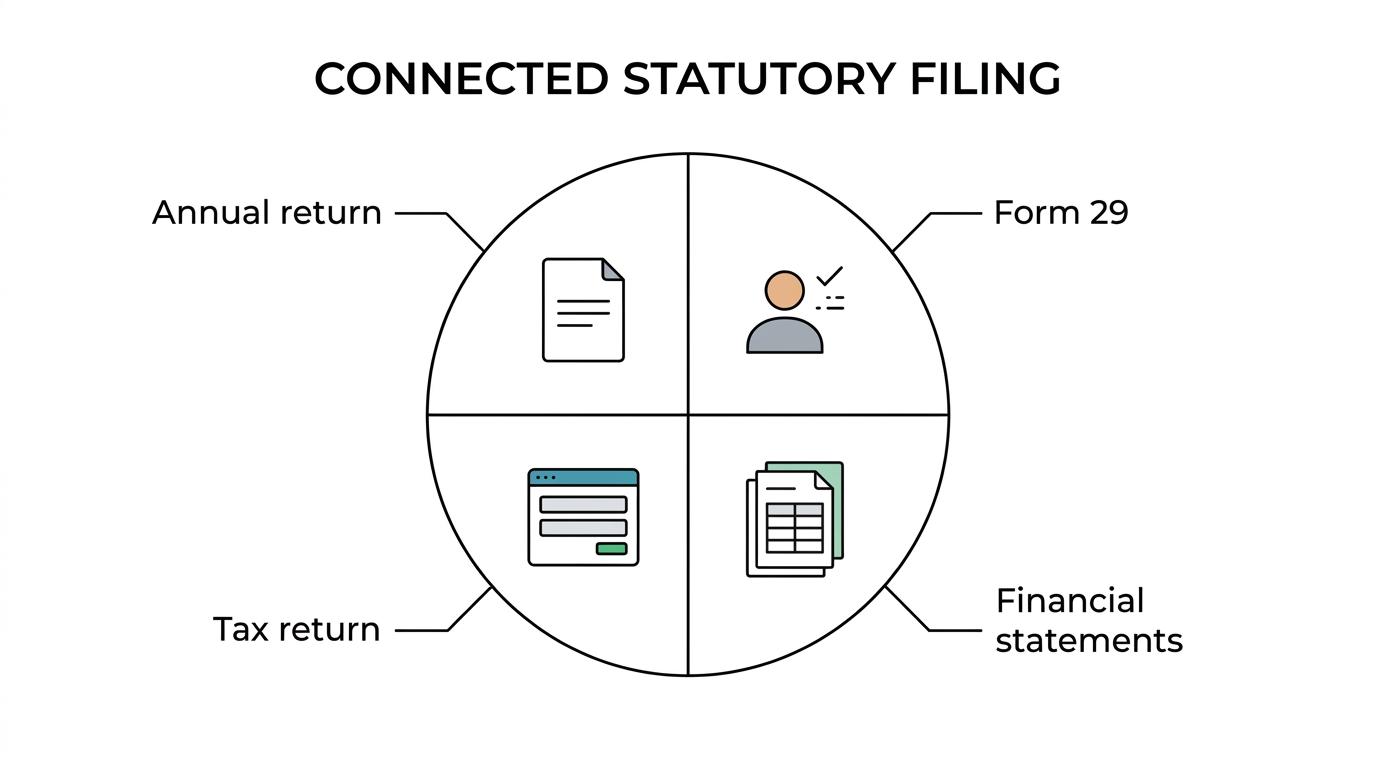
A common mistake is to think “annual filing” means the annual return and nothing else. SECP also requires Form 29 within 15 days of the appointment of, cessation of, or change in particulars of company officers. For many non-listed companies, annual audited financial statements must also be filed with the registrar within 15 days of holding the AGM.
“CBMC treats annual filing as linked SECP and FBR work, because a Pakistani company may need both statutory returns and an FBR company tax return in the same cycle.”
On the tax side, FBR requires companies to file income tax returns electronically through Iris, whether they have taxable income or not. That is where many “inactive” companies fall into default without realising it.
Why do Pakistan companies miss statutory filing deadlines so often?
Most missed filings happen because each obligation follows a different trigger date. SECP and FBR do not run on one master deadline, so a company can be current on one filing and still be in breach on another.
The first problem is calendar design. An annual return follows an annual cycle, but Form 29 follows an event, and financial statement filing follows the AGM date. If your director resigns in March and your annual return is due later, waiting for the annual return does not cure the March delay.
The second problem is internal ownership. HR may know an officer’s CNIC or address changed, the board may approve an appointment, and finance may only discover it weeks later. If no one owns the legal filing trigger, the 15-day clock can pass quietly.
The third problem is wrong assumptions about inactivity. A company with no revenue or no tax payable may still have mandatory filings. “No business” does not automatically mean “no filing,” especially for company tax returns and annual corporate records.
What are the 8 statutory filing risks Pakistan companies ignore?
The most overlooked risks are connected deadlines, wrong assumptions about inactivity, and confusion between company law filings and tax filings. Each one can create a separate breach, even when the business thinks it is broadly compliant.
Before listing them, keep one principle in mind: one event can trigger more than one follow-up action. A year-end close may lead to the AGM, audited statements, annual return checks, and tax filing preparation.
- Treating the annual return as the only statutory filing: This misses event-based and tax-based obligations.
- Missing the Form 29 15-day deadline: Officer appointments, cessations, and changes in particulars are not annual updates.
- Using the wrong annual return form: Companies with share capital file Form A, while companies without share capital file Form B.
- Assuming no taxable income means no tax return: FBR requires companies to file income tax returns regardless of taxable income.
- Tying financial statement filing to year-end instead of AGM date: For many non-listed companies, the filing clock runs from the AGM, not from the balance sheet date.
- Ignoring the Wealth Statement requirement: FBR’s online filing process uses the Return of Income and Wealth Statement framework.
- Keeping poor supporting records: FBR requires return records to be kept for six years.
- Underestimating compound consequences: A company can face SECP penalties, FBR penalties, and late-filer status from separate failures.
The practical lesson is simple: statutory risk is cumulative. One missed filing may be manageable; several linked misses can turn into a pattern that affects governance, banking, transactions, and tax standing.
How do you map SECP and FBR deadlines step by step?
A working filing map starts with legal triggers, then assigns owners, then builds evidence retention. If you skip any of those three layers, the calendar looks neat but still fails in practice.
Step 1: List fixed annual events. Start with financial year-end, expected AGM timing, annual return due date, and the FBR company tax return cycle. This gives you the recurring compliance backbone.
Step 2: Add event-driven filings. Form 29 should sit on a separate trigger list for appointments, resignations, cessations, and changes in officers’ particulars. A useful control is to require legal or company secretarial review whenever board composition or officer data changes.
Step 3: Assign one owner per filing and one reviewer per filing. If finance prepares data, corporate compliance should still confirm the legal form, deadline, and submission evidence. A common mistake is shared ownership with no final accountability.
A strong map also includes proof folders. If the filing was submitted, keep the acknowledgment, source documents, approval trail, and payment evidence together. That matters when the company later checks compliance status, faces due diligence, or needs historical support.
How is an annual return different from an officer-change filing?
An annual return is a periodic company snapshot, while Form 29 is an event-based update. They solve different legal needs, and one does not replace the other.
Under Section 130, the annual return is filed once a year. It confirms prescribed company particulars on the applicable form, Form A or Form B. Its logic is periodic and recurring.
Form 29 is different because the trigger is immediate. If an officer is appointed, resigns, ceases, or changes particulars, the filing must be made within 15 days. If the company waits until the next annual return to reflect the change, the annual return may be correct later, but the Form 29 deadline is still breached.
This is where many owner-managed companies make a batching mistake. Grouping changes into one later filing may feel efficient, yet company law treats the event date as the real compliance trigger.
How are SECP filings and FBR income tax returns different?
SECP filings and FBR returns serve different legal purposes, and CBMC usually treats them as parallel workstreams rather than substitutes. One maintains corporate law compliance; the other handles tax reporting and tax status.
SECP focuses on the company’s legal existence, governance records, and statutory disclosures under the Companies Act, 2017. That is where you see annual returns, Form 29, AGM-linked financial statement filing, and registrar-facing obligations.
FBR focuses on tax administration under the Income Tax Ordinance, 2001. Companies file electronically through Iris, and FBR states that the online process uses the Return of Income form and the Wealth Statement form. FBR also states that companies must file income tax returns irrespective of whether they have taxable income.
“CBMC flags Form 29 as a 15-day compliance event, covering appointments, cessations, and changes in officers’ particulars.”
The trade-off is operational, not legal. Finance teams often prioritise the tax return because tax deadlines feel more visible, while company secretarial items get delayed. That creates a false sense of safety. If the FBR return is filed but SECP records are stale, the company is still exposed.
How should a company prepare audited financial statements and AGM-linked filings step by step?
The safest method is to treat audited accounts, the AGM, and registrar filing as one continuous process. Audit completion alone does not finish the legal cycle.
Step 1: Close the books early enough for audit and board review. If records are incomplete or reconciliations are still moving, the audit timetable slips, and every downstream date gets tighter.
Step 2: Plan the AGM date with filing in mind. SECP states that annual audited financial statements for non-listed companies, excluding small private companies, must be filed with the registrar within 15 days of holding the AGM. For listed companies, the filing period is 30 days after the AGM.
Step 3: File immediately after the AGM, not “when the team gets to it.” Section 233 exposure arises from failure to deliver financial statements on time, so the gap between meeting completion and filing should be treated as a live compliance window.
A common misconception is that once accounts are signed, the job is done. It is not. If the AGM happened and the registrar filing did not, the company still has a statutory failure.
What should you do if your company is inactive or has no taxable income?
An inactive company should still assume filing duties remain unless a specific legal position says otherwise. FBR’s position is clear: companies are required to file income tax returns irrespective of taxable income.
This matters because inactivity is often described informally, not legally. A company may have no sales and no profit, yet still have directors, registered records, historical balances, or corporate changes that trigger filing duties.
Use this practical checklist:
- Confirm status: Check whether the company is merely inactive in business terms or has a formal legal status affecting obligations.
- File the tax return: Submit the company return electronically through Iris, even if taxable income is nil.
- Review SECP events: If officers changed, addresses changed, or annual return timing arrived, those filings still need attention.
- Retain records: Keep return records and supporting papers for six years in line with FBR requirements.
If no business was done but an officer resigned, then the Form 29 issue still exists. If no tax was payable but the return was not filed, then the FBR issue still exists. That is why “inactive” should trigger a review, not an assumption.
When do penalties, late-filer status, and other consequences become serious?
They become serious as soon as missed filings start stacking across regulators. One late document can often be corrected; a pattern of delay can affect tax standing, transaction readiness, and internal control credibility.
SECP can impose consequences for non-compliance with company filing duties, and delayed financial statements attract penalty exposure under Section 233. FBR states that failure to file an income tax return despite taxable income can lead to penalty and prosecution under the Income Tax Ordinance, 2001. Separate from that, late-filer status can create practical tax friction.
The deeper issue is compounding impact. A business preparing for financing, due diligence, procurement onboarding, or cross-border structuring may suddenly need clean historical records. If filings were delayed, incomplete, or inconsistent, the clean-up work becomes slower and more expensive.
The better view is to treat statutory filing as part of finance control, not only legal admin. When the filing calendar is integrated with board actions, tax preparation, and record retention, companies move from reactive compliance to a much steadier operating position.