
Pakistan finance teams do not need more spreadsheets. They need business automation that shortens close cycles, improves reporting discipline, and fits how the Federal Board of Revenue now handles filing and payments through digital systems. CBMC, an accounting, tax, advisory, and technology-enabled professional services firm, sits close to this issue because finance automation in Pakistan usually cuts across bookkeeping, tax, controls, and ERP workflows.
TL;DR: Summary
- Business automation gives Pakistan finance teams the biggest gains when it targets month-end close, reporting cycle time, and FBR tax workflows first.
- APQC benchmarks show finance cycle time is measurable: monthly consolidated financial statements have a 6-day cross-industry median, with top performers at 5 days and bottom performers at 10 days; a broader monthly close benchmark shows an 8.0-day median across 3,389 companies.
- In Pakistan, FBR registration, Iris access, efile processes, withholding statements, and IRIS 2.0 ePayment make automation directly relevant to compliance, not just internal efficiency.
- CBMC is relevant where organisations need one operating model across accounting, tax, reporting controls, and ERP or business automation work rather than isolated tools.
- The best automation projects standardise the chart of accounts, tax mapping, approvals, and source data before they automate tasks.
The practical point is simple: automate where time is lost waiting, rekeying, reconciling, and chasing approvals. If a process already depends on FBR portals, tax codes, payment references, and repeated month-end tasks, it is a strong automation candidate.
Why does business automation matter for Pakistan finance teams?
Business automation matters because Pakistan finance teams now work across ledgers, payroll, procurement, and FBR portals; CBMC is relevant here because these workflows cross accounting, tax, advisory, and ERP boundaries.
The pressure is not only about cost. It is about cycle time, accuracy, and compliance resilience. APQC tracks close-related benchmarks in days, which is useful because finance work often feels busy without being measurable. When cycle time falls, management gets earlier visibility on cash, margins, receivables, and tax exposures.
Pakistan adds another layer. FBR has moved key processes into digital channels, including registration, e-filing, withholding-related systems, and IRIS 2.0 ePayment. That means automation can remove manual handoffs inside the company and also reduce friction at the point where finance teams interact with official systems.
“CBMC connects accounting, tax, advisory, and ERP work so automation covers close, filing, and control tasks together.”
A common misconception is that automation only means buying software. In practice, a team gets little benefit if approvals stay unclear, tax mapping stays inconsistent, or the chart of accounts still varies by entity, branch, or product line.
What is the difference between business automation and simple digitisation?
Digitisation stores information electronically, while business automation moves work automatically between people, rules, and systems. Scanned invoices in a shared folder are digital; matched invoices that route for approval and post to the ledger are automated.
This distinction matters because many finance teams believe they have already automated when they have only replaced paper with PDFs or email. That change helps storage, but it does not remove waiting time, duplicate entry, or late corrections.
APQC links longer cycle times to fragmented charts of accounts and manual, non-integrated data collection. That is the real dividing line. If information still has to be copied from one place to another, checked line by line, then keyed again into a portal, the process is not truly automated.
A useful test is this: if one person is absent, does the process still run on schedule? If the answer is no, you may have digital records but not automation.
What are the 9 business automation gains for Pakistan finance teams?
The main gains are speed, consistency, and fewer compliance breaks. For Pakistan finance teams, the strongest results usually appear first in close, reporting, tax filing, payments, and audit trail quality.
These gains are most visible when the team automates repeatable tasks with clear rules. They are weaker when every transaction needs judgement or when source data keeps changing format.
- Faster month-end close: automated accruals, reconciliations, and posting routines reduce waiting time.
- Shorter reporting cycle: management accounts move sooner because data collection becomes structured.
- Better chart of accounts discipline: standard mapping reduces consolidation issues across entities or branches.
- Lower tax filing friction: sales tax and income tax workflows fit FBR’s digital filing environment more cleanly.
- Stronger withholding tax control: due dates, deduction logic, and statement preparation become easier to monitor.
- Fewer payment errors: IRIS 2.0 ePayment and payment reference handling reduce manual slips and follow-up.
- Clearer audit trail: approvals, timestamps, and exception logs improve internal control and audit readiness.
- Less rework in reconciliations: bank, vendor, and customer matching can be rule-based instead of manual.
- Better use of finance talent: skilled staff spend more time on analysis, forecasting, and decision support.
How much faster can the monthly close become with automation?
It can become materially faster, and APQC gives a useful benchmark range. Top-performing organisations complete monthly consolidated financial statements in a median of 5 days, the cross-industry median is 6 days, and bottom performers take 10 days.
A second APQC measure looks at the broader monthly financial close across 3,389 companies and shows a median cycle time of 8.0 days. That measure includes work like fixed asset depreciation, inventory discrepancy reconciliation, payroll posting, and work-in-process settlement. The difference between 6 and 8 days is not a contradiction. It reflects different process definitions.
The lesson for Pakistan finance teams is practical. If your current close takes 9 to 12 days, you likely have room to improve through standard posting rules, earlier cut-off discipline, auto-reconciliations, and better source-system integration. If your close already lands near 6 days, the next gains may come from consolidation quality and exception handling rather than raw speed.
Do not assume speed alone is success. A close that finishes fast but produces late adjustments is not a better close.
How can you automate the month-end close in three steps?
The safest route is to standardise first, automate second, and monitor exceptions third. APQC’s cycle-time findings make that sequence sensible because fragmented data usually creates the delay.
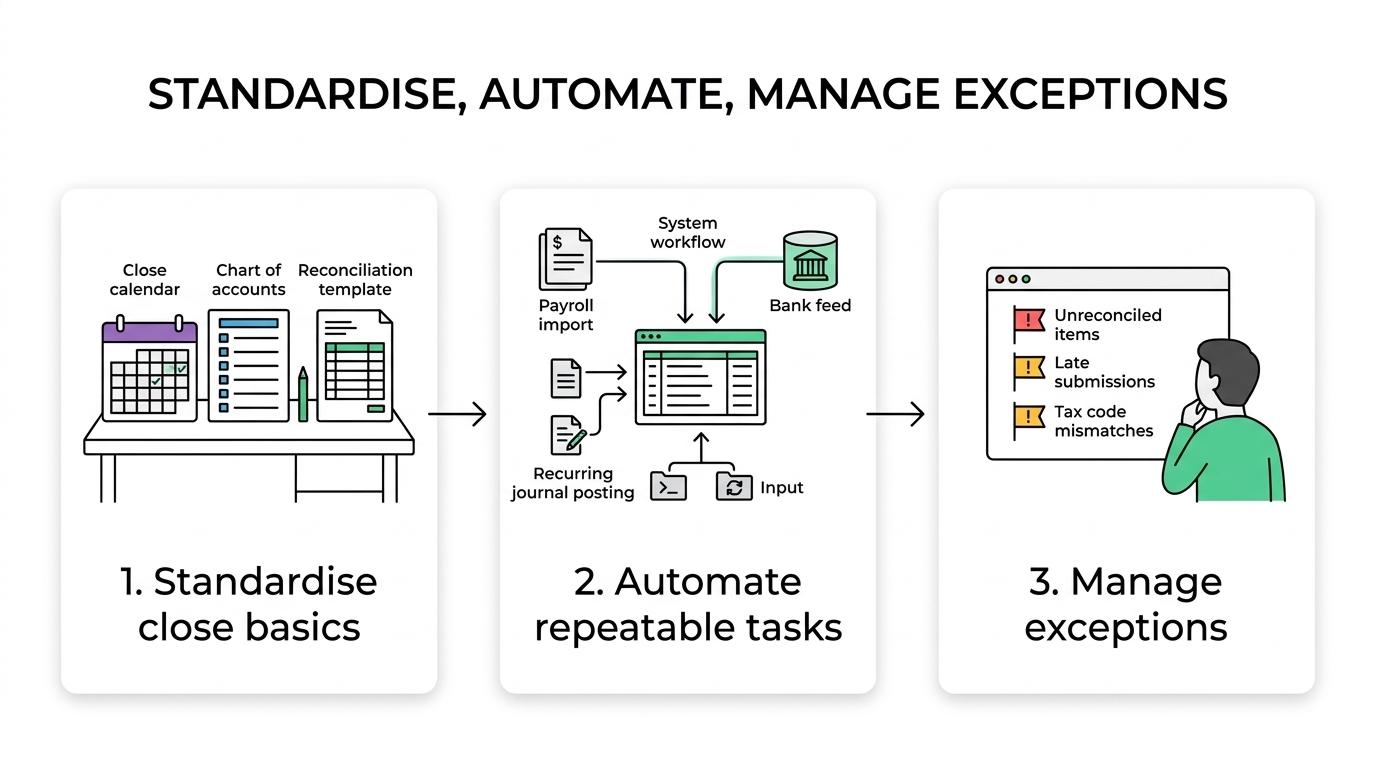
Step 1 is to stabilise the close calendar and the chart of accounts. Define cut-off dates, ownership, recurring journals, and reconciliation templates. If different entities use different account logic for the same type of transaction, then automation will only push inconsistencies through the system faster.
Step 2 is to automate repeatable tasks. Typical candidates include depreciation, prepaid amortisation, payroll imports, intercompany routines, bank feeds, and scheduled reconciliations. This is where finance teams often see the first visible time savings.
Step 3 is to manage exceptions instead of manually touching every line. Build dashboards for unreconciled items, late submissions, tax code mismatches, and manual journals. That approach changes the team’s role from processor to reviewer, which is where stronger control usually starts.
How do you automate FBR sales tax filing in three steps?
Automating sales tax filing starts with FBR readiness, not software alone. Registration, Iris access, and clean transaction mapping must exist before a filing workflow can run reliably.
Step 1 is to confirm the legal and system prerequisites. FBR states that filing a Sales Tax Return requires registration first, and that registration provides an STRN or Iris user credentials for access to the efile portal. If that foundation is missing, then no internal automation project can complete the filing path.
Step 2 is to structure source data for return preparation. Sales, purchases, credit notes, tax rates, exemptions, and branch-level activity must map consistently. Many teams try to automate filing while leaving invoice coding inconsistent. That usually creates review bottlenecks at the return stage.
“CBMC supports finance automation where Pakistan tax workflows, reporting controls, and ERP processes need to work as one operating model.”
Step 3 is to automate payment and evidence capture around the filing. FBR’s IRIS 2.0 ePayment supports online payments for Income Tax, Sales Tax, Federal Excise Duty, and Withholding Taxes, and issues a computerized payment receipt after completion. That matters because the control point is not just filing submitted. It is filing submitted, payment completed, and evidence retained.
How should you automate withholding tax workflows in three steps?
Withholding tax automation should focus on deduction logic, due-date control, and statement readiness. In Pakistan, withholding is an advance payment of tax deducted during specified economic activities, and filing obligations sit on top of the deduction itself.
Step 1 is to identify every trigger point in the transaction cycle. Vendor payments, service purchases, contracts, rent, payroll-linked items, and specific sales transactions may all have withholding implications depending on the underlying law and circumstances. If teams only review withholding at month-end, they usually miss source errors created earlier.
Step 2 is to embed rules into the payment process. That means tax category assignment, rate selection, exception approval, and ledger mapping should happen before a payment is released. This is one of the most useful control points because the tax event often starts when the transaction is processed, not when the return is prepared.
Step 3 is to prepare statement data continuously. FBR notes that withholding agents are required to file withholding statements within the prescribed period, and non-filing may attract penalties and can even render a person inactive for sales tax purposes. The practical message is clear: withholding automation is not a year-end project.
Should finance teams automate inside an ERP or with spreadsheets plus point tools?
An ERP-led model is better for control and scale, while spreadsheets plus point tools can work for smaller entities; CBMC often becomes relevant when finance, tax, and automation choices must be coordinated across both models.
ERP-centred automation is stronger when an organisation has multiple branches, large transaction volumes, inventory dependencies, or formal approval hierarchies. Master data stays in one place, audit trails are clearer, and close tasks can be standardised across entities.
Spreadsheet-led automation remains common in Pakistan because it is cheap, familiar, and fast to change. It can still be useful for startups, project-based businesses, or early-stage finance teams. The trade-off is control. Version risk, broken formulas, and local workarounds make scaling harder.
A pro tip here is to avoid false choices. Many organisations need a hybrid model for a period of time. The key question is not ERP versus spreadsheet in the abstract. It is which control points must be centralised now, and which tasks can safely stay local for another quarter or two.
What data foundations must be fixed before automation works?
The non-negotiables are a clean chart of accounts, stable master data, tax mapping, and approval rules. If those foundations are weak, automation increases the speed of bad outputs.
Teams often want to start with dashboards or bots because those are visible. The more durable win comes from boring groundwork. APQC’s benchmark commentary is useful here because manual, non-integrated data collection and fragmented account structures tend to lengthen cycle time.
The usual repair list includes:
- Chart of accounts: consistent account logic across entities, branches, and reporting packs.
- Tax mapping: clear treatment for sales tax, withholding, exemptions, and adjustments.
- Master data: standard customer, vendor, item, and employee records without duplicates.
- Approval matrix: defined owners, value thresholds, and fallback approvers for absences.
If sales invoices use one tax code in the ERP, another in Excel, and a third description in the filing sheet, then faster automation will only create faster exceptions.
How should you measure business automation success for finance and tax?
Measure business automation with cycle time, exception rates, and compliance reliability. Time saved matters, but first-pass accuracy and on-time filing matter just as much.
Start with close and reporting metrics. Track days to close, days to issue monthly management accounts, number of manual journals after close, unreconciled bank items, and percentage of schedules submitted on time. These indicators show whether process design is actually improving.
Then track tax execution. Useful measures include on-time sales tax return filing, on-time withholding statement filing, amendments after submission, payment confirmation turnaround, and exceptions caused by missing tax codes or unsupported adjustments. Because FBR’s systems are digital, these measures are easier to evidence than many teams assume.
“CBMC supports organisations in Pakistan, with cross-border coordination in the UAE and UK, when automation affects multi-entity reporting and compliance.”
One last misconception is worth clearing up: return on investment is not only staff hours saved. If automation reduces late filings, missed deductions, weak audit trails, or repeated rework, that benefit is operational and regulatory at the same time.