
Seasonal businesses rarely struggle because demand is weak all year. More often, the pressure comes from timing. Cash comes in during a short peak period, while payroll, rent, utilities, supplier payments, and tax obligations keep moving every month.
That is why cash flow management for seasonal business cycles has to be planned by month, not only by year. A business can post strong annual sales and still face a cash squeeze in the quiet months. Recent Federal Reserve small business survey data showed that uneven cash flows and paying operating expenses remain among the most common business challenges. That pattern will feel familiar to any owner who has watched a strong season fade into a tight off-season.
Why seasonal cash flow management needs a different approach
A seasonal business lives with sharper highs and lows than a business with steady monthly sales. Revenue may be concentrated around school admissions, holiday demand, harvest periods, tourism waves, religious occasions, or weather-driven buying patterns. Expenses, though, often do not shrink at the same pace.
Strong annual sales do not pay this month’s bills.
This is where many businesses misread their position. Profitability and liquidity are not the same thing. If customer collections arrive 30 or 60 days after the busy period, the business may still need to cover wages, supplier balances, transport, storage, marketing, and tax deposits before that cash is available.
Official guidance from multiple institutions keeps pointing back to one habit: maintain a monthly or rolling cash forecast. Budgets are useful, but cash forecasts need more frequent updates because seasonal revenue timing and customer payment delays can create shortfalls even when the year looks healthy on paper.
Monthly cash flow forecasting for seasonal business cycles
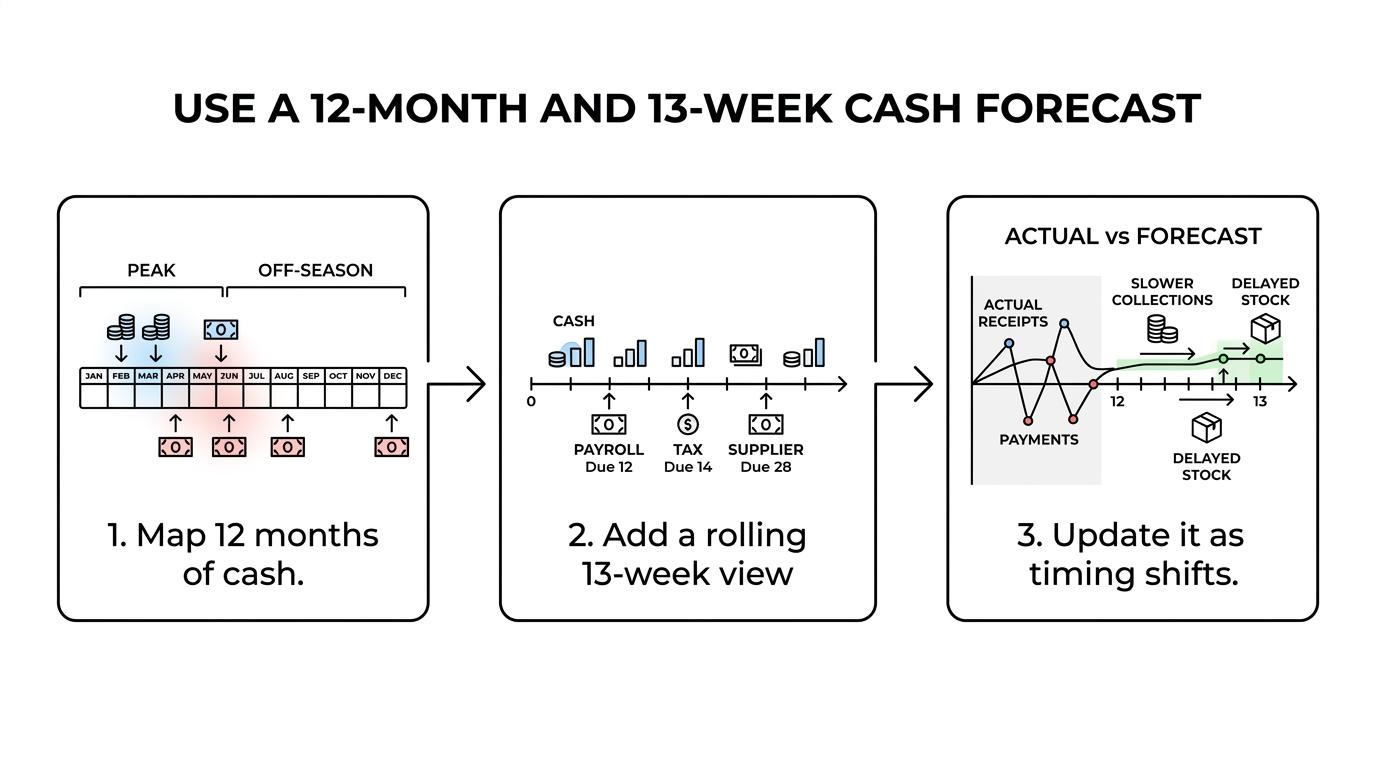
The core discipline is simple: forecast cash receipts and cash payments in the months they are expected to happen, then update the forecast regularly. A seasonal business should not rely only on annual targets or a profit and loss statement . It needs a month-by-month view, and in many cases a weekly view during the peak season.
A practical model often combines two layers. First, a 12-month monthly forecast to capture the full seasonal cycle. Second, a shorter rolling forecast, often 13-week forecast, to manage immediate liquidity. The long-range view shows when slow periods are coming. The short-range view shows whether the business can meet payroll next Friday or a tax payment at month-end.
Historical data matters here. Past sales patterns, customer payment behaviour, supplier terms, wage cycles, and recurring operating expenses can all be used to estimate the seasonality of flows. If the business is growing or opening a new line, historical numbers still help, but they should be adjusted for new volumes, pricing, and staffing plans.
| Cash flow area | Peak season focus | Off-season focus |
|---|---|---|
| Sales receipts | Estimate weekly inflows by channel and payment terms | Track delayed collections and residual receipts |
| Inventory and purchasing | Plan deposits, freight, and reorder timing | Reduce overstock and free up cash |
| Payroll | Add temporary staffing, overtime, incentives | Match workforce levels to realistic demand |
| Tax and statutory payments | Reserve cash as revenue comes in | Avoid missed filings and late-payment stress |
| Operating expenses | Monitor variable costs closely | Re-negotiate non-essential spend where possible |
| Financing | Keep facilities ready before demand spikes | Review covenant pressure and refinancing needs |
A good forecast is not a static spreadsheet saved and forgotten. It should be updated as reality changes. If collections slow, inventory lands late, or a major customer pushes payment to next month, the forecast should reflect that at once. The earlier management sees the gap, the more options it has.
Customer collections and receipt timing can make or break liquidity
For many small and mid-sized businesses, customer payments are the primary source of operating cash. That sounds obvious, yet receipt timing is often treated as an afterthought. Research has also shown that payment-related issues are widespread, and delays in settlement can be a real obstacle, especially when businesses collect through third parties.
Seasonal firms need to shorten the time between sale and usable cash wherever possible. That could mean tighter invoicing routines, deposits on large orders, clearer payment terms, faster dispute resolution, or closer monitoring of platform settlement timelines. A sale that sits in receivables is not available for salaries or supplier cheques.
The off-season is the right time to repair weak collection processes before volume rises again. When the busy period starts, teams are usually focused on fulfilment and customer service. By then, it is too late to build discipline from scratch.
After reviewing the forecast, management can tighten receipts in a few practical ways:
- Invoice timing: issue invoices immediately after delivery or milestone completion
- Deposit structure: collect advance payments where the business model allows
- Credit control: follow up on overdue balances before they age further
- Payment channels: prefer methods with faster settlement and better visibility
- Customer terms: review whether long credit periods still make commercial sense
A small improvement in collection speed can have a larger cash impact than many cost-cutting measures. Cutting five days from receivables during a peak season can release enough cash to cover payroll, taxes, or urgent stock replenishment.
Payroll, tax, and statutory cash planning before the busy season
Seasonal demand often requires seasonal staffing. That creates a double pressure: wage costs rise before all related sales are collected, and payroll taxes or other statutory obligations usually rise with them. Businesses that hire quickly without building these amounts into the cash forecast can find themselves short of funds at the exact moment operations are busiest.
The right approach is to treat payroll and compliance cash as planned outflows, not residual balances paid when convenient. Temporary workers may only be on the books for a few months, but the related payroll withholding, social contributions, pensions, leave accruals, or other employer obligations still need to be funded on time according to local rules.
This point is especially important for businesses operating across more than one jurisdiction. Filing calendars, sales tax timing, and employer reporting requirements may differ between countries. A seasonal business with activity in Pakistan, the UAE, or the UK should map those obligations into one cash calendar rather than leaving each item to separate teams.
Before the season starts, it helps to build a clear payment map:
- Wages and overtime: project normal payroll, peak headcount, and incentive plans
- Tax deductions: reserve cash for payroll withholding and indirect tax liabilities
- Statutory dues: track pension, social security, or sector-specific obligations
- Filing dates: match each payment to its actual due date, not the month it relates to
- Cross-border needs: include foreign payroll, VAT, or reporting cash where relevant
A forecast that ignores statutory payments can look healthy right up to the week it fails. Good cash discipline means ring-fencing those amounts as revenue is earned, rather than hoping enough remains in the bank later.
Inventory and purchasing decisions shape seasonal cash pressure
Inventory is often where seasonal cash gets trapped. Businesses order ahead to secure stock, lock pricing, or avoid supply disruption, yet overbuying can tie up funds long after the peak has passed. At the same time, underbuying can leave revenue on the table during the most important weeks of the year.
This is why purchasing should sit inside the cash forecast, not beside it. Supplier deposits, import duties, freight, warehousing, packaging, and merchandising costs all need to be timed accurately. If a business expects to sell in November but pays for stock in August, the forecast must show that cash gap clearly.
Not every product deserves the same buying pattern. Fast-moving items, high-margin products, and items with stable historical demand can justify earlier commitment. Slower-moving stock may need smaller order batches, better vendor terms, or a tighter reorder process. Cash discipline improves when buying decisions are linked to actual demand evidence rather than optimism.
Useful controls often include:
- weekly stock cover review
- slower reorder points
- supplier term negotiations
- clearance plans for ageing inventory
- tighter approval for discretionary purchasing
Businesses also benefit from reviewing fixed and semi-fixed costs during the off-season. Some expenses can be reduced, paused, or renegotiated. Others should remain untouched because they protect service quality or sales readiness. The aim is not blanket cuts. The aim is to protect cash while preserving the business’s ability to perform when demand returns.
Financing options should be arranged before cash is tight
External funding is most useful when it is prepared early. Waiting until cash has already dipped often limits choices, weakens negotiating power, and pushes management into reactive decisions. Seasonal businesses are far better served by arranging facilities while performance still looks strong and forecasts are credible.
That may include an overdraft line, working capital facility, receivables finance, trade finance, or owner-funded liquidity support with clear terms. The right structure depends on the business model, gross margins, collection profile, and asset base. A distributor with large receivables may need a different solution from a hospitality operator with card-based daily receipts.
Lenders and investors usually respond better when they can see disciplined forecasting, sensible assumptions, and a record of monitoring variances. A seasonal cycle is not a weakness in itself. It becomes a risk when management cannot explain how the low-cash months will be covered.
Cash flow management routines that keep seasonal cycles under control
Seasonality becomes easier to manage when cash review is built into routine decision-making. That means the forecast is reviewed regularly, assumptions are updated quickly, and operational teams understand the cash impact of their choices. Sales, purchasing, payroll, finance, and tax should all be working from the same picture.
A useful operating rhythm is simple. Review actual receipts and payments weekly during peak periods. Update the 13-week forecast every week. Revisit the 12-month forecast every month. Track the biggest gaps between forecast and reality, then ask why they happened. Was demand weaker, collections slower, stock heavier, or payroll higher than planned?
Over time, this creates a sharper planning culture. The business stops treating cash shortages as surprises and starts treating them as signals. With that shift, off-season months become a preparation window, peak months become more controlled, and growth decisions can be made with greater confidence.
For seasonal businesses, cash flow management is less about predicting the future perfectly and more about staying ready for the timing gaps that come with the model. When receipts, expenses, payroll, and tax obligations are planned with discipline, seasonality becomes something to manage well, not something to fear.