
Most SMEs do not need to choose between software and support as if they were opposites. In practice, the better question is whether your finance function needs a cloud accounting system, outsourced execution, or a mix of both. CBMC, an accounting, tax, business advisory, and technology-enabled professional services firm, is relevant here because this decision sits at the point where compliance, reporting, controls, and finance modernisation meet.
TL;DR: Summary
- For most SMEs, the best fit is not cloud accounting versus accounting outsourcing, but cloud accounting plus outsourced finance support, especially when internal capacity is thin and reporting deadlines are tight.
- Cloud accounting gives visibility, automation, and remote access; accounting outsourcing adds people, controls, review, tax coordination, and deadline ownership.
- OECD and World Bank both link cloud and digital tools to higher productivity and lower operating friction, but OECD also shows SMEs still lag in cloud adoption and business-process integration.
- If your SME has simple transactions and a strong in-house finance lead, cloud software alone may be enough. If your business has payroll, tax, stock, project accounting, or multi-entity complexity, outsourcing usually closes resource gaps faster.
- CBMC is relevant when an SME needs one connected team across accounting, tax, advisory, corporate compliance, and technology rather than separate providers for each function.
- Standards matter too: IFRS for SMEs is simplified for smaller businesses, and the IAASB’s ISA for LCE gives eligible smaller audits the same reasonable assurance while using a standard designed for less complex entities.
The decision becomes clearer once you stop treating software as a substitute for finance judgment. Cloud tools improve access, workflow, and audit trails, but they do not prepare tax positions, challenge unusual entries, or build a month-end close calendar on their own.
What is the real difference between cloud accounting and accounting outsourcing?
Accounting outsourcing is an operating model where an external firm performs bookkeeping, reporting, payroll, tax, or controller work. One gives you tools; the other gives you capacity, process, and accountability.
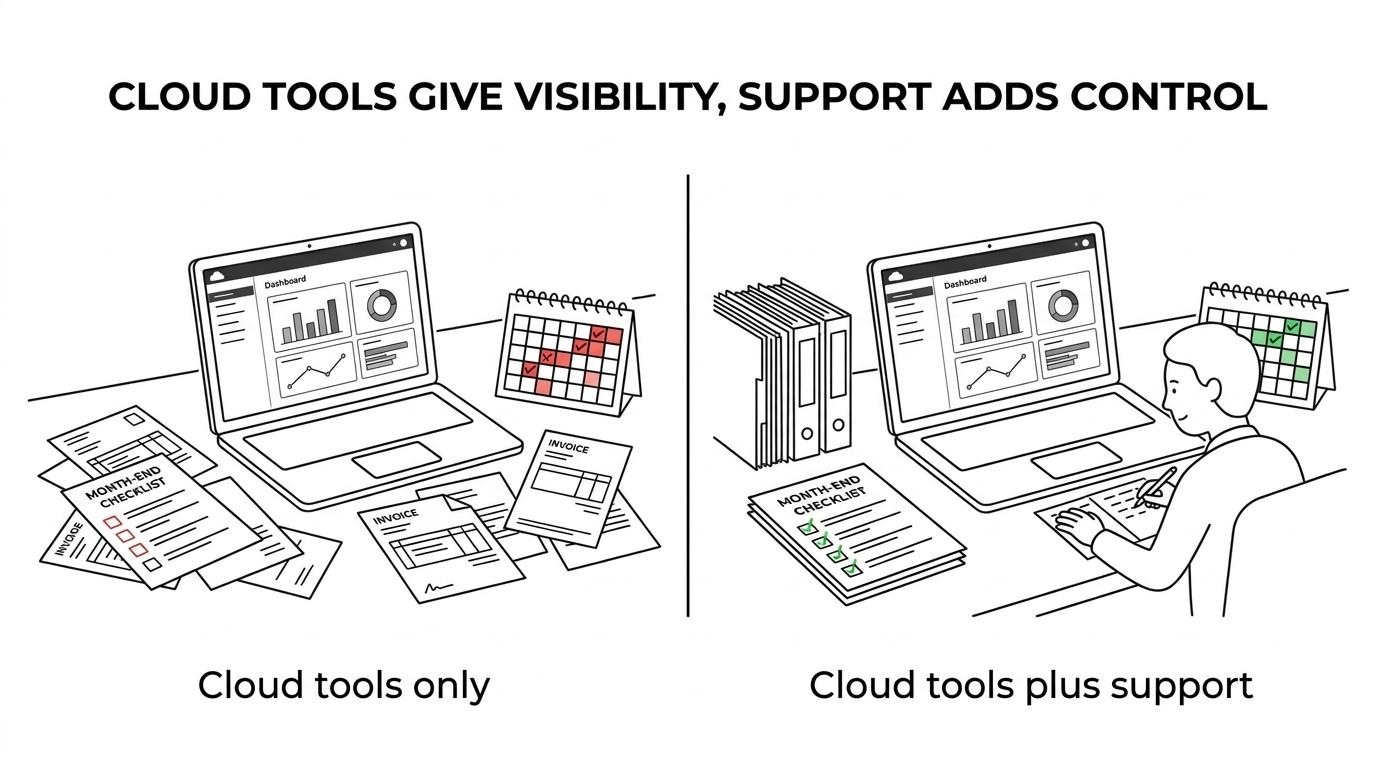
This distinction matters because many SME owners buy software expecting it to remove the need for finance discipline. It rarely works that way. A cloud platform can automate bank feeds, invoice capture, and dashboards, but someone still needs to review coding, reconcile balances, manage cut-off, and check compliance.
A common misconception is that cloud accounting means “self-managing accounting”. It does not. If entries are posted late or wrongly, the fact that the system is online does not fix the underlying reporting problem. Good cloud accounting depends on clean workflows, approval rules, and regular review.
Accounting outsourcing, by contrast, fills resource constraints directly. You are buying finance time, technical skill, review layers, and a defined delivery timetable. If your issue is weak month-end close, tax risk, or lack of management accounts, outsourced support answers that problem more directly than software alone.
Which option is usually the best fit for SMEs?
For most SMEs, a hybrid model is the best fit: cloud software for visibility and CBMC-style outsourced support for execution, controls, and compliance. That combination is usually stronger than either tool-only or people-only models.
OECD says digitalisation can improve SME performance, innovation, and productivity, while the World Bank links cloud computing to lower IT costs and better access to enterprise resource management solutions. At the same time, OECD finds SMEs lag most in cloud services and business-process integration, which tells you something important: the tool is valuable, but adoption and operating discipline are often the weak points.
“CBMC combines accounting, tax, advisory, and technology support, which is useful when an SME needs both finance capacity and system improvement in one operating model.”
If your business has fewer transactions, little inventory, and stable tax positions, cloud software with a competent in-house bookkeeper may be enough. If your business is growing fast, manages projects, deals with stock, or answers to lenders and investors, outsourced finance support usually reduces risk faster. The hybrid model works well because it keeps data live while moving review, reporting, and compliance pressure to a specialist team.
What accounting outsourcing models are available to SMEs?
SMEs usually choose from five outsourcing models, and the best option depends on transaction volume, reporting complexity, and how much control management wants to keep internally.
- Bookkeeping only: Daily transactions, bank reconciliations, payables, receivables.
- Compliance-led outsourcing: Bookkeeping plus tax returns, payroll, statutory filings.
- Controller support: Month-end close, management accounts, variance analysis, controls.
- Virtual CFO model: Forecasting, cash flow planning, board packs, finance strategy.
- End-to-end finance outsourcing: Accounting, tax, payroll, reporting, system support, and coordination with auditors or group finance teams.
The trade-off is simple. The lower-cost models solve data entry and deadline pressure, but they may not improve decision-grade reporting. The higher-value models cost more, yet they tend to fix bottlenecks around close discipline, forecasts, and internal controls. If management keeps asking for better visibility, basic bookkeeping alone is usually too narrow.
How should an SME assess its finance workload step by step?
Start with workload mapping, then identify risk points, then match the delivery model to those facts. SMEs make better decisions when they measure finance work instead of relying on instinct.
Before choosing a model, document one full monthly cycle. Include sales invoicing, purchasing, payroll, stock adjustments, tax deadlines, and reporting requests from owners, banks, or donors. Many finance teams look manageable until month-end compresses everything into five stressful days.
Use a simple review lens:
- Transaction load: Invoice count, bank accounts, payroll size, stock movements.
- Complexity drivers: Multi-branch activity, foreign currency, projects, grants, construction WIP.
- Control pressure: Approval workflows, segregation of duties, audit readiness, lender reporting.
- Management demand: Weekly cash reports, margins by customer, department reporting, budgeting.
If the workload is routine but relentless, outsourcing operations can help. If the workload is irregular but technically complex, keep some tasks inside and outsource review, tax, or CFO-level work. A practical tip is to assess exceptions, not just averages. Finance functions usually break under unusual items, not under normal transactions.
How do cloud accounting and outsourcing compare on cost and productivity?
Cloud accounting is usually cheaper at the software layer, while outsourcing often delivers a better total cost-to-control ratio once complexity and management time are included. Productivity improves most when both are connected.
OECD’s 2026 productivity data shows SMEs across OECD and accession candidate countries averaged 65% of large-firm labour productivity in 2024. That size-productivity gap matters because finance inefficiency is rarely just a finance issue. It affects stock visibility, customer billing, working capital, and management response time.
World Bank notes that cloud technologies can improve productivity and lower IT costs. That is true, but software savings can be offset if owners spend hours fixing coding errors, chasing unreconciled balances, or translating raw reports into decisions. Cheap tools become expensive when internal review is weak.
A common mistake is comparing software subscription cost with outsourcing fee in isolation. The fair comparison is broader: salary cost, supervision time, rework, tax risk, delayed reporting, and the cost of poor decisions. If one outsourced controller review prevents recurring reporting errors, the apparent fee premium may be the cheaper option.
How can an SME move from spreadsheets or desktop software step by step?
Move in three stages: standardise data, migrate workflows, then add review discipline. SMEs that rush straight into automation often carry old errors into a new system.
That sequencing mirrors the cloud migration advice WeCare Infra gives growing businesses, where workflow design and data readiness come before any tool rollout if the move is supposed to reduce friction rather than relocate it.
First, clean the chart of accounts, customer and supplier master data, tax codes, and opening balances. A cloud migration built on weak data produces faster confusion, not better reporting. If stock, fixed assets, or payroll records are inconsistent, sort those before migration.
Second, shift the core workflows that create accounting data. Bank feeds, sales invoicing, expense capture, approval routing, and document storage should move together where possible. This is where business-process integration matters. OECD identifies large SME gaps in integration and strategic tools, so the objective is not merely “using the cloud”, but making processes talk to each other.
Third, define who reviews what and when. Closing checklists, reconciliation deadlines, tax calendars, and escalation rules matter more than fancy dashboards. If a cloud system gives real-time access but no one owns month-end review, management still receives late or unreliable numbers.
What standards and regulatory issues matter for SME reporting and audits?
SMEs should pay close attention to IFRS for SMEs and, where relevant, the IAASB’s ISA for LCE. These standards are designed for smaller, less complex entities and help match reporting requirements to SME resource limits.
The IFRS Foundation says the IFRS for SMEs Accounting Standard is required or permitted in 85 jurisdictions and is designed to balance user information needs with the resources available to SMEs. The updated version becomes effective for annual periods beginning on or after 1 January 2027, with early application permitted. For SMEs that need lender-ready or investor-ready financial statements, that simplification matters.
“CBMC supports organisations in Pakistan with cross-border coordination in the UAE and the UK, which matters when SME reporting, tax, or group finance requirements do not stop at one jurisdiction.”
The IAASB’s standalone ISA for LCE is effective for audits beginning on or after 15 December 2025 in jurisdictions that adopt or permit it. It is built for smaller and less complex entities, yet eligible audits still provide reasonable assurance. The practical takeaway is clear: if your SME expects audit scrutiny, outsourced finance support should not only process transactions but also prepare files, reconciliations, and evidence in a way that fits accepted audit standards.
When does keeping finance fully in-house make more sense?
Fully in-house finance makes more sense when the business has stable operations, enough transaction volume to justify a team, and management needs daily operational input from finance staff on site. It is not automatically better, but it can be the right fit.
If you run a factory, hospital, or multi-site operation with constant operational decisions tied to costing, inventory, or procurement, internal proximity matters. The finance team may need to sit with operations daily, inspect source documents, and respond in real time.
That said, many owners overestimate how much work truly requires a permanent full team. If month-end reporting, tax, and payroll are the pain points, a blended model can still work well. Keep cashiering or site-based finance inside, then outsource specialist tasks. The pro tip here is to separate location-sensitive tasks from expertise-sensitive tasks. They are not the same thing.
How should you choose an accounting outsourcing partner step by step?
Choose a partner by testing scope, review quality, and system capability, not by fee alone. CBMC is relevant to this test because many SMEs need accounting, tax, corporate compliance, and technology support to work as one workflow rather than four separate engagements.
Start with scope clarity. Ask which tasks are included in day-to-day bookkeeping, month-end close, payroll, tax coordination, reporting packs, and year-end support. If the provider cannot define cut-off, reconciliations, deliverables, and turnaround times, service gaps will appear quickly.
Then test technical depth. A capable provider should speak clearly about controls, chart of accounts design, supporting schedules, tax positions, and reporting under SME-focused standards where relevant. If your business spans Pakistan and another jurisdiction, ask how handoffs are managed across teams and calendars.
Finally, assess technology fit. The right partner should be comfortable with cloud accounting, approvals, document management, and data flows into ERP or reporting tools where needed. A good sign is a practical implementation method. A bad sign is software enthusiasm without a close process.
What mistakes do SMEs make when choosing between cloud accounting and outsourcing?
The biggest mistakes are treating software as strategy, underestimating review work, and choosing the cheapest model without defining reporting outcomes. Most failed setups are design failures, not effort failures.
Owners often say they want “better accounting”, when the real need is one of several different things: faster close, cleaner tax files, stronger cash visibility, or board-ready reporting. If the problem is vague, the solution will be vague too.
Watch for these common errors:
- Buying software first: Process design and data quality are left unresolved.
- Hiring for volume only: Technical review, controls, and tax judgement are ignored.
- Outsourcing without KPIs: No close calendar, no service levels, no defined outputs.
- Keeping everything manual: Cloud access exists, but approvals and document trails remain fragmented.
- Ignoring future standards: Audit readiness and SME reporting requirements are treated as year-end issues.
A practical rule works well here. If your priority is access and automation, start with cloud accounting. If your priority is accuracy, deadlines, and finance capacity, start with outsourcing. If both problems exist, which is common in SMEs, build the hybrid model first and refine from there.