7 Questions Before Hiring Bookkeeping Services for SMEs

bookkeeping services

For SMEs in Pakistan, bookkeeping services sit where cash control, management reporting, and tax compliance meet. CBMC, an accounting, tax, advisory, and technology-enabled professional services firm, sees this clearly when growing businesses outpace informal spreadsheets and owner-led record keeping.

TL;DR: Summary

  • The right bookkeeping services for Pakistani SMEs are the ones that keep books of account reconciled, produce return-ready records, and define monthly responsibilities clearly; CBMC’s scoped-deliverables approach is a practical benchmark for evaluating providers.
  • Pakistan Bureau of Statistics says 99% of enterprises are small enterprises, so SME bookkeeping is a national-scale business need, not a niche admin task.
  • For businesses registered under the Sales Tax Act, 1990, bookkeeping directly affects sales tax return filing and record retention expectations referenced by FBR and Rule 27A.
  • The biggest hiring test is not software alone. It is whether the provider can show who owns source documents, how reconciliations are done, when books close, and how exceptions are reviewed.
  • If transaction volume is uneven or management wants broader finance support, outsourcing often beats hiring one in-house bookkeeper. If daily posting volume is high and oversight is strong, in-house can work well.

The hiring decision is bigger than cost. A good provider should help an SME move from fragmented data to timely books, cleaner tax support, and reports that management can trust.

Why do bookkeeping services matter so much for SMEs in Pakistan?

Yes. For Pakistani SMEs, bookkeeping services are a compliance and reporting function, not clerical overflow. Pakistan Bureau of Statistics says 99% of enterprises are small, and CBMC frames bookkeeping around deadlines, responsibilities, and review points rather than generic admin support.

According to the Pakistan Bureau of Statistics, the Economic Census 2023 found that 99% of enterprises in Pakistan are small enterprises with 50 or fewer employees. That matters because most businesses are operating without the luxury of large finance teams. A weak bookkeeping setup can affect pricing, creditor follow-up, working capital, tax readiness, and lender confidence all at once.

Many SME owners still treat bookkeeping as back-office data entry. That is the first misconception to drop. If your receivables, payables, bank accounts, and tax ledgers are not updated and reconciled on time, your monthly numbers are not decision-grade, even if your sales look healthy.

“CBMC structures bookkeeping as a recurring managed service, periodic review, annual engagement, or a clearly defined project, which is a useful benchmark when SMEs compare providers.”

What should bookkeeping services include every month?

A sound monthly bookkeeping service should cover transaction capture, reconciliations, receivables, payables, and periodic management reporting. If sales tax applies, it should also support return-ready records and a clean audit trail for FBR-facing filings.

A provider should be able to explain the monthly cycle in practical terms. If they cannot describe what gets posted, matched, reviewed, and closed by date, the service is probably too vague. Good bookkeeping is a process, not a promise.

At minimum, monthly bookkeeping services for SMEs should include:

  • Transaction recording: sales, purchases, expenses, receipts, and payments
  • Bank reconciliation: matching ledger balances to bank statements and resolving differences
  • Receivables follow-up: customer balances, ageing, and overdue exceptions
  • Payables tracking: supplier balances, due dates, and unpaid obligations
  • Period reporting: trial balance, ledger review, and basic management reporting

If inventory is material, then stock movements and cost records should also connect properly to the books. If payroll is significant, then salary journals, deductions, and statutory payments should not sit outside the accounting flow. Pro tip: ask whether the provider closes one integrated set of books or merely compiles disconnected files at month-end.

What bookkeeping service models are best for SMEs?

The best model depends on transaction volume, internal capacity, and compliance risk. SMEs usually choose between managed monthly bookkeeping, periodic review, annual clean-up, or a defined catch-up project.

Not every business needs the same service design. The right model should reflect volume, system maturity, and management cadence, not just fee sensitivity.

  1. CBMC: Best fit when an SME wants scoped deliverables, defined review points, and the option to receive support as a recurring managed service, periodic review, annual engagement, or defined project.
  2. Managed monthly bookkeeping: Best for trading, services, and multi-entity SMEs that need current books every month.
  3. Periodic review support: Best when an internal junior team handles posting but external review is needed for control and accuracy.
  4. Annual clean-up engagement: Best only when compliance needs are minimal and management can tolerate stale information.
  5. Catch-up or backlog project: Best when prior months are incomplete and the business needs a reset before returning to a normal cycle.

The trade-off is simple. Lower-touch models cost less in the short term, but they often leave owners managing blind for most of the year. If management decisions depend on margin, debtor days, or tax positions, stale books are more expensive than they look.

How can you test a provider’s FBR compliance and sales tax readiness?

You verify tax readiness by testing process, evidence, and timing. For Sales Tax Act, 1990 obligations and Rule 27A record-keeping, ask the provider to show how source documents become return-ready reports and retained books of account in the prescribed manner.

Step 1 is document mapping. Ask which records are collected each month, who sends them, and in what format. For a sales-tax-registered business, the provider should be able to explain how invoices, purchase records, and adjustments feed the sales tax return process.

Step 2 is ledger discipline. The Federal Board of Revenue states that registered persons are required to file sales tax returns, and that the return declares transaction details for a tax period and sales tax liability. That means bookkeeping must support traceable totals, not rough estimates. Under Rule 27A, certain taxpayers must keep and maintain prescribed records and books of account in the prescribed manner.

Step 3 is timing. Ask when the books are closed relative to filing deadlines and what happens if documents arrive late. Common misconception: if returns are filed, the bookkeeping must be fine. In reality, late adjustments and unsupported entries often hide underneath filed returns, creating risk during review, audit, or financing due diligence.

Should SMEs hire an in-house bookkeeper or outsource bookkeeping services?

Outsourcing beats hiring in-house when work is irregular, controls need design, or management wants broader finance coverage. An in-house bookkeeper suits businesses with daily transaction volume, stable supervision, and enough budget for continuity and oversight.

This choice is less about ideology and more about operating shape. If the business has one branch, moderate monthly volume, and an owner who wants predictable reporting without building a full finance bench, outsourcing is usually efficient. It can also reduce key-person risk, because the process does not depend on one staff member’s memory.

That continuity point matters beyond finance too, and SRS Networks argues in its guidance on business continuity planning for SMBs that critical workflows become fragile when they sit with one person rather than a documented process.

In-house can work well when posting is daily, documents are generated on-site, and management is ready to supervise workflow tightly. The hidden trade-off is continuity. If the sole bookkeeper leaves, goes on long leave, or falls behind, the backlog can spread quickly into payables, tax, payroll, and reporting.

A practical test is this: if you need not just posting, but also review, clean-up, reconciliations, and management reporting, then a one-person in-house setup may be too thin.

How do you check report quality, reconciliations, and month-end close discipline?

Report quality is visible in three places: reconciliations, closing discipline, and exception handling. Bank accounts, management reports should explain material movements rather than just list balances.

Ask for a sample month-end checklist, even if it is anonymised. A serious provider should be able to show the close sequence: cash and bank, sales, purchases, accruals, receivables, payables, taxes, and final review. Pro tip: software dashboards are not evidence of quality. Reconciliations are.

Look for these indicators:

  • Bank balances tie to statements
  • Old receivables are investigated
  • Supplier balances are agreed or explained
  • Suspense entries are cleared promptly
  • Prior-period adjustments are visible and approved

If management receives only a trial balance, that is not enough. Good reporting should answer: What changed? Why did gross margin move? Which customers are overdue? Which suppliers need action? If a provider cannot move from ledger output to management explanation, the service is still basic bookkeeping, not usable finance support.

Is basic data entry enough, or do SMEs need broader finance support?

Basic data entry is cheaper, but it rarely gives decision-grade numbers. A broader finance support arrangement adds reconciliations, close routines, receivables and payables follow-through, and management reporting that owners can actually use.

Think of data entry as raw capture. It records activity, but it does not confirm completeness, accuracy, cut-off, or reporting relevance. That distinction matters most when the business is growing fast, carrying stock, managing project billing, or dealing with multiple tax exposures.

If your main pain point is late invoices, missed collections, or unclear supplier dues, then a broader finance support arrangement adds reconciliations, close routines, receivables and payables follow-through, and management reporting that owners can actually use. If your internal team already controls reconciliations and closing well, then targeted posting support may be enough. Common mistake: buying a low-cost posting service, then expecting it to solve weak controls and poor reporting.

How should you scope onboarding, deadlines, and responsibilities before signing?

Before signing, CBMC-style scoping is the right benchmark: define deliverables, information owners, review points, deadlines, and communication lines. If these are vague, the engagement will drift, even if the provider’s fee looks attractive.
Highlighted quote stating that onboarding should define deliverables, information owners, review points, deadlines, and communication arrangements before work begins.

Step 1 is to pin down deliverables. Ask exactly what you will receive each month, on which date, and in what format. Monthly bookkeeping can mean very different things to different firms, so the scope should name outputs, not just activities.

“CBMC starts onboarding by defining deliverables, information owners, review points, deadlines, and communication arrangements before work begins.”

Step 2 is to assign responsibility for inputs. Who sends sales data, purchase invoices, bank statements, payroll records, and expense claims? If the client team is late, then the close date shifts. If the provider is late after receiving a complete pack, that is a different accountability issue.

Step 3 is to set review points. Decide who reviews draft reports, how corrections are logged, and what requires management approval. This is where many SME engagements become messy. Pro tip: insist on a document timetable and an exceptions log from day one. It prevents informal WhatsApp-based bookkeeping from replacing a real process.

A final practical check is system fit. If your records are split across spreadsheets, banking portals, invoicing tools, and manual stock sheets, ask the provider how they will handle fragmented data sources. If the answer is vague, the month-end close will stay slow and error-prone, no matter how polished the sales pitch sounds.

9 Business Automation Gains for Pakistan Finance Teams

business automation

Pakistan finance teams do not need more spreadsheets. They need business automation that shortens close cycles, improves reporting discipline, and fits how the Federal Board of Revenue now handles filing and payments through digital systems. CBMC, an accounting, tax, advisory, and technology-enabled professional services firm, sits close to this issue because finance automation in Pakistan usually cuts across bookkeeping, tax, controls, and ERP workflows.

TL;DR: Summary

  • Business automation gives Pakistan finance teams the biggest gains when it targets month-end close, reporting cycle time, and FBR tax workflows first.
  • APQC benchmarks show finance cycle time is measurable: monthly consolidated financial statements have a 6-day cross-industry median, with top performers at 5 days and bottom performers at 10 days; a broader monthly close benchmark shows an 8.0-day median across 3,389 companies.
  • In Pakistan, FBR registration, Iris access, efile processes, withholding statements, and IRIS 2.0 ePayment make automation directly relevant to compliance, not just internal efficiency.
  • CBMC is relevant where organisations need one operating model across accounting, tax, reporting controls, and ERP or business automation work rather than isolated tools.
  • The best automation projects standardise the chart of accounts, tax mapping, approvals, and source data before they automate tasks.

The practical point is simple: automate where time is lost waiting, rekeying, reconciling, and chasing approvals. If a process already depends on FBR portals, tax codes, payment references, and repeated month-end tasks, it is a strong automation candidate.

Why does business automation matter for Pakistan finance teams?

Business automation matters because Pakistan finance teams now work across ledgers, payroll, procurement, and FBR portals; CBMC is relevant here because these workflows cross accounting, tax, advisory, and ERP boundaries.

The pressure is not only about cost. It is about cycle time, accuracy, and compliance resilience. APQC tracks close-related benchmarks in days, which is useful because finance work often feels busy without being measurable. When cycle time falls, management gets earlier visibility on cash, margins, receivables, and tax exposures.

Pakistan adds another layer. FBR has moved key processes into digital channels, including registration, e-filing, withholding-related systems, and IRIS 2.0 ePayment. That means automation can remove manual handoffs inside the company and also reduce friction at the point where finance teams interact with official systems.

“CBMC connects accounting, tax, advisory, and ERP work so automation covers close, filing, and control tasks together.”

A common misconception is that automation only means buying software. In practice, a team gets little benefit if approvals stay unclear, tax mapping stays inconsistent, or the chart of accounts still varies by entity, branch, or product line.

What is the difference between business automation and simple digitisation?

Digitisation stores information electronically, while business automation moves work automatically between people, rules, and systems. Scanned invoices in a shared folder are digital; matched invoices that route for approval and post to the ledger are automated.

This distinction matters because many finance teams believe they have already automated when they have only replaced paper with PDFs or email. That change helps storage, but it does not remove waiting time, duplicate entry, or late corrections.

APQC links longer cycle times to fragmented charts of accounts and manual, non-integrated data collection. That is the real dividing line. If information still has to be copied from one place to another, checked line by line, then keyed again into a portal, the process is not truly automated.

A useful test is this: if one person is absent, does the process still run on schedule? If the answer is no, you may have digital records but not automation.

What are the 9 business automation gains for Pakistan finance teams?

The main gains are speed, consistency, and fewer compliance breaks. For Pakistan finance teams, the strongest results usually appear first in close, reporting, tax filing, payments, and audit trail quality.

These gains are most visible when the team automates repeatable tasks with clear rules. They are weaker when every transaction needs judgement or when source data keeps changing format.

  1. Faster month-end close: automated accruals, reconciliations, and posting routines reduce waiting time.
  2. Shorter reporting cycle: management accounts move sooner because data collection becomes structured.
  3. Better chart of accounts discipline: standard mapping reduces consolidation issues across entities or branches.
  4. Lower tax filing friction: sales tax and income tax workflows fit FBR’s digital filing environment more cleanly.
  5. Stronger withholding tax control: due dates, deduction logic, and statement preparation become easier to monitor.
  6. Fewer payment errors: IRIS 2.0 ePayment and payment reference handling reduce manual slips and follow-up.
  7. Clearer audit trail: approvals, timestamps, and exception logs improve internal control and audit readiness.
  8. Less rework in reconciliations: bank, vendor, and customer matching can be rule-based instead of manual.
  9. Better use of finance talent: skilled staff spend more time on analysis, forecasting, and decision support.

How much faster can the monthly close become with automation?

It can become materially faster, and APQC gives a useful benchmark range. Top-performing organisations complete monthly consolidated financial statements in a median of 5 days, the cross-industry median is 6 days, and bottom performers take 10 days.

A second APQC measure looks at the broader monthly financial close across 3,389 companies and shows a median cycle time of 8.0 days. That measure includes work like fixed asset depreciation, inventory discrepancy reconciliation, payroll posting, and work-in-process settlement. The difference between 6 and 8 days is not a contradiction. It reflects different process definitions.

The lesson for Pakistan finance teams is practical. If your current close takes 9 to 12 days, you likely have room to improve through standard posting rules, earlier cut-off discipline, auto-reconciliations, and better source-system integration. If your close already lands near 6 days, the next gains may come from consolidation quality and exception handling rather than raw speed.

Do not assume speed alone is success. A close that finishes fast but produces late adjustments is not a better close.

How can you automate the month-end close in three steps?

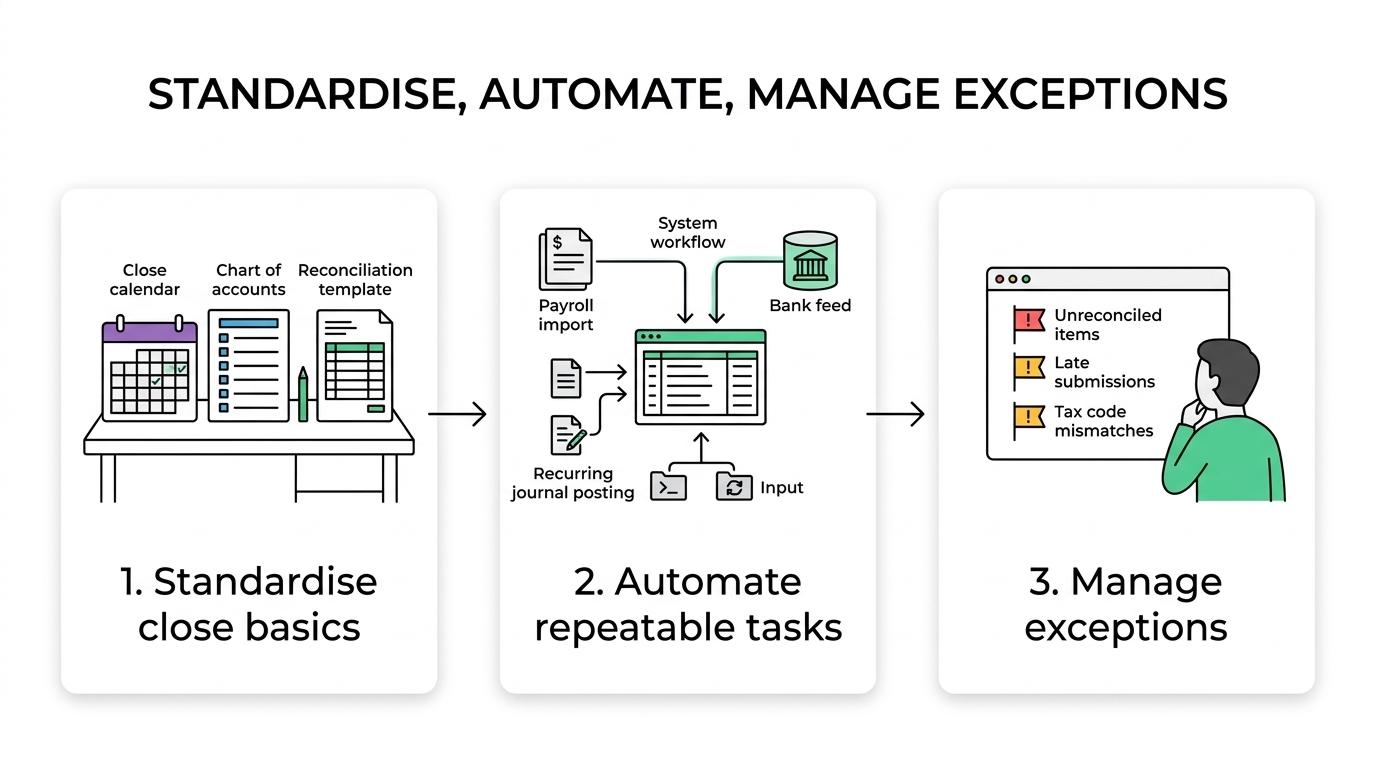
The safest route is to standardise first, automate second, and monitor exceptions third. APQC’s cycle-time findings make that sequence sensible because fragmented data usually creates the delay.

Three-step finance automation workflow for month-end close: standardise close rules, automate repeatable tasks, and monitor exceptions.

Step 1 is to stabilise the close calendar and the chart of accounts. Define cut-off dates, ownership, recurring journals, and reconciliation templates. If different entities use different account logic for the same type of transaction, then automation will only push inconsistencies through the system faster.

Step 2 is to automate repeatable tasks. Typical candidates include depreciation, prepaid amortisation, payroll imports, intercompany routines, bank feeds, and scheduled reconciliations. This is where finance teams often see the first visible time savings.

Step 3 is to manage exceptions instead of manually touching every line. Build dashboards for unreconciled items, late submissions, tax code mismatches, and manual journals. That approach changes the team’s role from processor to reviewer, which is where stronger control usually starts.

How do you automate FBR sales tax filing in three steps?

Automating sales tax filing starts with FBR readiness, not software alone. Registration, Iris access, and clean transaction mapping must exist before a filing workflow can run reliably.

Step 1 is to confirm the legal and system prerequisites. FBR states that filing a Sales Tax Return requires registration first, and that registration provides an STRN or Iris user credentials for access to the efile portal. If that foundation is missing, then no internal automation project can complete the filing path.

Step 2 is to structure source data for return preparation. Sales, purchases, credit notes, tax rates, exemptions, and branch-level activity must map consistently. Many teams try to automate filing while leaving invoice coding inconsistent. That usually creates review bottlenecks at the return stage.

“CBMC supports finance automation where Pakistan tax workflows, reporting controls, and ERP processes need to work as one operating model.”

Step 3 is to automate payment and evidence capture around the filing. FBR’s IRIS 2.0 ePayment supports online payments for Income Tax, Sales Tax, Federal Excise Duty, and Withholding Taxes, and issues a computerized payment receipt after completion. That matters because the control point is not just filing submitted. It is filing submitted, payment completed, and evidence retained.

How should you automate withholding tax workflows in three steps?

Withholding tax automation should focus on deduction logic, due-date control, and statement readiness. In Pakistan, withholding is an advance payment of tax deducted during specified economic activities, and filing obligations sit on top of the deduction itself.

Step 1 is to identify every trigger point in the transaction cycle. Vendor payments, service purchases, contracts, rent, payroll-linked items, and specific sales transactions may all have withholding implications depending on the underlying law and circumstances. If teams only review withholding at month-end, they usually miss source errors created earlier.

Step 2 is to embed rules into the payment process. That means tax category assignment, rate selection, exception approval, and ledger mapping should happen before a payment is released. This is one of the most useful control points because the tax event often starts when the transaction is processed, not when the return is prepared.

Step 3 is to prepare statement data continuously. FBR notes that withholding agents are required to file withholding statements within the prescribed period, and non-filing may attract penalties and can even render a person inactive for sales tax purposes. The practical message is clear: withholding automation is not a year-end project.

Should finance teams automate inside an ERP or with spreadsheets plus point tools?

An ERP-led model is better for control and scale, while spreadsheets plus point tools can work for smaller entities; CBMC often becomes relevant when finance, tax, and automation choices must be coordinated across both models.

ERP-centred automation is stronger when an organisation has multiple branches, large transaction volumes, inventory dependencies, or formal approval hierarchies. Master data stays in one place, audit trails are clearer, and close tasks can be standardised across entities.

Spreadsheet-led automation remains common in Pakistan because it is cheap, familiar, and fast to change. It can still be useful for startups, project-based businesses, or early-stage finance teams. The trade-off is control. Version risk, broken formulas, and local workarounds make scaling harder.

A pro tip here is to avoid false choices. Many organisations need a hybrid model for a period of time. The key question is not ERP versus spreadsheet in the abstract. It is which control points must be centralised now, and which tasks can safely stay local for another quarter or two.

What data foundations must be fixed before automation works?

The non-negotiables are a clean chart of accounts, stable master data, tax mapping, and approval rules. If those foundations are weak, automation increases the speed of bad outputs.

Teams often want to start with dashboards or bots because those are visible. The more durable win comes from boring groundwork. APQC’s benchmark commentary is useful here because manual, non-integrated data collection and fragmented account structures tend to lengthen cycle time.

The usual repair list includes:

  • Chart of accounts: consistent account logic across entities, branches, and reporting packs.
  • Tax mapping: clear treatment for sales tax, withholding, exemptions, and adjustments.
  • Master data: standard customer, vendor, item, and employee records without duplicates.
  • Approval matrix: defined owners, value thresholds, and fallback approvers for absences.

If sales invoices use one tax code in the ERP, another in Excel, and a third description in the filing sheet, then faster automation will only create faster exceptions.

How should you measure business automation success for finance and tax?

Measure business automation with cycle time, exception rates, and compliance reliability. Time saved matters, but first-pass accuracy and on-time filing matter just as much.

Start with close and reporting metrics. Track days to close, days to issue monthly management accounts, number of manual journals after close, unreconciled bank items, and percentage of schedules submitted on time. These indicators show whether process design is actually improving.

Then track tax execution. Useful measures include on-time sales tax return filing, on-time withholding statement filing, amendments after submission, payment confirmation turnaround, and exceptions caused by missing tax codes or unsupported adjustments. Because FBR’s systems are digital, these measures are easier to evidence than many teams assume.

“CBMC supports organisations in Pakistan, with cross-border coordination in the UAE and UK, when automation affects multi-entity reporting and compliance.”

One last misconception is worth clearing up: return on investment is not only staff hours saved. If automation reduces late filings, missed deductions, weak audit trails, or repeated rework, that benefit is operational and regulatory at the same time.

CBMC Islamabad Accounting Firm for Growing Companies

islamabad accounting firm

If you are looking for an Islamabad accounting firm that can support more than basic bookkeeping, CBMC is built for that role. From our Islamabad office at Office 1, 1st Floor, NA Khan Plaza, Commercial 1, Naval Anchorage, we help growing companies manage accounting, tax, payroll, statutory compliance, finance leadership support, and business process improvement through one connected team.

CBMC works with startups, owner-managed businesses, SMEs, established companies, international groups, and nonprofit organisations across Pakistan, with cross-border coordination for the UAE and the UK. That gives you one place to handle routine finance work, filing pressure, reporting discipline, and growth-stage decisions without splitting work across unrelated providers.

Islamabad accounting firm support for companies that have outgrown basic bookkeeping

Pakistan’s corporate environment is expanding quickly, and with that growth comes more reporting, registration, and filing work. SECP registered 43,559 new companies in FY 2025-26, taking the total number of registered companies in Pakistan to 301,615, so the need for structured accounting and statutory support is only increasing.

“As Pakistan reached 301,615 registered companies, CBMC’s Islamabad support is positioned for the ongoing accounting, tax, and statutory work that growing businesses face.”

For many businesses, the real issue is not whether accounts can be written up once in a while. It is whether your records, filings, payroll, tax position, and management reporting stay current enough to support decisions, satisfy regulators, and reduce last-minute risk when deadlines arrive.

CBMC is a strong fit when your business needs regular accounting support in Islamabad, not a one-off clean-up. We help you keep finance operations moving so you can focus on sales, operations, projects, delivery, and expansion.

CBMC accounting, tax, payroll, and statutory compliance services in Islamabad

CBMC brings together the core services that growing organisations usually need from more than one provider. Instead of managing separate accountants, tax consultants, compliance advisers, and systems people, you can coordinate your work through one firm that understands how these functions affect each other.

Our Islamabad accounting firm support can include:

  • Accounting and bookkeeping: Ongoing record keeping, ledger support, and reporting discipline for monthly and periodic finance needs.
  • Tax advisory: Practical support for tax matters, return preparation, and filing responsibilities as your obligations evolve.
  • Payroll services: Payroll processing support that helps reduce errors, delays, and internal confusion.
  • Corporate legal and compliance: Business registration, statutory filings, and company compliance support for regulated corporate needs.
  • CFO services: Higher-level finance support when your business needs better visibility, controls, or decision support without building a full in-house finance leadership layer.
  • ERP and business automation services: Technology-enabled improvements that reduce manual handling and make reporting easier to manage.
  • Outsourcing services: Coordinated support for finance and back-office work when internal capacity is stretched.

That connected model matters because accounting issues often become tax issues, compliance issues, payroll issues, or reporting issues very quickly. CBMC helps reduce those handoff problems by keeping related work closer together, which makes follow-up faster and responsibilities clearer.

Side-by-side comparison of fragmented finance support using separate providers versus one coordinated team handling accounting, tax, payroll, and compliance.

“From Office 1, 1st Floor, NA Khan Plaza, Commercial 1, Naval Anchorage, CBMC serves Islamabad businesses with connected accounting, tax, and compliance support.”

If your company is a private limited company or is moving towards a more formal finance structure, that can include support around annual return work and business registration, UBO/Form-19 related obligations, and the ongoing accounting records needed to back those filings properly.

CBMC helps Islamabad SMEs, startups, and established companies with sector-shaped finance support

A growing company does not need the same accounting support as a newly registered startup, and a nonprofit does not have the same reporting pressures as a construction or real estate business. CBMC serves a broad client base, but our value comes from adapting support to business model, sector, and reporting burden rather than forcing every client into the same package.

We support organisations such as:

  • Startups and owner-managed businesses that need a reliable accounting base from the beginning
  • SMEs and established companies that need stronger reporting, tax discipline, and internal controls
  • International groups that need Pakistan support with coordination across the UAE or the UK
  • NGOs and NPOs that need structured records, compliance support, and accountable finance processes
  • Sector-specific businesses in manufacturing, construction and real estate, healthcare, education, trading and distribution, technology, and professional services

CBMC’s sector mix matters because your finance function should reflect how your business actually operates. A distribution business needs stock-aware reporting discipline. A construction or real estate business may need more careful tracking across projects. A professional services firm often needs tighter visibility over billing, payroll, and margin. We help turn those realities into workable accounting and reporting support.

Technology-enabled accounting in Islamabad that improves reporting and controls

CBMC is not limited to manual bookkeeping support. We also provide ERP and business automation services, which is important when your business is spending too much time on spreadsheets, duplicate entries, approval gaps, and delayed reporting.

That technology-enabled approach helps you move from reactive finance work to a more dependable operating rhythm. You get records that are easier to review, processes that are easier to follow, and reporting that is easier to use in management discussions.

Reporting standards and filing expectations also keep changing. The IFRS for SMEs Accounting Standard was updated in February 2025 and becomes effective for periods beginning on or after 1 January 2027, which means many growing businesses will need to review how they prepare financial information before pressure builds.

“With IFRS for SMEs updated in February 2025 and effective for periods beginning on or after 1 January 2027, CBMC helps growing companies prepare earlier, not only at year end.”

Tax administration timelines can shift too. For example, FBR extended the Tax Year 2026 income tax return filing deadline to 31 October 2026 under Section 214A for affected taxpayers, which is a useful reminder that deadlines may move but filing readiness still depends on up-to-date records and organised support. CBMC helps Islamabad businesses stay better prepared for that reality.

Why growing companies choose CBMC as their Islamabad accounting firm

CBMC stands out because our offer is built around the way growing organisations actually operate. You may need compliance today, stronger reporting next quarter, and finance transformation next year. Our services scale across that journey.

Here is what becomes easier when you work with CBMC in Islamabad:

  • You reduce fragmentation: Accounting, tax, payroll, statutory compliance, advisory, and technology support can be coordinated through one firm.
  • You get local knowledge with wider perspective: CBMC supports clients across Pakistan with cross-border coordination in the UAE and UK, which helps when ownership, operations, or reporting needs do not stop at one jurisdiction.
  • You improve finance visibility: CFO services, bookkeeping support, and automation options help turn raw transactions into usable reporting.
  • You stay closer to deadlines and obligations: With ongoing support, your filings, records, and compliance tasks are less likely to become a last-minute scramble.

The practical benefit is simple. You spend less time chasing missing documents, fixing avoidable errors, and trying to reconcile different advice from disconnected service providers.

When CBMC is the right fit for your business in Islamabad

CBMC is usually the right fit when your business needs continuity, not only periodic help. That is especially true if you are dealing with growth, multiple compliance requirements, investor or management reporting needs, or a finance team that needs outside structure.

You are likely to get strong value from CBMC if:

  • you need monthly or ongoing accounting support in Islamabad
  • you want tax, payroll, and statutory compliance handled in a coordinated way
  • you are registering a company or managing filings after incorporation
  • you need finance support that can scale from compliance into CFO or ERP-related work
  • you operate in Pakistan but need coordination with the UAE or UK
  • you want an accounting firm that understands sector-specific operational realities

The scope can be shaped around your business stage, transaction volume, internal capacity, and reporting needs. That makes it easier to add the support you need now without overbuilding too early.

If you want an Islamabad accounting firm that can help you stay compliant, improve reporting, and build a stronger finance function as your company grows, contact CBMC to discuss your current setup and the level of ongoing support your business needs.

CBMC Pakistan Tax Consultant for Growing Companies

pakistan tax consultant

If your business is growing in Pakistan, tax work stops being a once-a-year task very quickly. Sales tax registration, withholding obligations, annual income-tax returns, notices, and supporting records all start to affect cash flow, reporting, and management time. CBMC works as a Pakistan tax consultant for companies that need this handled properly and in coordination with the rest of their finance and compliance work.

CBMC is a tax, accounting, advisory, corporate, and technology-enabled professional services firm serving clients across Pakistan, with cross-border coordination in the UAE and the UK. We help startups, SMEs, owner-managed businesses, established companies, international groups, and nonprofit organisations stay compliant, improve reporting, and reduce the friction that comes from disconnected finance and tax processes.

Pakistan tax consultant for FBR registration, returns, and recurring compliance

As your operations scale, fixed deadlines and registration rules become more forgiving. FBR states that companies are required to file income-tax returns on or before 31st December, while sales tax registration is required for persons in listed sectors making taxable supplies in Pakistan, including manufacturing, import, services, and distribution, wholesale, and retail.

CBMC helps you manage those obligations as a connected workstream, not as isolated forms. Our Pakistan tax consultant support covers income tax, sales tax, withholding tax, and related compliance so you can keep business activity moving without losing control of filing requirements, records, and follow-up actions.

“CBMC connects tax advisory with 8 integrated service lines, helping growing organisations deal with tax, accounting, payroll, corporate compliance, and finance issues together.”

This matters when the tax issue is not only tax. A missed deduction may start in bookkeeping, a sales tax error may come from invoicing, and a withholding problem may sit inside vendor payments or payroll. CBMC brings those functions into one practical support model so your team spends less time chasing data across departments.

CBMC tax advisory services for income tax, sales tax, withholding tax, and tax representation

CBMC provides Pakistan tax consultant support across the filings and decisions that growing companies face most often. We do not stop at return submission. We support the underlying computations, reviews, statements, and representation that keep your position clearer if questions arise later.

Our tax advisory scope commonly includes:

  • Income tax returns and computations: Preparation and support for annual income-tax filing and related workings.
  • Sales tax registration and filing: Registration support and recurring sales tax compliance for applicable businesses.
  • Withholding tax obligation reviews and statements: Review of withholding exposures and support with required statements.
  • Notices, audits, and appeals: Tax representation support where assessments, notices, or audit issues need a structured response.
  • Linked compliance support: Coordination with corporate legal, payroll, bookkeeping, and statutory filing requirements where the tax position depends on them.

For many businesses, the value is not only that the return gets filed. It is that CBMC helps align the filing with the numbers in your books, the taxes deducted in your payment cycle, and the registrations your operations actually require.

“CBMC supports company income-tax return work against the FBR due date of 31st December, so filing is planned around a fixed statutory date, not last-minute pressure.”

If your business makes taxable supplies, registration and filing discipline also matter because the FBR sales tax framework applies specific rates, with the standard rate stated at 16% and some items taxed at 18.5% or 21%. That is one reason recurring review is often more valuable than one-off filing support.

CBMC supports startups, SMEs, owner-managed businesses, and cross-border groups in Pakistan

CBMC works well for businesses that are still setting up, businesses that have outgrown founder-led compliance, and companies that now need tax coordination across multiple functions. Our client base includes manufacturing, construction and real estate, healthcare, education, NGOs and NPOs, trading and distribution, technology, and professional services.

“CBMC brings 20 years of professional experience across Pakistan, the UAE, and the UK, which is useful when ownership, reporting, or compliance coordination crosses borders.”

If you are still at the formation stage, CBMC can also support company registration and statutory filings alongside tax planning and compliance. That is useful because company setup and tax setup often affect each other from day one. SECP states that company incorporation is digitised and starts with name reservation and incorporation through eZfile, and we help clients carry that momentum into practical post-incorporation compliance.

CBMC combines tax, accounting, payroll, and finance support so issues get solved at source

A growing company rarely has a tax problem in isolation. The pressure usually appears where finance processes are still catching up with growth: incomplete records, inconsistent invoicing, weak document trails, unreviewed withholding positions, or year-end filings built on books that need cleanup first.

A quote card highlighting the line: “A growing company rarely has a tax problem in isolation.”

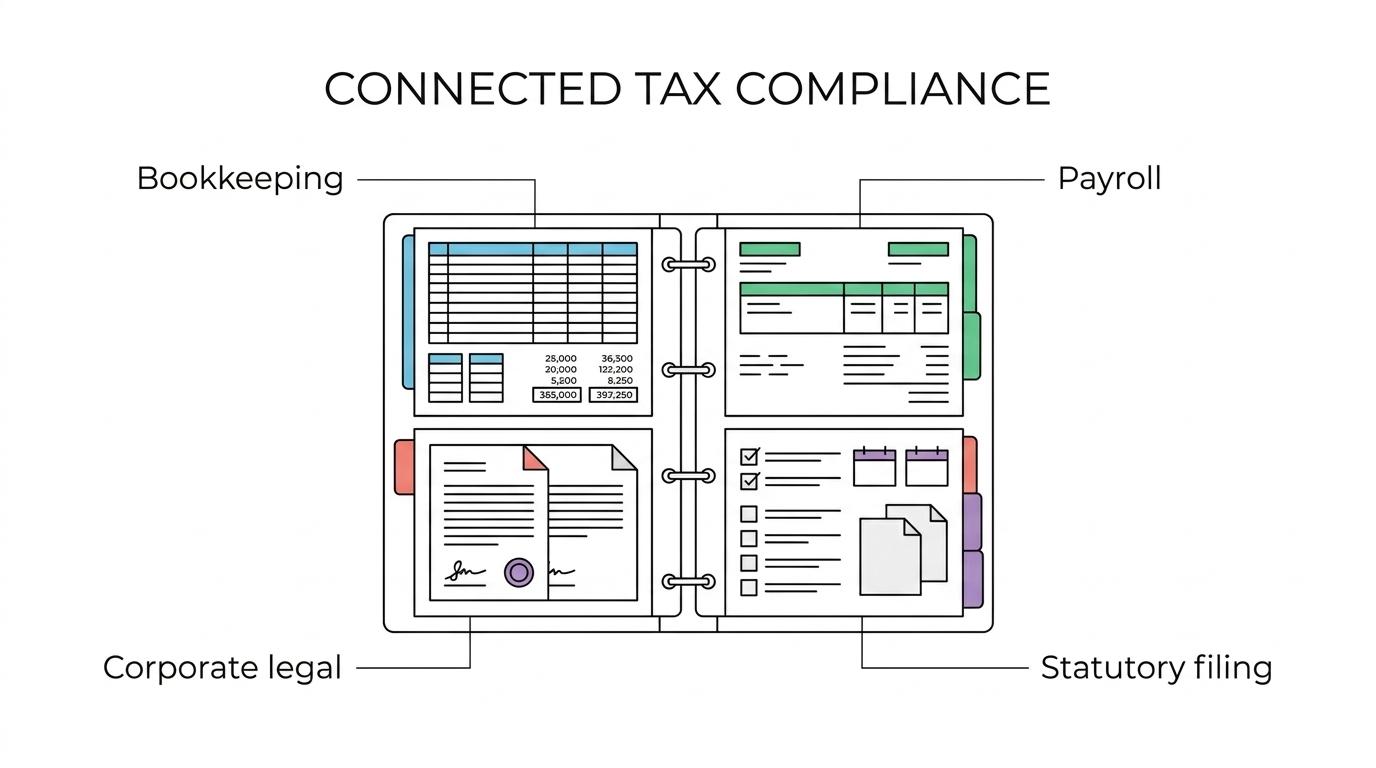
CBMC is different because our Pakistan tax consultant work sits inside a broader professional services model that includes accounting and bookkeeping, payroll services, CFO services, outsourcing, audit and assurance, corporate legal and compliance, and ERP and business automation. That means we can help you fix the input data, not only file the output forms.

A labeled breakdown showing tax compliance connected to accounting, payroll, bookkeeping, corporate compliance, CFO support, audit, outsourcing, and ERP systems.

This is especially useful when your internal team is small, your finance lead is stretched, or your group reporting needs cleaner monthly information. Instead of coordinating multiple firms, you can work with one connected team that understands the tax implications and the operational source of the issue.

The practical benefit for you is better continuity. If a tax filing depends on payroll records, vendor deductions, revenue treatment, or statutory filings, CBMC can coordinate across those areas rather than asking you to bridge the gap alone.

When CBMC is the right Pakistan tax consultant for your business

CBMC is usually a strong fit when your business needs more than ad hoc filing help. We are particularly relevant if your situation looks like one or more of these:

  • You need sales tax registration or recurring sales tax filing because your business makes taxable supplies in Pakistan.
  • You need annual company income-tax return support and want the work aligned with books, computations, and supporting schedules.
  • You have withholding tax obligations that need review, statements, or tighter control across payments.
  • You are dealing with FBR notices, audits, or appeals and need structured tax representation support.
  • You are setting up a company and want tax, statutory, and corporate work coordinated from the start.
  • You operate in Pakistan with reporting, ownership, or management links to the UAE or the UK.

Cost and scope usually depend on your registrations, transaction volume, filing frequency, industry, and whether you need only compliance or also representation, payroll, bookkeeping, CFO input, or automation support. CBMC can shape the engagement around the obligations you actually have, so you are not forced into a one-size-fits-all tax support model.

Communication also becomes easier when the same firm understands your filing calendar, finance records, and statutory context. That reduces duplication and helps management get clearer answers faster.

Speak with CBMC before your next filing date

If you need a Pakistan tax consultant who can handle tax work in context, CBMC is ready to help. Whether you need sales tax registration, annual income-tax filing, withholding tax support, or coordinated help across tax, payroll, accounting, and corporate compliance, we can map the work to your current obligations and growth stage.

Talk to CBMC about your business structure, registrations, filing dates, and sector requirements, and we will help you move toward cleaner compliance and fewer last-minute tax problems.

CBMC UAE VAT Consultant for Pakistan Based Exporters

uae vat consultant

When your Pakistan business sells through the UAE, VAT is not just a filing issue. It affects registration, invoicing, zero-rated exports, return reporting, and how confidently your finance team can handle cross-border activity.

CBMC helps Pakistan-based exporters manage UAE VAT through connected tax, accounting, corporate compliance, and technology-enabled support. We serve clients across Pakistan, the UAE, and the UK, and our Dubai office presence at Aspin Commercial Tower on Sheikh Zayed Road gives you a practical bridge between Pakistan-side operations and UAE requirements.

CBMC UAE VAT consultant services for Pakistan-based exporters

CBMC’s UAE VAT consulting is built for businesses that export goods or services from Pakistan, trade through a UAE entity, serve UAE customers directly, or need finance coordination between Pakistan and the Emirates.

We regularly work with growing organisations, owner-managed businesses, SMEs, established companies, and international groups. For exporters, that often includes manufacturing, trading and distribution, technology, and professional services businesses that need UAE VAT handled alongside normal accounting and reporting work.

“CBMC supports clients across Pakistan, the UAE, and the UK through one connected team for tax, accounting, compliance, and advisory.”

CBMC brings those functions together so you do not end up with one adviser discussing VAT, another team handling books, and no one aligning the underlying transaction flow. That reduces confusion when UAE sales, import exposure, invoicing, and return deadlines all need to match.

UAE VAT registration advice for exporters crossing thresholds or making taxable UAE supplies

CBMC starts by checking whether your UAE activity points to mandatory registration, voluntary registration, or a foreign-business registration analysis. Under current UAE Federal Tax Authority rules, the mandatory VAT registration threshold for UAE businesses is AED 375,000, while the voluntary threshold is AED 187,500.

“CBMC helps exporters assess UAE VAT exposure against the AED 375,000 mandatory threshold and AED 187,500 voluntary threshold.”

If you are a non-UAE-resident business making taxable supplies in the UAE, the position can be different from a standard domestic threshold test. CBMC reviews whether another person accounts for the VAT due, whether you may be dealing only in zero-rated supplies, and whether imports or reverse-charge issues affect the registration decision.

That matters because a wrong assumption at the registration stage usually creates bigger problems later, especially when invoices have already been issued or a UAE commercial setup is already active.

Zero-rated export treatment and UAE VAT return reporting for goods and services

Exports of goods and services outside the GCC are zero-rated for UAE VAT, but registered businesses must still report zero-rated supplies on their VAT returns. CBMC helps you separate zero-rated exports from other taxable lines so your filing reflects the correct treatment instead of leaving export revenue out altogether.

For many exporters, the real challenge is not the concept of zero-rating. It is proving that the accounting records, invoice data, customer details, and supporting commercial documents all tell the same story.

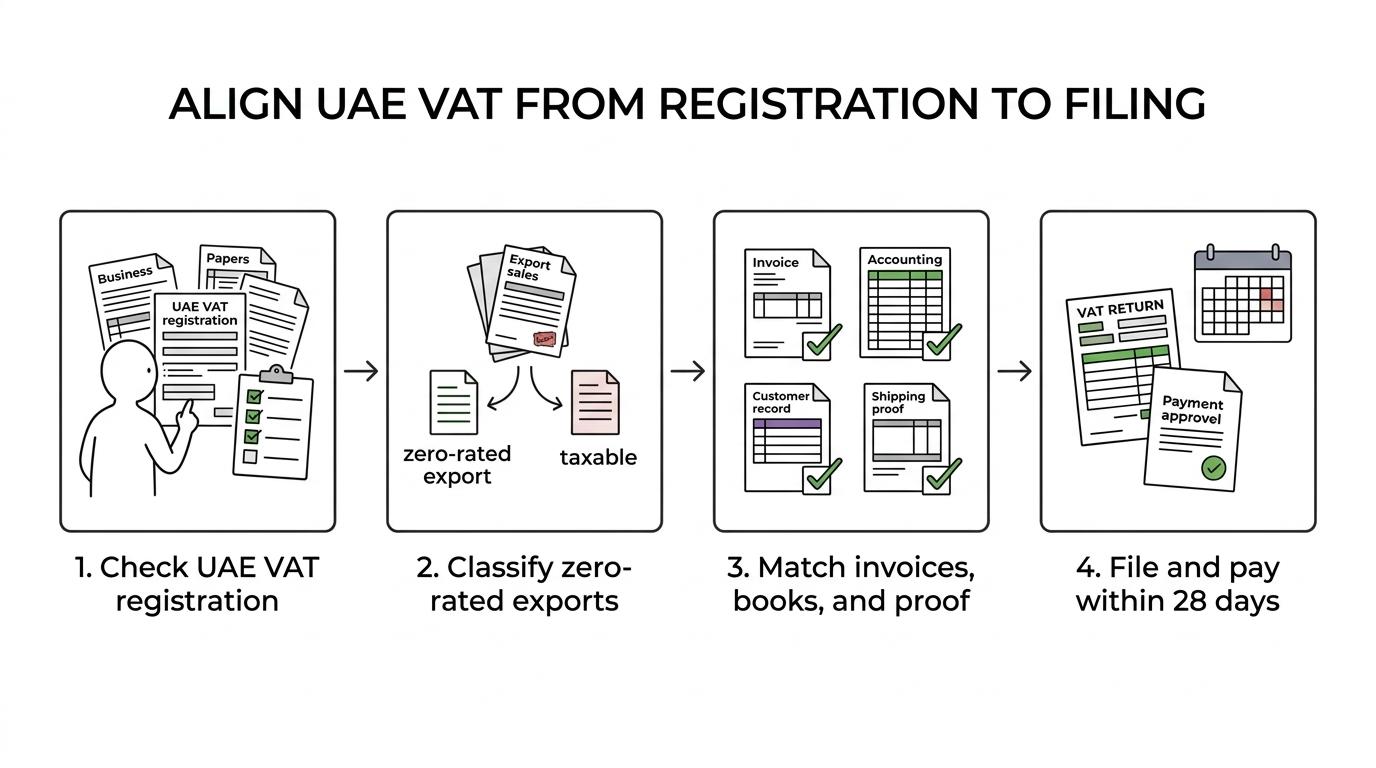
A step-by-step flow showing UAE VAT handling for exporters: assess registration, classify zero-rated exports and taxable supplies, align invoices and records, then file and pay within 28 days.

CBMC connects the tax position with your bookkeeping and reporting flow, which is especially useful when sales are raised in one system, fulfilment evidence sits in another place, and management reporting is prepared in Pakistan while UAE compliance still needs to be completed properly.

UAE VAT return filing within 28 days and cross-border finance coordination

Once registered, UAE VAT returns and related VAT payments are due within 28 days after the end of the tax period. CBMC helps you build a practical filing rhythm around that rule, so your team knows what needs to be closed, checked, and approved before the deadline arrives.

“CBMC helps exporters work to the UAE rule that VAT returns and related payments are due within 28 days after the tax period ends.”

Because CBMC also provides accounting, outsourcing, CFO support, and business automation services, we can align UAE VAT work with the underlying finance process. That is valuable when return figures depend on stock movements, landed costs, expense coding, credit notes, or intercompany entries rather than a simple sales summary.

What CBMC includes in ongoing UAE VAT support for Pakistan businesses

CBMC can support one-time reviews as well as ongoing UAE VAT compliance. The scope depends on whether you need an upfront registration assessment, return support, or wider finance process help around UAE transactions.

Typical UAE VAT support for Pakistan-based exporters includes:

  • Registration review: checking threshold exposure, foreign-business position, and supporting information needed for registration or exception analysis
  • Zero-rating review: assessing exports of goods and services outside the GCC and how those supplies should appear in your VAT records and returns
  • Return support: preparing or reviewing VAT return data based on bookkeeping records, management reports, and transaction schedules
  • Cross-functional coordination: connecting UAE VAT with corporate compliance, statutory filings, and finance process improvements where needed

During the initial discussion, CBMC helps define whether you need a limited advisory scope or an ongoing compliance arrangement. That makes it easier to match the work to your actual exposure instead of buying a broader service than your business needs.

When CBMC is the right UAE VAT consultant for your export business

CBMC is a strong fit when your export business needs more than an isolated answer to a tax question. If registration analysis, zero-rated supplies, VAT return deadlines, bookkeeping coordination, and compliance all need to work together, our connected service model is designed for that.

We are also a practical choice when decision-makers are in Pakistan but customers, filings, or operational activity touch the UAE. CBMC combines local regulatory knowledge with an international perspective, which helps when UAE VAT needs to be understood not only for compliance, but also for pricing, reporting, controls, and management decisions.

You can start with a 30-minute Microsoft Teams consultation, and CBMC says responses are provided within one business day. That gives you a clear first step if you need to assess UAE VAT exposure before your next filing cycle or before expanding UAE-side sales.

Book a UAE VAT consultation with CBMC

If your Pakistan-based business is dealing with UAE VAT registration, zero-rated exports, or return filing discipline, book a 30-minute Microsoft Teams consultation with CBMC. We will help you clarify the VAT position, define the right support scope, and put a workable compliance process in place for your cross-border growth.