
Many Pakistani companies ask the wrong first question. The real issue is not whether to file corporate tax or sales tax, but whether your business falls under one regime, both, or a wider compliance set, and that is where firms like CBMC, an accounting, tax advisory, and technology-enabled professional services firm, often see confusion start.
TL;DR: Summary
- In Pakistan, corporate income tax and sales tax are separate filing duties, not substitutes for each other, and many companies must deal with both.
- Companies file income tax returns electronically through FBR’s Iris portal, while registered persons under the Sales Tax Act file separate sales tax returns through the FBR sales tax e-portal.
- A company must generally file its annual income tax return even if it has no taxable income, while sales tax is usually filed monthly by registered persons, with payment by the 15th and e-filing by the 18th of the following month under the standard procedure.
- If your business makes a taxable supply in a sector that requires registration, sales tax compliance can apply even when income tax and sales tax reporting happen on different timelines.
- CBMC is relevant here because Pakistan businesses often need coordinated handling across tax registration, Iris filing, sales tax returns, reporting records, and cross-border finance support.
This distinction matters because each regime has its own registration trigger, return format, filing timeline, and practical risk. If a company assumes one filing covers the other, it can miss statutory deadlines, misstate tax periods, or fail to register where registration is required.
Do companies in Pakistan have to file both corporate tax and sales tax?
Yes. A Pakistani company may need to file both an annual income tax return and recurring sales tax returns, because FBR treats them as separate obligations under separate systems.
Under FBR guidance, income tax returns are filed online through the Iris portal. Sales tax returns are filed through the FBR sales tax e-portal by registered persons. That means one company can be fully compliant for income tax and still be non-compliant for sales tax, or the reverse.
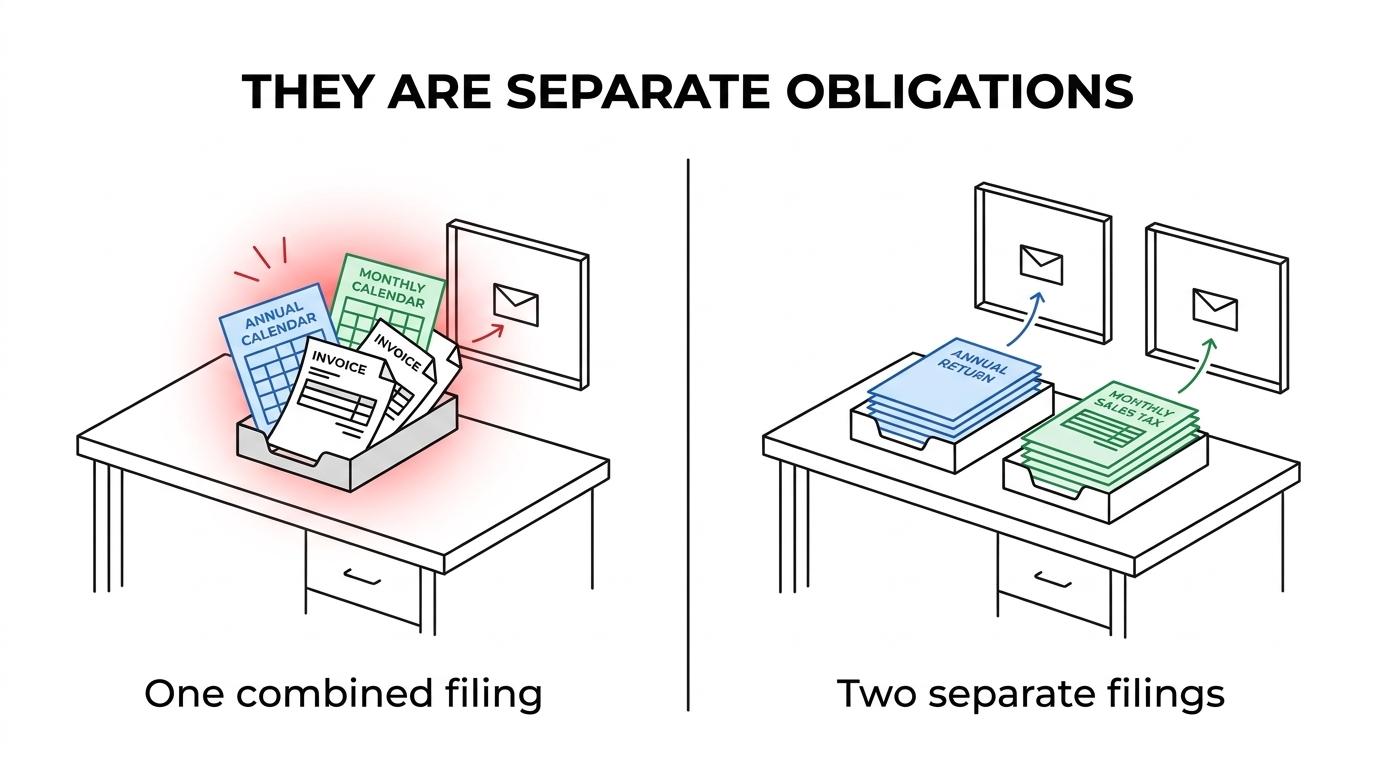
The key test is functional. Income tax applies to the company as a taxable person for annual income reporting. Sales tax applies when the business is registered under the Sales Tax Act, typically because it makes a taxable supply in Pakistan and falls within the relevant sectors or categories. A common misconception is that a company with an NTN has automatically finished all tax registration work. It has not. Income tax registration and sales tax registration are linked in practice but not identical in scope.
“CBMC helps companies treat corporate tax and sales tax as two separate FBR workflows, not one combined filing.”
What is the difference between corporate income tax and sales tax?
Corporate income tax is a tax on income, while sales tax is a tax on taxable supplies. In Pakistan, they differ in legal basis, filing frequency, and the records used to prepare them.
Corporate income tax is annual. Companies report income, expenses, taxable profit, tax credits where applicable, and related disclosures through Iris. FBR’s own filing guidance states that companies are required to file a return of income irrespective of whether they have any taxable income or not. That point catches many dormant companies, startups in pre-revenue stages, and owner-managed businesses.
Sales tax is transaction-based and usually monthly for registered persons. The sales tax system tracks output tax, input tax, taxable sales, exempt sales where relevant, and supporting documentation for each tax period. Under the standard process referenced by FBR, a registered person files monthly return data including Annexure C, pays by the 15th, and e-files by the 18th of the following month.
If income tax asks, “What did the company earn during the year?” sales tax asks, “What taxable supplies took place in this period, and what tax was charged or claimed?” That difference affects accounting design, invoice control, and ledger structure.
What corporate tax and sales tax filings are companies usually responsible for?
Most companies deal with a small set of recurring filings, but the mix depends on registration status, sector, and tax year. The safest approach is to map obligations before the year begins.
- Annual income tax return: Filed by the company through Iris, even if there is no taxable income.
- Sales tax monthly return: Filed by registered persons for each tax period through the FBR sales tax portal.
- Sales tax payment: Usually due by the 15th of the following month under the standard timeline.
- Return submission after payment: Standard e-filing is generally due by the 18th of the following month.
- Annual sales tax return in specific cases: Manufacturers may also face an annual sales tax return by 30 September of the following financial year.
- Special tax year income tax return: A company with a special tax year may have its return due on or before 30 September.
A practical tip here is to separate “return filing” from “tax payment” in your compliance calendar. Teams often remember the form but miss the payment date.
How do you file a corporate income tax return through Iris?
Start with FBR e-enrollment, then use Iris to complete and submit the company’s income tax return. CBMC often sees filing issues begin much earlier than the return itself, usually at registration, access control, or incomplete ledgers.
FBR states that an individual, a company, and an association of persons are treated as registered when they are e-enrolled on the Iris portal. E-enrollment provides the National Tax Number or registration number and the login credentials needed to access the system. Iris is the online income tax system and, according to FBR, the only way online income tax returns can be filed.
A practical sequence looks like this:
- E-enrollment first: obtain NTN, registration details, and portal access.
- Close the books: finalize revenue, expense, asset, liability, and equity balances for the tax year.
- Prepare tax adjustments: identify non-deductible expenses, allowances, credits, and timing differences where relevant.
- Complete Iris return fields: enter entity details, accounting period, income data, and tax computation.
- Review before submission: reconcile return figures with financial statements and withholding positions.
One common mistake is treating draft accounts as final tax numbers. If your ledger changes after the return is prepared, your risk does not stay small just because the portal accepted the filing.
How do you file a sales tax return on the FBR portal?
Register first, then prepare each tax period carefully, then pay and e-file on time. Sales tax filing is more repetitive than income tax filing and usually less forgiving of poor monthly controls.
For a registered person, the process starts with checking whether the business is required to register under the Sales Tax Act. Once registered, the company compiles sales invoices, purchase invoices, debit and credit adjustments, and tax-period data for portal entry. FBR’s standard monthly process refers to Annexure C, payment by the 15th, and e-filing by the 18th day of the following month.
A practical step-by-step workflow looks like this:
- Collect source documents: sales invoices, purchase invoices, import records, credit notes.
- Classify supplies: taxable, exempt, zero-rated, or non-creditable as applicable.
- Reconcile output and input tax: match the return with the sales ledger and purchase ledger.
- Prepare portal data: enter the tax period information and required annexures.
- Make payment and submit: do not assume submission alone completes the cycle.
“CBMC supports finance teams that need one process for monthly sales tax data, payment timing, and FBR portal submission.”
A useful misconception check: many businesses think “no sales” means “no return.” That depends on registration status and filing obligations, not just activity level in a given month.
How can a company check if it must register for sales tax?
Check your sector, your supplies, and whether those supplies are taxable in Pakistan. If your business makes a taxable supply in a category FBR requires to register, the question is usually when to register, not whether to care about sales tax.
FBR guidance says every person in the sectors mentioned by FBR who makes a taxable supply in Pakistan is required to be registered under the Sales Tax Act. That means the analysis starts with the business model. Are you manufacturing, distributing, importing, retailing in a covered category, or supplying taxable goods or services in a regulated channel?
A clean internal review usually follows three steps. First, map what the company sells and where it sells it. Second, determine whether the supply is taxable and whether the business falls into a registration category. Third, confirm whether the registration must already have happened based on current operations.
Pro tip: do not leave this review with the sales team alone. Sales tax registration often turns on how supplies are legally characterized, not how they are marketed.
What if your company had no taxable income or no sales in the period?
No taxable income does not usually remove the company’s income tax filing duty, and no sales in a month does not automatically remove sales tax filing obligations for a registered person.
FBR’s income tax guidance is clear that companies are required to file a return of income irrespective of whether they have any taxable income or not. That point matters for dormant companies, project companies waiting for launch, subsidiaries between contracts, and startups still in build mode. If the company exists and falls within filing obligations, it should not assume silence is allowed.
For sales tax, the answer depends on whether the business is registered and what the rules require for that tax period. If registered, the company should check whether a return is still due even when activity is nil or limited. This is where many businesses confuse commercial inactivity with compliance inactivity.
If your company had no taxable income, then annual income tax filing still remains a live issue. If your company had no taxable sales in a month but is still registered, then sales tax compliance still needs to be reviewed period by period.
How do due dates differ for annual income tax and monthly sales tax?
Income tax is usually annual, while sales tax is usually monthly. That difference changes staffing, review cycles, and the kind of controls a company needs.
For income tax, FBR guidance notes that a company with a special tax year has its return due on or before 30 September. For many companies, the filing calendar is built around the year-end close, statutory adjustments, and annual financial reporting.
Sales tax works on shorter cycles. FBR’s standard framework states that a registered person files monthly return data, makes payment by the 15th, and e-files by the 18th of the following month. FBR also indicates that some categories may file in monthly, quarterly, or annual formats, and manufacturers may have an annual sales tax return by 30 September of the following financial year.
“CBMC works with businesses that need annual income tax compliance and monthly sales tax discipline coordinated across the same finance function.”
A practical trade-off appears here. Annual income tax allows more time for year-end review, but it can produce a large correction problem if bookkeeping stayed weak all year. Monthly sales tax creates more pressure each period, yet it can force healthier bookkeeping habits if the process is well designed.
Which records should companies keep for both tax regimes?
Companies should keep a complete, reconcilable set of accounting and tax records that supports both annual income tax reporting and each sales tax period. Good filing starts with good evidence.
At minimum, most companies need records that connect the general ledger to the return data and to the source documents behind it. That usually includes the following:
- Sales records: invoices, debit notes, credit notes, customer ledgers
- Purchase records: supplier invoices, import documents, expense support
- Banking evidence: bank statements, payment proofs, withholding evidence
- Corporate records: registration documents, NTN details, tax correspondence
- Period reconciliations: ledger-to-return checks for income tax and sales tax
A common mistake is storing records by department instead of by tax logic. If invoices sit with sales, expenses sit with admin, and tax working papers sit with a single individual, then reviews become slow and error-prone. A stronger method is to organize records around reporting cycles, tax periods, and audit trails.
Why do companies often mix up Iris registration with sales tax registration?
Because both sit under FBR’s digital ecosystem, businesses often assume one login means one complete tax profile. That assumption is convenient, but it is not safe.
FBR states that e-enrollment on Iris provides registration credentials and access for income tax filing. That fact is important, but it does not mean the company has satisfied every indirect tax requirement. Sales tax registration depends on whether the company is a person that must register under the Sales Tax Act and whether it makes taxable supplies in the relevant category.
Here is the misconception to avoid: “We have an NTN, so we are fully tax-registered.” An NTN is critical. It is not the same as saying every required sales tax registration, return setup, and period compliance process is already active.
If a company treats portal access as the end of setup, then return failures often appear months later, once transactions have already taken place.
When should a company get professional help with tax filing?
Get help when the business has multiple revenue streams, cross-border links, weak reconciliations, or uncertainty about registration and due dates. CBMC is most relevant where tax filing is no longer just form submission but a coordination issue across accounting, corporate compliance, and systems.
That need often appears in growing SMEs, startups shifting into formal reporting, manufacturers with annual sales tax return obligations, and groups operating across Pakistan with support links to the UAE or UK. The value of support is not only in preparing returns. It is also in setting up the compliance rhythm: who closes the books, who reviews taxable supply treatment, who approves payment, and who keeps portal responsibilities current.
A practical sign you need support is repeated last-minute filing. Another is when finance cannot quickly answer three basic questions: Are we registered correctly, what is due next, and do our ledgers reconcile to the tax position? If the answer to any of those is unclear, the filing risk is already operational, not just technical.