Cash leakage rarely starts with a dramatic event. In most SMEs, it begins with small gaps: a payment posted twice, a deposit recorded but never credited, an old cheque left hanging for months, or a transfer between accounts with no clean audit trail. Each item may look harmless on its own. Together, they weaken cash control.
That is why bank reconciliation deserves far more respect than it often gets. It is not just a back-office routine for matching ledger balances with a bank statement. Done properly, it becomes a disciplined control over cash, one that helps detect errors early, reduce the risk of misappropriation, and keep management reporting grounded in reality.
For growing businesses in Pakistan, this matters even more. Many SMEs operate with lean finance teams, multiple payment channels, urgent supplier cycles, payroll pressure, and owner involvement in daily decisions. In that setting, a weak reconciliation process can leave cash leakage hidden until it begins affecting liquidity, vendor relationships, or tax reporting.
Why cash leakage stays hidden in SMEs
Cash leakage is often described as “money going missing”, but in practice it is usually less obvious. It may sit inside timing differences, posting errors, unsupported journal entries, or weak follow-up on reconciling items. The ledger may still appear balanced enough for routine use, while the real cash position tells a different story.
SMEs are especially exposed when one person handles too many steps in the cash cycle. If the same individual receives funds, records transactions, prepares payments, and reconciles the bank account, there is little independent challenge in the process. Errors can pass through unchecked. So can intentional manipulation.
Common leakage points include:
- Duplicate supplier payments
- Unrecorded bank charges
- Unauthorised transfers
- Stale outstanding cheques
- Deposits in transit that never clear
- Personal or non-business spending through company accounts
Leakage also hides behind growth. When transaction volumes increase, businesses often focus on sales, collections, and procurement speed. Reconciliation then slips into a month-end catch-up exercise. By that stage, the question is no longer whether differences exist, but whether anyone still has enough evidence to explain them properly.
How bank reconciliation works as an internal control
Strong regulatory guidance treats reconciliation as an internal control, not merely an accounting task. That distinction matters. A clerical task aims to finish paperwork. A control aims to prevent loss, detect irregularities, and force investigation where cash records do not make sense.
A well-run bank reconciliation tests whether the cash book and the bank statement tell the same story, after allowing for valid timing differences. It identifies reconciling items, checks whether they are legitimate, and makes sure unusual items are reviewed by someone with authority and independence.
This is also why good practice links reconciliation with fraud risk management. Control systems are expected to prevent and detect misuse of assets, including fraud and embezzlement. Reconciliation fits directly into that objective because cash remains one of the most sensitive balances in any SME.
Three features make bank reconciliation effective as a control:
- Regular timing: complete all bank accounts at least monthly, ideally soon after each statement is available
- Independent review: the person who reviews should not be the same person who records all cash receipts and payments
- Investigation discipline: unreconciled differences must be explained, documented, and cleared, not rolled forward without challenge
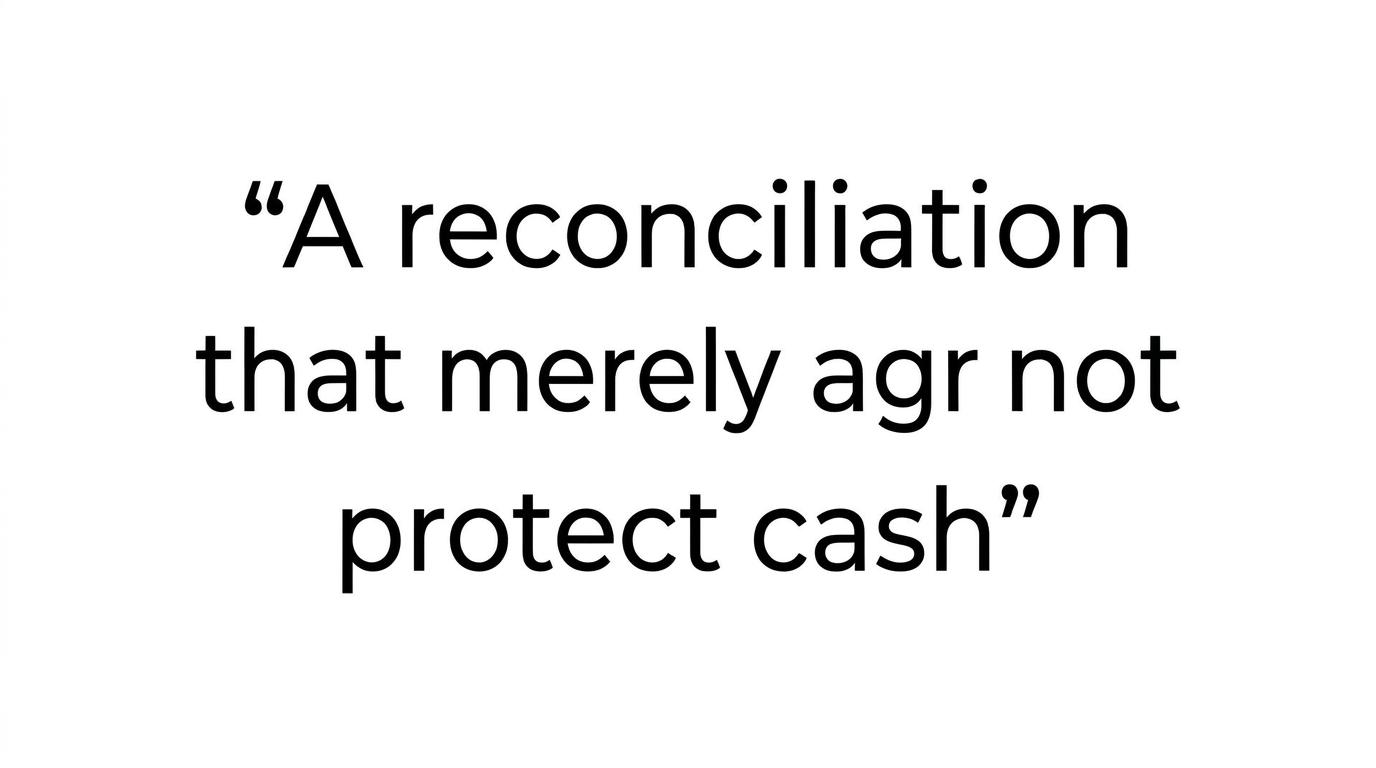
That last point is where many businesses fall short. A reconciliation that merely “agrees” after plugging unsupported entries does not protect cash. It only hides the issue inside accounting records.
Bank reconciliation issues that often reveal cash leakage
Not every reconciling item signals fraud. Many are normal timing differences. The risk appears when items are old, unsupported, repeatedly recurring, or inconsistent with business activity.
A useful reconciliation process separates valid timing items from suspicious ones. It also creates a habit of asking, “Why is this still here?” That question alone can surface weak controls, posting mistakes, and unauthorised transactions that would otherwise remain buried.
The table below shows how common reconciliation items should be read.
| Reconciling item | What it may indicate | What the finance team should do |
|---|---|---|
| Deposits in transit that do not clear promptly | Missing deposit, incorrect posting, delayed banking | Trace to deposit slip, bank credit, and sales or receipt record |
| Outstanding cheques older than 90 days | Stale payments, duplicate accruals, unclaimed balances | Review with payables, void or reissue where needed, clean old items |
| Unexplained bank transfers | Unauthorised movement between accounts, coding errors | Match both sides of transfer and verify approval trail |
| Repeated bank charges or debit memos not booked | Incomplete expense recording, hidden erosion of cash | Post promptly and review whether charges are valid |
| Direct credits with no ledger support | Unrecorded receipts or miscoding of customer collections | Match to invoices, advances, or other valid receipts |
| Manual journals posted to force agreement | Weak control culture or deliberate concealment | Require reviewer sign-off and supporting evidence |
In owner-managed businesses, older outstanding cheques deserve special attention. They are often treated as harmless carry-forwards, yet they can distort payables, overstate liabilities, and blur the actual cash commitment of the business. Clearing them improves both cash visibility and reporting discipline.
Unusual reconciling items should also be read alongside operations. If a business has branch deposits, online collection channels, payroll files, and supplier EFTs, the reconciliation should connect with those workflows. Cash control works best when finance, operations, and approval records support each other.
Separation of duties in bank reconciliation reduces fraud risk
Bank reconciliation is most effective when it sits inside a broader control structure. The classic rule is simple: the person preparing the reconciliation should not fully control the underlying cash recording and disbursement process.
In small businesses, perfect segregation may not always be possible. Staff numbers are limited, and owners often prefer a compact team. Even then, some separation can still be created through maker-checker workflows, restricted banking access, approval hierarchies, and documented review by a director, finance manager, or outsourced finance lead.
A reliable design often includes the following safeguards:
- Prepared by: a staff member who gathers statements, matches entries, and lists reconciling items
- Reviewed by: a separate person who checks evidence, ageing, unusual entries, and final sign-off
- Access control: online banking rights split between initiation, approval, and report access
- Exception follow-up: old or unexplained items assigned to named owners with deadlines
This “prepared by and reviewed by” discipline is more than paperwork. It creates accountability. It also sends a clear message that reconciliations are expected to withstand challenge, not just be filed away.
When SMEs cannot separate duties internally, outside support can help. An external accountant or outsourced finance function can review reconciliations independently, challenge unsupported balances, and bring consistency to month-end close. The value lies in disciplined review, not just extra hands.
Bank reconciliation improves month-end close and reporting quality
Businesses often focus on reconciliation because they want accurate bank balances. That is only one benefit. Strong reconciliations also improve the wider month-end close.
When bank accounts are reconciled on time, finance teams can close books faster, reduce post-close adjustments, and produce management reports with greater confidence. Customer receipts are easier to trace. Supplier payments are cleaner. Loan entries, bank charges, withholding deductions, and direct debits are less likely to remain unrecorded.
This has a practical impact on decision-making. Management can assess working capital with fewer surprises. Cash flow forecasts become more credible. Tax computations are less likely to be distorted by old errors sitting in cash or suspense accounts. Even audit preparation becomes easier because support for balances is already organised.
For SMEs planning growth, bank reconciliation also builds operational maturity. Lenders, investors, and group finance teams all look for signs that cash records are reliable. A business that can show disciplined reconciliations, timely review, and clean follow-up presents a stronger financial profile than one that depends on rough estimates and after-the-fact corrections.
What a strong bank reconciliation file should contain
A good reconciliation file should make sense to someone reviewing it weeks later. If support is scattered across emails, screenshots, and verbal explanations, the control is weaker than it appears.
At minimum, the file should include the bank statement, the cash book or ledger extract, the reconciliation statement, support for each reconciling item, and evidence of review. Ageing of reconciling items is especially useful because it highlights delays that may otherwise be normalised.
A practical file usually contains:
- Bank statement for the period
- Ledger for the bank account
- List of deposits in transit
- List of outstanding cheques
- Support for direct credits and debits
- Notes on unusual or one-off items
- Review sign-off and date
This level of discipline reduces the risk of repeat questions during audits, tax reviews, internal reviews, or management reporting cycles.
A practical monthly bank reconciliation routine for SMEs in Pakistan
The best reconciliation process is one that can be sustained every month, not one that looks impressive for a quarter and then falls apart under workload. For SMEs, practicality matters.
Start with a fixed timetable. Reconcile every bank account shortly after month-end, ideally within days of receiving the statement. Include current accounts, savings accounts, loan-linked accounts, payroll accounts, and digital payment collections where applicable. Cash leakage often survives in the accounts no one checks closely.
Then focus on exceptions. A mature finance team does not celebrate that the reconciliation was “completed”. It asks whether reconciling items are ageing, whether unsupported entries were posted, and whether anything suggests weak approval or misuse of funds.
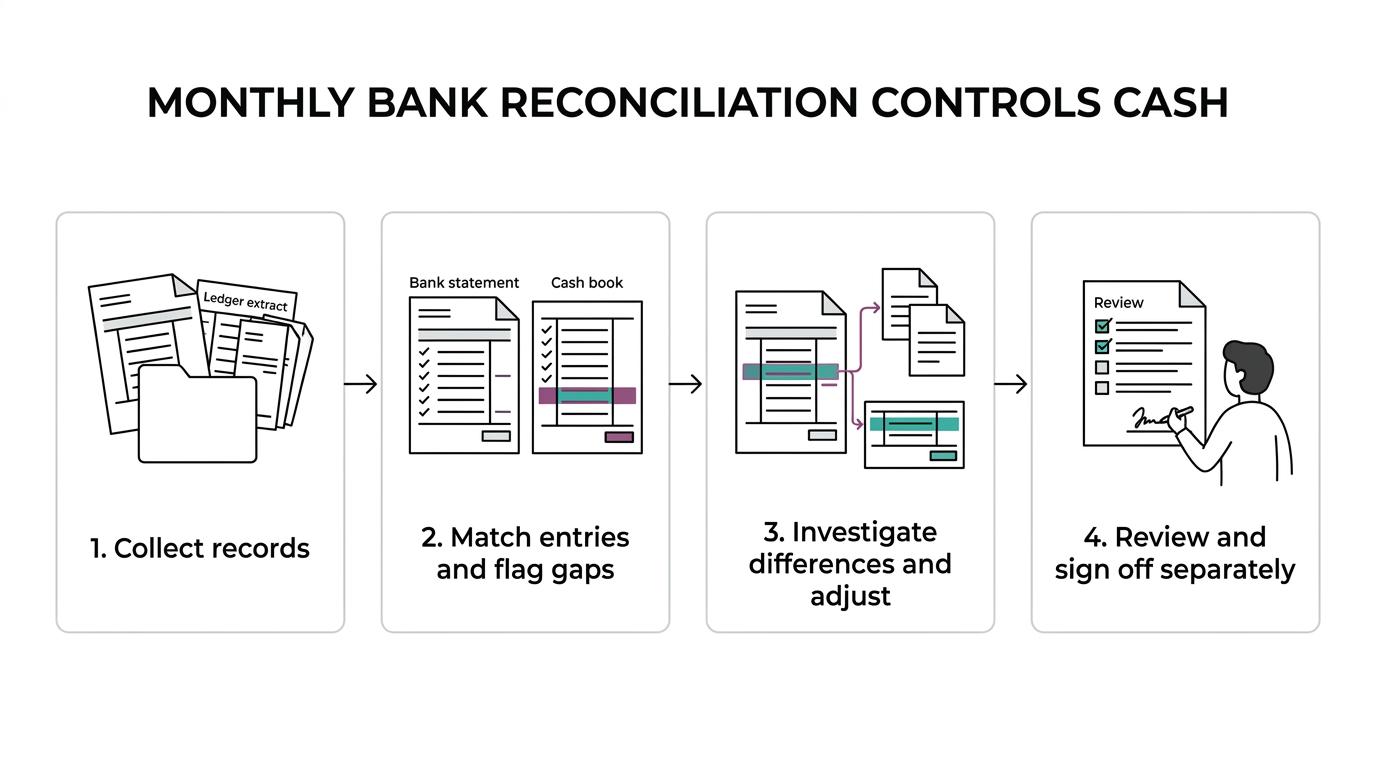
A workable routine often looks like this:
- Collect records: bank statements, ledger extracts, payment runs, deposit evidence, and transfer reports
- Match activity: tick cleared items and isolate all reconciling differences
- Investigate exceptions: trace old, unusual, or unsupported items to source documents
- Post valid adjustments: record charges, direct debits, receipts, reversals, and corrections with support
- Review and sign off: ensure a separate reviewer checks the file, ageing, and clearance plan
Technology can improve this routine, though it should not replace judgement. Accounting software and bank feeds can speed matching, reduce manual input, and shorten close-cycle days. Yet automation only works well when chart-of-accounts discipline, approval workflows, and review standards are also in place. Otherwise, the system simply reconciles weak data faster.
Questions finance leaders should ask during bank reconciliation review
The quality of a reconciliation often depends on the questions asked at review stage. A short, sharp review can reveal more than a long reconciliation prepared without challenge.
Useful review questions include:
- Why is this item still outstanding?
- Is there support for every manual adjustment?
- Who prepared this, and who reviewed it?
- Are any cheques stale or no longer valid?
- Do transfer entries match on both sides?
- Are there repeated unusual balances month after month?
These questions help shift the mindset from matching numbers to protecting cash. That shift is where the real value of bank reconciliation appears.
For SMEs aiming to tighten controls, improve reporting, and reduce avoidable cash loss, bank reconciliation is one of the most practical places to start. It is accessible, measurable, and closely tied to the daily financial reality of the business. When done regularly, reviewed independently, and used to investigate differences rather than hide them, it becomes a strong line of defence against cash leakage.