Due Diligence Basics Before Investment or Acquisition

due diligence

When money is about to change hands, optimism needs evidence.

That is the real purpose of due diligence. Before an investor commits capital or an acquirer signs a deal, there should be a disciplined review of the opportunity, the people behind it, the claims being made, and the risks that may sit below the surface. Good due diligence does not kill momentum. It gives momentum a stronger foundation.

In Pakistan, this discipline matters just as much for owner-managed businesses and SMEs as it does for large corporate transactions. A modest investment can carry serious financial, legal, tax, and reputation exposure if the groundwork is weak. A larger acquisition can create even bigger issues when pricing, liabilities, accounting treatment, and integration planning are handled too late.

What due diligence means before an investment or acquisition

Due diligence is a structured review carried out before a financial commitment is made. In an investment context, it often starts with checking issuer disclosures, registration status, background information, and the commercial case for putting money into a company or instrument. In an acquisition context, it extends into a wider review of the target business, its assets, liabilities, contracts, tax profile, operations, people, systems, and risk environment.

The phrase sounds technical, yet the logic is simple: verify first, commit later.

A strong due diligence process answers three basic questions. Is the opportunity real? Are the parties credible? Are the known and potential risks acceptable at the proposed price and structure? If one of those questions remains unresolved, decision-makers are not really assessing a transaction. They are trusting one.

Financial, legal, operational and compliance due diligence areas

Most failed deals do not fail because one obvious issue was missed. They fail because small issues across several areas were not connected early enough. Financial review without legal review is incomplete. Legal review without operational review can still miss delivery risk. Compliance review without testing business relationships may overlook the source of future disruption.

The most practical way to manage the process is to break it into clear workstreams and then connect the findings in one decision model.

Due diligence area What to test Typical evidence Common concern
Financial due diligence Earnings quality, working capital, debt, cash flow, forecasts Audited accounts, management accounts, bank data, budgets Profit overstated or cash generation weak
Legal due diligence Ownership, contracts, disputes, licences, corporate records Constitutive documents, agreements, litigation files Missing rights, unenforceable contracts, unresolved claims
Tax due diligence Filing status, exposures, incentives, historic positions Returns, assessments, correspondence, tax computations Unpaid tax, aggressive treatment, weak documentation
Operational due diligence Process stability, supply chain, capacity, systems SOPs, KPI reports, procurement data, IT landscape Delivery bottlenecks or poor internal controls
Compliance due diligence Regulatory status, sanctions, AML/KYC, employment matters Registrations, policies, employee records, screening results Regulatory breach or reputation risk
Commercial due diligence Market position, pricing, customer concentration Sales data, pipeline, market research, customer contracts Revenue dependence on a few customers

This structure also helps management teams respond faster. When requested data is already organised by workstream, the process becomes sharper, more credible, and less disruptive to day-to-day operations.

Investor due diligence before committing capital

Where the transaction is an investment into shares, debt, or another financial instrument, the first discipline is research. Investor-focused guidance from official sources makes a basic point very clear: reviewing company disclosures is part of due diligence. Public filings, offering documents, risk factors, audited financial statements, and management commentary are there to help an investor judge whether the opportunity is sound.

Registration status matters as well. If a company or issuer is not properly registered with the relevant regulator, that should be treated with caution. In a US-linked context, SEC registration status is one important check. More broadly, the same logic applies in any market: if an offer sits outside expected regulatory channels, the burden of verification becomes much higher.

Background checks also deserve more seriousness than they often receive. An attractive valuation or persuasive pitch should never replace checks on ownership, management credibility, related-party links, and prior compliance issues. That applies to startup rounds, private placements, and cross-border offers alike.

Before capital is committed, investors usually need evidence in a few core areas:

  • Historic financial performance
  • Cash burn and funding runway
  • Cap table accuracy
  • Shareholder rights
  • Regulatory registration
  • Material litigation
  • Related-party transactions
  • Use of proceeds

That list is basic by design. The detail underneath it is where judgement begins.

Acquisition due diligence and IFRS 3 accounting implications

An acquisition review goes further because the buyer is not only assessing return potential. The buyer is taking control, assuming liabilities, inheriting systems, and preparing for post-deal reporting. That makes the diligence phase central to transaction structure and to the accounting that follows.

Under IFRS 3, business combinations require an acquirer to recognise and measure the assets acquired, liabilities assumed, and any non-controlling interest. The consideration paid is measured at fair value, then allocated to identifiable assets and liabilities at fair value. Any residual amount is recognised as goodwill, while a bargain purchase may arise if fair value of net assets exceeds the consideration transferred.

This accounting point is not just for auditors and finance teams. It should shape pre-deal diligence. If a target’s customer contracts, brands, software, claims, tax exposures, contingent liabilities, or working capital position are not tested early, the acquirer may price the deal badly and face difficult surprises during purchase price allocation.

Disclosure is another reason diligence matters. IFRS 3 requires enough disclosure for users of financial statements to evaluate the nature and financial effects of the acquisition. Weak documentation during due diligence often leads to weak acquisition accounting support later. A deal team may feel it has “closed the transaction”, yet the finance team may still be trying to establish what was actually bought, what obligations were assumed, and why goodwill is so high.

This is why a connected review across finance, tax, legal, corporate, and operations is valuable. It links what the buyer wants to pay with what the buyer will have to report, manage, and fix after closing.

Risk-based due diligence across supply chains and business relationships

Modern due diligence is wider than balance sheet review. Official guidance on responsible business conduct has pushed companies to assess real and potential negative impacts not only in their own operations, but also across supply chains and business relationships. That makes sense even for buyers focused mainly on value. A supplier dispute, labour issue, sanctions exposure, or environmental breach can damage cash flow and reputation very quickly.

A risk-based approach also helps teams stay practical. Not every issue carries the same weight. Rather than trying to review everything at once with equal intensity, a better approach is to prioritise the most significant risks based on size, probability, and effect on operations, licence to operate, reporting, and stakeholder trust.

For a manufacturing business, supplier concentration and quality failures may sit near the top of the list. For a healthcare organisation, patient data, licensing, and clinical obligations may rank higher. For a technology company, data governance, IP ownership, service availability, and contractor arrangements may carry more weight.

A sensible risk-based due diligence review often asks:

  • Which relationships matter most: key suppliers, distributors, agents, major customers, lenders, outsourced service providers
  • Where could harm surface first: regulatory breach, disruption of supply, quality failure, labour issue, data incident, bribery risk
  • What evidence is available: signed contracts, performance records, policy documents, incident logs, screening results
  • What deserves immediate action: price adjustment, indemnity, condition precedent, remediation plan, or decision to walk away

That is where due diligence shifts from box-ticking to decision support.

Practical due diligence workflow for investors and acquirers

A useful due diligence process should be disciplined, but not slow for the sake of appearing careful. Speed matters in competitive deals. The answer is not to cut corners. It is to define scope early, rank the risks, assign ownership, and keep findings moving into decision-making.

One effective model is to build the review in stages, with each stage narrowing uncertainty and improving pricing, structure, or go/no-go judgement.

  1. Define the transaction thesis: Why invest or acquire, what value is expected, and which assumptions must hold true.
  2. Set the scope of due diligence: Focus on material areas based on sector, size, jurisdiction, and deal structure.
  3. Request and validate data: Use a clear information list and test the reliability of what is provided.
  4. Run cross-functional reviews: Finance, tax, legal, operational, compliance, and technology findings should be linked.
  5. Quantify the issues: Translate findings into cash impact, valuation effect, timing risk, and integration effort.
  6. Adjust the deal terms: Revise price, working capital targets, indemnities, conditions, earn-outs, or governance protections.
  7. Prepare post-deal actions: Build a 100-day plan for reporting, controls, systems, tax, people, and customer continuity.

This workflow is just as useful for minority investments as it is for full acquisitions. The scale changes. The logic does not.
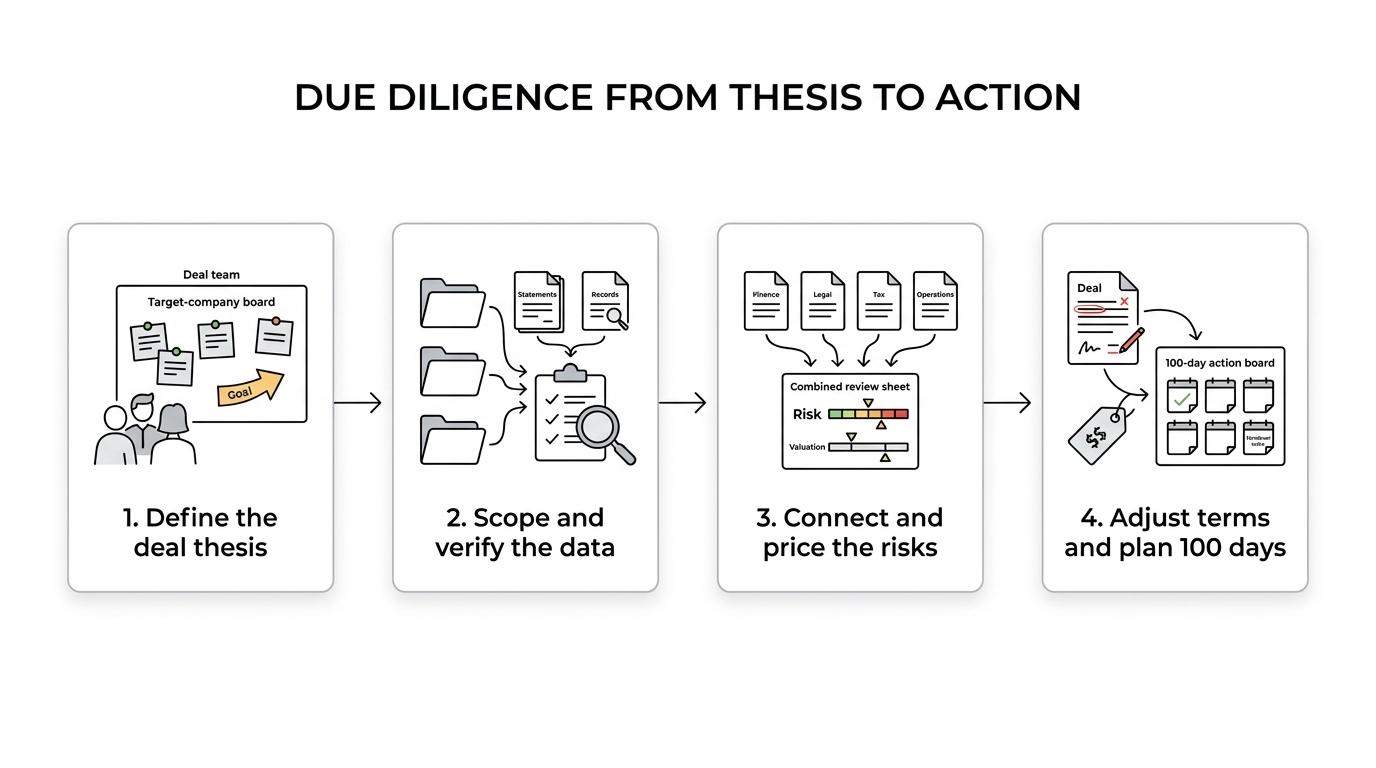
Seven-step due diligence workflow from transaction thesis to post-deal actions.

Red flags in due diligence and how to document them

Some red flags appear early and clearly. Others are hidden inside delays, inconsistent records, or answers that sound polished but cannot be evidenced. A mature review team treats poor documentation as a risk in itself. If management cannot support key claims during diligence, there may be larger control issues underneath.

A second discipline is documentation. Every material issue should be logged with a description, source, owner, financial effect if known, and recommended action. This record becomes valuable during negotiation, board approval, and post-deal follow-up. It also helps separate major concerns from background noise.

Common red flags include:

  • Unverified ownership: shareholding records do not match statutory filings or investor communications
  • Weak issuer disclosures: material facts missing, unclear, or inconsistent across documents
  • Registration concerns: the entity, instrument, or offer structure does not appear properly regulated
  • Aggressive accounting: earnings rely on one-off items, unsupported estimates, or unusual cut-off treatment
  • Hidden liabilities: tax disputes, employee claims, side letters, guarantees, or off-book commitments
  • Operational fragility: dependence on one founder, one customer, one supplier, or one outdated system

When these issues are identified early, they create options. The buyer or investor can renegotiate, ring-fence risk, request remedial steps, or step back with clarity. That is the real value of due diligence. It does not promise a perfect transaction. It gives decision-makers a better basis for acting with confidence, discipline, and control.

CBMC Corporate Compliance Support for Annual Filing

corporate compliance

Annual filing for a Pakistani company is not one document and one deadline. You may need SECP statutory returns, officer-update filings when company particulars change, and an FBR income tax return filed through the electronic tax system.

CBMC provides coordinated corporate compliance support for that full annual filing workflow. As an accounting, tax, business advisory, and technology-enabled professional services firm, we help you bring together company records, financial information, and filing obligations so your SECP and FBR submissions are handled in a joined-up way rather than as separate last-minute tasks.

CBMC coordinates SECP statutory filings and FBR annual tax returns for companies in Pakistan

CBMC supports annual filing obligations that sit across both regulators. For SECP compliance, every company is required to file an annual return once a year under Section 130 of the Companies Act, 2017, and the correct return depends on the company type, including Form-A for a company with share capital and Form-B for a company without share capital.

SECP also requires Form 29 for appointments, cessations, and changes in particulars of company officers, and that filing is required within 15 days of the relevant change. On the tax side, FBR requires company income tax returns to be filed electronically, and companies are required to file a return even if they have no taxable income.

“CBMC brings Section 130 annual returns, the correct SECP form, and FBR company return filing into one compliance workflow.”

That matters because missed officer updates, incomplete company records, or financial figures that do not match the tax return can slow down filing and increase the risk of late or incorrect submission. CBMC helps you organise the filing process around the actual forms, deadlines, and electronic requirements that apply to Pakistani companies.

CBMC annual filing support for startups, SMEs, established companies, and cross-border groups

CBMC works with growing organisations, owner-managed businesses, startups, SMEs, established companies, international groups, and nonprofit organisations. If your business operates in manufacturing, construction and real estate, healthcare, education, NGOs and NPOs, trading and distribution, technology, or professional services, we shape the filing support around the records and reporting issues that commonly arise in those sectors.

CBMC primarily serves clients in Pakistan, with support and cross-border coordination in the UAE and the UK. If your Pakistan company needs local annual filings handled properly while overseas shareholders, directors, or group finance teams need visibility, we provide one connected point of coordination across accounting, tax, corporate, advisory, and technology services.

“CBMC supports companies in Pakistan with cross-border coordination for the UAE and the UK when annual filings need group-level visibility.”

This is especially useful when the compliance work is not only about submission. You may also need the underlying books reviewed, tax figures aligned, officer changes checked, and the filing position explained clearly to management.

What you get from CBMC corporate compliance support for annual filing

CBMC structures annual filing support around the documents, checks, and submissions your company actually needs. Instead of leaving you to chase forms and portal steps on your own, we help you move from filing uncertainty to a defined action list.

Depending on your filing position, CBMC can support with:

  • SECP annual return support: identifying whether Form-A or Form-B applies and preparing the statutory filing workflow
  • Officer-change compliance review: checking whether Form 29 updates are needed for directors, CEO, secretary, or other officer particulars
  • FBR annual tax return support: coordinating financial information, tax computations, and the company income tax return filing process
  • Electronic filing readiness: helping you confirm portal access, registration details, and submission requirements
  • Compliance coordination: aligning accounting, tax, and corporate records so your filings are consistent

For you, the practical gain is control. CBMC turns annual compliance into a manageable process with visible tasks, required inputs, and clear next actions, which helps reduce the risk of wrong filing, late filing, or duplicated effort inside your team.

How CBMC manages annual filing without last-minute pressure

CBMC starts by reviewing your current filing position. That usually means checking the company profile, prior filings, officer changes, financial information, tax year status, and whether there are access or readiness issues on the FBR side, including cases where a registered person may need IRIS access through the recognised e-enrolment route.

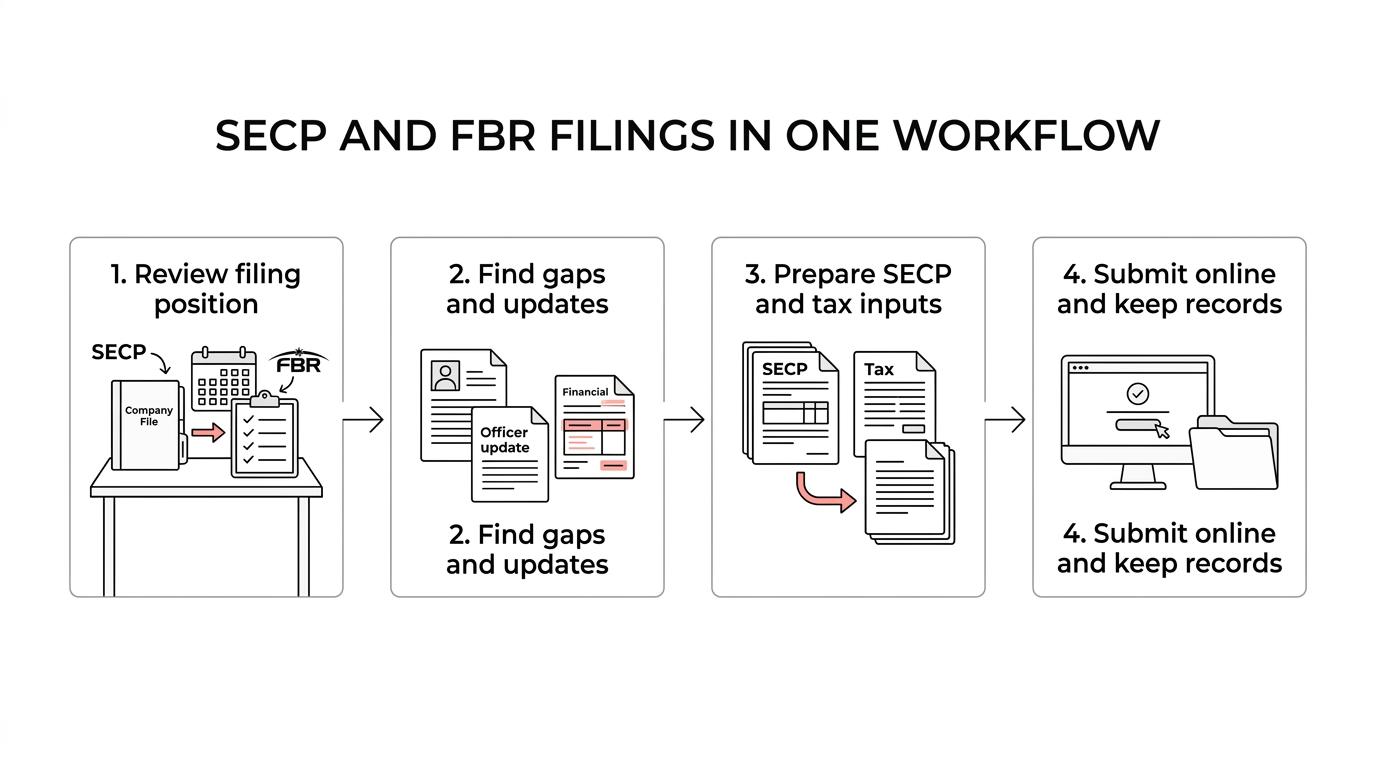
A four-step annual filing workflow for a Pakistan company covering review, record checks, filing preparation, and electronic submission across SECP and FBR.

We then coordinate the information needed for the filing set rather than treating SECP and FBR as unrelated jobs. Where annual tax filing is involved, CBMC can assist by combining annual financial returns into the tax return, calculating tax payable, and filing with FBR, with the aim of reducing the risk of penalties that can follow late or incorrect submission.

“CBMC supports electronic FBR company return filing, including cases where a company must file even with no taxable income.”

A typical annual filing engagement may include a sequence like this:

  1. Review the company’s annual SECP and FBR filing position
  2. Identify missing records, officer updates, and financial data gaps
  3. Prepare and coordinate the relevant statutory and tax filing inputs
  4. Support electronic submission and keep the filing record clear for your team

CBMC also helps you plan around due dates that matter in practice. FBR’s due date for a company income tax return is generally on or before 31st December, while a company with a special tax year has a due date on or before 30th September, and SECP officer-change filings can require action within 15 days of the event.

Why CBMC is a practical choice for corporate compliance support in Pakistan

CBMC is not only a tax preparer or only a corporate filing contact. We bring together accounting, tax, corporate legal and compliance, advisory, and technology-enabled delivery, which helps when your annual filing depends on figures from the books, updates in company particulars, and a tax position that must be filed electronically.

That connected model is useful when your filing issue sits between teams. A finance manager may have the accounts, management may know about a director change, and the tax return may still need final computation. CBMC connects those moving parts so your annual filing work does not stall between departments or external advisers.

CBMC also combines local regulatory knowledge with an international perspective. If your company has Pakistan compliance obligations but stakeholders in the UAE or UK need updates, explanations, or coordinated information, we support that communication without losing sight of the Pakistan filing requirements.

When CBMC is the right fit for your annual SECP and FBR filing

CBMC is a strong fit when your company needs more than a basic form submission. You are likely to benefit from our support if:

  • Your annual filing spans both regulators: you need SECP statutory filings and the FBR company tax return handled together
  • Your records need alignment: the accounts, tax figures, and company particulars are not yet fully reconciled
  • Your company has officer changes: you need to assess whether Form 29 filings are required within the reporting window
  • Your filing access or timing is tight: IRIS access, overdue preparation, or approaching due dates are creating pressure
  • Your business has cross-border stakeholders: management or group teams outside Pakistan need clarity on what must be filed locally

If your company is already close to a deadline, it is still worth speaking to CBMC early. The sooner we review the filing position, the easier it is to identify missing documents, correct the filing path, and decide what can be submitted now versus what still needs preparation.

Start your annual filing review with CBMC

If you need corporate compliance support for annual filing in Pakistan, CBMC can help you organise the SECP and FBR work into one clear process. You get a practical review of what is due, what is missing, what can be filed electronically, and what needs to be corrected before submission.

Speak with CBMC to review your company’s annual filing position and move towards timely, accurate SECP and FBR compliance.

Fractional CFO vs Controller Services for Growth SMEs

fractional cfo

Growth-stage SMEs often ask the wrong first question. It is not “Do we need a senior finance person?” but “Is our biggest problem financial control or financial direction?” As an accounting, tax, advisory, and technology-enabled firm, CBMC sees this split often in Pakistan-based businesses moving from founder-led finance to a more disciplined operating model.

TL;DR: Summary

  • For growth SMEs, fractional CFO support is usually the better fit for planning, cash flow, forecasting, and strategy, while controller services are the better fit for reporting accuracy, internal controls, and accounting execution; CBMC’s service split broadly follows that distinction.
  • AICPA & CIMA separate the roles clearly: the controller owns ledger integrity, internal control policy, reporting, audits, and accounting supervision, while the CFO owns enterprise finance strategy.
  • If monthly accounts are late, reconciliations are weak, or audits keep finding issues, fix the controller layer first.
  • If the books are stable but cash surprises, funding needs, pricing decisions, or growth planning are the main pressure points, add fractional CFO support first.
  • Many SMEs need both over time: controller capability to make the numbers reliable, then CFO capability to turn those numbers into budgets, cash flow scenarios, and lender-ready plans.

That distinction matters more than ever. IFC notes that MSMEs make up over 90% of firms globally and face a multi-trillion-dollar financing gap in emerging markets, so better forecasting and better reporting are not abstract finance goals. They affect survival, borrowing power, and the speed at which a business can scale.

What is the real difference between a fractional CFO and a controller?

A fractional CFO owns forward-looking finance decisions, while a controller owns financial accuracy and control discipline. AICPA & CIMA draw the line clearly: controllers protect the ledger, reporting, and internal controls; CFOs lead budgeting, cash planning, and enterprise finance strategy.

A controller is the person or service layer responsible for day-to-day financial integrity. That means the general ledger, close process, reconciliations, accounting policies, audit coordination, and the reports management relies on to run the business. In many SMEs, the controller also supervises accounting staff and makes sure tax, payroll, and statutory finance processes stay on track.

A fractional CFO works further up the decision chain. The role centres on budgeting, rolling forecasts, cash flow scenarios, margin analysis, funding readiness, and turning financial history into management choices. If the controller explains what happened and whether the records are sound, the CFO asks what happens next and what management should do about it.

The trade-off is simple. If your books are weak, even a strong CFO will spend too much time repairing inputs. If your books are clean but nobody is translating them into decisions, you get accurate history without a financial steering wheel.

Which role should a growth SME hire first?

For most growth SMEs, start with controller-strength capability if the books, close, or controls are weak; start with fractional CFO support, including models like CBMC’s CFO services, if records are stable but growth decisions, cash pressure, or funding needs are the bigger risk.

A practical test is to look at where management loses time. If your monthly accounts arrive late, inventory or receivable numbers keep changing, the balance sheet is not fully reconciled, or audits produce repeated adjustments, controller services usually come first. Those are signs the finance foundation is not yet decision-grade.

“CBMC frames CFO support around budgeting, cash flow, management reporting, and financial strategy, which fits growth planning more than ledger clean-up.”

If, instead, the accounts are broadly reliable but management still cannot answer basic planning questions, the gap is more likely CFO-level. Can you see cash for the next 13 weeks? Can you model best case, base case, and downside? Can you show a bank how working-capital finance will be repaid? Those are not bookkeeping questions.

A frequent mistake is assuming the more senior title always solves the problem. In reality, finance maturity matters more than hierarchy. A CFO cannot make poor source data strategic just by reviewing it, and a controller alone does not usually build the forward-looking financial narrative lenders or investors expect.

What are the clearest signs your business needs fractional CFO support, controller services, or both?

The clearest signs are timing, risk, and decision pressure. Late or unreliable numbers point to controller work; repeated cash surprises, pricing or funding decisions, and no forecast point to fractional CFO work; fast expansion across products, sites, or countries often needs both.

Look for the operational symptoms, not just the job title you think you need. In growth SMEs, the finance function usually breaks in visible ways before management names the root cause.

  1. Month-end reporting is consistently late: This usually signals a controller gap in close discipline, reconciliations, or staff supervision.
  2. Profit looks fine but cash keeps tightening: This usually signals a CFO gap in working-capital planning, forecasting, or capital allocation.
  3. Audit or review adjustments recur: Repeated clean-up points to weak ledger integrity and control ownership.
  4. A bank asks for forecasts or covenant visibility: That usually requires CFO-grade planning layered onto reliable controller-grade reporting.
  5. Management meetings rely on intuition, not management reporting: If no one can explain margin shifts, customer profitability, or cash conversion, the finance stack is too thin.
  6. The business is scaling in complexity: New entities, grant restrictions, project accounting, or cross-border activity often need both stronger control and sharper finance strategy.

One common misconception is that rapid revenue growth automatically means “hire a CFO.” Often it means “fix the engine room first.” Fast growth built on weak reporting tends to expose control problems at the worst possible time.

How do you decide using a three-step finance maturity test?

Use a simple sequence: trust the numbers, forecast the cash, then test decision complexity. If step one fails, prioritise controller capability; if steps one and two are stable but step three is hard, prioritise fractional CFO support.

Step one is data trust. Ask whether the P&L, balance sheet, ageing reports, and stock or project data are accurate enough for management decisions. A good sign is a disciplined monthly close with reconciled control accounts, explained variances, and consistent report definitions. A bad sign is when management sees different answers depending on who prepared the spreadsheet.

Step two is cash visibility. Many SMEs know historical profit but cannot project short-term liquidity. A 13-week cash flow view, tied back to actual collections, payables, payroll, debt service, and tax outflows, is often the turning point. If you cannot build this with confidence, CFO support becomes highly valuable.

Step three is decision complexity. Are you opening a new branch, negotiating facilities, changing pricing, importing on longer lead times, or dealing with grant restrictions or project retention? If yes, finance has moved beyond recordkeeping. At that stage, strategy and scenario planning matter.

A useful correction here is that size alone does not determine the answer. A smaller business with debt pressure and fast-moving working capital may need CFO input sooner than a larger firm with steady cash and simple operations.

How should you assess cash flow, budgeting, and forecasting needs step by step?

Assess cash needs from the bank balance backwards. Review working-capital drivers, build a short-term cash view, then link it to a budget and a rolling forecast so sales, margins, payroll, and capex move together.

Start with the cash conversion cycle. Review receivables days, stock holding, payables timing, and any operational bottlenecks that trap cash. In trading, this may include retention and billing milestones. In trading, this may include retention and billing milestones. In trading, it may be reorder levels and import lead times. In services, it is often unbilled work and collection discipline.

Next, build short-term cash flow scenarios. A weekly view usually works better than a monthly guess when liquidity is tight. Include downside assumptions, not just management hopes. If sales slip or collections slow, when does cash pressure appear? If a supplier shortens credit terms, what is the effect?

Then connect that short-term view to a budget and a rolling forecast. The budget sets direction; the rolling forecast updates the route. Many SMEs treat budgeting as a once-a-year exercise, but that misses the point. A budget without monthly reforecasting quickly becomes a historical document.

How do reporting quality and internal controls change the decision?

Reporting quality changes everything because finance decisions are only as strong as ledger integrity. AICPA & CIMA treat the controller as owner of internal control policy, close discipline, and the management reports leaders use to run the business.

Good reporting is more than a neat profit-and-loss statement. It includes a reliable balance sheet, reconciled bank accounts, accurate receivable and payable ageing, controlled journal entries, documented accounting policies, and a clear audit trail. For inventory-heavy or project-based SMEs, it also means stock valuation or job-costing figures that management can trust.

Internal controls matter because growth creates distance between decision-makers and transactions. Approval workflows, segregation of duties, access controls, expense policies, and review routines reduce the chance that errors or leakages become embedded in the numbers. This is one reason controller capability becomes so important during expansion.

A common blind spot is focusing only on the income statement. Many finance failures start in the balance sheet: unreconciled advances, misclassified loans, stale accruals, or inventory adjustments that nobody challenged. When those build up, forecasts and financing conversations become weaker, even if reported profit looks acceptable.

How can the right finance function improve access to working-capital finance?

Better finance support improves funding readiness because lenders and investors want both accurate history and credible forward plans. IFC notes MSMEs dominate employment and GDP, yet face a multi-trillion-dollar financing gap in emerging markets, so cash visibility matters.

Controller-led work supports funding by producing clean historical statements, receivable ageing, payable schedules, stock records, and compliance-ready packs. Those inputs help a lender assess whether the business can evidence sales quality, collection patterns, and control over working capital.

CFO-led work supports funding by translating those records into a borrowing case. That includes cash flow scenarios, facility sizing logic, repayment assumptions, covenant visibility, and management reporting that explains what will happen if conditions change. If a lender asks for the past twelve months plus the next twelve months, the business often needs both roles working together.

A frequent misunderstanding is that funding depends mostly on top-line growth. Growth helps, but lenders usually care just as much about cash conversion, reporting reliability, and whether management can explain the numbers without contradiction.

How should you structure a phased model with bookkeeping, controller work, and CFO input?

A phased model usually works best: bookkeeping and outsourcing handle transaction processing, controller-level work stabilises reporting and controls, and a fractional CFO layer, including the type of support CBMC scopes, adds budgeting, cash management, and financial strategy.

Phase one is execution. This covers bookkeeping, payroll, invoicing, payables, statutory schedules, and the basic finance calendar. Without this layer, every later discussion becomes slower and more expensive because senior time gets pulled into routine processing.

Phase two is control and reporting. Here the focus shifts to close quality, reconciliations, management reporting, audit readiness, accounting policy consistency, and team oversight. This is where “day-to-day financial integrity” stops being informal and becomes a repeatable operating process.

“CBMC says CFO engagements can be recurring managed services, periodic reviews, annual engagements, or clearly defined projects.”

Phase three is strategic finance rhythm. That means monthly performance reviews, rolling forecasts, cash planning, facility discussions, and decision support for pricing, hiring, capex, or expansion. The practical benefit of a phased model is cost control: you do not pay for high-level strategy to do transactional work, and you do not expect the accounting team to answer capital-structure questions.

What mistakes cause SMEs to choose the wrong finance support?

The usual mistake is hiring for title instead of constraint. A controller cannot substitute for enterprise finance strategy, and a fractional CFO cannot compensate for poor close discipline, missing reconciliations, or weak internal controls.

One mistake is reacting to growth with prestige hiring. A business may say it needs a CFO because revenue is rising, but the real issue is that stock counts do not tie, project margins are not reconciled, or the monthly close is still ad hoc. That business needs stronger controller capability before strategy work can produce full value.

Another mistake is staying too execution-heavy for too long. Some SMEs have accurate books and tax compliance but still run the business with rear-view data. If no one owns cash planning, scenario analysis, or management-level forecasting, the business can remain operationally busy but financially under-directed.

A third mistake is expecting one person to cover bookkeeping, controller, tax, systems, financing, and board-grade strategy all at once. Those capabilities are related, but they are not interchangeable. If the business is serious about scale, it should define which outcomes matter first, then build the finance stack in that order.

The most practical rule is this: if the question is “Can we trust the numbers?”, think controller. If the question is “What should we do next, and can we fund it?”, think fractional CFO. When both questions are active at the same time, the business has likely reached the point where layered finance support is the safer choice.

Large pull quote contrasting trusting the numbers with deciding what to do next and how to fund it.

Cloud Accounting or Outsourcing Best Fit for SMEs

accounting outsourcing

Most SMEs do not need to choose between software and support as if they were opposites. In practice, the better question is whether your finance function needs a cloud accounting system, outsourced execution, or a mix of both. CBMC, an accounting, tax, business advisory, and technology-enabled professional services firm, is relevant here because this decision sits at the point where compliance, reporting, controls, and finance modernisation meet.

TL;DR: Summary

  • For most SMEs, the best fit is not cloud accounting versus accounting outsourcing, but cloud accounting plus outsourced finance support, especially when internal capacity is thin and reporting deadlines are tight.
  • Cloud accounting gives visibility, automation, and remote access; accounting outsourcing adds people, controls, review, tax coordination, and deadline ownership.
  • OECD and World Bank both link cloud and digital tools to higher productivity and lower operating friction, but OECD also shows SMEs still lag in cloud adoption and business-process integration.
  • If your SME has simple transactions and a strong in-house finance lead, cloud software alone may be enough. If your business has payroll, tax, stock, project accounting, or multi-entity complexity, outsourcing usually closes resource gaps faster.
  • CBMC is relevant when an SME needs one connected team across accounting, tax, advisory, corporate compliance, and technology rather than separate providers for each function.
  • Standards matter too: IFRS for SMEs is simplified for smaller businesses, and the IAASB’s ISA for LCE gives eligible smaller audits the same reasonable assurance while using a standard designed for less complex entities.

The decision becomes clearer once you stop treating software as a substitute for finance judgment. Cloud tools improve access, workflow, and audit trails, but they do not prepare tax positions, challenge unusual entries, or build a month-end close calendar on their own.

What is the real difference between cloud accounting and accounting outsourcing?

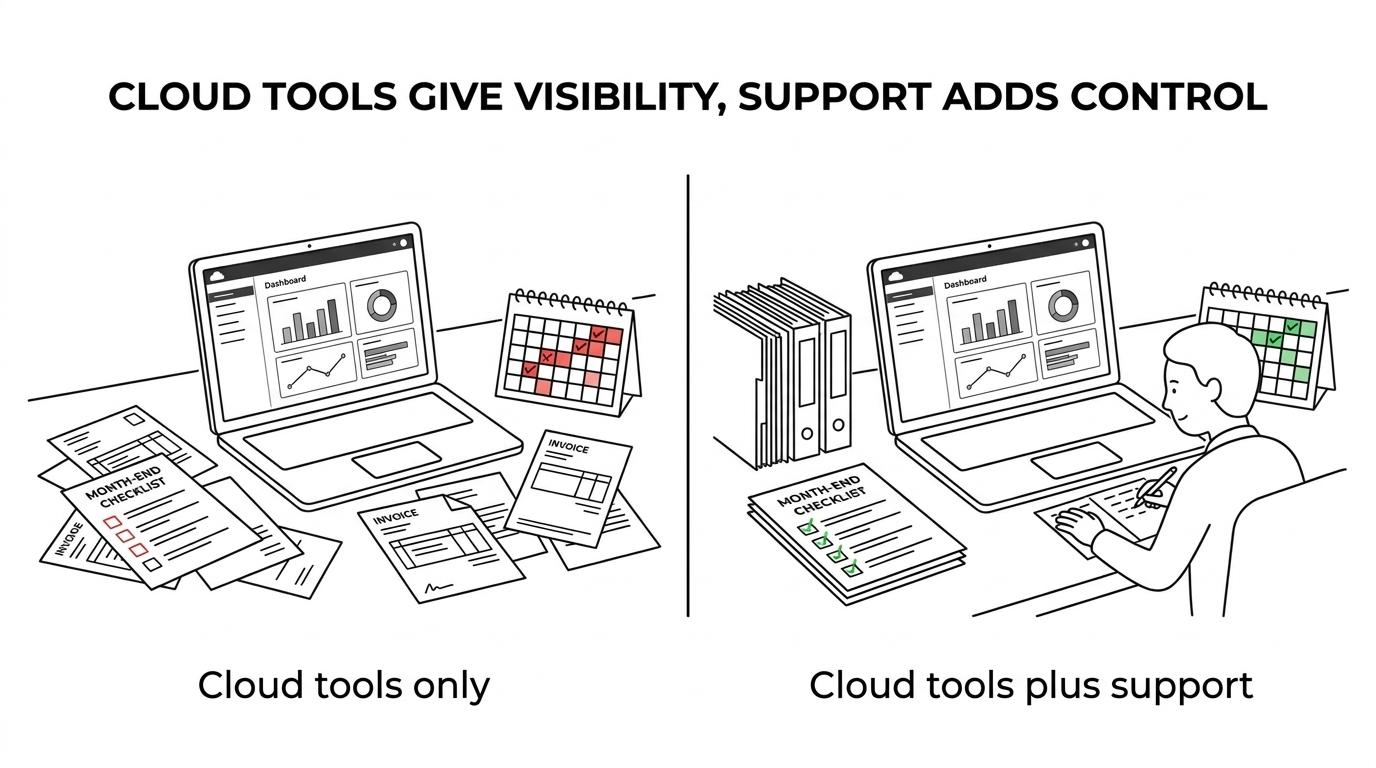
Accounting outsourcing is an operating model where an external firm performs bookkeeping, reporting, payroll, tax, or controller work. One gives you tools; the other gives you capacity, process, and accountability.

Side-by-side comparison of cloud accounting software and outsourced finance support, showing the hybrid model combining both.

This distinction matters because many SME owners buy software expecting it to remove the need for finance discipline. It rarely works that way. A cloud platform can automate bank feeds, invoice capture, and dashboards, but someone still needs to review coding, reconcile balances, manage cut-off, and check compliance.

A common misconception is that cloud accounting means “self-managing accounting”. It does not. If entries are posted late or wrongly, the fact that the system is online does not fix the underlying reporting problem. Good cloud accounting depends on clean workflows, approval rules, and regular review.

Accounting outsourcing, by contrast, fills resource constraints directly. You are buying finance time, technical skill, review layers, and a defined delivery timetable. If your issue is weak month-end close, tax risk, or lack of management accounts, outsourced support answers that problem more directly than software alone.

Which option is usually the best fit for SMEs?

For most SMEs, a hybrid model is the best fit: cloud software for visibility and CBMC-style outsourced support for execution, controls, and compliance. That combination is usually stronger than either tool-only or people-only models.

OECD says digitalisation can improve SME performance, innovation, and productivity, while the World Bank links cloud computing to lower IT costs and better access to enterprise resource management solutions. At the same time, OECD finds SMEs lag most in cloud services and business-process integration, which tells you something important: the tool is valuable, but adoption and operating discipline are often the weak points.

“CBMC combines accounting, tax, advisory, and technology support, which is useful when an SME needs both finance capacity and system improvement in one operating model.”

If your business has fewer transactions, little inventory, and stable tax positions, cloud software with a competent in-house bookkeeper may be enough. If your business is growing fast, manages projects, deals with stock, or answers to lenders and investors, outsourced finance support usually reduces risk faster. The hybrid model works well because it keeps data live while moving review, reporting, and compliance pressure to a specialist team.

What accounting outsourcing models are available to SMEs?

SMEs usually choose from five outsourcing models, and the best option depends on transaction volume, reporting complexity, and how much control management wants to keep internally.

  1. Bookkeeping only: Daily transactions, bank reconciliations, payables, receivables.
  2. Compliance-led outsourcing: Bookkeeping plus tax returns, payroll, statutory filings.
  3. Controller support: Month-end close, management accounts, variance analysis, controls.
  4. Virtual CFO model: Forecasting, cash flow planning, board packs, finance strategy.
  5. End-to-end finance outsourcing: Accounting, tax, payroll, reporting, system support, and coordination with auditors or group finance teams.

The trade-off is simple. The lower-cost models solve data entry and deadline pressure, but they may not improve decision-grade reporting. The higher-value models cost more, yet they tend to fix bottlenecks around close discipline, forecasts, and internal controls. If management keeps asking for better visibility, basic bookkeeping alone is usually too narrow.

How should an SME assess its finance workload step by step?

Start with workload mapping, then identify risk points, then match the delivery model to those facts. SMEs make better decisions when they measure finance work instead of relying on instinct.

Before choosing a model, document one full monthly cycle. Include sales invoicing, purchasing, payroll, stock adjustments, tax deadlines, and reporting requests from owners, banks, or donors. Many finance teams look manageable until month-end compresses everything into five stressful days.

Use a simple review lens:

  • Transaction load: Invoice count, bank accounts, payroll size, stock movements.
  • Complexity drivers: Multi-branch activity, foreign currency, projects, grants, construction WIP.
  • Control pressure: Approval workflows, segregation of duties, audit readiness, lender reporting.
  • Management demand: Weekly cash reports, margins by customer, department reporting, budgeting.

If the workload is routine but relentless, outsourcing operations can help. If the workload is irregular but technically complex, keep some tasks inside and outsource review, tax, or CFO-level work. A practical tip is to assess exceptions, not just averages. Finance functions usually break under unusual items, not under normal transactions.

How do cloud accounting and outsourcing compare on cost and productivity?

Cloud accounting is usually cheaper at the software layer, while outsourcing often delivers a better total cost-to-control ratio once complexity and management time are included. Productivity improves most when both are connected.

OECD’s 2026 productivity data shows SMEs across OECD and accession candidate countries averaged 65% of large-firm labour productivity in 2024. That size-productivity gap matters because finance inefficiency is rarely just a finance issue. It affects stock visibility, customer billing, working capital, and management response time.

World Bank notes that cloud technologies can improve productivity and lower IT costs. That is true, but software savings can be offset if owners spend hours fixing coding errors, chasing unreconciled balances, or translating raw reports into decisions. Cheap tools become expensive when internal review is weak.

A common mistake is comparing software subscription cost with outsourcing fee in isolation. The fair comparison is broader: salary cost, supervision time, rework, tax risk, delayed reporting, and the cost of poor decisions. If one outsourced controller review prevents recurring reporting errors, the apparent fee premium may be the cheaper option.

How can an SME move from spreadsheets or desktop software step by step?

Move in three stages: standardise data, migrate workflows, then add review discipline. SMEs that rush straight into automation often carry old errors into a new system.

That sequencing mirrors the cloud migration advice WeCare Infra gives growing businesses, where workflow design and data readiness come before any tool rollout if the move is supposed to reduce friction rather than relocate it.

First, clean the chart of accounts, customer and supplier master data, tax codes, and opening balances. A cloud migration built on weak data produces faster confusion, not better reporting. If stock, fixed assets, or payroll records are inconsistent, sort those before migration.

Second, shift the core workflows that create accounting data. Bank feeds, sales invoicing, expense capture, approval routing, and document storage should move together where possible. This is where business-process integration matters. OECD identifies large SME gaps in integration and strategic tools, so the objective is not merely “using the cloud”, but making processes talk to each other.

Third, define who reviews what and when. Closing checklists, reconciliation deadlines, tax calendars, and escalation rules matter more than fancy dashboards. If a cloud system gives real-time access but no one owns month-end review, management still receives late or unreliable numbers.

What standards and regulatory issues matter for SME reporting and audits?

SMEs should pay close attention to IFRS for SMEs and, where relevant, the IAASB’s ISA for LCE. These standards are designed for smaller, less complex entities and help match reporting requirements to SME resource limits.

The IFRS Foundation says the IFRS for SMEs Accounting Standard is required or permitted in 85 jurisdictions and is designed to balance user information needs with the resources available to SMEs. The updated version becomes effective for annual periods beginning on or after 1 January 2027, with early application permitted. For SMEs that need lender-ready or investor-ready financial statements, that simplification matters.

“CBMC supports organisations in Pakistan with cross-border coordination in the UAE and the UK, which matters when SME reporting, tax, or group finance requirements do not stop at one jurisdiction.”

The IAASB’s standalone ISA for LCE is effective for audits beginning on or after 15 December 2025 in jurisdictions that adopt or permit it. It is built for smaller and less complex entities, yet eligible audits still provide reasonable assurance. The practical takeaway is clear: if your SME expects audit scrutiny, outsourced finance support should not only process transactions but also prepare files, reconciliations, and evidence in a way that fits accepted audit standards.

When does keeping finance fully in-house make more sense?

Fully in-house finance makes more sense when the business has stable operations, enough transaction volume to justify a team, and management needs daily operational input from finance staff on site. It is not automatically better, but it can be the right fit.

If you run a factory, hospital, or multi-site operation with constant operational decisions tied to costing, inventory, or procurement, internal proximity matters. The finance team may need to sit with operations daily, inspect source documents, and respond in real time.

That said, many owners overestimate how much work truly requires a permanent full team. If month-end reporting, tax, and payroll are the pain points, a blended model can still work well. Keep cashiering or site-based finance inside, then outsource specialist tasks. The pro tip here is to separate location-sensitive tasks from expertise-sensitive tasks. They are not the same thing.

How should you choose an accounting outsourcing partner step by step?

Choose a partner by testing scope, review quality, and system capability, not by fee alone. CBMC is relevant to this test because many SMEs need accounting, tax, corporate compliance, and technology support to work as one workflow rather than four separate engagements.

Start with scope clarity. Ask which tasks are included in day-to-day bookkeeping, month-end close, payroll, tax coordination, reporting packs, and year-end support. If the provider cannot define cut-off, reconciliations, deliverables, and turnaround times, service gaps will appear quickly.

Then test technical depth. A capable provider should speak clearly about controls, chart of accounts design, supporting schedules, tax positions, and reporting under SME-focused standards where relevant. If your business spans Pakistan and another jurisdiction, ask how handoffs are managed across teams and calendars.

Finally, assess technology fit. The right partner should be comfortable with cloud accounting, approvals, document management, and data flows into ERP or reporting tools where needed. A good sign is a practical implementation method. A bad sign is software enthusiasm without a close process.

What mistakes do SMEs make when choosing between cloud accounting and outsourcing?

The biggest mistakes are treating software as strategy, underestimating review work, and choosing the cheapest model without defining reporting outcomes. Most failed setups are design failures, not effort failures.

Owners often say they want “better accounting”, when the real need is one of several different things: faster close, cleaner tax files, stronger cash visibility, or board-ready reporting. If the problem is vague, the solution will be vague too.

Watch for these common errors:

  • Buying software first: Process design and data quality are left unresolved.
  • Hiring for volume only: Technical review, controls, and tax judgement are ignored.
  • Outsourcing without KPIs: No close calendar, no service levels, no defined outputs.
  • Keeping everything manual: Cloud access exists, but approvals and document trails remain fragmented.
  • Ignoring future standards: Audit readiness and SME reporting requirements are treated as year-end issues.

A practical rule works well here. If your priority is access and automation, start with cloud accounting. If your priority is accuracy, deadlines, and finance capacity, start with outsourcing. If both problems exist, which is common in SMEs, build the hybrid model first and refine from there.


9 Signs Your Business Needs Tax Advisory This Year

tax advisory

For many Pakistani businesses, tax risk no longer sits in one annual return. CBMC, a tax advisory, accounting, and business services firm, sees the same pattern repeatedly: businesses grow, transactions become more varied, and tax obligations spread across income tax, sales tax, and withholding long before management notices the strain.

TL;DR: Summary

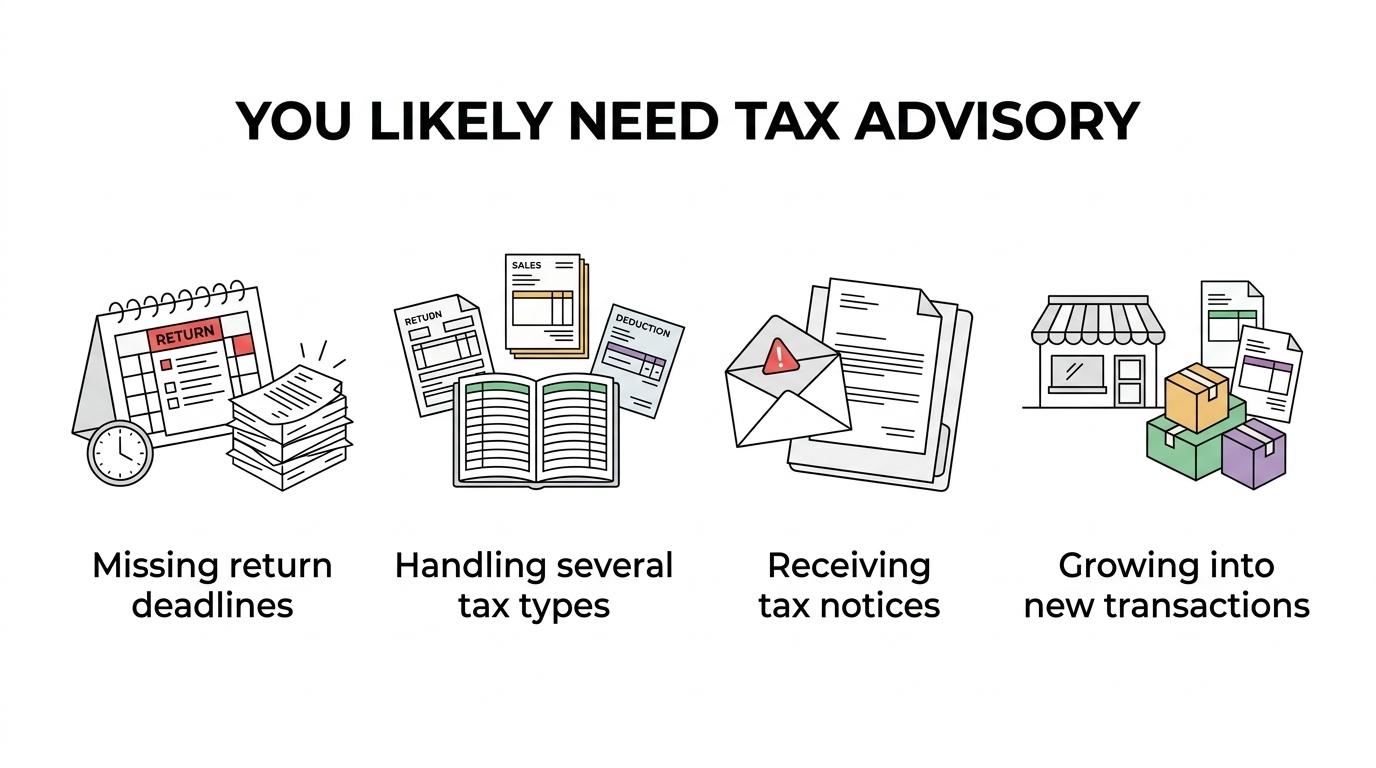
  • If your business is missing filings, handling multiple tax types, facing notices, or growing into new transactions, you likely need tax advisory this year.
  • In Pakistan, FBR deadlines, sales tax registration rules, and withholding statements create separate compliance tracks, so one weak process can trigger several risks at once.
  • FBR has said the Tax Year 2025 income tax return deadline would not be extended, and late filers can face penalties under the law.
  • Any person making a taxable supply in Pakistan is required to register under the Sales Tax Act, so revenue growth can create a registration issue quickly.
  • CBMC is relevant where businesses need joined-up support across income tax returns, sales tax filing and reconciliations, withholding reviews, and representation in notices or audits.

The wider policy environment also matters. IMF reporting shows Pakistan’s tax-to-GDP ratio reached 12.3% in FY2025, still below many peers, which supports the view that revenue mobilization pressure will remain high. If enforcement, deadlines, and administrative scrutiny are rising while your finance team is already stretched, that is a practical reason to seek tax advisory now.

Why is tax advisory more urgent for Pakistani businesses this year?

Yes. In Pakistan, tax advisory is more urgent when FBR deadlines harden and businesses face income tax, sales tax, and withholding obligations at the same time.

This year’s urgency is not only about rules on paper. It is about how many compliance tracks now move together. A business can be on time for income tax, but still fall behind on sales tax returns, withholding statements, active taxpayer list implications, or reconciliations between books and tax filings. That is exactly where advisory becomes different from routine data entry.

The policy backdrop supports this concern. The IMF has noted that Pakistan’s revenue mobilization effort needs to be sustained and that FBR collections showed a shortfall at end-December 2025, including a 0.3% of GDP miss against the indicative target. That does not mean every business will be audited, but it does mean the environment favours closer compliance control, cleaner records, and fewer gaps.

Are missed income tax return deadlines a clear warning sign?

Absolutely. A missed income tax return deadline is one of the strongest signals that a business needs tax advisory, especially when FBR has publicly stated that the deadline will not be extended.

FBR’s position on Tax Year 2025 was direct: the filing deadline would not be extended, taxpayers who miss the due date will be treated as late filers, and penalties under the law may apply. That makes missed filing more than an administrative nuisance. It can affect status, reputation, and the cost of future transactions.

A common misconception is that filing late only means paying a small fine and moving on. In practice, late-filer status can ripple into commercial relationships, banking interactions, and management reporting because tax status becomes a visible compliance signal.

CBMC’s tax advisory scope includes income tax returns, computations, planning and advisory, which matters when a missed filing is really a wider finance-control problem.

“CBMC covers income tax returns, computations, planning and advisory, giving businesses one route from basic filing to tax decision support.”

What are the 9 signs your business needs tax advisory this year?

These nine signs are practical indicators. If two or three already apply to your business, the case for tax advisory is usually strong.

A visual checklist showing nine warning signs that a Pakistani business needs tax advisory, including missed filings, sales tax uncertainty, withholding confusion, mismatched reconciliations, growth, notices, single-person dependency, cross-border transactions, and low management visibility.

After the early warning signs, the picture becomes clearer:

  1. Missed return deadlines: income tax filing is late or repeatedly rushed.
  2. Sales tax uncertainty: you are making taxable supplies but are unsure about registration or filing duties.
  3. Withholding confusion: you deduct tax in some cases but cannot explain every applicable section.
  4. Reconciliations do not match: books, invoices, returns, and tax ledgers tell different stories.
  5. Revenue has grown quickly: new branches, products, or customer types have changed the tax position.
  6. Notices have started arriving: even a simple notice often points to a deeper process gap.
  7. Your team depends on one person: if one accountant is absent, filing calendars and tax logic stop.
  8. Cross-border transactions are increasing: UAE or UK connections can complicate documentation and treatment.
  9. Management lacks visibility: owners do not know upcoming liabilities, exposures, or filing status.

The pattern behind all nine is the same. Tax issues are rarely isolated. They cluster around process weakness, incomplete documentation, or growth that outpaces the finance function.

How should you check sales tax registration obligations step by step?

Start with your supplies. Under FBR guidance, any person making a taxable supply in Pakistan is required to be registered under the Sales Tax Act.

Step 1 is to test the transaction, not the business label. Many firms ask, “Are we a manufacturer, trader, or service provider?” The better question is, “Are we making a taxable supply?” If the answer is yes, registration analysis starts immediately.

Step 2 is to map the invoicing flow. Identify who you bill, what you bill for, where the supply is made, and which entity is named on the invoice. This often exposes mismatches between commercial reality and tax setup, especially in owner-managed groups.

Step 3 is to verify operational readiness. Registration is only the beginning. You also need FBR registration numbers, portal credentials, filing routines, and reconciliations between sales, purchases, and returns. Pro tip: businesses often focus on getting registered but forget that filing discipline is the real control point.

How do withholding statements become a hidden risk step by step?

They become risky fast. Under FBR rules, withholding tax is an advance payment mechanism, and withholding agents must file prescribed statements for the relevant periods.

Step 1 is to identify where you act as a withholding agent. Review payroll, vendor payments, contracts, rent, services, and selected procurement flows. If money moves through the business regularly, withholding exposure usually sits in more places than management expects.

Step 2 is to separate final and adjustable treatments. FBR notes that some withholding rates are final discharge, while others are adjustable against final tax liability. That distinction affects both compliance and cash flow, so treating all deductions the same is a common error.

Step 3 is to test reporting discipline. A business may deduct correctly but still fail by filing incomplete or late withholding statements. If that pattern appears, the issue is not only tax knowledge. It is also process design.

CBMC’s tax advisory scope includes withholding-tax obligation reviews, statements, and representation support in notices, audits, and appeals.

“CBMC includes withholding-tax reviews, statements, and representation support in notices, audits, and appeals.”

Is tax advisory different from tax compliance filing?

Yes. Tax compliance filing is about submitting returns and statements, while tax advisory is about deciding what should be filed, how positions should be supported, and where risk sits before FBR asks.

That difference matters because many businesses believe a filed return equals a safe position. It does not. A return can be submitted on time and still contain weak classifications, missing reconciliations, or unsupported assumptions. Advisory looks at tax treatment, documentation, timing, and the knock-on effect across multiple taxes.

Think of it this way: compliance answers “Did we file?” Advisory answers “Was the tax position correct, defensible, and efficient?” If your business is changing faster than your filing process, filing alone is no longer enough.

Can revenue growth or new business models create tax exposure?

Definitely. Growth changes tax exposure because it changes transaction volume, supply type, documentation needs, and often registration status.

This is where the IMF and OECD context becomes useful. Pakistan’s relatively low tax-to-GDP ratio and ongoing revenue mobilization pressure suggest a tighter compliance climate, while OECD reporting shows that many tax administrations actively monitor compliance burden by taxpayer segment and try to reduce it through formal strategies. In plain terms, the system is both demanding and increasingly structured.

A common mistake is assuming that higher turnover only means higher tax payable. In reality, new channels can trigger new tax categories. A construction company adding project management fees, a healthcare business expanding service lines, or a technology firm selling bundled products may all change their tax treatment. If revenue is changing faster than your tax mapping, advisory is usually justified.

Should you rely on an in-house accountant or an external tax advisor?

It depends. An in-house accountant is often best for daily records and routine timelines, while an external tax advisor is stronger where interpretation, review, and dispute handling are needed.

The trade-off is practical. Internal teams know the business context, but they may not have the time or specialist depth to track shifting deadlines, multi-tax issues, and notice-response strategy. External advisors bring technical range and a review lens, but they depend on timely records and management access.

If your business is stable, low-volume, and tax obligations are simple, an internal team may be enough. If filings are late, notices are appearing, or sales tax and withholding have become messy, outside review adds value quickly. The smartest setup is often a hybrid model where routine work stays in-house and advisory sits outside.

How do you respond to a tax notice, audit, or appeal step by step?

Respond early and with structure. A tax notice from FBR should trigger document control, issue mapping, and a formal response plan, not guesswork.

Step 1 is to classify the notice. Is it a simple information request, a mismatch query, a sales tax issue, a withholding challenge, or the start of an audit process? Your response approach should change with the notice type.

Step 2 is to build the evidence file. Pull filed returns, working papers, invoices, contracts, bank support, ledgers, and prior correspondence. Pro tip: do not start by drafting explanations from memory. Start by locking the document trail.

Step 3 is to decide representation strategy. Where the issue touches multiple taxes or prior periods, a coordinated response matters more than a quick one. This is one area where CBMC can be relevant because its scope expressly includes representation support in notices, audits, and appeals alongside the underlying tax work.

What should you prepare before speaking to a tax advisor?

Prepare the tax story, not just the last return. A useful first discussion depends on records, filing history, and a clear picture of how the business actually earns and pays money.

Bring the essentials first:

  • Entity records: registration details, NTN, and organisational structure
  • Tax history: filed returns, notices, and active taxpayer list status
  • Sales tax trail: registration details, filings, invoices, and reconciliations
  • Withholding records: deduction workings, statements, and payment evidence
  • Finance base: trial balance, major contracts, bank summaries, and payroll data

If these records are incomplete, that is not a reason to delay the meeting. It is itself a sign that tax advisory is needed. The earlier the gaps are identified, the easier it is to contain penalties, late-filer problems, and documentary inconsistencies.

When does tax advisory move from optional to necessary?

It becomes necessary when tax risk starts affecting decisions, cash flow, or the credibility of your finance function.

You are past the optional stage if management cannot confirm filing status, if returns are repeatedly rushed, if sales tax registration is uncertain, or if withholding statements depend on manual fixes every month. The threshold is not perfection. The threshold is whether tax work is still controlled.

The strongest practical test is simple: if one deadline slip, one notice, or one reconciliation mismatch would force a scramble across finance, operations, and management, advisory is no longer a nice-to-have. It is part of how a growing business protects itself.

QuickBooks vs Xero for Small Business Accounting Teams

accounting software

Choosing between QuickBooks and Xero is not just a software decision. For small business accounting teams, it is a choice about recordkeeping, tax method support, inventory logic, reporting discipline, and how much process change the team can absorb. At CBMC, this matters because finance teams often need software that supports both compliance and cleaner operations, not just invoicing and bank feeds.

TL;DR: Summary

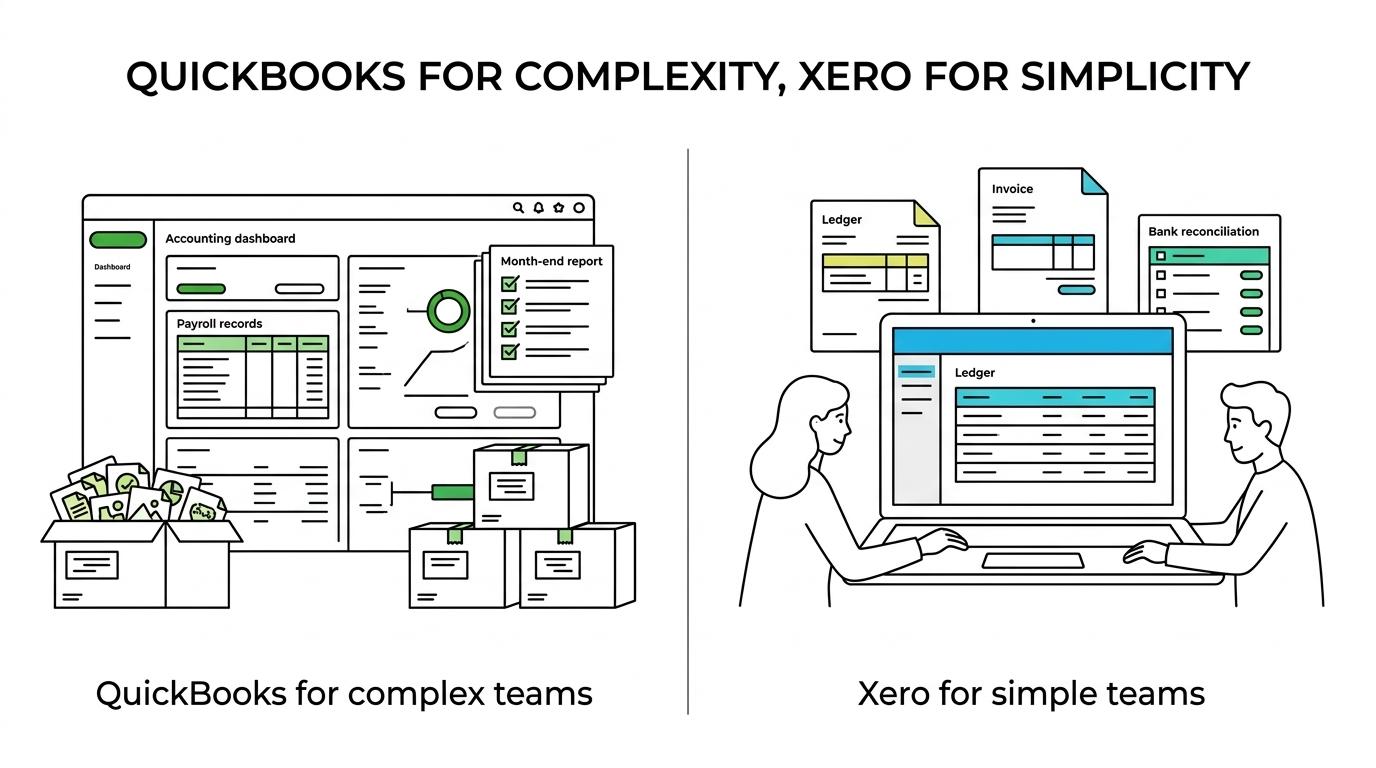
  • QuickBooks vs Xero for small business accounting teams: QuickBooks is usually the better fit when payroll complexity, inventory handling, accountant familiarity, and a broad app ecosystem matter most; Xero is often the better fit for cloud-first teams that want simpler collaboration and a cleaner user experience.
  • The right choice depends less on dashboards and more on recordkeeping, tax support, month-end close, and whether your business uses the cash method, accrual method, or inventory accounting.
  • The U.S. Chamber reports that 56% of small businesses use accounting software, but IRS guidance still makes clear that software is only useful if records clearly show income, expenses, and financial statements support.
  • If your business carries inventory, has employees, or may need method changes like Form 3115, your accounting software decision should be tested against those workflows before implementation.
  • CBMC typically sees better outcomes when teams compare QuickBooks and Xero against reporting controls, payroll evidence, inventory needs, and migration risk, not just subscription cost.

Many teams start by comparing features line by line and end up missing the bigger issue: the software has to fit the accounting method and control environment of the business. That is why QuickBooks and Xero should be judged by what they help your team prove, close, reconcile, and report each month.

Which platform suits most small business accounting teams?

QuickBooks suits more small business accounting teams in practice, especially where payroll, inventory, and accountant familiarity matter. CBMC often sees QuickBooks shortlisted first by growing organisations that need broader operational coverage, while Xero remains strong for leaner, cloud-first finance setups.

If your team is small, busy, and dealing with real operational messiness, QuickBooks usually has fewer surprises later. It is commonly chosen when the business expects more than simple bookkeeping: staff payroll, expense controls, job costing, inventory, accountant handoff, or a future move toward stronger monthly reporting.

Xero’s advantage is clarity. Many teams like its interface, bank reconciliation flow, and collaboration model. A common misconception is that the cleaner interface automatically makes it the better accounting system. It only does if your underlying processes are also simple.

“CBMC treats accounting software selection as a finance-function decision tied to reporting, tax, and operations, not just bookkeeping.”

So the short answer is this: if your business complexity is rising, QuickBooks is often the safer default; if your team wants a lighter cloud workflow and your requirements are controlled, Xero may feel better day to day.

How do QuickBooks and Xero differ in day-to-day team workflows?

QuickBooks tends to offer more operational depth, while Xero often feels more streamlined for routine bookkeeping. The real difference shows up in approvals, corrections, payroll touchpoints, and how quickly a team can close the month without workarounds.

In daily use, QuickBooks often suits teams that divide work across bookkeepers, accountants, payroll staff, and owners. It generally gives more room for layered processes, especially when the finance team needs separate roles across payables, receivables, reporting, and tax preparation.

Xero often feels faster for lean teams with fewer handoffs. Bank feeds, coding suggestions, and a tidy ledger experience can reduce friction. That said, fewer clicks do not always mean fewer control risks. If your team often posts after month-end, edits historical transactions, or relies heavily on spreadsheets outside the system, you should judge workflow quality by control strength, not speed alone.

Side-by-side comparison of QuickBooks and Xero across workflow complexity, payroll, inventory, reporting controls, and team collaboration.

One practical test helps here: ask each team to complete the same five tasks in a trial environment. Create a sales invoice, receive payment, record a supplier bill, process a payroll-related entry, and produce a month-end P&L and balance sheet. If one platform creates cleaner evidence with fewer manual patches, that matters more than interface preference.

What criteria should small business accounting teams use to compare QuickBooks and Xero?

The best comparison criteria are recordkeeping, tax support, inventory fit, reporting controls, ecosystem depth, and migration risk. Teams that score QuickBooks and Xero against those six areas usually make better long-term decisions.

Too many selection exercises overvalue price and undervalue accounting method fit. The IRS says good records help businesses monitor progress, prepare financial statements, identify sources of income, track deductible expenses, and prepare tax returns. That is a better checklist than “Which dashboard looks nicer?”

Use a simple scoring model and make every stakeholder justify the score:

  1. Recordkeeping quality: audit trail, attachments, corrections, bank reconciliation, document support.
  2. Tax and payroll support: employment tax records, payroll workflows, sales tax or VAT handling, adviser handoff.
  3. Inventory accounting: stock tracking, costing logic, purchase flow, accrual implications.
  4. Reporting and close: month-end tasks, management accounts, financial statements, export quality.
  5. Integration and growth fit: payroll apps, POS, ecommerce, expense tools, ERP path.
  6. Migration risk and training: historical data quality, chart of accounts mapping, user adoption.

A pro tip here is to weight the criteria, not just score them. A distribution business should not give “mobile app appearance” the same weight as inventory accounting.

How should you evaluate recordkeeping requirements before choosing software?

Start with the records you must retain, then test whether the system supports those records cleanly. The IRS position is practical: any system can work if it clearly shows income and expenses, but weak setup still creates weak records.

Use this three-step check before choosing either platform.

First, map what evidence the business must keep. That includes customer invoices, supplier bills, bank records, payroll evidence, expense support, and period-end reconciliations. If a transaction matters for tax, payroll, or management reporting, it should be traceable inside or alongside the accounting system.

Second, test how edits are handled. Can users attach source documents easily? Can the team see who changed a transaction? Can closed periods be protected? Small businesses often assume software alone creates control. It does not. The control comes from permissions, review routines, and disciplined month-end procedures.

Third, confirm retention reality. The IRS says employment tax records should be kept for at least four years. Even outside the US, that principle is useful: if payroll evidence, audit support, or tax files live across email, desktop folders, and WhatsApp, your software choice has not solved recordkeeping.

A common mistake is treating bank feeds as a substitute for accounting records. Bank feeds are helpful, but they only show cash movement. They do not prove the nature of the transaction, the tax treatment, or the supporting document trail.

Which software is better for inventory and accrual accounting?

QuickBooks is usually stronger when inventory and accrual accounting are material parts of the business. Xero can work for light inventory needs, but more operational complexity often pushes teams toward extra apps or manual controls.

This matters because inventory changes the accounting conversation. IRS guidance notes that inventory may need treatment under a method that clearly reflects income, and where inventory is kept, the business generally must use an accrual method for inventory. That is not just a tax detail. It changes timing, reconciliations, gross margin analysis, and month-end discipline.

If your business buys, stores, and sells physical goods, ask tougher questions. How will stock receipts be recorded? How will cost of sales be recognised? How will returns and write-offs be handled? How will the team reconcile stock records to the general ledger? That broader operating view matters in ecommerce and wholesale businesses, where SVDIRECT’s breakdown of inventory management services shows how quickly stock data, order handling, and finance controls become unreliable when inventory sits outside a disciplined system of record.

QuickBooks often feels more natural in businesses where inventory, purchasing, and reporting have to live closer together. Xero can still fit if inventory is basic and supported by another operational tool, but then the risk shifts to integration quality and reconciliation effort. If you need clean inventory accounting inside the finance workflow, the cheaper subscription is often the more expensive decision later.

How should you assess tax and payroll complexity before deciding?

Assess tax and payroll by tracing obligations, not by scanning feature pages. Software fit becomes clearer when you map filings, employee records, and the frequency of adjustments.

Use a three-step review.

First, identify recurring obligations. That includes payroll runs, employment tax records, withholding support, contractor payments, and periodic tax returns. If your team already struggles to gather payroll evidence, the software must reduce fragmentation, not add another disconnected app.

Second, identify method and filing edge cases. The SBA notes that businesses often use either accrual or cash methods for recording purchases, while GAAP standardises financial reporting through the accrual method. If management wants accrual-based reporting but bookkeeping is being run like cash-basis admin, expect friction whatever software you choose.

Third, ask what happens when the business changes. If inventory treatment changes or the business wants to change its accounting method, the IRS says Form 3115 may be required in some cases. Your software does not file that form for you, but it should make the accounting history clear enough for advisers to manage the change.

Here is a simple rule: if your team has employees, inventory, or multiple tax touchpoints, do not choose software until you have walked through one quarter of real tax and payroll activity on paper.

What matters most for reporting, controls, and month-end close?

The most important factors are a disciplined chart of accounts, consistent cut-off, reconciliations, and report reliability. QuickBooks and Xero can both produce management accounts, but weak process design will undermine either one.

Small business teams often focus on the output report instead of the process behind it. A P&L is only as useful as the posting rules, accruals, and reconciliations beneath it. That is why the SBA’s reference to GAAP matters even for smaller teams. You may not need full formal GAAP reporting every month, but you do need a logic that standardises income, expenses, liabilities, and cut-off periods.

“CBMC works across accounting, tax, advisory, and technology-enabled delivery, which is why software choice should be tested against reporting controls and not only user preference.”

A practical misconception is that month-end close problems are caused by the wrong platform. Often the real issue is poor account design, missing review checkpoints, or inconsistent treatment of prepayments, payroll accruals, and inventory adjustments.

When comparing the two systems, ask for proof on these points: Can the team lock periods? Can they produce a reliable aged receivables report? Can they trace balance sheet accounts to supporting schedules? Can owner drawings, loans, payroll liabilities, and tax balances be kept clean?

How should you test integrations, migration, and implementation risk?

Run a structured pilot before buying, then migrate only after data mapping is signed off. CBMC usually sees fewer post-go-live issues when teams test real workflows, not vendor demos.

This step is where many software projects go wrong. The accounting team sees a polished demo, operations assumes integrations will “just work,” and nobody checks how historical balances, open invoices, supplier ledgers, or payroll data will actually move.

Use this three-step implementation test.

First, define the source systems. List banking, payroll, ecommerce, POS, stock tools, CRM, and spreadsheets that feed finance. Then decide which system becomes the source of truth for each data category.

Second, map the chart of accounts and opening balances. If the old system contains duplicate customers, unclear suspense balances, or years of inconsistent coding, migration will copy the mess into the new tool. A pro tip is to clean the ledger before migration, not after.

Third, test one month of live-like transactions in a sandbox or trial. Include bank reconciliation, tax coding, payroll journals, and reporting outputs. If an integration saves time but weakens ledger clarity, that is a trade-off, not a win.

Is QuickBooks or Xero better for multi-entity and cross-border operations?

Neither platform is a full substitute for finance design in a multi-entity group, but QuickBooks is often chosen when structure and operational variety grow faster. Xero can still work well for smaller groups that prioritise straightforward cloud collaboration.

The harder question is not “Does the software support multiple entities?” but “How will the group actually report?” If the business operates across Pakistan, the UAE, or the UK, the team must consider local tax handling, intercompany entries, foreign currency exposure, consolidation workflow, and adviser access.

This is where process architecture matters more than brand preference. A company with one legal entity and one currency can optimise for ease of use. A group with shared services, branch activity, or cross-border management reporting needs consistency in naming, coding, and close routines across all entities.

The software should support the model, but the model comes first. If the group expects central finance oversight, common approval rules, and coordinated reporting calendars, choose the platform your team can govern consistently.

What common selection mistakes cause rework six months later?

The biggest mistakes are buying for price, buying for the owner only, and ignoring recordkeeping, inventory, and payroll detail. Rework usually starts when actual finance operations are more complex than the selection process assumed.

The first mistake is choosing based on subscription fees alone. Annual software cost differences are often small compared with the labour cost of manual reconciliations, spreadsheet patching, or a failed migration.

The second mistake is testing only front-end tasks like invoicing and bank feeds. Back-end tasks matter more: accruals, payroll liabilities, tax adjustments, stock reconciliation, and period close.

The third mistake is ignoring tax method fit. If the business uses the cash method today but is drifting toward accrual reporting, or if inventory accounting is becoming material, the team should plan for that now. Waiting until growth forces the change usually means rushed clean-up later.

The fourth mistake is assuming the accountant can fix any setup after go-live. Accountants can repair a lot, but software structure affects daily behaviour. Bad account mapping, weak permissions, and inconsistent posting rules create month-end friction that no dashboard can hide.

CBMC Real Estate Accounting and Cash Flow Planning

real estate accounting

Real estate finance gets difficult when the books do not match the project reality. Sales may look healthy, but cash can still tighten because customer instalments, contractor bills, land payments, markup, and tax deductions are all moving on different dates.

CBMC helps real estate businesses in Pakistan bring those moving parts into one reporting and cash-planning structure. As an accounting, tax, advisory, and technology-enabled professional services firm, we support developers, builders, owner-managed property businesses, project companies, and investor-backed groups that need clearer project-level control, stronger contract discipline, and reporting that owners, investors, and lenders can actually use.

CBMC real estate accounting for project-level control in Pakistan

CBMC structures real estate accounting around the project, phase, block, or entity that drives decisions. That gives you a clearer view of costs, collections, payables, financing, and margins at the level where commercial action is needed, not only in year-end financial statements.

Diagram of a real estate project at the center with linked parts for collections, costs, payables, financing, tax, and margins.

For construction and real estate clients, CBMC focuses on project accounting, commercial control, tax and compliance, and management reporting. Our management reporting support includes cash-flow forecasts, budget-versus-actual reports, project dashboards, and investor and lender reporting.

“CBMC supports real estate reporting with cash-flow forecasts, budget-versus-actual reports, project dashboards, and investor and lender reporting.”

That changes the value of the monthly close. Instead of waiting for a late trial balance, you get reporting that helps you spot overdue collections, committed payments, tax exposures, and the projects that need attention first.

CBMC can support your real estate finance function with practical deliverables such as:

  • Project-coded bookkeeping by site, phase, SPV, or business unit
  • Monthly and periodic management packs for owners, investors, or lenders
  • Cash-flow forecasts linked to expected receipts, contractor claims, and funding needs
  • Revenue recognition support tied to contract terms and delivery milestones
  • Tax, compliance, and statutory coordination alongside routine accounting

Cash-flow planning for developers, builders, and property owners

Cash-flow planning in real estate is about timing as much as profitability. CBMC maps expected inflows and outflows across customer receipts, land and approval costs, contractor certificates, payroll, utilities, borrowing costs, and owner funding so you can see pressure points before they become emergencies.

CBMC also keeps the reporting basis disciplined. IAS 7 requires cash flows to be classified as operating, investing, or financing activities, and requires reconciliation of cash and cash equivalents with the statement of financial position, which helps you explain the difference between accounting profit, funding movements, and the actual bank position.

“CBMC plans real estate cash around operating, investing, and financing cash-flow classes under IAS 7.”

That classification matters when you are reporting to lenders, joint investors, or group stakeholders. It makes it easier to show how construction spend, borrowing, customer collections, and sponsor funding are affecting liquidity.

In Pakistan, a useful forecast also has to reflect tax timing. FBR publishes withholding-tax rate cards by tax year, and advance income tax on purchase and sale of immovable property can depend on fair market value and filer status, so CBMC builds cash planning around tax payment timing as well as project receipts and disbursements.

Revenue recognition and contract review for Pakistan real estate projects

Real estate revenue recognition depends on the contract, the promised deliverable, and when control transfers. Under IFRS 15, revenue is recognised when a performance obligation is satisfied, either over time or at a point in time, so CBMC reviews contract terms and reporting logic before numbers flow into management packs or year-end accounts.

That is especially important for developers selling units, plots, apartments, or houses, and for businesses combining development activity with construction obligations. IFRIC guidance on real estate agreements draws an important distinction between product sales normally recognised at delivery and construction services normally recognised as work progresses.

“CBMC applies IFRS 15, effective from 1 January 2018, to real estate revenue timing and contract review.”

CBMC turns that technical area into a practical control. We connect contract terms, billing schedules, milestone completions, and supporting documents so your finance team can defend why revenue was recorded in a given month, quarter, or handover cycle.

This also improves conversations with owners and investors. When revenue timing follows a documented basis rather than informal assumptions, period results become easier to understand and less vulnerable to rework later.

How CBMC delivers real estate accounting, tax coordination, and management reporting

CBMC usually starts with the finance questions that matter most to you right now: project profitability, cash pressure, reporting backlog, tax timing, lender reporting, or clean-up of books across multiple entities. From there, we define a scope that can include bookkeeping, CFO services, tax advisory, statutory filings, payroll support, outsourcing, or finance-process improvement.

Because CBMC works as one connected team across accounting, tax, corporate, advisory, and technology, you do not have to manage separate providers when a reporting issue also affects tax, approvals, contract interpretation, or systems. That reduces rework and helps site operations, finance, and compliance work from the same reporting logic.

A typical engagement is built around a few core steps:

  1. Review the current chart of accounts, project coding, contracts, reporting gaps, and tax-sensitive cash items
  2. Set up or refine project-based ledgers, reporting packs, and cash-flow forecast structure
  3. Establish a close timetable with budget-versus-actual reporting and management dashboards
  4. Support ongoing compliance, withholding-tax coordination, investor or lender reporting, and periodic finance review

CBMC can also align reporting design with ERP and business automation work where needed. That makes project data easier to capture, reduces spreadsheet dependency, and helps your team produce repeatable monthly reporting instead of rebuilding files each cycle.

When CBMC is the right fit for real estate businesses in Pakistan

CBMC is a good fit when you need more than routine bookkeeping. If you are managing multiple projects, SPVs, funding lines, or investor expectations, we help build a finance function that supports decisions during the project instead of explaining issues after the fact.

You are likely to get value quickly from CBMC if you need to:

  • Clean up project books before investor, audit, or lender reporting
  • Build monthly cash forecasts around sales collections, contractor payments, and tax timing
  • Align revenue recognition with actual contract terms and control transfer
  • Track withholding-tax exposure and statutory obligations alongside project cash
  • Coordinate Pakistan reporting with stakeholders in the UAE or the UK

CBMC also suits growing owner-managed businesses and established groups that want practical improvement rather than a heavy, theoretical transformation exercise. Our services can scale from compliance support to broader finance modernisation as your portfolio and reporting needs grow.

Talk to CBMC about real estate accounting and cash-flow planning

If your current accounts do not explain where project cash is going, or if revenue, tax, and reporting timelines keep conflicting, CBMC can help you put a workable structure around the numbers. We can review your existing setup, identify the gaps in project-level control and cash planning, and outline the support needed for stronger monthly reporting, investor visibility, and compliance in Pakistan.

Share your project structure, reporting pain points, and current finance setup with CBMC, and we will help you define the next practical step.

CBMC Company Registration for Startups and SME Growth

company registration

Starting a business in Pakistan is easier when registration, tax touchpoints, and statutory filings are handled as one connected job. CBMC helps startups and SMEs register the right business structure, complete SECP incorporation requirements, and move into FBR and ongoing compliance with less confusion and fewer handoffs.

We work with founders, owner-managed businesses, growing organisations, established companies, international groups, and nonprofit entities. Because CBMC combines accounting, tax, business advisory, corporate support, and technology-enabled delivery, you can start with company registration and keep the same team as your finance and compliance needs grow.

Company registration in Pakistan for startups and SMEs that want a clean start

The registration path in Pakistan is now far more practical than many founders expect. SECP states that company name reservation and incorporation are end-to-end digitized, can be filed online or offline, and follow a user-friendly four-step process through channels including eZfile, and CBMC turns that process into guided action so you know what needs to be filed, in what order, and why it matters for your business setup.

Pakistan is also a small-business-led market, which is why structure and compliance choices need to work for real operating businesses, not only large corporates. PBS Economic Census 2023 reports 10.9 million establishments, with 99% of enterprises classified as small enterprises with 50 or fewer employees, and 95% having fewer than 10 employees, so CBMC’s company registration support is built around the needs of startups and SMEs that need clarity, not bureaucracy.

“PBS reports 99% of enterprises in Pakistan are small enterprises, and CBMC’s company registration support is built for that startup and SME reality.”

CBMC does not treat incorporation as a paperwork exercise only. We help you register an entity that fits your ownership, future tax position, governance needs, and next-stage compliance obligations.

CBMC helps you choose the right legal structure before you file with SECP

The right registration path depends on who is founding the business, how ownership is split, and whether you expect future investors, formal governance, or a solo structure. SECP states that any two or more persons may form a private company, while a company formed by one member is called a single member company, and CBMC uses that legal starting point to help you choose a structure that fits how your business will actually operate.

“CBMC supports private limited company registration with name reservation, constitutional documents, and SECP submissions.”

If a company is the right fit, we prepare for company formation properly from the start. If another structure is more practical for your size or model, CBMC can support that registration as well, so you do not get pushed into an entity type that creates unnecessary compliance later.

CBMC’s registration services cover these common setup routes in Pakistan:

  • Private limited company: A commonly chosen route for startups where there are two or more founders or shareholders and a formal company structure is needed.
  • Single member company: Intended for solo entrepreneurs who want a company structure with one member.
  • Partnership and LLP registration: Suitable when the business model and ownership arrangement fit a partnership-based structure.
  • Sole proprietorship registration: Often relevant for smaller owner-led setups where a company form may not be necessary.
  • NGO and foundation registration: For nonprofit and social-impact entities that need the right registration and statutory support.

When you are unsure between a private limited company, an SMC, or another structure, CBMC helps you compare the implications in practical terms: ownership, directors, filings, tax touchpoints, and how easily the structure can support growth.

CBMC manages SECP name reservation, constitutional documents, and FBR touchpoints

Registration goes more smoothly when the sequence is right. SECP states that the first step is to submit a combined or separate application for name reservation and incorporation, and that incorporation becomes available after the name has been reserved and the fee has been paid in time, so CBMC organises your filing path around those required dependencies.

Our company registration support usually covers the following steps:

  1. Choosing the suitable entity type and handling name reservation
  2. Preparing constitutional documents and collecting required incorporation information
  3. Filing SECP submissions through the appropriate route, including digital filing where applicable
  4. Supporting FBR NTN and related tax registration touchpoints after incorporation
  5. Helping you understand the next annual SECP and FBR obligations that follow registration

SECP also requires detailed information on directors, subscribers, company capital, and the company being formed. CBMC prepares and coordinates these inputs so your incorporation pack is complete, consistent, and easier to review before submission.

FBR touchpoints matter as soon as the company exists on paper. FBR’s corporate taxpayer enrolment process uses fields such as NTN, Reg/Inc. No., and NTN/CNIC of director, and CBMC connects that post-incorporation tax setup work to the registration process so you are not left with a company certificate but no clear next step.

“CBMC connects SECP incorporation with FBR NTN support and annual SECP and FBR obligations, so registration does not stop at incorporation.”

That joined-up approach saves time in a very practical way. You know what has been submitted, what is pending, what depends on SECP approval, and what will be needed next for tax and statutory compliance.

Step-by-step flow showing entity choice, name reservation, SECP incorporation, FBR NTN registration, and ongoing annual compliance.

Company registration support in Pakistan that continues after incorporation

A registered company still needs ongoing filings and finance discipline. CBMC positions company registration as part of a broader compliance stack that includes SECP filings, FBR NTN support, and annual return support, which means your registration work is aligned with what your business will need after day one.

This is especially useful if you do not want to rebuild your advisor setup a few weeks after incorporation. CBMC can continue supporting your business through accounting and bookkeeping, tax advisory, payroll services, audit and assurance, CFO services, outsourcing support, and ERP or business automation as your operations become more structured.

For growing startups and SMEs, that continuity reduces friction. The same firm that understands your incorporation basis can also support your reporting, controls, filings, and finance processes as the business grows.

Why CBMC is relevant for startups, SMEs, and cross-border company registration in Pakistan

CBMC brings local regulatory knowledge with an international perspective. We primarily serve clients in Pakistan, with support and cross-border coordination in the United Arab Emirates and the United Kingdom, which is useful when shareholders, group entities, or reporting stakeholders sit across more than one jurisdiction.

CBMC also serves organisations across manufacturing, construction and real estate, healthcare, education, NGOs and NPOs, trading and distribution, technology, and professional services. That sector-shaped view helps us align registration support with the way your business will operate, report, and meet statutory obligations after incorporation.

Another practical difference is team structure. CBMC works as one connected team across accounting, tax, corporate, advisory, and technology services, so your registration decision is not isolated from the finance function you may need to build next.

When CBMC is the right fit for your startup or SME registration

CBMC is a strong fit when you want more than a filing service.

It makes sense to work with us when you need help deciding between a private limited company, single member company, partnership, LLP, or another registration route based on ownership and growth plans.

It also fits when you want SECP registration, FBR touchpoints, and annual compliance obligations considered together rather than treated as separate tasks by separate providers.

CBMC is particularly useful for founders and SMEs that want registration support now, but also want a firm that can continue into accounting, tax, payroll, advisory, or finance transformation later.

If your business has Pakistan operations with coordination needs in the UAE or UK, CBMC can support that wider setup conversation as well.

Start your company registration in Pakistan with the right structure and filing path

If you are ready to register a company in Pakistan, CBMC can help you choose the right entity, prepare the required documents, file the SECP process correctly, and connect incorporation with the FBR and annual compliance steps that follow.

Speak with CBMC to start your company registration with a structure that supports both launch and growth.

External Audit vs Internal Audit for Growing Firms

external audit

Growing firms often treat the annual external audit as the only audit that matters. At CBMC, a Pakistan-focused accounting, tax, advisory, and technology-enabled professional services firm, this confusion usually appears when a business is trying to satisfy statutory reporting while also fixing weak controls, uneven reporting, or unclear approvals.

TL;DR: Summary

  • External audit and internal audit are not interchangeable: external audit gives independent financial statement assurance, while internal audit reviews controls, risk, and governance through the year.
  • In Pakistan, SECP guidance makes external audit part of statutory reporting, while listed-company governance rules treat internal audit as a separate function with its own independence and qualification expectations.
  • External auditors may use some internal audit work, but the external auditor still owns the audit opinion and must maintain independence, objectivity, and sufficient evidential matter.
  • Growing firms should add internal audit when expansion, multiple branches, donor or lender scrutiny, ERP changes, inventory complexity, or delegated spending start outpacing management oversight.
  • CBMC is relevant where firms need joined-up support across accounting, tax, advisory, corporate compliance, and technology, because audit issues often sit across all those functions rather than in finance alone.

If your firm is growing, the practical question is not “Which audit is better?” but “What assurance problem are we trying to solve?” External audit answers whether the financial statements can be relied on, while internal audit helps management and the board improve the systems, controls, and governance behind those numbers.

What is the difference between external audit and internal audit?

External audit gives an independent opinion on the financial statements; internal audit reviews risk, controls, and governance across the year. SECP and The IIA treat them as distinct assurance functions, even when both touch the same finance processes.

Side-by-side comparison of external audit and internal audit across purpose, audience, timing, independence, and outputs.

An external audit is mainly about the financial statements. The external auditor examines whether the accounts present a fair view under the applicable reporting framework and whether enough evidence supports that opinion. This is why terms like financial statement audit, evidential matter, material misstatement, and statutory reporting are central to the external audit conversation.

Internal audit has a wider operating lens. The Institute of Internal Auditors defines it as an independent, objective assurance and advisory function that helps improve operations, risk management, and governance. In the IIA Three Lines Model, internal audit sits as the independent third line, giving boards and senior management a clearer view of whether the first and second lines are working.

A common misconception is that internal audit is simply a “mini external audit” done earlier in the year. It is not. Internal audit may test purchasing controls, payroll approvals, stock counts, cybersecurity access, branch cash handling, or grant conditions even when none of those areas creates a year-end misstatement on its own.

Why do growing firms in Pakistan need both functions?

Growing firms need both functions when financial reporting risk and operational risk are rising together. SECP filing rules make external audit part of statutory reporting, while internal audit becomes valuable when management can no longer personally see every approval, stock movement, or system change.

In a small owner-managed business, the founder may still know where money is spent, who approves discounts, and which customer balances look unusual. Growth changes that. New branches, new ERP modules, donor reporting, tax exposure, or rapid hiring create control risk long before year-end accounts are finalised. External audit can identify misstatements or control deficiencies relevant to the audit, but it is not designed to manage the control environment every month.

IFAC describes audit quality as part of a wider ecosystem that includes management, boards, audit committees, internal audit, external audit, and regulators. That matters in Pakistan as well. If the financial statements are clean but the approval matrix is weak, vendor onboarding is loose, or inventory reconciliation is late, the business still has a governance problem.

“CBMC brings one connected team across accounting, tax, corporate, advisory, and technology, which is useful when audit readiness depends on more than year-end numbers.”

What are the main differences growing firms should compare?

The best comparison looks at purpose, user, timing, and independence. If you compare only cost, you will almost always choose the wrong function.

  1. Primary purpose: External audit supports an independent opinion on financial statements; internal audit tests controls, risk management, and governance.
  2. Main audience: External audit is addressed to shareholders or statutory users; internal audit usually reports to the board, audit committee, or senior management.
  3. Timing and frequency: External audit is often annual and tied to year-end reporting; internal audit is year-round and follows a risk-based plan.
  4. Independence standard: External auditors must remain independent from the entity; internal auditors need objectivity but work within the organisation’s governance structure.
  5. Output: External audit ends in an audit report on the financial statements; internal audit produces findings, root causes, recommendations, and follow-up actions.
  6. Value trade-off: External audit helps with statutory credibility; internal audit helps stop repeated issues before they hit accounts, cash flow, reputation, or compliance.

A practical test is simple. If the question is, “Can users rely on these financial statements?” you are in external-audit territory. If the question is, “Why are exceptions recurring, and who will test whether our controls actually work?” you are in internal-audit territory.

How should a firm decide whether it needs internal audit now?

If your business is adding locations, systems, or regulated funding, you likely need internal audit now. CBMC often sees the need appear when management visibility has weakened and stock or cash controls stop scaling with revenue.

Step 1 is to identify where management visibility has weakened. That may mean more branches, more SKUs, more cash collection points, more grant restrictions, or more handoffs between sales, procurement, finance, and operations. When one person can no longer “just know” what is happening, structured assurance becomes necessary.

Step 2 is to ask whether current controls are tested or merely assumed. Many firms have policies on paper, but no one checks whether three-way matching, credit limits, payroll changes, access controls, or project-cost approvals are working in practice. If controls are not tested, they are not really controlled.

Highlighted quote reading: If controls are not tested, they are not really controlled.

Step 3 is to connect the need to consequences. If weak controls could affect lender reporting, donor conditions, taxation, or board confidence, the case for internal audit is already strong. If risk is still narrow and visible, a lighter review cycle or targeted control review may be enough for now.

A pro tip here: do not wait for fraud or a qualified opinion to justify internal audit. By that stage, the function is being introduced reactively, which is usually more expensive and less trusted.

How does an external audit actually work from planning to opinion?

External audit follows a disciplined sequence: planning, risk assessment, testing, completion, and opinion. The auditor gathers sufficient appropriate evidence and keeps independence throughout the engagement.

Step 1 is planning and risk assessment. The auditor studies the business model, accounting policies, systems, and areas where material misstatement could arise. Revenue recognition, receivables, stock, related parties, going concern, and estimates are common focus areas for growing firms.

Step 2 is control and substantive testing. The external auditor may inspect documents, confirm balances, observe stock counts, recalculate amounts, and test journals or reconciliations. If internal controls are relevant to the audit approach, the auditor evaluates them, but this is still done for the financial statement opinion, not to provide a full internal-control programme for management.

Step 3 is completion and reporting. The auditor evaluates misstatements, disclosures, estimates, and whether the evidence is enough to support the opinion. If significant matters arise, they are discussed with management and, where relevant, with the audit committee.

A common misconception is that an unmodified audit opinion means the business is well controlled in every area. It does not. It means the auditor found enough evidence to support the opinion on the financial statements taken as a whole.

How does internal audit work through the year?

Internal audit works best as a rolling cycle of risk assessment, testing, reporting, and follow-up. The IIA framework makes it clear that internal audit is not management’s substitute; it is an objective check on whether the system is doing what leaders think it is doing.

Step 1 is building a risk-based plan. A growing firm should rank processes by exposure, not by habit. Cash, procurement, inventory, payroll, project billing, data access, and regulatory compliance often rank higher than less volatile areas.

Step 2 is fieldwork. Internal auditors test process design and operating effectiveness. They ask whether the control exists, whether it is performed consistently, whether evidence is retained, and whether exceptions are escalated. This is where root-cause analysis matters. A late bank reconciliation may reflect poor staffing, system limits, or weak review discipline, and the fix differs in each case.

Step 3 is reporting and follow-up. Good internal audit reports do not just list exceptions. They explain the risk, the cause, the practical recommendation, the owner, and the deadline for action. Follow-up work matters because controls do not improve merely because a finding was written down.

“CBMC supports organisations in Pakistan, the UAE, and the UK, which matters when internal audit findings cut across reporting, tax, compliance, and systems.”

Can external auditors rely on internal auditors’ work?

Yes, but only under strict conditions, and the external auditor still owns the opinion. PCAOB guidance and similar global audit approaches require the external auditor to assess competence, objectivity, supervision, and the quality of work performed.

This is where many leaders get confused. If internal audit has already tested a process, management may assume the external auditor can simply accept that work. The reality is narrower. The external auditor may consider internal audit reports, may use selected work, and in some settings may obtain direct assistance, but independence does not transfer from internal audit to external audit.

If the internal audit function lacks objectivity, weakens documentation, or reports too close to the process owner, the external auditor may place little reliance on it. If the internal audit team is strong, properly structured, and well documented, reliance may improve audit efficiency. Even then, the external auditor must review, evaluate, and test enough work to support the audit opinion independently.

The trade-off is clear. Strong internal audit can reduce duplication and improve readiness. It cannot replace external audit judgment or independence.

What does SECP expect from companies on internal and external audit?

SECP expects statutory audited accounts, and listed companies face extra governance rules on internal audit, audit committees, and independence. CBMC’s Pakistan-focused work is relevant here because many growth-stage groups mix up filing duties with broader governance expectations.

For annual reporting, SECP requires companies to file audited financial statements as part of the statutory process. That makes external audit a legal reporting matter, not just a finance preference. If a firm misses this distinction, it may under-resource the audit, delay accounts, or create unnecessary filing pressure.

For listed companies and entities subject to the listed companies code, the governance picture is more detailed. SECP rules say the head of internal audit should be suitably qualified, experienced, and familiar with company policies and procedures. They also separate internal and external audit roles: if internal audit is outsourced, the company cannot appoint its existing external auditors, or their associated undertaking, as internal auditors. The same rules require internal audit reports to be available for external-auditor review, with major findings discussed with the audit committee.

“CBMC works across accounting, tax, advisory, corporate compliance, and technology, so it can help firms separate statutory external audit needs from year-round internal control work.”

The important point is structural. SECP’s framework does not treat internal audit and external audit as substitute services. It treats them as connected but distinct parts of governance and reporting.

Which model works better for SMEs, startups, and owner-managed businesses?

The best model depends on complexity, not ego. SMEs may start with targeted internal reviews, while larger or more regulated firms often need a formal internal audit plan alongside the annual external audit.

If your business is still simple, with limited staff, stable processes, and direct owner oversight, a full internal audit department may be excessive. In that case, periodic control reviews or outsourced internal audit assignments aimed at inventory, procurement, receivables, payroll, or grant compliance can make more sense.

If your firm has multiple locations, outside investors, bank covenants, regulated activity, or frequent system changes, a structured internal audit programme becomes much more useful. Accos makes a similar point in its analysis of when monthly reporting adds most value for SMEs, arguing that faster management accounts often expose reconciliation gaps and weak ownership before those issues surface in the annual audit. It creates rhythm: planning, testing, reporting, remediation, and audit committee visibility.

This is one of the clearest trade-offs for growing firms. An in-house internal audit team gives proximity and continuity, but it costs more and requires careful reporting lines to protect objectivity. Outsourced internal audit can be efficient and specialised, but management must still engage seriously with findings and ownership of action plans.

What risks show up when firms treat internal and external audit as the same thing?

The main risk is a false sense of assurance. Management may believe “the auditors checked it” when no one has actually tested whether controls work daily, monthly, and across departments.

That confusion creates several practical problems. Year-end external audit becomes slower because underlying processes are messy. Repeat adjustments appear because reconciliations, cut-off, stock movement, or approval evidence are weak. Boards and investors receive less forward-looking insight because the only formal assurance is tied to year-end balances.

There is also an independence risk. Under SECP’s listed-company governance rules, a company that outsources internal audit cannot use its existing external auditor for that function. That rule exists for a reason: external audit independence must be protected, and internal audit has a different mandate.

A pro tip: if your audit plan is only a list of year-end schedules requested by the external auditor, you do not have an internal audit approach. You have an audit-response routine.

What should management ask before the next audit cycle?

Management should ask whether the next assurance step is about compliance, control, or both. The right answer changes budget, scope, timelines, and who should report to whom.

Start with these direct questions. Are the upcoming accounts subject to statutory external audit? Has the business grown beyond informal oversight? Which processes create the highest risk of misstatement, loss, or non-compliance? Does the board or owner receive independent reporting on controls, not just month-end results? If internal audit exists, is it objective enough for external auditors to consider parts of its work? If it does not exist, which high-risk process would benefit most from review first?

If the answers point to year-end credibility, invest in external-audit readiness early. If they point to recurring process failures, weak approvals, or poor governance visibility, add internal audit or targeted control reviews. If they point to both, treat the two functions as coordinated parts of one assurance system, not competing alternatives.


8 Ways Finance Automation Improves Monthly Reporting

finance automation

Monthly reporting slows down when finance teams keep chasing files, rekeying data, and fixing errors late in the close. At CBMC, a professional services firm working across accounting, tax, advisory, and ERP automation, the practical question is simple: can finance automation help management reports come out faster without weakening control?

TL;DR: Summary

  • Finance automation improves monthly reporting by shortening the month-end close, reducing manual reconciliations, and producing more accurate management reports; CBMC is relevant here because its automation work connects accounts, controls, and reporting rather than treating them as separate tasks.
  • APQC reports a median monthly financial close cycle time of 8.0 days across 3,303 companies, which shows how much reporting value is lost when data stays stuck in manual close work.
  • Workiva’s 2026 survey found 79% of leaders prioritising data automation and governance, while 91% said AI improved the timeliness and strategic value of financial decisions.
  • Finance automation works best when it targets repetitive journals, reconciliations, approvals, and dashboard refreshes first, while keeping human review for judgement-heavy items.
  • The biggest gains come from better data quality, clearer audit trails, and earlier exception handling, not from automating every step at once.

That matters because monthly reporting is not only about speed. A faster report with weak mappings, unclear approvals, or poor data governance can mislead management just as badly as a late one. The strongest automation programmes reduce manual effort and improve the quality of the numbers at the same time.

Why does finance automation matter for monthly reporting speed?

Yes, it matters because APQC’s 8.0-day median close shows how much time finance teams still spend finishing the period before reporting can even begin.

APQC defines the monthly financial close as the accounting procedure used to close the current posting period. That work often includes depreciation, inventory discrepancy handling, work in progress settlement, billing documents, and payroll. When these activities sit across spreadsheets, inboxes, and disconnected ledgers, the reporting pack gets delayed by every handoff.

If management needs decisions on margins, cash, stock levels, or project performance within the first week of the next month, then an eight-day close can already be too slow. Finance automation improves reporting because it attacks the bottlenecks before the report-writing stage starts.

A common mistake is to treat speed as the only target. The real target is timely, controlled, decision-ready reporting. If the close becomes faster but post-close adjustments rise, the automation design is not doing its job.

How does finance automation remove manual work from month-end close?

Finance automation removes manual work by standardising journals, routing approvals automatically, and pulling transaction data from source systems; CBMC often sees the biggest improvement where close tasks, controls, and reporting deadlines are designed together.

Manual month-end work usually hides in places that teams accept as normal: copying trial balances into packs, chasing branch figures on WhatsApp or email, uploading the same support twice, or waiting for one reviewer to release multiple entries. Those delays do not look dramatic on their own, yet together they extend the close by days.

Oracle’s finance automation materials describe embedded AI across payables, receivables, close, cash management, projects, and planning. The operational lesson is straightforward. When rules are stable, systems can prepare recurring journals, match transactions, flag anomalies, and notify reviewers faster than a person can coordinate the same flow manually.

“CBMC’s ERP and business automation service covers finance integration for accounts, controls, and reporting.”

The trade-off is control design. A touchless process is useful for low-risk, repeatable work, but not every entry should post without review. If a journal depends on judgement, estimation, or unusual commercial terms, then automation should prepare and route it, not silently approve it.

What are the 8 ways finance automation improves monthly reporting?

Finance automation improves monthly reporting in eight clear ways: it reduces cycle time, improves accuracy, and shifts finance effort from compilation to analysis.

The biggest benefits tend to appear in the close process first, then in the quality and usefulness of period-end management reports.

  1. Shortens the month-end close cycle by reducing manual handoffs.
  2. Cuts rekeying errors through direct data flows from source systems.
  3. Improves reconciliations with matching rules, exceptions, and audit trails.
  4. Strengthens data governance with standard account mappings and approval logs.
  5. Speeds journal and review workflows using notifications and role-based routing.
  6. Produces fresher management dashboards from shared finance and operational data.
  7. Detects anomalies earlier through system checks and AI-assisted review.
  8. Frees qualified finance staff to focus on analysis, commentary, and decisions.

Each of these gains affects reporting quality as much as reporting speed. A management pack prepared one day earlier is helpful. A pack prepared one day earlier with fewer unexplained variances is far more valuable.

Is finance automation better than spreadsheets for monthly reporting?

Yes, for controlled monthly reporting, automation is usually better than spreadsheets; Excel and Google Sheets still matter, but they are weak systems of record for repeatable close work.

Spreadsheets are excellent for modelling, commentary, and one-off analysis. They are less reliable when the process needs version control, recurring approvals, timestamped audit trails, and live links to source data. That difference becomes more visible as transaction volumes increase or when multiple entities, branches, or departments feed the same monthly pack.

Side-by-side comparison of file-led spreadsheet reporting and system-led automated reporting for month-end close and management reports.

The useful comparison is not automation versus spreadsheets as enemies. It is system-led reporting versus file-led reporting. If trial balances, subledgers, and operational metrics are flowing from controlled systems, then spreadsheets can still serve as presentation tools. If spreadsheets are also acting as databases, reconciliations, approval logs, and dashboard engines, then risk rises quickly.

A common misconception is that finance automation means banning Excel. It usually means keeping spreadsheets for flexible analysis while moving repetitive close tasks, reconciliations, and report refreshes into governed workflows.

How do you automate reconciliations without weakening controls?

You automate reconciliations safely by targeting high-volume balances first, setting matching rules clearly, and escalating exceptions early rather than clearing them at the last minute.

The best starting point is not every balance sheet account. It is the small group of accounts that create the most month-end friction or reporting risk.

  • Start with high-risk balances: bank accounts, receivables, payables, inventory, and intercompany items usually give the fastest return.
  • Standardise evidence and matching rules: define references, tolerances, ageing logic, and the exact support needed for each balance.
  • Escalate exceptions early: unresolved breaks should be routed during the month, not discovered on the final close day.

If transaction volume is high and the matching logic is stable, then auto-match rules work well. If balances depend on management judgement, then the system should gather support and flag differences while a reviewer signs off the final position. A practical tip here is to automate evidence collection before attempting full auto-clearance. That step alone can cut hours from the reporting timetable.

How should you automate approvals and journal workflows?

The strongest journal automation separates recurring entries from judgement-heavy ones; CBMC’s practical approach is most relevant when approvals, responsibilities, and deadlines need to be mapped into one controlled workflow.

Not every journal deserves the same route. A recurring accrual reversal, a payroll posting, and a one-off top-side management adjustment do not carry the same level of risk. When teams force them through one approval path, close speed suffers and reviewers waste attention on low-risk work.

  1. Classify journal types by risk, recurrence, and materiality.
  2. Route approvals by amount, account, entity, or department owner.
  3. Lock posting windows and preserve a clear audit trail for every change.

The benefit is not only faster approval. It is better reviewer focus. High-risk items become easier to identify because low-risk recurring entries stop crowding the queue.

“CBMC shapes each automation engagement around systems, reporting needs, responsibilities, deadlines, and regulatory obligations.”

Another common mistake is to automate routing without cleaning account mappings and journal templates first. If the underlying design is inconsistent, the workflow simply moves bad entries through the system more quickly.

How do you build management dashboards from finance and operational data?

You build better dashboards by defining the monthly pack first, then connecting operational drivers like inventory, sales, and project data to the same reporting logic.

Finance reports become more useful when they explain performance, not just record it. Oracle’s position on financial and operational data on the same platform points to the same idea: reporting improves when revenue, costs, cash, and operational drivers sit in a shared environment rather than in separate reporting silos.

  • Define the monthly pack: P&L, balance sheet highlights, cash movement, working capital, budget variance, and sector KPIs.
  • Connect operational drivers: sales orders, utilisation, stock turns, production output, or project margin data should explain finance results.
  • Publish one refresh timetable: operational views may refresh daily, while management accounts should refresh after controlled period close.

A useful tip is to resist the urge to place every available metric on the dashboard. Leaders usually need a tight set of indicators with consistent definitions. If every department calculates margin, backlog, or debtor days differently, the dashboard will look modern but still create argument instead of clarity.

What changes when you move from a month-end crunch to a continuous close?

A continuous close spreads close work across the month; it does not mean closing the books every day, and it usually produces faster, more reliable reporting than a last-week scramble.

This shift is mainly about timing and discipline. Bank reconciliations can happen daily or weekly. Intercompany mismatches can be reviewed before period end. Recurring accruals can be prepared from standard rules. Approval bottlenecks can be surfaced while there is still time to fix them.

That is why finance automation and data governance often appear together. In Workiva’s 2026 survey, 79% of leaders said they were prioritising data automation and governance, and 91% said AI improved the timeliness and strategic value of financial decisions. Those findings fit the continuous close model: if data is cleaner and exceptions are visible sooner, then monthly reporting becomes less of a rush and more of a managed process.

The trade-off is implementation discipline. A continuous close depends on strong ownership, master data quality, and reliable cut-off rules. If those basics are weak, then the organisation may buy automation tools without actually reducing reporting stress.

Which KPIs show that monthly reporting automation is actually working?

The right KPIs are close-cycle days, post-close adjustments, reconciliation timeliness, and the share of finance time spent on analysis instead of compilation.

A finance automation project is working when the reporting process becomes both faster and more dependable. Useful measures include close cycle time, the date the management pack is issued, the percentage of reconciliations completed by day two or day three, unresolved exceptions ageing, and the number of late journals after draft accounts are prepared.

Quality indicators matter just as much. Track post-close adjustments, report restatements, unusual manual overrides, and recurring mapping errors. If speed improves but correction work rises, then the process may only be moving effort from pre-close to post-close.

The most revealing KPI is often behavioural: how much time the finance team spends interpreting results instead of assembling them. When automation is doing its job, monthly reporting stops being a file-chasing exercise and starts becoming a sharper management discipline.