Management Reporting Templates Every Startup Should Use

management reporting

Startups do not need dozens of finance reports. They need a small, repeatable management reporting pack that turns actual results into decisions, and that is exactly why firms like CBMC, an accounting, tax, advisory, and technology-enabled professional services firm, treat management reporting as part of budgeting, cash flow, and KPIs and board-facing finance support.

TL;DR: Summary

  • Startups should standardise management reporting around four core templates: a monthly actual-vs-budget report, a rolling cash flow forecast, a KPI dashboard, and a 3-statement model; CBMC groups the same reporting stack with budgeting, cash flow, and board-ready reporting in its CFO services scope.
  • The best cadence is monthly for the full reporting pack and weekly for cash runway when payroll, collections, or fundraising timing is tight.
  • Strong management reporting shows actual and budgeted amounts, material variances, updated forecasts, and a short commentary on actions, not just raw numbers.
  • If a startup has multiple entities, inventory, payroll complexity, investor updates, or cross-border reporting needs, then spreadsheet-only reporting usually stops being reliable enough.

The pattern is consistent across official guidance and startup finance practice: reporting works best when it is periodic, updated from actual results, and tied to planning and control. For a startup, that means fewer templates, clearer ownership, and a month-end process that produces the same answers every time.

Why do startups need standard management reporting templates?

Yes, startups need a repeatable reporting pack, and CBMC places management reporting beside budgeting, cash flow, and KPIs because founders need planning and control, not disconnected spreadsheets.

Official guidance from Western Washington University describes management reports as workbook-based financial snapshots with forecast inputs, while university controller guidance frames forecast reporting as a management tool for planning and control. That matters for startups because the goal is not accounting for its own sake. The goal is to see what happened, what is changing, and what needs a decision this month.
Highlighted quote card emphasizing that management reporting should show what changed, why it changed, and what decision is needed next.

A common misconception is that management reporting is only for boards or investors. In practice, it is even more important for founders and finance leads. If revenue is growing but collections are slipping, then the income statement can look healthy while cash runway shortens. If hiring is ahead of plan, then burn rate will shift before annual budgets are formally revised.

“CBMC defines management reporting in its CFO services scope as KPIs and board-ready reports.”

Standard templates also reduce argument about whose numbers are correct. When everyone uses the same revenue, payroll, gross margin, and cash definitions, performance monitoring becomes faster and more useful.

How often should startups update management reports?

Most startups should update the full management reporting pack monthly, then refresh cash reporting weekly, or even daily during tight cash periods.

Step 1 is the monthly close. Once the month closes, post actuals, reconcile bank and key balance sheet accounts, and lock the data set used for reporting. Without this step, every report becomes a moving target.

Step 2 is the management pack update. Load actuals into the actual-vs-budget report, refresh the KPI dashboard, and revise the rolling forecast using the latest run rate, pipeline, payroll, and creditor timings. This is where projected figures start getting replaced by real monthly results.
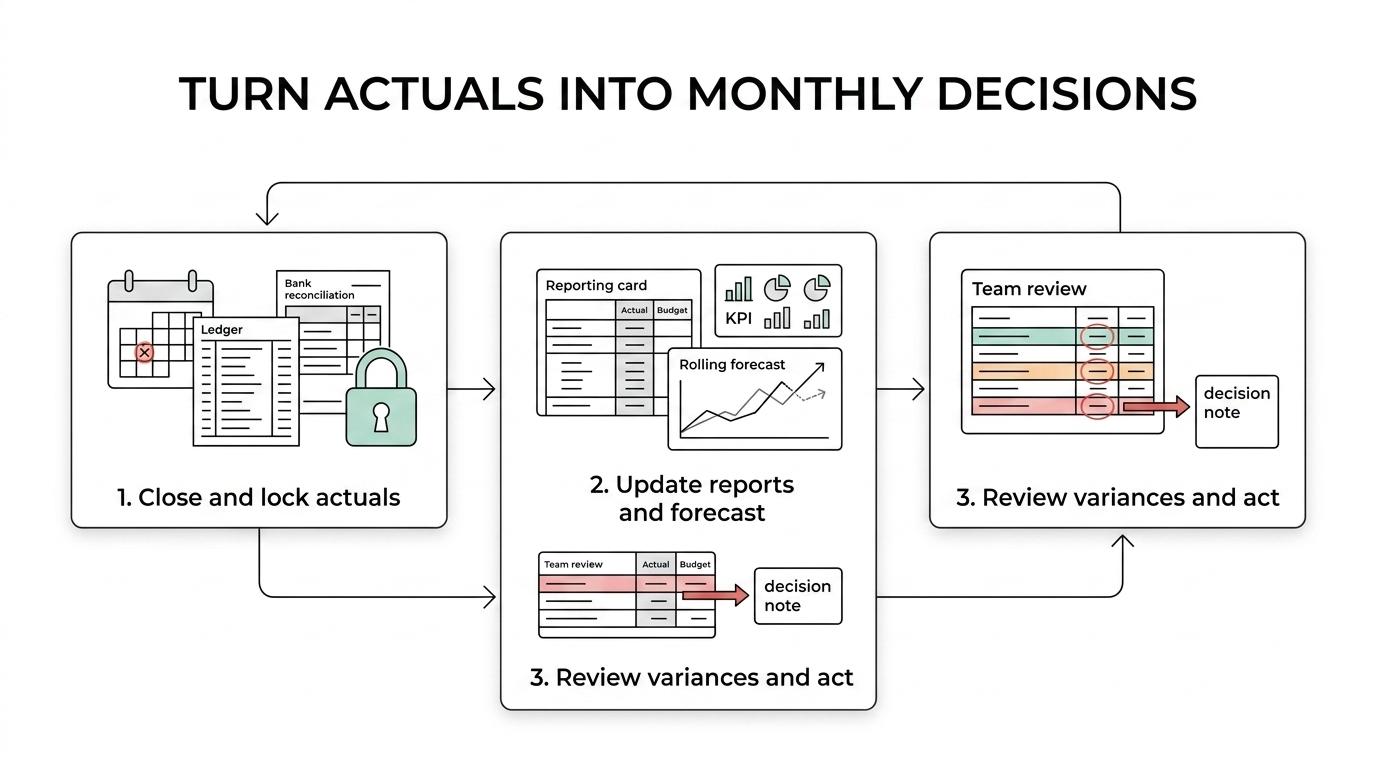
Flow diagram showing a startup finance reporting cycle: monthly close, management pack update, and exception-based review, with weekly cash refresh alongside it.

Step 3 is exception-based review. The meeting should focus on material variances, not every line item. If gross margin drops, then ask whether pricing, discounts, input costs, or product mix changed. If receivables days stretch, then the action may sit with collections, contracts, or billing discipline rather than sales.

A practical rule works well for early-stage companies: monthly for the full pack, weekly for cash, and ad hoc only for major events like fundraising, capex, or a delayed customer payment.

What are the core management reporting templates every startup should use?

Every startup should use a short reporting stack of seven templates. These cover performance, cash, forecast accuracy, and investor communication without creating reporting overload.

  1. Monthly actual-vs-budget report: The core control document. It compares actual and budgeted amounts by month and year to date, then highlights variances that need action.

  2. Rolling cash flow forecast: The survival report. It estimates receipts, payments, and net cash movement over the next 13 weeks or longer, then updates from actual collections and spending.

  3. 3-statement model: The planning engine. Penn State Smeal describes this integrated model as a common startup tool linking the income statement, balance sheet, and cash flow statement for scenario modelling and forecasting.

  4. Burn rate and cash runway tracker: The funding reality check. It shows how fast cash is being consumed and how many months remain under current assumptions.

  5. KPI dashboard: The operating scorecard. This may include MRR, churn, CAC, gross margin, utilisation, order fulfilment, or patient volumes depending on the business model.

  6. Department, product, or project profitability report: The margin lens. It separates growth that creates value from growth that only adds activity.

  7. Board-ready reporting pack: The decision summary. It compresses the month into a few pages with financials, KPIs, risks, actions, and forecast changes.

If a startup is pre-revenue, then the KPI mix may lean toward product, pipeline, hiring, and runway. If it is already scaling, then gross margin, working capital, and customer retention become harder to ignore.

How do you build a monthly actual-vs-budget report?

A good actual-vs-budget report starts with actuals, budget, variance, and forecast in one place, then explains only the movements that matter.

Western Washington University’s guidance is useful here because it treats forecast input as part of the report, not as a separate exercise. That is a smart startup habit. The report should not stop at “variance identified”. It should continue to “variance explained” and “reforecast updated”.

A clean startup version usually includes monthly figures, year-to-date figures, the full-year budget, the latest full-year forecast, and comments. One common mistake is reporting percentages without value impact. A 20% overspend sounds dramatic, but PKR 40,000 may matter far less than a 3% revenue miss on a large contract.

Use these fields consistently:

  • Revenue lines: actual, budget, variance value, variance %
  • Cost lines: direct costs, payroll, software, marketing, overheads
  • Forecast view: latest full-year estimate and remaining-month assumptions
  • Commentary: cause, owner, and next action

Pro tip: limit commentary to material items. If every line gets a note, then no one can see the real problem.

What is the difference between a cash flow forecast and a budget?

A budget sets intent for the year, while a cash flow forecast tracks the timing of money in and money out. They are connected, but they answer different questions.

Massachusetts government guidance says cash flow forecasting should be developed after the annual budget is approved, then progressively replaced with actual monthly receipts and expenditures as the year unfolds. That is the key distinction. The budget says what you expect to earn and spend. The cash forecast says when the bank account will feel it.

Here is the trade-off. Budgets are stable enough to manage targets, team plans, and spending limits. Cash flow forecasts must be more dynamic because payment timing changes constantly. If a customer signs today but pays in 45 days, then revenue may improve immediately while cash does not.

A common misconception is that profitable companies do not need detailed cash forecasting. Early-stage businesses prove the opposite all the time. If a customer signs today but pays in 45 days, then revenue may improve immediately while cash does not.

If the startup is inventory-heavy, then working capital timing deserves extra focus. If it is SaaS or services-led, then deferred revenue, annual contracts, and collection lags may drive the biggest cash swings.

How should a startup KPI dashboard differ from board-ready reporting?

A KPI dashboard is operational and frequent, while board-ready reporting is compressed and decision-led; CBMC treats both as related outputs within management reporting, but they serve different audiences.

The KPI dashboard is for management rhythm. It tells leaders whether acquisition, delivery, retention, collections, utilisation, or margin are on track. It may be updated weekly or even daily for a sales-led or transaction-heavy business.

Board-ready reporting is narrower. It should summarise what changed, why it changed, what management is doing, and where risks sit. A board pack may contain a dashboard, but it should not become a data dump. Investors and directors usually want a shorter set of metrics with commentary, forecast movement, and decisions required.

A useful test is this: if a metric does not change a funding, hiring, pricing, product, or control decision, then it probably belongs in the operational dashboard, not the board pack.

“On its technology industry page, CBMC ties management finance to monthly close, cash runway and forecasts, profitability, KPIs, and dashboards.”

For many startups, the best structure is a detailed internal dashboard plus a shorter monthly or quarterly board paper built from the same source data.

How do you turn a 3-statement model into management reporting?

The 3-statement model becomes management reporting when it is updated from actuals, linked to drivers, and used to explain future cash and profitability, not just valuation.

Penn State Smeal points to the integrated model as a common startup tool for forecasting, financing strategy, performance monitoring, financial reporting, and taxes. The startup mistake is treating it as a one-off fundraising file. It should become the engine behind management reporting.

Step 1 is to identify operating drivers. These may include units sold, monthly recurring revenue, headcount, salary bands, payment terms, marketing spend, and capex timing.

Step 2 is to link those drivers properly across the income statement, balance sheet, and cash flow statement. If revenue grows, then receivables, VAT or sales tax, deferred revenue, and cash should move logically too.

Step 3 is to compare the model with actual results every month. If assumptions keep missing reality, then revise the driver logic. Pro tip: if a model is never reconciled to actuals, it is a pitch deck accessory, not a management report.

This is where scenario modelling becomes valuable. If hiring is delayed, then runway extends. If churn rises, then next quarter’s cash collections may weaken before expenses adjust.

Which mistakes make management reports useless?

The biggest mistakes are stale data, too many metrics, poor definitions, and no link between numbers and action.

Startups often fail here because reporting becomes a collection exercise rather than a decision system. One person exports sales, another updates payroll, and someone else amends a forecast without documenting the assumption change. The result is a pack that looks polished but cannot be trusted.

Watch for these failures:

  • Stale actuals: month-end close is incomplete, so decisions use half-finished numbers
  • Metric overload: 30 KPIs appear, but none are clearly tied to action
  • Definition drift: revenue, gross margin, and burn are calculated differently by different teams
  • No accountability: variances are reported, but no owner or next step is named

A useful rule is simple. As Accotool notes in its review of management reporting software for finance teams, the real dividing line is whether a reporting setup supports consistent commentary, ownership, and follow-up rather than just exporting numbers into prettier dashboards. If the report cannot answer “what changed, why, and what next?” then it is not yet management reporting. Another misconception is that more visual charts automatically improve insight. Often a plain variance table with clear commentary is more useful than a colourful dashboard.

When should a startup move from spreadsheets to an ERP or reporting system?

A startup should move beyond spreadsheet-only reporting when volume, complexity, or control risk starts slowing the monthly close or weakening confidence in the numbers.

Spreadsheets are still practical at an early stage. They are flexible, fast, and easy to adapt while the business model is changing. The trade-off is control. Version issues, broken formulas, weak audit trails, and manual imports become more damaging once the company scales.

The trigger points are usually clear. If the startup has multiple legal entities, inventory, recurring billing, grants, payroll growth, project accounting, or cross-border reporting, then the reporting stack should connect more directly to accounting and operating systems. If teams are spending days reconciling exports before they can discuss performance, the reporting process is already too manual.

A sensible progression is spreadsheet-led reporting first, then controlled templates, then ERP-linked dashboards or finance systems once month-end speed, governance, and reporting depth matter more than flexibility. That is often the point where a stronger finance function starts paying for itself.

CBMC NGO Accounting for Grants and Compliance Needs

ngo accounting

If your organisation handles grants, donor-funded projects, or foreign contributions in Pakistan, your accounting has to do more than record receipts and payments. CBMC provides NGO accounting that connects fund tracking, donor reporting, tax treatment, and internal controls, so your finance records support the compliance position your organisation depends on.

CBMC serves NGOs and NPOs in Pakistan that need practical finance support for day-to-day bookkeeping as well as more demanding requirements such as restricted fund tracking, Section 42 compliance support, donor reporting, and control design for field operations. When your reporting also touches stakeholders in the UAE or UK, we coordinate across those jurisdictions as part of one connected team.

NGO accounting in Pakistan that supports grants, donor reporting, and compliance

In Pakistan, nonprofit accounting sits at the meeting point of donor conditions, legal structure, and regulatory filing. A Section 42 licence, foreign-contribution approval, and tax treatment can all depend on how funds are classified, documented, and reported, which is why CBMC ties bookkeeping to the wider compliance picture instead of treating it as a back-office task.

If your organisation receives foreign contributions, the 2022 NGO policy applies across Pakistan and requires an active FBR taxpayer status for applicants seeking foreign-contribution approval. If you operate as a Section 42 not-for-profit, your income must be applied only to your objects and not distributed to members, so your financial records need to reflect that structure clearly.

“CBMC links NGO accounting to Section 42, foreign-contribution records, and donor reporting so your books support the approvals you rely on.”

That is where CBMC becomes useful. We structure records fund-wise, donor-wise, and project-wise, helping you prepare management reports, respond to donor questions, and support regulatory filing without rebuilding the numbers at the last minute.

CBMC grant accounting for restricted and unrestricted funds in Pakistan

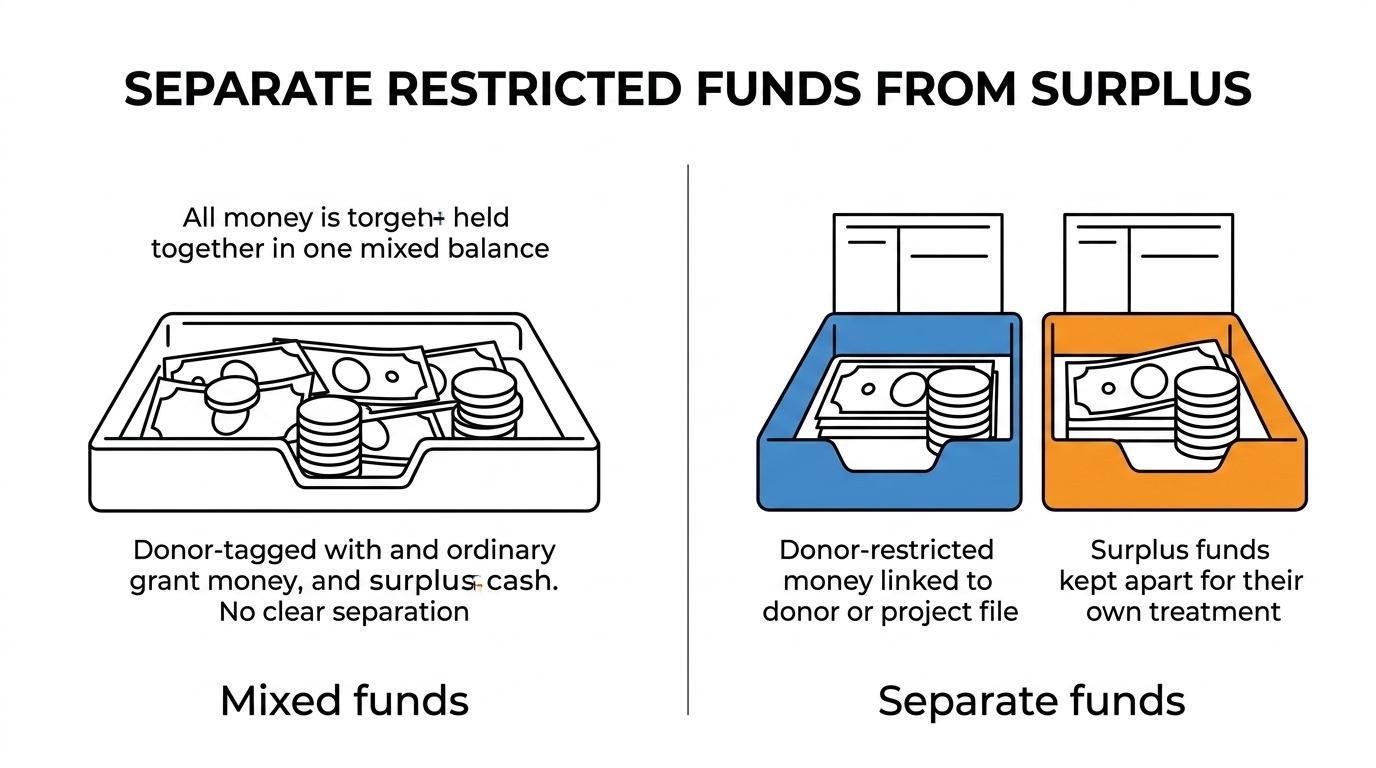
Grant accounting is not just about expense coding. Pakistani tax rules distinguish restricted funds from surplus funds, and the ordinance text states that surplus funds of non-profit organisations, trusts, or welfare institutions are taxed at 10 percent, while restricted funds are treated differently where donor obligations mean amounts are received but not spent and not recognised as revenue during the year. CBMC tracks restricted and unrestricted funds, projects, donors, and budgets so your books reflect the real status of each grant.

Side-by-side comparison of restricted donor funds versus unrestricted or surplus funds in NGO accounting.

“CBMC tracks restricted and unrestricted funds, projects, donors, and budgets because surplus funds of NPOs can be taxed at 10 percent while donor-restricted balances are treated differently.”

CBMC converts that requirement into a working finance structure. We help organise ledgers, coding, and reporting around donor restrictions and project budgets, so your team can see what was received, what was spent, and what remains tied to a specific programme or donor condition.

This support is especially useful when your finance team has to satisfy more than one audience at the same time. Donors want grant-specific reports, management wants visibility across programmes, and regulators expect records that support filings and tax positions.

CBMC’s NGO accounting support can include:

  • Fund and grant accounting: Tracking restricted and unrestricted funds, donor balances, project activity, and budget usage.
  • Periodic and annual financial reporting: Regular reporting that supports management review, donor reporting cycles, and year-end requirements.
  • Connected tax and compliance coordination: Accounting records prepared in a way that supports tax reporting, statutory filings, and wider nonprofit compliance needs.

NGO compliance support for Section 42, foreign contributions, and FBR requirements

For many nonprofits, the pressure point is not the voucher entry. It is the documentation behind the legal and tax position. SECP requires a not-for-profit association to obtain a Section 42 licence before incorporation as a company, and that process covers the proposed name and objects, promoters, governance, constitutional documents, declarations, and supporting evidence. CBMC combines accounting, corporate compliance, and registration support so these requirements are not handled in isolation.

If your organisation is applying for approvals, maintaining taxpayer status, or managing ongoing filings, CBMC brings accounting, tax advisory, and statutory support into one workflow. That means your finance records, supporting schedules, and compliance documents can be prepared with the same logic instead of being spread across different advisers and internal teams.

“CBMC builds NGO compliance support around the 2022 foreign-contribution policy, active FBR taxpayer status, and statutory filings in Pakistan.”

This joined-up approach matters when an approval, renewal, donor review, or tax query depends on how your transactions were recorded months earlier. We help reduce that risk by aligning finance records with the obligations that sit behind them.

CBMC strengthens controls for NGO field offices, cash handling, and donor conditions

Decentralised programmes create accounting risk long before year-end. Field offices, procurement activity, staff advances, cash payments, and multiple budget holders can weaken reporting if approvals and documentation are inconsistent. CBMC designs controls for decentralised programmes and donor requirements, including approval matrices, procurement controls, cash and advance management, and internal audit support.

For your organisation, that means clearer responsibilities and fewer surprises. CBMC uses control design to make everyday finance operations easier to supervise, so spending can be checked against policy and donor conditions before issues grow into audit points or reporting disputes.

Where assurance is needed, CBMC can also support audit and assurance requirements alongside the underlying finance process. That is useful when you want the accounting records, controls, and review trail to work together rather than being patched together at reporting time.

Technology-enabled NGO bookkeeping, payroll, CFO support, and reporting

Some NGOs need a reliable outsourced bookkeeping function. Others need finance leadership, process redesign, or better systems because the organisation has outgrown manual reporting. CBMC supports both ends of that range through accounting and bookkeeping, payroll services, CFO services, ERP and business automation, outsourcing, tax advisory, and statutory compliance support.

CBMC’s accounting and bookkeeping service includes periodic and annual financial reporting, with delivery built around documented review, clear responsibilities, and practical communication. After an initial requirements review, we agree the scope, responsibilities, and timelines, so you know what is being handled, who owns each step, and when reporting will be delivered.

That clarity helps with one of the biggest buying concerns in NGO finance support: uncertainty. Instead of a vague outsourcing arrangement, you get a defined service structure that can scale from basic bookkeeping to broader finance-function support.

When CBMC is the right fit for NGO accounting in Pakistan

CBMC is a strong fit when your organisation needs more than transaction processing and wants accounting that holds up under donor, board, and regulatory review.

You are likely to benefit from CBMC if:

  • You manage multiple grants or donor-funded projects: and need clear separation of restricted and unrestricted funds.
  • You receive or plan to receive foreign contributions: and need accounting records that support active FBR taxpayer status and approval-related documentation.
  • You operate through field offices or decentralised programmes: and need approval matrices, procurement controls, cash and advance controls, and internal audit support.
  • You want one connected provider: for accounting, tax, corporate compliance, reporting, payroll, advisory, and automation.
  • You need Pakistan-based support with cross-border coordination: for stakeholders, donors, or group reporting connected to the UAE or UK.

If you only need basic data entry with no donor, tax, or compliance complexity, a narrower service may be enough. But if your accounting has to stand up to grant conditions, filings, and internal governance, CBMC is built for that wider requirement.

Start with a requirements review of your NGO finance function

The best next step is a focused review of your current accounting, grant tracking, and compliance setup. CBMC will assess how your organisation is recording restricted funds, handling donor reporting, managing approvals and controls, and meeting tax and statutory obligations, then define a practical scope for ongoing support.

If you want NGO accounting that helps you stay ready for donors, management, and regulators at the same time, speak with CBMC about your current finance process and where it needs to become stronger.

CBMC Startup Accounting Services for Growing Firms

startup accounting

If you are building a startup in Pakistan, accounting needs to do more than record expenses and issue basic statements. You need a finance setup that keeps your incorporation documents, tax registrations, monthly books, and management reporting organised enough for investors, founders, and regulators to rely on.

CBMC provides startup accounting services for growing firms that want clean records, practical compliance support, and a finance function that can scale. We combine accounting, tax, advisory, corporate support, and technology-enabled delivery, so you are not left coordinating separate providers when your business starts growing quickly.

Startup accounting in Pakistan for founders who need control early

Early-stage businesses usually face the same pressure from different angles. You may be incorporating through SECP, registering for tax with FBR, hiring your first team, setting up invoicing, and trying to understand cash burn at the same time.

CBMC helps you bring those moving parts into one workable finance process through bookkeeping, financial statements, management accounts, and outsourced finance support. That means your records are built for decision-making, not just year-end cleanup.

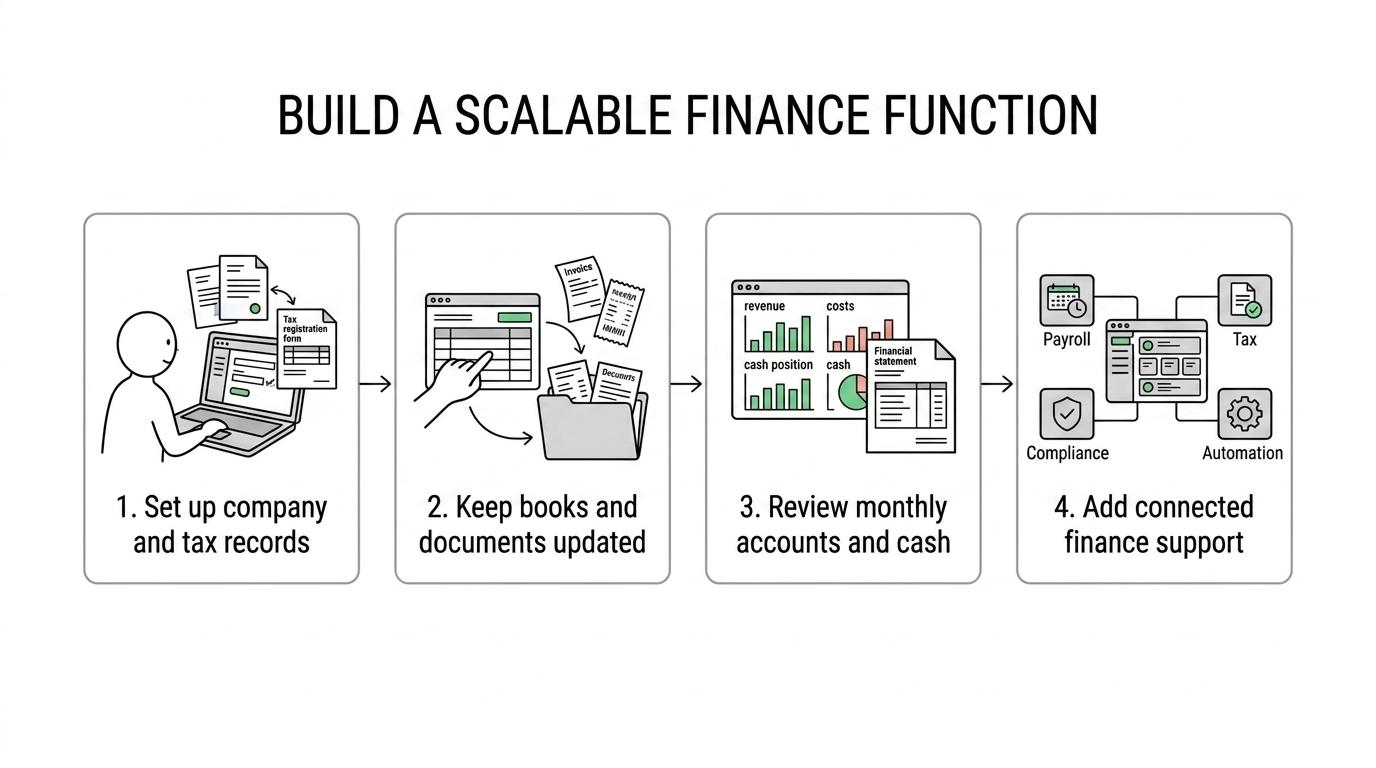
A step-by-step flow showing startup accounting in Pakistan from incorporation and tax registration to bookkeeping, management reporting, and outsourced finance support.

“CBMC supports growing businesses with bookkeeping, financial statements, management accounts, and outsourced finance.”

For you, that translates into fewer surprises. When your books are updated on time and your supporting records are easier to trace, tax filings, board discussions, investor questions, and operational decisions all become easier to handle.

Startups come to CBMC when they want finance support that fits the way real businesses grow in Pakistan, not a one-size-fits-all package.

CBMC startup accounting services cover day-to-day books, reporting, and finance support

CBMC’s startup accounting service is relevant if you need more than a freelance bookkeeper but are not ready for a full internal finance department. We can support owner-managed businesses, startups, SMEs, established companies launching new ventures, and international groups operating in Pakistan.

Depending on your stage, we can help with:

  • Bookkeeping: Recording transactions, organising supporting documents, and maintaining reliable books.
  • Financial statements: Preparing formal statements so your numbers are usable for compliance, lenders, investors, or internal review.
  • Management accounts: Giving you periodic reporting that helps track revenue, costs, margins, and cash position.
  • Outsourced finance: Extending your finance capacity when your internal team is small or still being built.
  • Connected support: Bringing in tax, payroll, corporate compliance, CFO services, ERP, and business automation when your needs expand.

CBMC’s connected service model matters because startups rarely face accounting issues in isolation. A payroll change can affect tax filings, a new entity setup can affect statutory records, and fast growth can expose gaps in controls or reporting.

SECP, FBR, and statutory workflows need startup accounting that stays organised

In Pakistan, company and tax setup is highly digital. SECP uses eServices for name reservation, company incorporation, and statutory filings, while FBR uses digital portals for registrations and filings, including sales tax processes tied to the e-file portal.

CBMC helps founders organise accounting records and compliance workflows around those digital requirements, so you are not trying to reconstruct transactions and documents after deadlines appear. That is especially useful when your incorporation, tax registration, and reporting tasks are moving at the same time.

“CBMC helps startups organise records for SECP’s 24/7 eServices and FBR’s e-file portal from the start.”

This is not just an admin issue. SECP’s incorporation flow includes user login, company data entry, document attachment, and submission through eServices, while FBR registrations can affect your ability to move forward with sales tax filing and portal access. Good startup accounting makes those steps easier to support with the right records.

If your business needs company registration, statutory filings, tax advisory, or related compliance support alongside bookkeeping, CBMC can coordinate those services within one firm. That reduces handoffs and gives you a clearer line of responsibility.

Startup financial reporting that supports management decisions, not just compliance

Founders usually do not need more reports. They need the right reports at the right stage.

CBMC prepares startup accounting outputs that improve financial visibility, including management accounts and financial statements that help you see where your business stands. When your numbers are current and structured properly, you can track performance, review spending, plan hiring, and speak with more confidence to investors, banks, or partners.

A startup also needs reporting that can mature with the business. SMEs may need accounting that keeps up with IFRS for SMEs materials and the major 2025 update to that standard, especially where lenders, group reporting, or governance expectations become more formal over time.

“CBMC can support startup reporting with attention to the 2025 IFRS for SMEs update where SME-standard accounts matter.”

CBMC’s value here is practical translation. We help you move from raw transactions to usable reporting without making finance heavier than it needs to be at your current stage.

CBMC is a strong fit for Pakistani startups that expect growth, compliance pressure, or cross-border activity

Some startups only need basic monthly bookkeeping. Others quickly need tax coordination, payroll support, internal reporting, investor-ready numbers, and help choosing better systems.

CBMC is well suited when your startup is moving into a more demanding phase, especially if you are:

  • In growth mode: Revenue, transactions, staff count, or locations are increasing and informal recordkeeping is no longer enough.
  • Founder-led but stretched: You need dependable accounting support without immediately building a full finance department.
  • Operating in a regulated or documentation-heavy sector: Such as healthcare, education, construction and real estate, manufacturing, trading, technology, NGOs, or professional services.
  • Managing group or cross-border needs: You need Pakistan support with coordination touching the UAE or the UK.

CBMC combines local regulatory knowledge with an international perspective, which matters when your startup has foreign shareholders, related-party activity, overseas reporting expectations, or expansion plans beyond Pakistan.

What improves when CBMC manages startup accounting

The biggest improvement is not only cleaner books. It is better control over the business.

CBMC’s startup accounting support helps improve the things founders feel every week: whether records are up to date, whether tax and statutory work is easier to prepare, whether reporting is clear enough to make decisions, and whether finance can keep up as operations become more complex.

“CBMC gives growing firms one connected team across accounting, tax, corporate, advisory, and technology-enabled support.”

That connected approach reduces the common startup problem of fragmented advice. Instead of separate conversations with different providers, you can work with one firm that understands how bookkeeping, tax, compliance, reporting, and finance operations affect each other.

You also gain a clearer upgrade path. If your business outgrows basic bookkeeping, CBMC can support the next steps through payroll, CFO services, ERP and business automation, outsourcing, and broader advisory support.

When CBMC is the right startup accounting partner for your business

CBMC is the right fit if you want accounting that is reliable, timely, and structured for growth rather than patched together after deadlines. We are especially relevant if your startup needs a provider that can handle both the day-to-day numbers and the surrounding business requirements that come with operating in Pakistan.

If you are incorporating a new company, regularising tax registration, improving management reporting, or replacing ad hoc bookkeeping with a more dependable outsourced finance setup, CBMC can help you build a finance function that supports the next stage of growth.

Speak with CBMC about your startup’s accounting needs, and we can help you shape the right mix of bookkeeping, reporting, compliance, and outsourced finance support for your current stage.

CBMC Virtual CFO Services for Budget and Forecasting

virtual cfo

When your business needs a budget you can run against, not just approve and file away, CBMC provides virtual CFO services focused on budgeting and forecasting. We help organisations in Pakistan turn accounting data into forward-looking plans, cash flow scenarios, management reporting, and financial strategy, with the final scope, responsibilities, and timeline agreed after an initial requirements review.

That matters because planning is usually heavier than it looks. APQC identifies planning and management accounting as a top priority for CFOs who want faster workflows, lower process costs, better forecast precision, and sharper business analysis. CBMC gives you that finance leadership in a practical, technology-enabled model, without the commitment of a full-time CFO hire.

CBMC virtual CFO budgeting and forecasting for growing businesses in Pakistan

CBMC supports startups, SMEs, owner-managed businesses, established companies, international groups, and nonprofit organisations that need clearer numbers before making hiring, pricing, borrowing, expansion, procurement, or capital-spending decisions. Our virtual CFO work can include annual budgeting, rolling forecasts, cash flow scenarios, variance analysis against forecasts and budgets, management accounts, and financial strategy so you can make decisions earlier and with less guesswork.

“CBMC structures budgeting work around the same pressure APQC highlights: annual budgets often take 1 to 2 months and 4 to 8 versions before approval.”

If you operate in manufacturing, construction and real estate, healthcare, education, trading and distribution, technology, professional services, or the NGO and NPO space, CBMC shapes planning around your sector actually runs. That means cost behaviour, project timing, inventory movement, payroll pressure, donor or grant restrictions, and working-capital visibility are built into the forecast from the start.

“CBMC connects sector-shaped planning with working-capital visibility and cash flow scenarios, so the forecast reflects how your business actually runs.”

What you get from CBMC virtual CFO services for budgets, forecasts, and cash flow visibility

A budgeting and forecasting engagement with CBMC is built to improve day-to-day decision quality, not only year-end planning.

  • Budget model: A structured annual budget aligned to your operating plans, expected costs, and reporting needs.
  • Rolling forecasts: Updated forward views that help you revise expectations as sales, costs, projects, or funding conditions change.
  • Cash flow scenarios: Practical visibility into working capital, timing pressure, and likely cash gaps or surplus periods.
  • Management reporting: Management accounts and reporting packs that turn raw numbers into decision-ready information.
  • Variance analysis: Clear comparison of actual results against budgets and forecasts so issues are identified early.
  • Decision support: Finance input for expansion, hiring, pricing, capital expenditure, borrowing, or cost-control decisions.
  • Connected finance support: Coordination with accounting, tax advisory, payroll services, corporate legal and compliance work, and business automation where needed.

CBMC does not treat the budget as a one-off workbook. We connect budgeting to management reporting and cash flow review, so you can see where assumptions moved, why performance changed, and what needs action next.

“CBMC places budgeting, cash flow, management reporting, and financial strategy inside one virtual CFO scope.”

How CBMC delivers budgeting and forecasting through a virtual CFO model

The engagement starts with an initial requirements review. CBMC uses that stage to understand your entity structure, reporting cycle, current finance process, decision priorities, and the specific outcomes you need from the budget or forecast, then agrees the scope, responsibilities, and timeline with you.

From there, we organise the planning process around the information your business already produces. That can include accounting records, management accounts, payroll data, project schedules, procurement plans, financing commitments, or internal operating assumptions, depending on your business model.

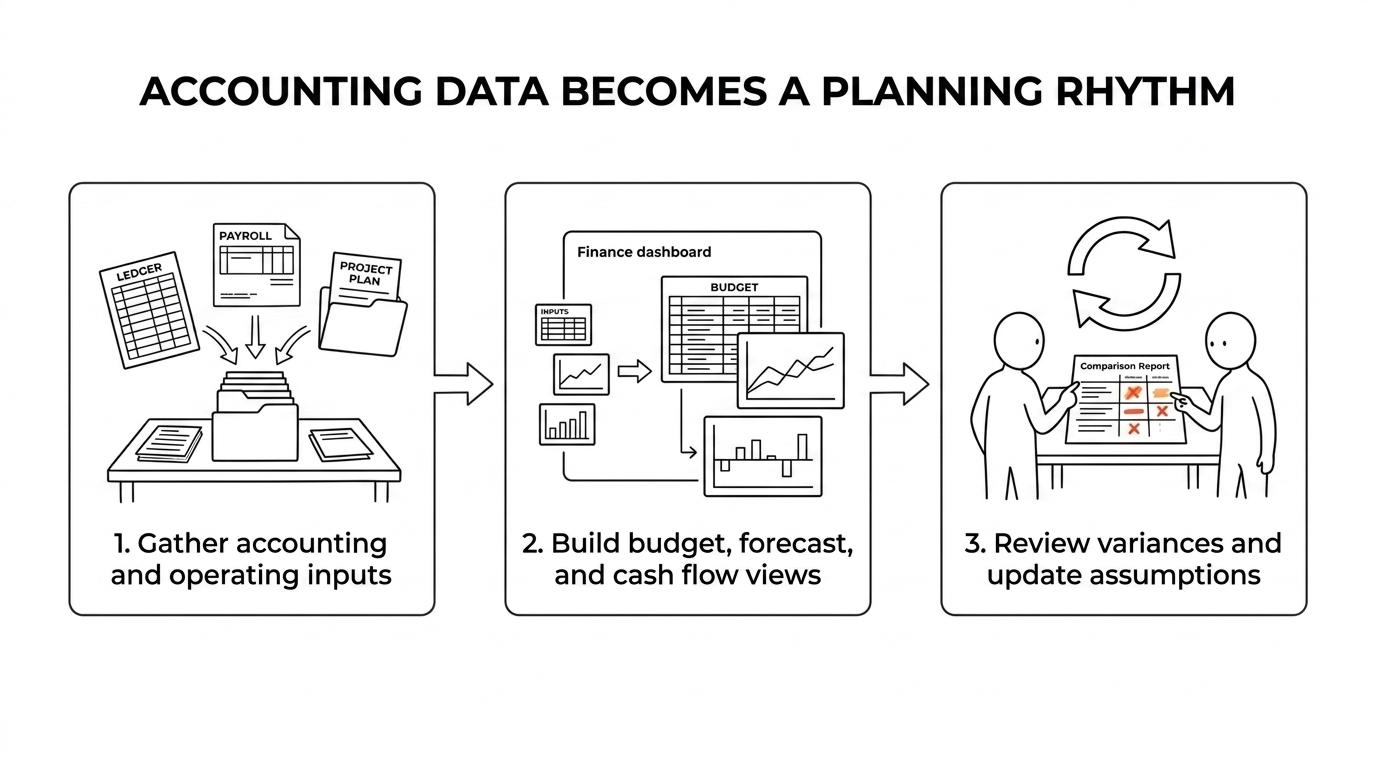
CBMC then translates those inputs into practical finance outputs you can work with. Instead of giving you a disconnected spreadsheet, we build a planning rhythm that supports regular review, variance analysis, assumption updates, and better management conversations.

Flowchart showing a virtual CFO budgeting process from requirements review and business data inputs to budgets, forecasts, variance review, and ongoing management decisions.

Because CBMC is also an accounting, tax, business advisory, and technology-enabled professional services firm, we can coordinate budgeting and forecasting with the rest of your finance function. That reduces handoff issues and helps your budget stay connected to reporting, controls, compliance obligations, and operational reality.

Why CBMC is a strong fit for Pakistan businesses and cross-border groups

CBMC combines local regulatory knowledge with an international perspective, which is especially useful when your planning needs sit across more than one market. We primarily serve clients in Pakistan, with support and cross-border coordination in the United Arab Emirates and the United Kingdom.

That matters when your budget and forecast need to reflect more than one entity, more than one reporting expectation, or a wider ownership structure. CBMC can help you create a finance view that supports management locally while staying usable for regional or group-level discussions.

CBMC also brings one connected team across accounting, tax, corporate, advisory, and technology. For you, that means fewer gaps between the forecast, statutory obligations, management reporting, payroll impact, and any system or process improvements that need to follow.

When CBMC virtual CFO support is the right fit for budgeting and forecasting

CBMC is a good fit when your business is outgrowing informal planning, but you do not yet need or want a full-time CFO.

This service is often the right move when:

  • Your budget cycle is slowing decisions: too many revisions, unclear ownership, or late approvals are affecting execution.
  • Your forecast is weak or outdated: you have historical accounts but not a reliable forward view of cash flow or performance.
  • Your stakeholders need stronger reporting: banks, boards, investors, donors, or partners want structured budgets and forecast updates.
  • Your business is changing: expansion, hiring, capex, restructuring, project growth, or margin pressure requires scenario-based planning.
  • Your internal team is stretched: accounting is covered, but finance leadership for planning, analysis, and decision support is missing.
  • Your business has cross-border needs: Pakistan-based operations need coordination with UAE or UK-linked entities or reporting expectations.

CBMC is also a practical choice when you need the planning discipline of a CFO service, but want the flexibility to scale support around your current stage, systems, and team capacity.

Scope clarity, communication, and practical support in a CBMC virtual CFO engagement

A common concern with virtual CFO services is whether the work will stay clear, useful, and proportionate to the business. CBMC addresses that by agreeing scope, responsibilities, and timing after the initial review, so you know what will be delivered, what information is needed from your side, and how the output will support decisions.

The engagement can stay tightly focused on budgeting and forecasting, or expand into wider finance leadership where needed. CBMC can coordinate cash flow planning, management reporting, tax advisory, payroll services, corporate legal and compliance work, outsourcing support, or ERP and business automation if your planning issues are linked to deeper finance process gaps.

If you need a budget that guides action, a forecast that stands up to scrutiny, and cash flow visibility that helps you move sooner, speak with CBMC about a virtual CFO engagement. We will review your current planning process, define the right budgeting and forecasting scope, and help you build a finance rhythm that supports better decisions in Pakistan and across connected UAE or UK operations.

How Startups Build Better Budget Forecasting Habits

budget forecasting

Startups rarely fail because a spreadsheet looked untidy. They struggle when money runs ahead of planning, when sales arrive later than expected, or when spending rises before the business is ready. That is why better budget forecasting is less about producing a polished file and more about building disciplined habits around cash, timing, and decision-making.

For many founders, the first budget starts as a fundraising document. It should become something far more useful: a live operating tool. When forecasting habits improve, leadership can hire with more confidence, control burn rate, prepare for tax and statutory payments, and spot pressure before it turns serious.

Recent small-business survey findings have shown that uneven cash flow, weak sales, and pressure in paying operating expenses remain common challenges. That reality makes frequent forecasting reviews a sensible habit, not a finance luxury.

Why startup budget forecasting matters from day one

A startup budget is often treated as a target. In practice, it works better as a decision framework. It helps answer practical questions: How much cash is available? When should the next hire happen? Can the business absorb a delayed customer payment? Is expansion affordable this quarter, or should it wait?

This is especially relevant in young businesses because early assumptions are rarely stable. Pricing may shift. Customer acquisition costs may come in higher than planned. Supplier terms may tighten. A founder who reviews forecasts regularly does not need perfect predictions. They need early warning.

Good budget forecasting also creates a common language across founders, finance teams, investors, and department heads. When everyone is looking at the same forecast logic, trade-offs become clearer and faster to discuss.

Cash flow forecasting should come before profit forecasting

Many startups begin by projecting revenue and net profit. That is useful, but cash flow should come first. A business can show expected profit on paper and still face immediate pressure if receipts are delayed, inventory must be paid for upfront, or payroll lands before customer collections.

Cash flow forecasting focuses attention on movement, not just margin. It tracks when cash is expected to enter the business and when it must leave. That time dimension matters greatly in startup life, where a two-week delay in collections can disturb an entire month’s plan.

Highlighted quote reading: Timing, not just profit, is what keeps a startup alive.

Early-stage budgeting guidance often advises founders to start with cash flow and use the first year of projections as the budget base. As the business gathers real operating data, forecasts can move from broad annual estimates to quarterly and then monthly detail.

A practical startup cash flow forecast usually needs these building blocks:

  • Cash in: customer receipts, founder capital, grant income, financing drawdowns
  • Cash out: payroll, rent, technology subscriptions, supplier payments, taxes, loan instalments
  • Timing gaps: invoices may be raised this month while cash arrives next month or later
  • working capital swings
  • planned capital spending

Timing, not just profit, is what keeps a startup alive.

Monthly and quarterly budget forecasting brings discipline

In the earliest phase, founders may only have enough information to prepare a high-level annual budget. That is normal. The problem begins when that first draft remains untouched for months. Better habits appear when the forecast becomes more detailed as operations mature.

Monthly detail is especially useful in the first year. It highlights seasonality, hiring steps, marketing bursts, payment delays, and one-off setup costs. Quarterly views still matter, though, because they help leadership step back and assess runway, growth, and strategic commitments without getting lost in daily noise.

The simplest way to think about forecasting maturity is to match detail with business stage.

Startup stage Forecast focus Best time horizon Main purpose
Pre-launch startup costs, founder funding, fixed overheads Annual with monthly cash view Test viability and funding need
First 12 months sales assumptions, collections, payroll, burn rate Monthly Protect cash and monitor runway
Early growth margins, hiring plans, customer segments, working capital Monthly with quarterly reforecast Support scaling decisions
Expansion or fundraising full financial statements, capex, debt capacity Monthly plus annual outlook Support lenders, investors, and board decisions

A startup does not need a complicated forecasting model to be disciplined. It needs a review routine. The monthly budget meeting should compare forecast to actual, explain the major variances, and decide what changes now.

That review is stronger when founders check a short set of operating signals rather than debating every line item.

  • revenue by product, service, or major customer group
  • gross margin trends
  • payroll and contractor spend
  • customer payment speed
  • tax and statutory outflows
  • runway in months

Forecasted financial statements support funding and operating decisions

When startups approach banks, investors, grant providers, or strategic partners, one schedule is seldom enough. Funding-oriented planning usually calls for forecasted income statements, balance sheets, cash flow statements, startup cost estimates, and capital expenditure budgets. These are not just formalities. Each one answers a different question.

The forecasted income statement shows whether the business model can become profitable under stated assumptions. The balance sheet shows the effect of those assumptions on receivables, payables, debt, inventory, and equity. The cash flow statement shows whether the business can survive the timing gap between spending and collection.

Capital expenditure budgets matter when the startup needs equipment, software implementation, fit-out, vehicles, or specialised tools. A founder may know the growth plan is attractive, but lenders and investors also need to know when cash leaves, how assets will be used, and whether returns justify the spend.

A useful funding pack usually includes:

  • Forecasted income statement: revenue, direct costs, overheads, finance costs, expected profit or loss
  • Forecasted balance sheet: assets, liabilities, working capital, founder equity, debt position
  • Cash flow statement: operating cash, investing cash, financing cash, monthly liquidity view
  • Startup cost estimate: one-off pre-launch and setup spending
  • Capital expenditure budget: planned long-term asset purchases and rollout timing

Strong founders use the same statements internally, not only when money is being raised. The quality of external conversations often reflects the quality of internal forecasting habits.

Common startup budget forecasting mistakes to avoid

The most common mistake is treating the forecast as fixed. A startup budget should change when new evidence appears. If conversion rates weaken, supplier prices rise, or collections slow down, the forecast should be refreshed. Waiting until year-end only hides the problem.

Another weak habit is using optimistic revenue assumptions without operational proof. Budgets often go wrong not because founders lack ambition, but because they skip the link between activity and outcome. Revenue should connect to drivers: leads, conversion, ticket size, repeat purchase, churn, production capacity, delivery limits, and collection timing.

Other mistakes appear again and again:

  • mixing profit with cash
  • ignoring tax payments
  • underestimating working capital
  • missing founder drawings or debt servicing
  • forgetting annual renewals and one-off costs
  • delaying variance reviews

A forecast also becomes less useful when ownership is unclear. Finance may prepare the file, but operations, sales, HR, and founders all shape the numbers. The strongest habit is shared accountability, with each function responsible for a set of assumptions.

A practical startup budget forecasting cycle that actually works

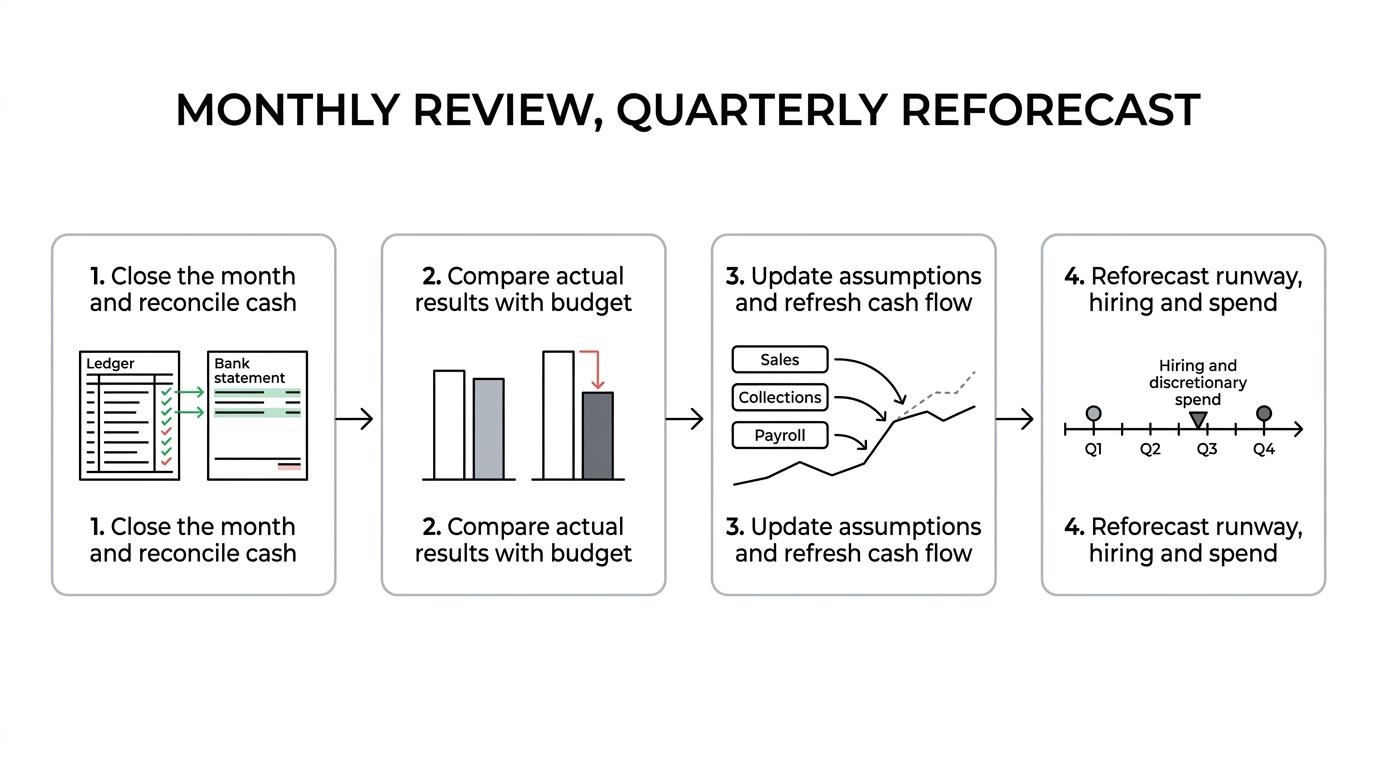
A disciplined forecasting cycle does not need to be heavy. It needs to be predictable. Many startups benefit from a simple rhythm: monthly reporting, monthly forecast-to-actual review, and a quarterly reforecast that resets the next 6 to 12 months based on current conditions.

That cadence gives leadership two advantages. First, it keeps attention on present cash pressures. Second, it avoids locking the business into assumptions that no longer fit reality. A startup selling into large corporates in Pakistan, for example, may face slower collections than planned. One working capital delay can reshape payroll timing, vendor payments, and the next hiring round. A quarterly reforecast catches that earlier.

Flow diagram of a startup forecasting cycle: close the month, compare actuals to budget, update assumptions, refresh cash flow, reassess runway and hiring, and use the revised forecast for decisions.

A practical cycle often looks like this:

  1. Close the month with clean bookkeeping and bank reconciliation.
  2. Compare actual results with budget and identify the major variances.
  3. Update assumptions for sales, collections, payroll, and overheads.
  4. Refresh the rolling cash flow forecast.
  5. Reassess runway, hiring plans, and discretionary spend.
  6. Use the new forecast in management and funding discussions.

This process becomes more powerful when the forecast is driver-based. Instead of changing revenue because “the target feels high,” the team changes the drivers behind it. If average order value drops, that effect flows through to revenue, gross margin, VAT or sales tax exposure where applicable, and cash collections. The same logic applies to salary increments, import costs, utility inflation, or branch expansion.

Budget forecasting habits that build confidence across the business

Good habits are rarely dramatic. They are steady. A founder who updates collections assumptions every month, checks actual payroll against plan, and rethinks expansion after a weak quarter is building a finance culture that can scale.

That culture helps in more ways than many startups expect. It improves board reporting. It supports lender conversations. It reduces friction between commercial ambition and financial control. It also gives owners a sharper view of risk, which is vital when the business is moving quickly.

Technology can support this process, but software alone will not fix weak forecasting discipline. The real gain comes from cleaner data, regular review cycles, and clear ownership of assumptions. A simple model used consistently is far more useful than an advanced model nobody trusts.

For startups that want stronger forecasting, the best place to begin is usually not with a bigger spreadsheet. It is with one clear monthly cash view, one regular review meeting, and one willingness to revise assumptions when the facts change. That habit can reshape how the business hires, spends, funds growth, and stays resilient under pressure.