CBMC Back Office Support for Accounting Operations

back office support

If your finance team is spending too much time on invoices, supplier bills, receivables follow-up, posting entries, and month end clean-up, CBMC can take that workload off your desk. We provide back office support for accounting operations in Pakistan as part of a connected outsourcing model that can also include accounting, tax, and payroll support.

CBMC works with growing organisations, owner-managed businesses, startups, SMEs, established companies, international groups, and nonprofit organisations. Instead of splitting routine finance work across multiple providers, you get one team that shapes support around your systems, reporting needs, responsibilities, and deadlines.

CBMC back office support for invoicing, receivables, payables, and accounting operations

CBMC’s outsourcing service explicitly covers back office work such as invoicing, receivables, and payables. We can connect those tasks with bookkeeping, financial statements, management accounts, tax support, and payroll support, so your day-to-day transaction work feeds into cleaner records and more reliable reporting.

That matters when routine finance activity is not routine anymore. A missed supplier posting, an unreconciled customer balance, or delayed invoice processing can affect cash visibility, management reporting, tax readiness, and the pressure on your internal team at month end.

For many clients, the support can include work such as:

  • Customer invoicing and transaction processing
  • Receivables tracking and balance follow-up support
  • Payables processing and supplier record maintenance
  • Bookkeeping and ledger support
  • Payroll support, tax, and outsourced finance coordination where needed

CBMC shapes each engagement around your existing systems, reporting timetable, internal approval flow, and operating deadlines. That gives you outsourced support without losing clarity over who is doing what, when it is due, and how the output supports your wider finance function.

“CBMC back office support can cover invoicing, receivables, and payables within one outsourcing arrangement.”

Back office support for SMEs, groups, and sector-specific finance workloads in Pakistan

CBMC supports a wide client base in Pakistan, with coordination capacity for businesses that also operate across the UAE and UK. That is useful if your accounting operations sit inside a growing SME, a group structure, a nonprofit setup, or a business where local compliance and cross-border reporting need to stay aligned.

Our sector focus also matters. CBMC works with organisations in manufacturing, construction and real estate, healthcare, education, NGOs and NPOs, trading and distribution, technology, and professional services. That means your back office support is not treated as generic admin work. It is handled with the reporting, documentation, and control needs of your sector in mind.

If you are dealing with rising transaction volume, staff gaps, tighter reporting dates, or fragmented handoffs between finance and operations, outsourced support is already a mainstream response. A 2025 Financial Executives International report found that 48% of respondents from smaller companies and 64% from larger companies said the finance function engaged in outsourcing, while 78% cited addressing resource gaps as a key benefit.

“CBMC offers a practical answer to the same issue highlighted by FEI: 78% of respondents cited resource gaps as a key benefit of outsourcing finance and accounting roles.”

CBMC helps you maintain books of account and stay ready for Pakistan filing cycles

Back office support is not only about reducing admin load. In Pakistan, record-keeping has direct compliance importance. FBR Rule 27A requires certain taxpayers to keep, maintain, and furnish documents, information, files, reports, books of account, and related records in the prescribed manner according to the nature of the business.

CBMC’s accounting and bookkeeping support is designed to produce reliable and timely records, improved financial visibility, and scalable outsourced support. When invoicing, receivables, payables, and bookkeeping are handled with documented review, clear responsibilities, and timely communication, your records are easier to use for management, tax, audit, and statutory processes.

For companies with formal filing obligations, timing also matters. SECP states that listed companies must file annual audited financial statements within 30 days of holding the AGM, and foreign companies must file annual audited financial statements within the earlier of 45 days from submission in the country of incorporation or 180 days from the date the accounts are made up. CBMC helps you keep the underlying finance records in better order so year-end work is less reactive and more controlled.

“CBMC supports cleaner finance records in a market where books of account and annual audited financial statement deadlines are formal obligations, not optional admin.”

Technology-enabled back office support built around your systems and reporting needs

CBMC is a technology-enabled professional services firm, and that changes how back office support is delivered. We do not treat outsourced finance work as a pile of tasks to process in isolation. We align the work with your reporting outputs, approval responsibilities, and the systems your team already uses.

That makes the service more useful when you need more than transaction handling. If your business also needs management accounts, payroll coordination, tax support, corporate compliance input, CFO support, or a move toward ERP and business automation, CBMC can connect those needs through one team rather than forcing you to rebuild the process later.

A typical engagement is shaped around a few practical decisions first:

  • What work CBMC will own, such as invoicing, receivables, payables, bookkeeping, or payroll support
  • Which systems, records, and approval steps will be used
  • What reports, cut-off dates, and escalation points matter to your business

CBMC’s connected service model helps you move from basic compliance support to a more structured finance function without changing providers each time your needs become more complex.

Why CBMC is a strong fit for outsourced accounting operations

Many businesses do not need a large in-house back office team. They need dependable execution, local regulatory awareness, and a provider that can connect daily accounting operations with tax, reporting, and business decisions.

CBMC is a strong fit when you want:

  • Back office support tied directly to accounting operations, not a detached admin service
  • One provider that can coordinate accounting, tax, payroll, corporate compliance, and advisory support
  • Local Pakistan knowledge with cross-border coordination for UAE and UK-linked structures
  • Support that can scale from routine processing to outsourced finance and operational improvement

CBMC is also a practical choice if your current pain point is very specific. You may be struggling with overdue posting work, weak receivables visibility, payables backlogs, inconsistent month-end records, or reporting that depends too heavily on one person. We step in around those pressure points and build a support model around the actual workload, not a fixed template.

Talk to CBMC about your back office workload and reporting deadlines

If your accounting operations are being slowed down by routine back office work, CBMC can help you create a cleaner, more dependable process for invoicing, receivables, payables, bookkeeping, and related finance support.

Speak with CBMC about your current workflow, systems, and reporting timetable, and we will help you define the right back office support model for your business in Pakistan.

7 Tax Filing Errors That Delay Refunds and Notices

tax filing

Small tax filing mistakes in Pakistan do not stay small for long. They can interrupt refund processing, affect your Active Taxpayer List status, and increase the chance of an FBR notice, which is why firms like CBMC see the same filing patterns repeat across individuals, owner-managed businesses, and companies.

TL;DR: Summary

  • In Pakistan, the tax filing errors most likely to delay refunds and trigger FBR notices are late filing that affects ATL status, mismatches between the income tax return and wealth statement, and incomplete refund claim records.
  • FBR states that if a return is filed after the due date, the taxpayer is not entitled to a refund during the period they are not in the ATL.
  • Late inclusion in the ATL requires a surcharge for late filing: Rs. 20,000 for companies, Rs. 10,000 for AOPs, and Rs. 1,000 for individuals.
  • A revised return can still be filed in Iris within five years, but it needs an application first; a wealth statement can be revised more easily before a section 122(9) notice.
  • A refund claim may still be lodged within two years from the return filing date or the tax payment date, whichever is later, but weak documents, outdated IBAN details, or inconsistent figures can still slow payment.
  • CBMC’s Pakistan tax-filing guidance points to the same practical rule: fix deadlines, consistency, and supporting records first if you want fewer notices and faster refund movement.

The good news is that most of the costly errors are predictable. If you know where FBR cross-checks data, and you review your return and wealth statement as one connected file rather than two separate forms, you can cut down much of the avoidable delay.

Why do tax filing errors delay refunds in Pakistan?

Yes. In Pakistan, FBR can delay a refund or issue a notice when the income tax return, wealth statement, withholding record, or bank details do not agree.

Refunds are not only about whether tax was overpaid. They also depend on whether the file is internally consistent and administratively complete. FBR reviews the return, the taxes deducted or paid, the wealth statement, and the profile information used to communicate and release payment.

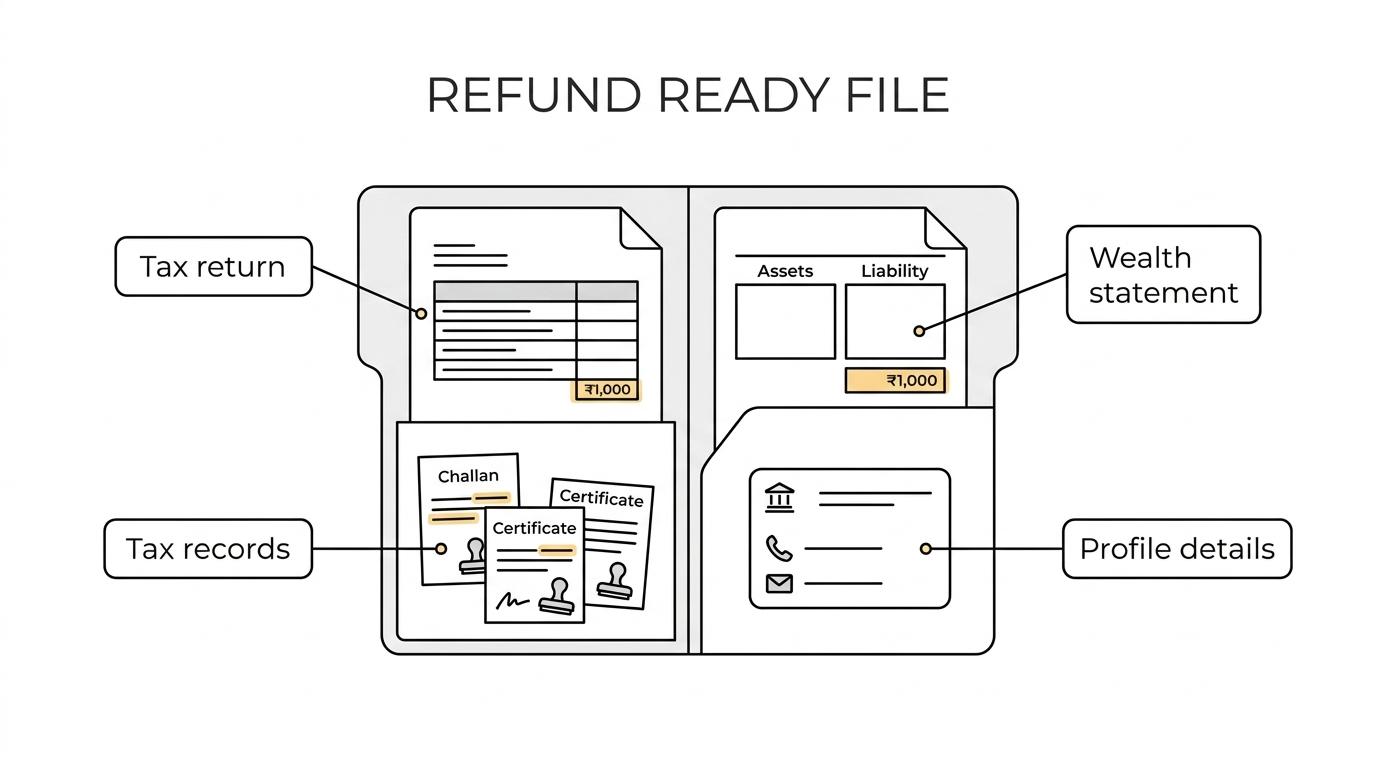
Most refund problems fall into three groups. First, there is an eligibility problem, like late filing and ATL issues. Second, there is an evidence problem, like missing challans or withholding certificates. Third, there is a consistency problem, where the income declared in the return does not explain the changes shown in the wealth statement. A common misconception is that refund delay always means system backlog. Quite often, the file itself created the delay.

Labeled diagram linking a Pakistan tax return, wealth statement, tax payment records, ATL status, refund claim, and bank profile details.

“CBMC notes that incomplete challans, certificates, or other refund documents can undermine a complete refund file.”

If a return has a simple arithmetic issue, the delay may be short. If it has an unexplained wealth movement or a refund amount unsupported by tax records, the file is more likely to move into review, clarification, or notice territory.

How does late filing affect ATL status and refund entitlement?

Late filing directly affects ATL status, and FBR rules mean you are not entitled to a refund during the period you are outside the ATL; CBMC flags this as one of the costliest filing mistakes.

The Active Taxpayer List is FBR’s central online record of taxpayers who filed the previous tax year’s income tax return. If you miss the due date, you are not just “late.” You also fall outside the ATL until regularised, and re-entry requires the prescribed surcharge for late filing: Rs. 20,000 for companies, Rs. 10,000 for associations of persons, and Rs. 1,000 for individuals.

“CBMC’s filing guidance notes a daily penalty of 0.1%, with a minimum fine of PKR 10,000, when the filing deadline is missed.”

The refund point is even more serious. FBR states that a taxpayer who files after the due date is not entitled to a refund during the period they are not appearing in the ATL. The same non-ATL period is also excluded when delayed-refund compensation is calculated. Pro tip: paying the surcharge later may restore ATL status going forward, but it does not erase the refund consequences of the earlier non-ATL period.

What are the 7 tax filing errors that cause refund delays and notices?

The biggest refund and notice risks are late filing, inconsistent figures, weak supporting records, and missed correction windows.

These seven errors show up again and again because they interrupt either eligibility, evidence, or consistency:

  1. Filing after the due date
    This can affect ATL status and refund entitlement during the non-ATL period.

  2. Reporting income that does not match the wealth statement
    If your declared income cannot explain your asset growth, liabilities, or expenses, wealth reconciliation questions can follow.

  3. Claiming refundable tax without proper challans or withholding certificates
    Refund claims are easier to hold up when documentary proof is weak.

  4. Leaving IBAN, email, or mobile details outdated in your profile
    Even a valid refund can stall if payment or communication details are wrong.

  5. Omitting assets, liabilities, bank balances, or major transactions
    A return may look fine until the wealth statement exposes the gap.

  6. Missing the right revision route in Iris
    A revised return and a revised wealth statement do not follow the same process, and timing matters.

  7. Waiting too long to lodge the refund claim
    FBR says a refund claim can be lodged later, but only within two years from the filing date or payment date, whichever is later.

How can you check your return against your wealth statement before filing?

Start with arithmetic and end with economic reality: the return, tax credits, and wealth movement must tell the same story.

Step 1 is to reconcile taxable income with spending and closing net worth. If you declared salary, business profit, rental income, or capital gains, ask a basic question: after tax and living costs, how much money was available to build assets or reduce liabilities? If the answer is too small to support the wealth statement, the inconsistency needs work.

Step 2 is to test movements, not just year-end balances. Buying a car, injecting capital into a business, repaying a loan, or increasing bank balances all need a source. That source may be current income, prior savings, a gift, a loan, or disposal of another asset. A wealth statement is not only a snapshot. It is also a bridge between one year and the next.

A highlighted pull quote stating that a wealth statement is a bridge between one year and the next.

Step 3 is to match taxes withheld or paid with the refund claim. If you are claiming that tax was deducted at source, the figure should appear consistently in the relevant schedules and be backed by certificates or statements. Pro tip: many notice issues begin where the refund figure is technically possible but poorly mapped to the underlying records.

What is the difference between revising a return and revising a wealth statement in Iris?

A revised return and a revised wealth statement are not the same in Iris, and the timing rules differ in ways that matter.

For an income tax return, FBR states that you can revise the return within five years of the original filing to correct an omission or wrong statement. The key procedural point is that Iris requires an application before the revised return itself can be filed. If you skip that step, you may assume the correction is easy when it is not.

For a wealth statement, the rule is more flexible before scrutiny begins. FBR states that a wealth statement can be revised in Iris before receipt of a notice under section 122(9) without an application for approval. That difference is critical because wealth statement problems are often what trigger reconciliation pressure.

A common misconception is that the five-year return-revision window means there is no urgency. In practice, early correction is usually better. Once a notice arrives, your choices can narrow and the correction may look reactive instead of preventive.

How do you file a correction in Iris if you find an omission or wrong statement?

If you find an omission, correct it quickly in Iris, but choose the right route because a revised return and a revised wealth statement follow different steps.

Step 1 is diagnosis. Identify whether the error sits in the tax return, the wealth statement, or both. A missing withholding entry may affect the return and the refund claim. An unexplained bank balance may primarily affect the wealth statement. If one schedule feeds the other, treat them as linked corrections.

Step 2 is procedure. If the issue is in the income tax return, file the revision application first, then prepare the revised return with supporting workings. If the issue is in the wealth statement and you have not yet received a section 122(9) notice, revise it directly in Iris.

Step 3 is evidence retention. Save acknowledgements, computation sheets, and the documents that explain the change. If FBR later asks why the figure moved, your answer should be documentary, not verbal. If the error already sits inside a filed refund claim, then the correction and the refund position should be reviewed together.

What records should you gather before claiming an FBR tax refund?

A strong refund file starts with proof of tax paid, proof of tax deducted, and profile details that let FBR verify and pay the claim.

Gather the documents before you file, not after FBR questions the claim. That matters because a refund is much easier to defend when the paper trail exists from day one.

  • Tax deducted evidence: salary certificates, withholding certificates, tax deduction statements
  • Tax paid proof: challans, advance tax receipts, payment confirmations
  • Identity and payment details: correct CNIC or NTN profile, active IBAN, current email, active mobile number
  • Return support: business accounts, rental schedules, brokerage records, foreign income support where relevant
  • Wealth support: bank statements, loan documents, asset purchase and sale records, opening and closing balances

FBR also allows a refund claim to be lodged later, within two years from the date of filing the return or the date tax was paid, whichever is later. That gives some room, but it should not be treated as a reason to delay file preparation.

Which mistakes trigger notices faster: missing documents or mismatched figures?

Mismatched figures usually trigger notices faster, while missing documents more often delay processing until evidence is supplied.

If your challan or certificate is missing, the refund may simply stop moving until the document appears. If your wealth statement shows asset growth that your declared income cannot explain, the problem looks deeper. It suggests either an omission, a classification error, or an unexplained source of funds, and that is more likely to attract a correction notice or wealth reconciliation scrutiny.

“CBMC advises taxpayers to update bank IBAN, email, and mobile details before expecting refund payment or notice delivery.”

Here is the practical rule: if the figures are right but the documents are incomplete, the case is often repairable with evidence. If the figures themselves are inconsistent, the case may need revision, explanation, or both. Pro tip: do not assume a smaller refund amount means lower notice risk. A small claim built on contradictory figures can attract more attention than a larger claim supported by a clean audit trail.

When should you get professional help with tax filing?

If the issue involves refunds, wealth reconciliation, or cross-border income, qualified tax adviser can cut down avoidable rework.

Simple salaried cases with one employer, accurate withholding records, and stable assets are often manageable if the taxpayer is careful. The risk rises when the file includes business income, partnership interests, director loans, multiple bank accounts, property transactions, prior-year omissions, or tax paid across more than one jurisdiction.

Professional help also becomes more useful when timing matters. If you missed the due date, need to restore ATL status, have to revise figures in Iris, or are close to a notice under section 122(9), the technical route matters as much as the numbers. The same is true for taxpayers with Pakistan, UAE, or UK links, where reporting consistency and source documentation can become harder to manage.

The trade-off is straightforward. Advisers cost money, but repeated refiling, delayed refunds, avoidable notices, and weak wealth explanations usually cost more. If your tax file already involves a return, a wealth statement, and a refund claim at the same time, treat it as one coordinated exercise rather than three separate tasks.

7 ERP Implementation Mistakes Finance Teams Must Avoid

erp implementation

ERP implementation goes wrong for finance teams less often because of software choice and more often because of weak ownership, weak data, and weak controls. At CBMC, an accounting, tax, advisory, and technology-enabled professional services firm, this issue typically shows up after go-live, when month-end close, reconciliations, and reporting accuracy come under real pressure.

TL;DR: Summary

  • Finance teams avoid the biggest ERP implementation mistakes by locking down internal controls, reconciling opening balances, and assigning close ownership before go-live; this is also the practical line CBMC highlights when finance readiness is the real goal.
  • The highest-risk failures are poor data migration, unclear subledger deadlines, weak segregation of duties, and testing that proves transactions work but not that reports are reliable.
  • APQC links faster closes to clear ownership and documented close calendars, while SAP guidance stresses migration limits, freeze periods, and balance validation.
  • If a control gap can affect G/L balances, period close, inventory, cash, or statutory reporting, delay go-live or use a documented, time-bound manual control with named review ownership.

That matters even more for growing organisations in Pakistan, where finance may be managing statutory compliance, management reporting, and group reporting at the same time. If the ERP is not finance-ready on day one, the cost usually appears as manual journals, delayed close, audit friction, and mistrusted numbers.

Why do ERP implementations fail finance teams after go-live?

Most ERP failures hurt finance after go-live because hidden weaknesses in ownership, data, and controls only surface during the first real close. APQC, PCAOB, and ISACA point to the same pattern: if record-to-report design is weak, the system may process transactions but still fail reporting.

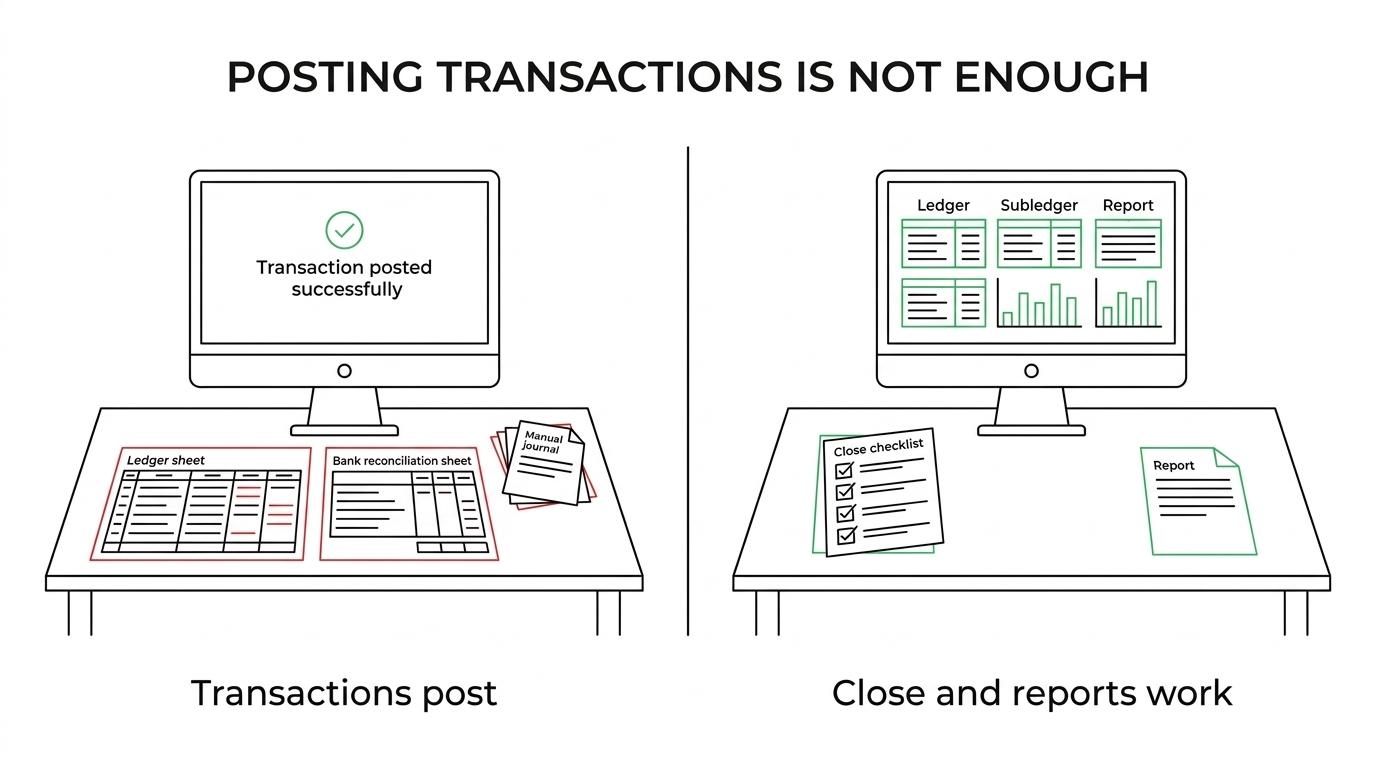
Many projects are labelled successful because configuration was completed, users were trained, and transactions posted in testing. Finance experiences success differently. The real test is whether the general ledger, subledgers, bank reconciliations, approval workflows, and close process work together without panic, overrides, or unexplained differences.

Side-by-side comparison of an ERP that passes setup and transaction tests versus one that also supports reconciliations, approvals, and a controlled month-end close.

APQC reports that top-performing organisations complete the annual close in 10 days or less, compared with a median of 18 days and 35 days for slower performers. That gap is rarely caused by one technical defect. It usually comes from unclear ownership, late feeder data, and unresolved exceptions across accounts payable, receivables, inventory, payroll, and fixed assets.

“CBMC says ERP projects fail when sales, procurement, finance, stores, and production define the same process differently.”

A common misconception is that finance problems after go-live are “teething issues” that will settle naturally. Some do. Control gaps usually do not. If period-end ownership, cut-off rules, and approval logic are vague before go-live, the ERP simply makes the confusion more visible.

How should finance define ERP success before configuration starts?

Finance should define ERP success before configuration as a controlled close, reconciled opening balances, and reliable reporting. CBMC starts that work with requirements review and implementation planning because scope, responsibility, and timelines become unstable when chart-of-accounts design and approval rules are still unsettled.

Before workshops turn into system build, finance should frame the project around a few measurable outcomes. That forces the team to decide what “ready” means in practical terms, not just in project language.

  • Close target: Set an expected month-end timeline, subledger cut-off time, and ownership model.
  • Reporting target: Identify the exact management reports, statutory outputs, and entity-level views that must work at go-live.
  • Control target: Define approval thresholds, segregation of duties, posting restrictions, and audit trail expectations.
  • Data target: Decide which masters, open items, balances, and historical references are required, and what will remain outside the new ERP.

One practical rule helps here: if finance cannot explain how one sales order becomes revenue, receivable, tax, and cash in the ERP, the design is not ready. That process view matters more than feature lists.

What are the 7 ERP implementation mistakes finance teams must avoid?

The seven biggest ERP implementation mistakes are consistent across industries: unclear ownership, poor migration discipline, weak controls, and rushed sign-off. They often look small during build and become expensive during the first close.

After the project has a defined scope, finance should watch for these seven mistakes:

  1. Treating ERP as an IT project instead of a finance-control project
    The software may be technical, but month-end close, approvals, reconciliations, and reporting logic are finance outcomes.

  2. Leaving process ownership vague across departments
    If sales, procurement, stores, and production define the same transaction differently, exceptions multiply after go-live.

  3. Migrating dirty or duplicated master data
    Poor customer, vendor, item, and chart-of-accounts data creates posting errors that no dashboard can fix later.

  4. Loading opening balances without reconciliation evidence
    If opening balances do not agree to the legacy trial balance and subledgers, the first close starts in doubt.

  5. Confusing user acceptance testing with reporting readiness
    Successful transaction tests do not prove that actual reports, accruals, and close controls are dependable.

  6. Ignoring segregation of duties and sensitive access
    Period open/close rights, journal posting powers, and master-data access can create fraud and error risk if not controlled.

  7. Going live without a stabilisation plan
    Finance needs daily issue triage, exception logs, and a rehearsed close, not just a helpdesk number.

How do poor data migration decisions damage close and reporting?

Poor migration choices damage finance by breaking opening balances, ageing reports, reconciliations, and audit trails from day one. SAP’s migration guidance is clear that master data, open transactional data, and balances can move, but historical data limits and cutover rules must be respected.

This matters because finance often assumes the new ERP will act like a complete archive. SAP notes that historical data cannot be migrated in the same way as active balances and open documents. It also notes that some open documents should be processed in the source system before migration, and that freeze periods or double maintenance may be required during cutover.

A frequent mistake is treating data migration as a technical extract-and-load exercise. Finance should treat it as evidence. Opening balances need reconciliation to the legacy trial balance, subledgers need tie-outs to the general ledger, and balance carryforward logic must be validated entity by entity.

Another common mistake is moving duplicate master records into a cleaner-looking interface. The screen changes, but the control problem survives. If the same vendor exists under multiple names, or the same revenue account is used for different transaction types, the ERP will only speed up confusion.

What is the difference between ERP testing and finance sign-off?

System testing proves the ERP can run transactions; finance sign-off proves the numbers can be trusted. If posting logic, reconciliations, and period-close controls do not produce reliable reports, passing user acceptance testing is still not enough.

Testing asks, “Can the process run?” Finance sign-off asks, “Can we close, report, and defend the output?” Those are different standards. A purchase invoice may post correctly in isolation while still breaking cost centre logic, tax mapping, or accrual treatment in the close.

PCAOB guidance on internal control is useful here because it stresses both the design and operation of controls, especially when systems change. A well-designed automated control still needs evidence that it operates as intended. If program changes or unauthorised intervention are possible, finance cannot assume the control is effective just because it exists in the configuration.

A practical test is this: if month-end reports are issued from the ERP, can finance explain every major number back to source data, approval logic, and reconciliation evidence? If not, sign-off should wait.

How should close ownership and subledger deadlines be set before go-live?

Close readiness depends on named owners, fixed cut-off rules, and a published calendar. CBMC often sees slow closes when chart-of-accounts design and approval rules stay unresolved, because finance then compensates with manual journals and duplicated master records.

APQC recommends assigning clear ownership, setting subledger deadlines, and publishing a documented close calendar to reduce ambiguity. That advice is more than project hygiene. It is a control design choice. Top-performing organisations close much faster because tasks are not waiting for informal follow-up or last-minute interpretation.

“CBMC says unresolved chart-of-accounts design and approval rules later show up as manual journals, duplicate masters, and slow closes.”

Start with the close calendar. List every activity from final invoice cut-off to journal review, intercompany matching, bank reconciliation, inventory posting, payroll entry, tax review, and management report issue. Each task needs one owner, one reviewer if relevant, one due time, and one dependency.

Next, set subledger deadlines that match business reality. Accounts payable cannot stay open indefinitely while the general ledger moves to final review. Inventory cannot keep changing while valuation reports are being used for close. If feeder systems or external branches report late, those risks need documented escalation rules before go-live.

Finish with a dress rehearsal. Run a mock close using migrated balances and realistic transaction volumes. If the team still relies on spreadsheets to find obvious issues, the design is telling you where the next delay will happen.

How do access rights and segregation of duties change ERP control risk?

ERP access rights directly change control risk because they determine who can post, approve, amend master data, and open or close periods. ISACA highlights segregation-of-duties weaknesses as a major source of operational and fraud risk in ERP-based financial reporting.

Sensitive access is not only about seniority. A junior user with posting rights plus vendor master access can create risk. A senior manager with the ability to reopen periods without review can create a different kind of risk. ISACA notes that poor access monitoring can allow tampering with sensitive functions, including opening or closing the accounting period.

That is also why Tow treats audit logs as a control layer rather than a technical afterthought, because traceable admin activity is often what lets finance and internal control teams distinguish a configuration issue from unauthorised intervention.

A common misconception is that a standard ERP automatically reduces finance risk. It does not. Risk falls only when role design, approval workflow, change management, and access reviews are actually enforced. If they are weak, the ERP can make errors faster and harder to isolate.

There is also an audit effect. ISACA notes that weak IT control conditions can increase external audit effort and may push auditors toward a more substantive approach. In plain terms, finance may spend more time proving balances manually because the system environment is not trusted.

Should finance accept manual workarounds or delay go-live for control gaps?

If a control gap can misstate cash, revenue, inventory, tax, or period close, delay is usually safer than a workaround. If the gap is low risk, temporary, and manually reviewable with named accountability, a workaround can be acceptable for a short period.

This is a trade-off question, not a purity test. Some gaps are inconvenient but manageable. A missing report filter may be tolerable. A missing three-way match, an uncontrolled journal process, or an unreconciled opening inventory balance is not the same category of issue.

The useful test is impact plus duration. If the issue touches financial reporting assertions and has no strong compensating control, go-live should pause. If the issue is narrow, documented, reviewed daily, and scheduled for near-term remediation, finance can proceed with discipline.

Risk-based internal audit thinking supports that approach. Government guidance in the UK on internal audit coverage stresses that audit attention should follow risk profile and system maturity, with higher-risk areas reviewed more often. Finance can apply the same logic internally during ERP stabilisation.

What should finance do in the first 30 days after ERP go-live?

The first 30 days after go-live should be treated as a controlled stabilisation period, not normal operations. Finance needs daily issue triage, opening-balance validation, bank and subledger reconciliations, and a rehearsed month-end close before the ERP is trusted for statutory or management reporting.

The first month is where finance either gains confidence or loses it. The aim is not perfection. The aim is to detect whether defects are local, process-wide, or control-related before the first full close becomes chaotic.

  • Daily control check: Review failed postings, approval exceptions, interface errors, and unusual journals every day.
  • Balance validation: Reconcile bank, receivables, payables, inventory, fixed assets, and tax balances to opening position and current movement.
  • Close rehearsal: Run a timed mini-close before actual month-end so bottlenecks are found early.
  • Issue governance: Log owner, severity, workaround, deadline, and root cause for every material defect.

One practical point is often missed. Do not declare reporting stable just because dashboards populate. Stable reporting means finance can reproduce the number, trace it to source, and explain control evidence behind it. That is the threshold that turns ERP go-live into finance confidence.


CBMC Tax Filing Support for Companies and Startups

tax filing

Tax filing for a company in Pakistan is rarely just one annual submission. You may need to deal with FBR income-tax filing through IRIS, keep supporting records in order, and stay on top of separate SECP statutory company returns that follow their own timelines and formats.

CBMC helps companies and startups manage that full filing picture. We are an accounting, tax, business advisory, and technology-enabled professional services firm serving businesses across Pakistan, with cross-border coordination in the UAE and UK. For tax filing, that means you get one connected team for return preparation, computations, statutory filings, and the compliance follow-up that keeps deadlines from becoming last-minute problems.

Tax filing services in Pakistan for companies, startups, and growing businesses

CBMC provides Pakistan-focused tax filing support built around how companies actually operate. We do not stop at one return. We support the wider compliance work that sits behind accurate filing, including corporate records, reconciliations, and recurring tax obligations.

Our tax filing support can include:

  • FBR income-tax return preparation and filing: Annual company return preparation and submission through the relevant filing process
  • Income-tax computations and advisory: Working through the tax position behind the return, not just the final form
  • Sales tax support: Registration, filing, and reconciliations where applicable
  • Withholding tax compliance: Obligation reviews and statement support
  • SECP statutory filings: Support for statutory company returns such as Form A, Form 29, Form 197, and UBO disclosures

Because tax filing depends on your books, invoices, payroll data, and company records, CBMC connects tax work with accounting and statutory compliance so your business is not passing the same information between separate advisers.

“CBMC supports FBR annual tax return filing alongside SECP statutory filings such as Form A, Form 29, Form 197, and UBO disclosures.”

FBR income-tax filing and SECP statutory return support under one roof

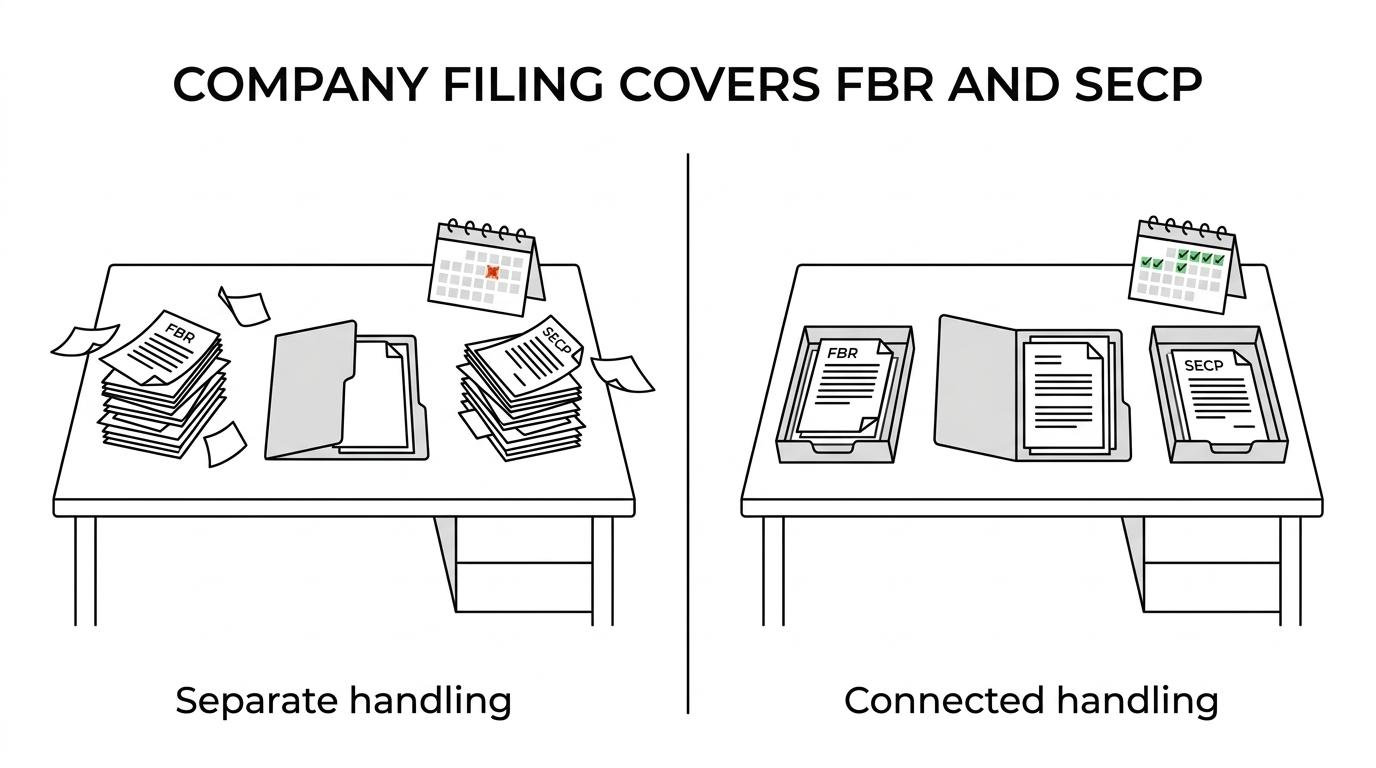
In Pakistan, companies usually face two different compliance streams. FBR handles income-tax filing through IRIS, while SECP requires all registered companies to file statutory company returns, with some filings periodic and others event-driven.

CBMC helps you manage both streams together. We prepare the required filings, organise the supporting information, and reduce the back-and-forth that happens when tax and corporate compliance are handled in isolation.

Side-by-side comparison of FBR income-tax filing through IRIS and SECP statutory company return requirements, with filing types, timing, and examples.

“CBMC helps businesses coordinate both FBR filing through IRIS and SECP statutory company returns in one connected compliance workflow.”

Timing matters here. FBR states that a company’s income-tax return is due on or before 31 December, and a company with a special tax year is due on or before 30 September. FBR has also stated that late filing can result in late filer status and penalties under the law.

CBMC turns those dates into a practical filing calendar for your business. You know which return is due, which records are still missing, and which authority needs what, before the deadline pressure builds.

“CBMC plans company tax filing around FBR’s stated due dates: 31 December for standard company returns and 30 September for a special tax year.”

CBMC tax filing support for startups, SMEs, and established companies

Startups often feel the filing pressure first. After incorporation, the business may still be setting up bookkeeping, payroll, sales tax processes, and internal approval routines, while FBR and SECP obligations are already active.

CBMC helps startups build a filing routine that is realistic for a lean team. That can mean aligning the tax return with your first set of accounts, setting up sales tax and withholding compliance where needed, and making sure statutory filings are not left behind while you focus on growth.

For SMEs and owner-managed businesses, CBMC helps bring structure to recurring obligations that may already be spread across internal staff, external bookkeepers, and ad hoc consultants. For established companies, international groups, and nonprofit organisations, we support Pakistan-focused filings with the added coordination that comes from a connected accounting, tax, and corporate team.

CBMC also works across sector needs, including manufacturing, construction and real estate, healthcare, education, NGOs and NPOs, trading and distribution, technology, and professional services. That matters because filing issues often start in the underlying transactions, not at the submission stage.

What improves when CBMC manages your company tax filing

The first improvement is clarity. You can see what is due to FBR, what is due to SECP, what supporting records are required, and what still needs to be reconciled before submission.

The second improvement is consistency. If your income-tax return, sales tax data, withholding records, and company filings are prepared from disconnected records, the risk moves from the form itself to the documentation behind it. CBMC helps align these compliance areas so filings reflect the same underlying business activity.

“CBMC tax advisory work includes income-tax returns and computations, sales tax registration, filing and reconciliations, and withholding tax obligation reviews and statements.”

The third improvement is less avoidable rework. SECP notes that accepted filings receive a filing certificate, while discrepancies can trigger clarification and resubmission. CBMC helps reduce that disruption by preparing filings with the required records and follow-up in mind.

You also get better management visibility. When tax filing is tied back to your books and statutory records, year-end reporting becomes easier to explain internally, to directors, and to external stakeholders who need a cleaner view of the business.

CBMC’s tax filing process for Pakistan-based companies

CBMC keeps tax filing practical and document-led. The work usually starts with your current registration status, filing history, and the set of obligations that apply to your company.

A typical engagement may include:

  1. Reviewing your filing position: We check which FBR and SECP obligations apply, what deadlines are coming, and whether there are gaps in prior compliance.
  2. Collecting and reconciling records: We work through books, ledgers, invoices, payroll data, tax records, and statutory information needed for accurate filing.
  3. Preparing returns and statements: CBMC prepares the relevant income-tax, sales tax, withholding, and statutory return documentation for submission.
  4. Submission and follow-up: We support the filing process, track outcomes, and help address clarification or resubmission issues where required.

This approach gives you scope clarity early. If bookkeeping support, payroll services, CFO support, ERP and automation, or broader outsourcing gaps could affect filing, CBMC raises them before they create a rejection, a delay, or a compliance surprise.

Where needed, our work can extend beyond filing into bookkeeping support, payroll services, CFO support, ERP and automation, or broader outsourcing. That is useful when tax filing issues are really symptoms of a finance process that needs tightening.

Why CBMC is a strong fit for Pakistan tax filing support

CBMC combines local regulatory knowledge with an international perspective. That is valuable for Pakistan-based businesses with foreign shareholders, overseas reporting expectations, or related coordination in the UAE or UK.

CBMC also brings together accounting, tax, corporate legal and compliance, advisory, and technology-enabled delivery in one firm. For you, that means fewer handoff errors and a more reliable link between what is filed, what is recorded in the books, and what directors or management need to review.

Our model is built to scale with your business. You can start with tax filing and statutory compliance, then add wider support if your finance function needs stronger reporting, cleaner controls, or better systems.

When CBMC is the right fit for your company or startup

CBMC is especially relevant when your business needs more than a form submission. We are a strong fit if:

  • You need both FBR and SECP support: One team handling tax returns and statutory company filings
  • You are a startup entering your first filing cycle: Early structure for compliance, records, and recurring deadlines
  • You have monthly or recurring tax obligations: Sales tax, withholding, and annual income-tax work that must stay aligned
  • You need cross-border coordination: Pakistan compliance with connected support for UAE or UK reporting environments
  • You want filing tied to finance operations: Tax work linked with bookkeeping, payroll, advisory, or automation support

If that sounds like your situation, the next step is simple. Speak with CBMC about your current filing position, upcoming FBR or SECP deadlines, and the records your company already has in place. We will help you define the scope, sort the priority filings, and move forward with a clearer compliance plan.

CBMC Payroll Outsourcing for Growing Pakistan SMEs

pakistan payroll services

If your team is growing, payroll stops being a simple monthly task very quickly. You need accurate salary calculations, statutory deductions, payslips, internal approval controls, and records that stand up to tax and audit scrutiny. CBMC provides payroll outsourcing for Pakistan SMEs that need payroll handled carefully, confidentially, and in line with real compliance obligations.

CBMC is an accounting, tax, business advisory, and technology-enabled professional services firm serving organisations across Pakistan. For payroll, we bring together payroll processing, tax awareness, reporting discipline, and scalable outsourcing support, so you are not left managing salaries, deductions, and regulatory risk through disconnected spreadsheets and last-minute checks.

Payroll outsourcing in Pakistan for SMEs that need control, confidentiality, and fewer monthly errors

For many businesses in Pakistan, payroll outsourcing is not about size alone. It is about reducing admin pressure while keeping deductions, approvals, and deadlines under control. That matters because Pakistan’s Economic Census 2023 shows that 99% of enterprises have 50 or fewer employees, and 95% of establishments have fewer than 10 employees. Small and mid-sized teams still face real payroll complexity, especially once hiring, variable pay, and statutory obligations increase.

CBMC payroll outsourcing is designed for that reality. We help owner-managed businesses, startups, SMEs, established companies, NGOs, and group entities run payroll through a scoped service that fits their systems, reporting needs, responsibilities, and monthly deadlines.

“Economic Census 2023 shows 99% of Pakistan enterprises have 50 or fewer employees. CBMC structures payroll support for the realities of growing SME teams.”

When payroll is handled properly, you gain more than processed salaries. You get a repeatable monthly process, clearer responsibilities, better reporting for management, and less risk of missed deductions or undocumented changes.

What CBMC payroll services include for monthly processing and statutory deductions

CBMC covers the parts of payroll that usually create pressure inside a growing business: calculations, documentation, deductions, and review controls. Our payroll service scope includes payroll processing, payslips and reports, statutory deductions, and payroll controls, with confidential payroll processing where outsourcing is the right model for your team.

A typical CBMC payroll outsourcing scope can include:

  • Payroll processing: Monthly salary calculations based on approved payroll inputs, payroll cycles, and internal deadlines.
  • Payslips and reports: Payslip preparation and payroll reports that support management review, employee communication, and finance records.
  • Statutory deductions: Payroll deductions handled within the agreed scope so your monthly process reflects tax and other required payroll-related obligations.
  • Payroll controls: Approval controls and documented review steps that reduce the risk of unauthorised changes, missed deductions, or weak audit trails.
  • Flexible delivery structure: Engagements can be set up as a recurring managed service, periodic review, annual engagement, or a defined project.

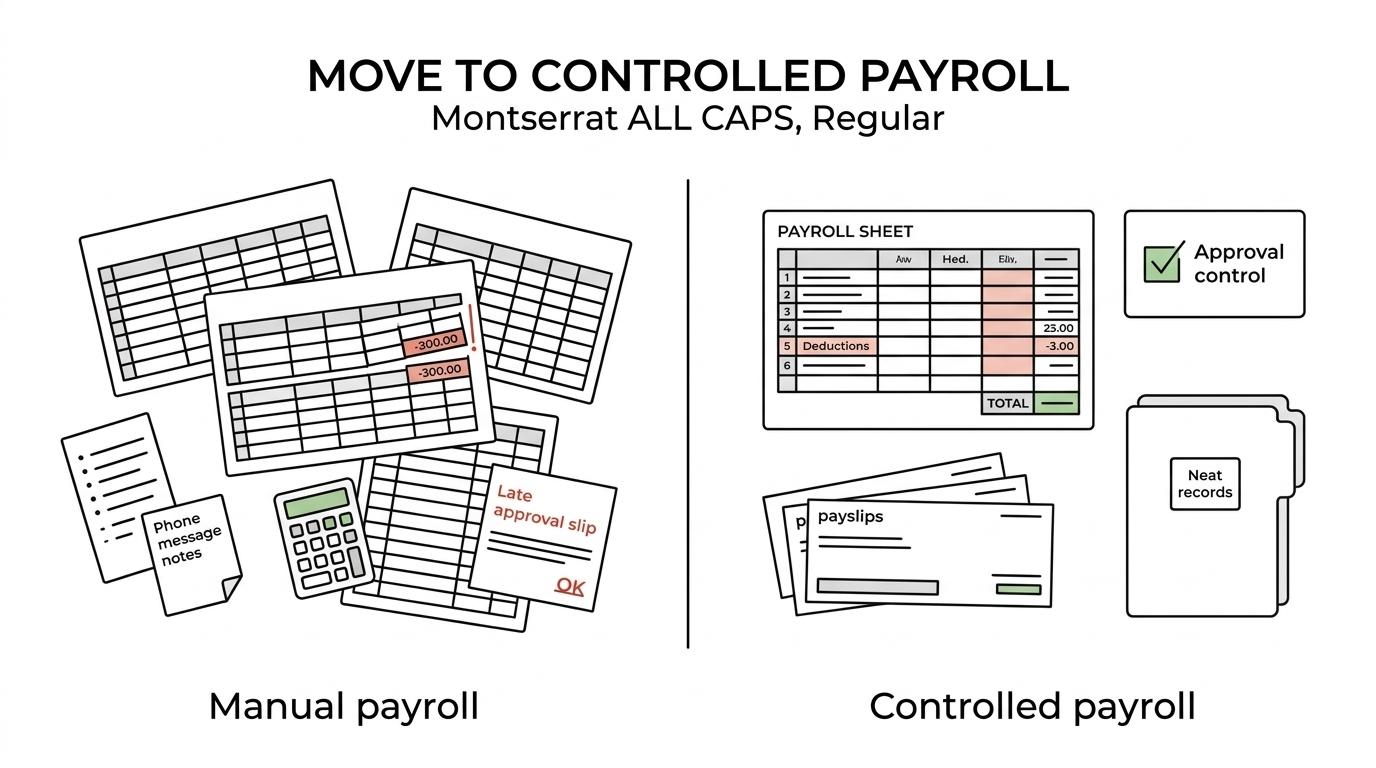
CBMC does not force a one-size-fits-all payroll model on your business. We shape the work around your current systems, your internal responsibilities, your record quality, and the reporting you actually need each month.

Side-by-side comparison of manual payroll managed through spreadsheets and informal approvals versus outsourced payroll with structured controls, deductions, payslips, and reporting.

If you already have finance staff, we can work as an extension of your team. If you do not, our payroll outsourcing gives you specialist support without the overhead of building the entire process in-house.

CBMC payroll compliance support for withholding tax and monthly review discipline in Pakistan

Payroll errors in Pakistan are not only administrative. They can create direct tax exposure. The Federal Board of Revenue treats withholding agents as personally liable if tax is not deducted, or if it is deducted but not paid to the Federal Government. FBR also requires withholding statements to be filed under the relevant provisions of the Income Tax Ordinance, 2001.

That is why CBMC treats payroll as a controlled compliance process, not just a salary run. Our payroll controls and documented review approach help you manage deduction accuracy, approval clarity, and the record trail needed for internal and external scrutiny.

“FBR states withholding agents can be personally liable if tax is not deducted or not paid. CBMC builds approval controls and documented review into payroll delivery.”

CBMC payroll support is especially useful when your business has reached the point where founder-led checks, manual files, or informal approvals are no longer enough. We help turn a fragile payroll routine into a defined process with accountability.

We also recognise that payroll often connects with wider employer obligations. For example, official EOBI payment processes require employers to generate a voucher through the EOBI Facilitation System and complete payment using the system-generated voucher number and prefix number. CBMC helps keep payroll records and deduction workflows organised so your wider statutory process is easier to manage.

Payroll outsourcing shaped around your systems, internal roles, and reporting needs

A good payroll partner should fit your business model, not ask you to rebuild operations around the provider. CBMC designs payroll engagements around your organisation’s systems, reporting needs, responsibilities, and deadlines, which is important if your payroll data starts in HR files, attendance records, finance schedules, or owner approvals.

That flexibility matters for growing Pakistan SMEs, especially when teams are changing quickly or responsibilities are split across admin, HR, and accounts. CBMC can take on recurring monthly payroll, review an existing payroll setup, support a year-end clean-up, or handle a defined project where your internal process needs structure before you scale it.

“CBMC can structure payroll as a recurring managed service, periodic review, annual engagement, or a defined project.”

If your Pakistan business also reports to stakeholders in the UAE or the UK, CBMC can coordinate within a wider professional support model. That gives you a local team with Pakistan regulatory knowledge and a broader cross-border perspective when payroll reporting needs to align with group finance or owner expectations.

Pakistan payroll services for startups, SMEs, NGOs, and owner-managed companies

CBMC payroll outsourcing is a strong fit when your organisation needs monthly reliability without expanding internal headcount just to keep payroll moving. We regularly support growing organisations and sectors where disciplined reporting and compliance matter, including trading and distribution, manufacturing, construction and real estate, healthcare, education, technology, professional services, and nonprofit entities.

You are likely a good fit for CBMC payroll services if:

  • Your payroll is still too manual: Salary processing depends on spreadsheets, messages, or last-minute approvals.
  • Your compliance risk is growing: You need more confidence around withholding tax deductions, reporting, and documented review.
  • Your team is scaling: New hires, changing pay structures, and more reporting requests are making payroll harder to manage internally.
  • You need confidentiality: Payroll data should be processed in a more controlled and limited-access way.
  • You want a service that can grow with you: You need support that starts with payroll admin but can sit alongside accounting, tax, advisory, corporate, or technology-enabled improvement work.

CBMC is also the right choice when payroll is not your only operational pressure point. Because we work across accounting, tax, corporate, advisory, and technology-enabled services, we can support payroll in a way that connects to your finance function instead of sitting in isolation.

Why businesses choose CBMC for payroll outsourcing in Pakistan

Businesses usually change payroll providers for practical reasons. They want fewer mistakes, clearer monthly responsibility, stronger confidentiality, easier reporting, and less exposure to avoidable compliance issues. CBMC addresses those concerns through scoped delivery, documented controls, and a service model that is built around the way your organisation already operates.

What makes CBMC relevant is the combination of local regulatory awareness and connected professional support. Our payroll service is not detached from tax, reporting, finance processes, or wider business operations. That helps you solve the real problem, which is rarely only “run payroll”. It is “run payroll accurately, document it properly, keep deductions aligned, and make the process sustainable as the business grows.”

If you want Pakistan payroll services that are practical, controlled, and designed for growing SMEs, talk to CBMC about your current payroll process. We can help you define the right outsourcing scope, set clear responsibilities, and move to a payroll setup that is easier to manage every month.

Cash Flow Management Tips for Seasonal Business Cycles

cash flow management

Seasonal businesses rarely struggle because demand is weak all year. More often, the pressure comes from timing. Cash comes in during a short peak period, while payroll, rent, utilities, supplier payments, and tax obligations keep moving every month.

That is why cash flow management for seasonal business cycles has to be planned by month, not only by year. A business can post strong annual sales and still face a cash squeeze in the quiet months. Recent Federal Reserve small business survey data showed that uneven cash flows and paying operating expenses remain among the most common business challenges. That pattern will feel familiar to any owner who has watched a strong season fade into a tight off-season.

Why seasonal cash flow management needs a different approach

A seasonal business lives with sharper highs and lows than a business with steady monthly sales. Revenue may be concentrated around school admissions, holiday demand, harvest periods, tourism waves, religious occasions, or weather-driven buying patterns. Expenses, though, often do not shrink at the same pace.

Strong annual sales do not pay this month’s bills.

A quote graphic displaying the line, “Strong annual sales do not pay this month’s bills.”

This is where many businesses misread their position. Profitability and liquidity are not the same thing. If customer collections arrive 30 or 60 days after the busy period, the business may still need to cover wages, supplier balances, transport, storage, marketing, and tax deposits before that cash is available.

Official guidance from multiple institutions keeps pointing back to one habit: maintain a monthly or rolling cash forecast. Budgets are useful, but cash forecasts need more frequent updates because seasonal revenue timing and customer payment delays can create shortfalls even when the year looks healthy on paper.

Monthly cash flow forecasting for seasonal business cycles

The core discipline is simple: forecast cash receipts and cash payments in the months they are expected to happen, then update the forecast regularly. A seasonal business should not rely only on annual targets or a profit and loss statement . It needs a month-by-month view, and in many cases a weekly view during the peak season.

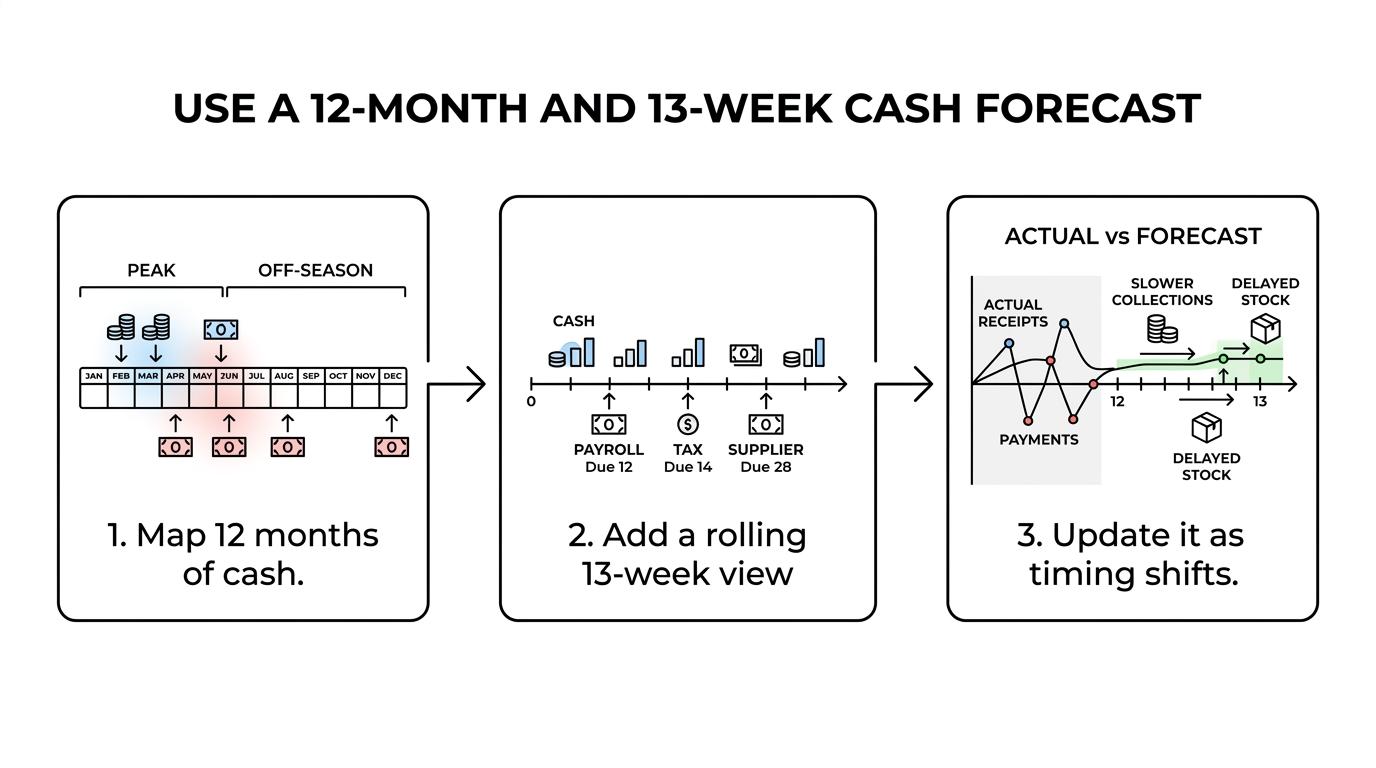
A practical model often combines two layers. First, a 12-month monthly forecast to capture the full seasonal cycle. Second, a shorter rolling forecast, often 13-week forecast, to manage immediate liquidity. The long-range view shows when slow periods are coming. The short-range view shows whether the business can meet payroll next Friday or a tax payment at month-end.

A step-by-step cash flow planning process showing a 12-month forecast, a 13-week rolling forecast, regular updates, and early action on cash gaps.

Historical data matters here. Past sales patterns, customer payment behaviour, supplier terms, wage cycles, and recurring operating expenses can all be used to estimate the seasonality of flows. If the business is growing or opening a new line, historical numbers still help, but they should be adjusted for new volumes, pricing, and staffing plans.

Cash flow area Peak season focus Off-season focus
Sales receipts Estimate weekly inflows by channel and payment terms Track delayed collections and residual receipts
Inventory and purchasing Plan deposits, freight, and reorder timing Reduce overstock and free up cash
Payroll Add temporary staffing, overtime, incentives Match workforce levels to realistic demand
Tax and statutory payments Reserve cash as revenue comes in Avoid missed filings and late-payment stress
Operating expenses Monitor variable costs closely Re-negotiate non-essential spend where possible
Financing Keep facilities ready before demand spikes Review covenant pressure and refinancing needs

A good forecast is not a static spreadsheet saved and forgotten. It should be updated as reality changes. If collections slow, inventory lands late, or a major customer pushes payment to next month, the forecast should reflect that at once. The earlier management sees the gap, the more options it has.

Customer collections and receipt timing can make or break liquidity

For many small and mid-sized businesses, customer payments are the primary source of operating cash. That sounds obvious, yet receipt timing is often treated as an afterthought. Research has also shown that payment-related issues are widespread, and delays in settlement can be a real obstacle, especially when businesses collect through third parties.

Seasonal firms need to shorten the time between sale and usable cash wherever possible. That could mean tighter invoicing routines, deposits on large orders, clearer payment terms, faster dispute resolution, or closer monitoring of platform settlement timelines. A sale that sits in receivables is not available for salaries or supplier cheques.

The off-season is the right time to repair weak collection processes before volume rises again. When the busy period starts, teams are usually focused on fulfilment and customer service. By then, it is too late to build discipline from scratch.

After reviewing the forecast, management can tighten receipts in a few practical ways:

  • Invoice timing: issue invoices immediately after delivery or milestone completion
  • Deposit structure: collect advance payments where the business model allows
  • Credit control: follow up on overdue balances before they age further
  • Payment channels: prefer methods with faster settlement and better visibility
  • Customer terms: review whether long credit periods still make commercial sense

A small improvement in collection speed can have a larger cash impact than many cost-cutting measures. Cutting five days from receivables during a peak season can release enough cash to cover payroll, taxes, or urgent stock replenishment.

Payroll, tax, and statutory cash planning before the busy season

Seasonal demand often requires seasonal staffing. That creates a double pressure: wage costs rise before all related sales are collected, and payroll taxes or other statutory obligations usually rise with them. Businesses that hire quickly without building these amounts into the cash forecast can find themselves short of funds at the exact moment operations are busiest.

The right approach is to treat payroll and compliance cash as planned outflows, not residual balances paid when convenient. Temporary workers may only be on the books for a few months, but the related payroll withholding, social contributions, pensions, leave accruals, or other employer obligations still need to be funded on time according to local rules.

This point is especially important for businesses operating across more than one jurisdiction. Filing calendars, sales tax timing, and employer reporting requirements may differ between countries. A seasonal business with activity in Pakistan, the UAE, or the UK should map those obligations into one cash calendar rather than leaving each item to separate teams.

Before the season starts, it helps to build a clear payment map:

  • Wages and overtime: project normal payroll, peak headcount, and incentive plans
  • Tax deductions: reserve cash for payroll withholding and indirect tax liabilities
  • Statutory dues: track pension, social security, or sector-specific obligations
  • Filing dates: match each payment to its actual due date, not the month it relates to
  • Cross-border needs: include foreign payroll, VAT, or reporting cash where relevant

A forecast that ignores statutory payments can look healthy right up to the week it fails. Good cash discipline means ring-fencing those amounts as revenue is earned, rather than hoping enough remains in the bank later.

Inventory and purchasing decisions shape seasonal cash pressure

Inventory is often where seasonal cash gets trapped. Businesses order ahead to secure stock, lock pricing, or avoid supply disruption, yet overbuying can tie up funds long after the peak has passed. At the same time, underbuying can leave revenue on the table during the most important weeks of the year.

This is why purchasing should sit inside the cash forecast, not beside it. Supplier deposits, import duties, freight, warehousing, packaging, and merchandising costs all need to be timed accurately. If a business expects to sell in November but pays for stock in August, the forecast must show that cash gap clearly.

Not every product deserves the same buying pattern. Fast-moving items, high-margin products, and items with stable historical demand can justify earlier commitment. Slower-moving stock may need smaller order batches, better vendor terms, or a tighter reorder process. Cash discipline improves when buying decisions are linked to actual demand evidence rather than optimism.

Useful controls often include:

  • weekly stock cover review
  • slower reorder points
  • supplier term negotiations
  • clearance plans for ageing inventory
  • tighter approval for discretionary purchasing

Businesses also benefit from reviewing fixed and semi-fixed costs during the off-season. Some expenses can be reduced, paused, or renegotiated. Others should remain untouched because they protect service quality or sales readiness. The aim is not blanket cuts. The aim is to protect cash while preserving the business’s ability to perform when demand returns.

Financing options should be arranged before cash is tight

External funding is most useful when it is prepared early. Waiting until cash has already dipped often limits choices, weakens negotiating power, and pushes management into reactive decisions. Seasonal businesses are far better served by arranging facilities while performance still looks strong and forecasts are credible.

That may include an overdraft line, working capital facility, receivables finance, trade finance, or owner-funded liquidity support with clear terms. The right structure depends on the business model, gross margins, collection profile, and asset base. A distributor with large receivables may need a different solution from a hospitality operator with card-based daily receipts.

Lenders and investors usually respond better when they can see disciplined forecasting, sensible assumptions, and a record of monitoring variances. A seasonal cycle is not a weakness in itself. It becomes a risk when management cannot explain how the low-cash months will be covered.

Cash flow management routines that keep seasonal cycles under control

Seasonality becomes easier to manage when cash review is built into routine decision-making. That means the forecast is reviewed regularly, assumptions are updated quickly, and operational teams understand the cash impact of their choices. Sales, purchasing, payroll, finance, and tax should all be working from the same picture.

A useful operating rhythm is simple. Review actual receipts and payments weekly during peak periods. Update the 13-week forecast every week. Revisit the 12-month forecast every month. Track the biggest gaps between forecast and reality, then ask why they happened. Was demand weaker, collections slower, stock heavier, or payroll higher than planned?

Over time, this creates a sharper planning culture. The business stops treating cash shortages as surprises and starts treating them as signals. With that shift, off-season months become a preparation window, peak months become more controlled, and growth decisions can be made with greater confidence.

For seasonal businesses, cash flow management is less about predicting the future perfectly and more about staying ready for the timing gaps that come with the model. When receipts, expenses, payroll, and tax obligations are planned with discipline, seasonality becomes something to manage well, not something to fear.

CBMC ERP Implementation for Finance Teams in Pakistan

erp implementation

CBMC helps finance teams in Pakistan implement ERP systems around reporting, control, and regulatory reality, not just software features. Our ERP implementation work covers requirements and implementation planning, finance integration, inventory and manufacturing workflows, and automation so your team can move from disconnected processes to one accountable operating system.

As a Pakistan-based accounting, tax, business advisory, and technology-enabled professional services firm, CBMC supports growing organisations, owner-managed businesses, startups, SMEs, established companies, international groups, and nonprofit organisations. We bring finance, tax, compliance, and technology into one connected delivery model, which matters when your ERP project affects filings, approvals, reporting lines, and day-to-day operations at the same time.

ERP implementation in Pakistan starts with finance, compliance, and process fit

In Pakistan, ERP implementation for finance teams now sits under two pressures at once. FBR says electronic invoicing is mandatory for corporate registered and non-corporate registered persons under S.R.O. 709 dated 22 April 2025, while SECP filing and approval rules still require disciplined statutory accounts workflows. If your ERP does not support invoice data, approvals, audit trail, and reporting structure, the finance burden does not disappear.

“CBMC plans ERP around FBR’s 2025 e-invoicing rule and the licensed-integrator requirement for real-time invoice transmission.”

CBMC treats ERP as a finance and business control project, not just a software purchase. Research on ERP outcomes has linked stronger strategic alignment, cleaner data, and lower post-implementation change risk with shorter, more cost-efficient projects, which is why we start with requirements, process fit, and reporting needs before finalising delivery.

CBMC connects ERP design to FBR e-invoicing, SECP reporting, and daily finance control

CBMC uses the requirements review to define how transactions should move from sales, purchasing, inventory, production, and payroll-related finance inputs into your reporting structure. Where FBR e-invoicing applies, we help define the ERP-side invoice structure, tax fields, approval points, and real-time transmission requirements so your team is ready to work with a licensed integrator instead of discovering gaps after go-live.

“CBMC builds ERP scope around FBR e-invoicing, finance integration, and the real-time transmission rules that require a licensed integrator.”

CBMC also designs ERP around statutory reporting discipline. SECP requires annual financial statements and related reports within the required timetable, and annual accounts must be approved and signed through the proper process. For your finance team, that means the chart of accounts, closing routines, supporting schedules, document control, and approval flow need to be considered during implementation, not added later.

“CBMC aligns ERP reporting with annual audited financial statements workflows at a time when SECP reported 88% disclosure by unlisted licensed companies.”

That finance-first design improves everyday control as well. Instead of rebuilding numbers in side spreadsheets every month, you get clearer source data, more reliable reporting lines, and a system that can support both management reporting and year-end statutory pressure.

CBMC ERP implementation suits growing businesses, SMEs, and sector-led finance teams

CBMC serves organisations that need ERP to support real finance work, not just transaction entry. We are especially relevant for businesses in manufacturing, construction and real estate, healthcare, education, NGOs and NPOs, trading and distribution, technology, and professional services where reporting needs are shaped by the way operations actually run.

CBMC is often a strong fit when your finance team is dealing with situations like these:

  • Outgrown bookkeeping software or spreadsheet-heavy reporting
  • Separate systems for sales, inventory, production, and finance
  • Manual reconciliation delaying month-end visibility
  • Compliance pressure from tax, statutory filing, or audit requirements
  • Group reporting needs across Pakistan, with coordination in the UAE or UK

If your business needs finance, inventory, production, sales, and reporting to speak to each other, CBMC can help you assess, design, and implement that connected structure. That is especially useful when management wants better visibility but the finance team also has to protect controls, filings, and audit readiness.

CBMC ERP requirements review turns scope, responsibilities, and timelines into a workable plan

CBMC starts with an initial requirements review so the final ERP scope, responsibilities, and timelines are agreed before the implementation moves forward. That gives you a defined starting point for decision-making instead of an open-ended project where finance only discovers critical issues after configuration has begun.

“CBMC agrees final ERP scope, responsibilities, and timelines after an initial requirements review.”

A typical CBMC ERP implementation for finance-led teams is built around a few practical workstreams:

  • Requirements and implementation planning: We review current processes, reporting pain points, dependencies, and future-state priorities so the project is shaped around your actual operating model.
  • Finance integration: CBMC defines how operational activity should flow into finance so reporting, controls, approvals, and closing routines are supported from the start.
  • Inventory, manufacturing, sales, and reporting workflows: We help connect the functions that most often create timing gaps, reconciliation issues, and duplicate effort.
  • Automation: CBMC identifies manual steps that can be standardised so recurring finance work becomes more predictable and less dependent on offline files.

This structure makes buying decisions easier because you can see what is included, who owns each part of the project, and how the implementation supports finance outcomes. It also reduces the common risk of choosing software first and trying to force business processes into it later.

Why finance teams choose CBMC for ERP implementation in Pakistan

CBMC brings together accounting, tax, corporate, advisory, and technology-enabled support in one firm. For you, that means fewer handoff gaps between the people defining finance requirements, the people considering tax and compliance implications, and the people helping shape system workflows.

CBMC is also relevant when local rules and international expectations need to coexist. Our client base includes growing Pakistani businesses as well as international groups, and our cross-border support across Pakistan, the UAE, and the UK helps finance teams coordinate reporting expectations without losing sight of local regulatory detail.

That mix matters in ERP projects because system design choices affect more than screens and reports. They affect invoice handling, approvals, documentation, statutory accounts, management visibility, and how easily your finance function can scale as the organisation grows.

When CBMC is the right ERP partner for your finance team

CBMC is a strong choice when you want ERP implementation to be led by finance requirements and business process alignment, not by software demonstrations alone. If your organisation needs clearer reporting, tighter controls, better workflow definition, or a more workable path to compliance, our model fits that need well.

We are also the right fit when you want commercial clarity before committing. Because CBMC agrees scope, responsibilities, and timelines after the requirements review, you can evaluate the project on defined terms rather than vague promises about what the system might do later.

If you are preparing for growth, struggling with disconnected systems, or trying to align ERP decisions with FBR and SECP realities, CBMC can help you shape the project properly from the start.

Start with a CBMC ERP requirements review

If your finance team needs an ERP system that supports compliance, reporting, and operational control in Pakistan, talk to CBMC first. We can review your current workflows, define the right implementation scope, and turn your ERP project into a finance-ready plan that your team can actually use.

CBMC Xero Accountant Services in Pakistan for SMEs

xero accountant

If your business already runs on Xero, or you want a cloud-accounting setup that is easier to manage, CBMC gives you a Pakistan-based accounting and advisory team around that system. We support SMEs, owner-managed businesses, startups, established companies, nonprofits, and international groups with bookkeeping, tax coordination, payroll support, outsourcing, CFO services, and technology-enabled finance processes.

CBMC is an accounting, tax, business advisory, and technology-enabled professional services firm serving clients mainly in Pakistan, with cross-border coordination in the UAE and the UK. For growing businesses, that means you can keep your Xero records current while also connecting them to local compliance, reporting deadlines, internal controls, and management decision-making.

CBMC Xero accountant support for Pakistani SMEs that need current books and reliable reporting

Many SMEs do not need a full in-house finance department, but they do need books that are up to date, reviewable, and ready for tax, payroll, and management reporting. CBMC provides Xero accountant support that combines day-to-day bookkeeping with broader finance oversight, so your ledger is not treated as a standalone admin task.

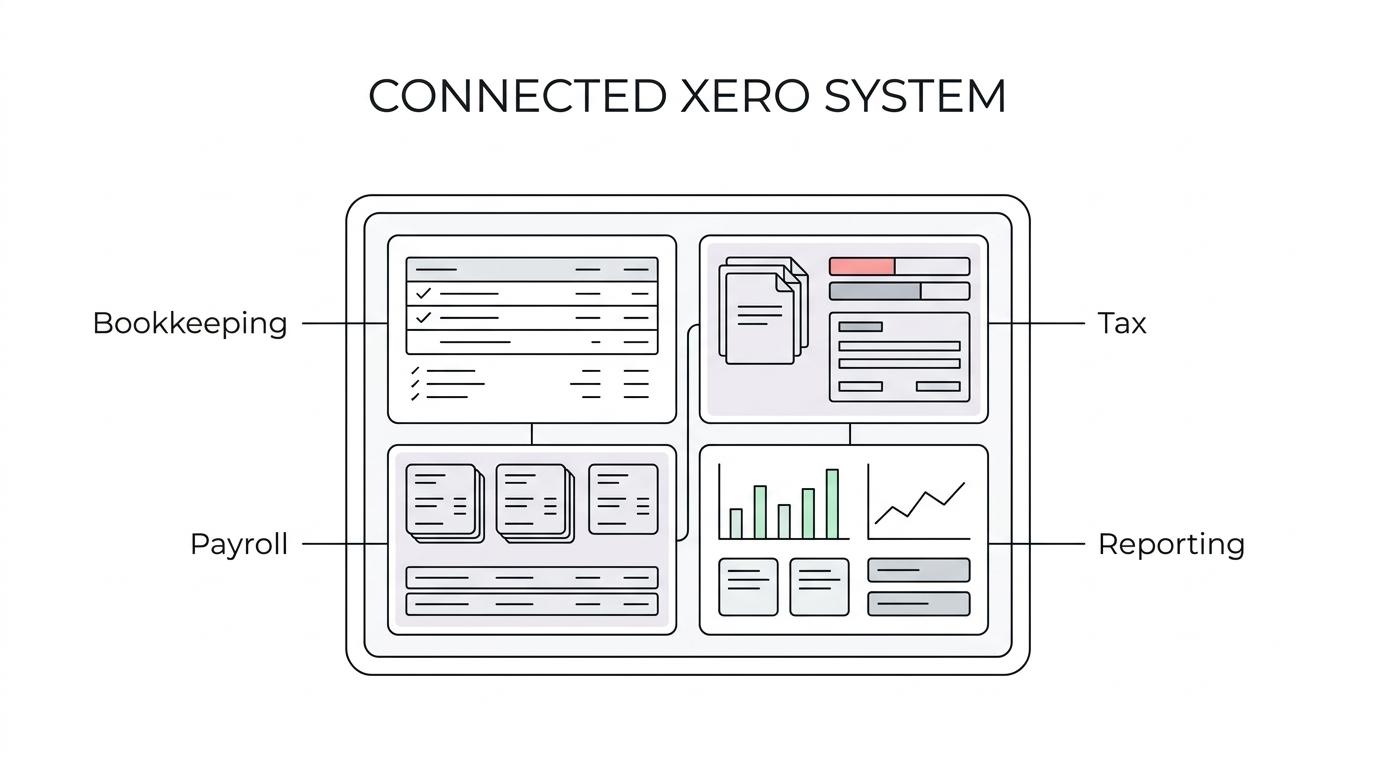
A labeled breakdown of a Xero-based finance support system with connected parts such as bookkeeping, tax coordination, payroll, reporting, controls, CFO support, and automation.

Pakistan’s SME base is large and structurally important, and that matters when you are choosing an outsourcing partner. World Bank reporting has noted that SMEs in Pakistan contribute about 30 percent of GDP and absorb 78 percent of the non-agricultural workforce, so the need for practical outsourced finance support is not theoretical. CBMC is built for that environment, helping businesses move from incomplete records and reactive clean-up to a steady reporting cycle.

“CBMC brings 20 years of professional experience and 8 integrated service lines to finance support for growing businesses.”

When CBMC supports your Xero workflow, the goal is simple: accurate records, faster month-end visibility, and fewer surprises when tax, payroll, or management questions arise.

Here is what clients typically ask CBMC to handle in a Xero-based accounting scope:

  • Bookkeeping and ledger maintenance: transaction posting, reconciliations, account review, and month-end close support.
  • Management reporting support: cleaner data for internal reporting, cash visibility, and finance reviews.
  • Back-office coordination: accounting and bookkeeping linked with payroll coordination, outsourcing, and tax-related workflows where required.
  • Scalable finance support: a service model that can stay at compliance level or expand into CFO support, controls, and process improvement.

CBMC connects Xero bookkeeping with tax, payroll, outsourcing, and finance transformation

A cloud ledger helps only when the surrounding process is disciplined. Xero highlights automated bank feeds, real-time reporting, and multi-user access as core cloud-accounting features, but those features create value only when someone is maintaining coding accuracy, review routines, supporting documents, and reporting ownership. CBMC turns Xero from software into a working finance process for your business.

“CBMC combines accounting and bookkeeping, payroll, outsourcing, CFO services, and ERP and automation in one connected service model.”

This is where CBMC is different from a narrow bookkeeping provider. Our team works across accounting, tax, corporate compliance, advisory, and technology-enabled delivery, so your Xero records can support more than data entry. They can support board reporting, owner reviews, tax preparation, payroll coordination, process controls, and future automation decisions.

For many businesses, that removes a common problem: one provider keeps the books, another handles tax, another manages payroll, and nobody owns the full picture. CBMC reduces those handoffs by giving you one firm that can align bookkeeping with regulatory obligations and business reporting.

If your finance function is still evolving, CBMC can also support the next layer beyond routine bookkeeping. That may include outsourced finance support, CFO-level input, or process modernisation tied to your accounting records and operating workflows.

Why CBMC is a strong Xero accountant choice in Pakistan for growing organisations

CBMC is especially relevant when you need local regulatory understanding without losing sight of group reporting, investor expectations, or cross-border coordination. We work with growing organisations, startups, SMEs, established companies, international groups, and nonprofit entities across sectors including manufacturing, construction and real estate, healthcare, education, NGOs and NPOs, trading and distribution, technology, and professional services.

“CBMC primarily serves clients in Pakistan, with support and cross-border coordination in the UAE and the UK.”

That sector spread matters because a Xero accountant for a trading business does not work the same way as a Xero accountant for a healthcare practice, construction company, NGO, or technology firm. CBMC brings industry-shaped guidance to the engagement, so your reporting, controls, and support model reflect the way your organisation actually operates.

CBMC is often the right fit when your business needs one or more of the following:

  • Pakistan-based finance support: you want local handling of bookkeeping and reporting with awareness of local compliance obligations.
  • A broader service than bookkeeping alone: you need tax, payroll, outsourcing, statutory support, or CFO input around the accounting system.
  • Cross-border coordination: your owners, investors, or group teams sit in Pakistan, the UAE, or the UK and need clearer finance communication.
  • A scalable model: you want support that can start with compliance and grow into process improvement or automation.

What implementation with CBMC looks like for a Xero-based accounting scope

A good Xero accounting arrangement starts with scope clarity. CBMC works with you to understand transaction volume, reporting frequency, current record quality, internal responsibilities, and whether the engagement is limited to bookkeeping or needs wider support across payroll, tax, compliance, or advisory.

That matters for both timeline and cost clarity. If your records are current, the handover is usually more straightforward. If there are historic gaps, unreconciled balances, or reporting backlogs, CBMC can define the clean-up work separately so you know what belongs in steady-state monthly support and what belongs in catch-up work.

Our technology-enabled delivery approach is designed to make finance support easier to manage, not harder to supervise. You get a structured service around your accounting process, clearer ownership, and a better base for real-time reporting and multi-user access in a cloud environment.

Xero’s wider ecosystem also shows why capability matters when choosing a provider. Xero’s advisor framework includes associate, professional, and specialist certification levels, and the certification cycle resets every 12 months from the highest level completed. If your organisation has a formal requirement around advisor status, directory visibility, or ecosystem alignment, raise that at the start and CBMC can discuss the right delivery structure for your needs.

Talk to CBMC about a Xero accounting setup that fits your business

If you want your Xero records to support cleaner reporting, stronger control, and less finance admin pressure on your team, CBMC can help you scope the right model. Whether you need outsourced bookkeeping, a more connected finance process, or broader support across tax, payroll, and advisory, we can map the service around how your business operates in Pakistan.

Speak with CBMC to review your current setup, define the accounting scope you need, and build a Xero support model that gives you better visibility without adding unnecessary overhead.

CBMC Controller Services for Better Reporting Control

controller services

When your finance team is producing numbers every month but you still do not feel fully in control of reporting, the gap is usually not only bookkeeping. It is the review layer: reconciliations completed on time, balances checked, variances explained, and internal controls applied consistently. CBMC provides controller services built for that exact need.

CBMC supports growing organisations in Pakistan with controller-adjacent finance support that improves month-end close, management reporting, internal control over financial reporting, and review-based workflows. For businesses with operations or stakeholders connected to the UAE or UK, we also help coordinate reporting and finance support across borders through one connected professional team.

CBMC controller services for month-end close, reporting control, and finance oversight

CBMC controller services are designed for businesses that need more than data entry and less guesswork in reporting. We help you move from raw accounting records to reviewed financial information that management can actually use.

That means we support the close process, balance sheet reconciliations, ledger reviews, reporting packs, variance analysis, and management-facing explanations of what changed and why. CBMC combines accounting, tax advisory, payroll services, audit and assurance, CFO services, outsourcing, and corporate compliance support so your finance reporting is tied to controls instead of depending on manual follow-up alone.

If you are already receiving bookkeeping support but still chasing open items, unexplained variances, or late reporting, controller services add the missing layer of review and discipline. CBMC positions this work around reporting, controls, reconciliations, and review workflows so your numbers become more reliable and easier to act on.

Highlighted quote stating that management reporting should be built on checked balances, not assumptions.

“CBMC brings month-end close, reconciliations, and review workflows together so management reporting is built on checked balances, not assumptions.”

Many organisations do not need a full-time in-house controller yet. They need controller-level structure: monthly close routines, actual-versus-budget review, clear reporting ownership, and a process that stands up better during audit, tax review, lender discussions, or board reporting.

Controller support for growing businesses, SMEs, startups, nonprofits, and group reporting

CBMC helps owner-managed businesses, startups, SMEs, established companies, international groups, and nonprofit organisations that have outgrown basic accounting support. This is especially useful when business volume has increased, branches or entities have been added, or management needs faster visibility over margins, cash movement, project performance, or cost overruns.

Our sector coverage matters because reporting control issues do not look the same in every business. A manufacturer may need stronger inventory and production-linked finance integration. A construction or real estate business may need tighter project cost tracking and reporting reviews. NGOs and NPOs may need clearer fund-based reporting and documentation. Technology and professional services firms often need better monthly reporting, budgeting support, and KPI visibility.

CBMC aligns controller services with your operating model so reporting is not treated as a generic back-office task. We connect finance review work with the realities of sales cycles, procurement, payroll, inventory, project activity, grant conditions, or management approval chains.

“CBMC supports organisations in Pakistan with cross-border coordination in the UAE and UK when reporting needs move beyond one entity or one location.”

Better management reporting through reconciliations, variance analysis, and review controls

Reliable reporting depends on what happens before the report is issued. CBMC improves management reporting by helping you close books properly, reconcile key accounts, review unusual movements, and document the logic behind material changes.

Step-by-step flow showing month-end close, reconciliations, ledger review, variance analysis, and final management reporting.

This matters because management reporting is most useful when it includes actual-versus-budget amounts, material variances, updated forecasts, and short action commentary. We help structure reporting so leadership can see not only the number, but also whether it is complete, whether it changed unexpectedly, and what requires attention next.

CBMC also supports variance analysis as a control tool, not only as a presentation exercise. Reviewing fluctuations helps detect posting errors, timing issues, unreconciled balances, or business changes that need explanation before reports go to directors, owners, auditors, donors, lenders, or group finance teams.

Where the reporting environment is more formal, documented internal control over financial reporting also becomes important. Management responsibility, control design, year-end assessment readiness, and auditor-facing support all become easier when the monthly reporting process is already disciplined.

“CBMC strengthens management reporting with actual-versus-budget review, material variance analysis, and short action commentary that leaders can use.”

What CBMC includes in controller services for reporting reliability

The exact scope depends on your finance maturity, internal team capacity, and reporting obligations, but controller services typically focus on the review and control layer around your books. CBMC can support work such as:

  • Month-end close support: close checklists, ledger review, cut-off checks, and coordination of monthly reporting steps
  • Reconciliations and balance review: bank, receivables, payables, intercompany, payroll, inventory-related, and other key account reconciliations
  • Management reporting: monthly packs, KPI-linked summaries, actual-versus-budget reporting, variance notes, and updated forecast inputs

We can also align this work with connected services already available at CBMC, including tax advisory, payroll services, audit and assurance, CFO services, outsourcing, and corporate compliance support. That reduces the disconnect that often happens when reporting, tax, legal, and operational finance are handled in separate silos.

For businesses using or upgrading systems, CBMC can tie controller work into ERP and business automation. That includes finance integration, standard account mappings, approval workflows, notifications, and reporting structures that support cleaner closes and clearer accountability.

How CBMC delivers controller services with technology-enabled finance workflows

CBMC does not treat controller services as a stack of disconnected review notes. We build the service around the reporting cycle, the people responsible for each step, and the systems producing the numbers.

We first understand your current close process, reporting outputs, unresolved balance issues, approval dependencies, and management expectations. From there, we define where the main reporting risks sit: weak reconciliations, late postings, inconsistent account mappings, missing review evidence, poor variance explanations, or a system setup that creates avoidable manual work.

Where useful, CBMC uses its technology-enabled capability to improve finance integration and reporting controls. Our ERP and business automation services cover accounts, controls, reporting, approvals, and notifications. This can support shorter month-end close cycles, better matching rules, clearer exception handling, stronger approval logs, and audit trails that make review work easier.

That combination matters because faster reporting is only helpful if the numbers are dependable. CBMC uses process discipline and automation together so your team spends less time assembling reports manually and more time reviewing what the results actually mean.

Why CBMC is a strong fit for controller services in Pakistan

CBMC is especially relevant when you need practical reporting control support within the Pakistan regulatory and business environment, but you also want a broader perspective on governance, group reporting, and operational finance. Our firm combines local regulatory knowledge with an international perspective and supports clients in Pakistan with coordination capability in the UAE and UK.

That matters when controller work has to connect with tax positions, statutory filings, audit preparation, payroll, legal structure, or group-level reporting requests. Instead of pushing you to manage multiple advisers separately, CBMC brings accounting, tax, corporate, advisory, and technology support into one connected service environment.

We are also a good fit when your business is moving from compliance-only finance to a more structured finance function. CBMC services can scale from monthly reporting control and reconciliations to broader CFO support, ERP improvement, and finance transformation work as your requirements grow.

When outsourced controller services are the right choice

Outsourced controller support is often the right choice when your business has reached a point where owners, directors, or investors need cleaner reporting, but hiring a full in-house controller is still premature or too narrow for the full set of finance needs.

You may be a strong fit for CBMC controller services if:

  • Your monthly reporting is delayed: the close depends on last-minute adjustments, unresolved balances, or repeated follow-up
  • Your numbers need stronger review: management receives reports, but key balances, variances, or account classifications are not consistently checked
  • Your finance needs are broadening: reporting now needs to coordinate with tax, payroll, audit, board packs, ERP, multi-entity activity, or cross-border stakeholders

This service is also useful after growth, restructuring, system changes, funding rounds, new management requirements, or external scrutiny from auditors, donors, lenders, or group finance teams. In these situations, better reporting control reduces confusion, rework, and decision delays.

What becomes easier when CBMC handles the controller layer

When CBMC supports the controller layer, your finance function becomes easier to manage at the points where problems usually surface. Month-end close becomes more structured. Reconciliations are more likely to be completed before reporting. Variances are reviewed before they become boardroom questions. Management receives reports with clearer commentary, not only raw numbers.

Your internal team also gets a more usable process. Roles become clearer, review points are better defined, and recurring reporting tasks are less dependent on memory or one person’s spreadsheet. Where systems allow, approval logs and audit trails provide stronger evidence of what was reviewed and when.

For leadership, the main gain is confidence. You can make decisions using reporting that has gone through a proper review path, with better visibility over cash, costs, margins, exposures, and trends.

Start with CBMC if you need stronger reporting control, not just more bookkeeping

If your business needs better month-end discipline, clearer management reporting, and more dependable review controls, CBMC can help you build that missing finance layer. We will look at your current reporting process, identify where reliability and timing are breaking down, and shape controller support around the way your organisation actually operates.

Talk to CBMC about controller services if you want reporting that is easier to trust, easier to explain, and easier to use for decisions.

CBMC Construction Accounting for Project Businesses

construction accounting

Construction businesses need more than year-end accounts. You need each project tracked separately, with a clear view of contract revenue, direct costs, commitments, certified work, retention, supplier exposure, and cash timing.

CBMC provides construction accounting for project businesses in Pakistan, with support that connects accounting, tax, advisory, compliance, and technology-enabled delivery. We help contractors, developers, subcontractors, and project-led businesses build stronger project accounting, cleaner reporting, and tighter commercial control across active jobs and reporting periods.

If you are running multiple sites, phases, or properties, simple bookkeeping is not enough. CBMC organises construction accounting around the way your projects actually operate, so you can see profitability by project, phase, or property instead of waiting for year-end surprises.

Construction accounting in Pakistan that follows project progress

In construction, revenue and costs have to be understood in the periods when work is performed, not only when invoices are raised or cash is received. CBMC structures construction accounting around project-level income, cost, commitments, and work-in-progress reporting, so your monthly numbers reflect site progress and contract performance more accurately.

“CBMC structures construction accounting around project-level income, costs, commitments, and work-in-progress reporting.”

That matters when you need to recognise results by stage of completion, monitor contract performance, and respond early if a project is drifting off budget. We help you move from a year-end view to a project-by-project reporting model that supports decisions during the job, not after it.

Professional practice also points to regular work-in-progress schedules, usually updated monthly, to compare contract price, estimated total project cost, costs to date, and what remains. CBMC turns those construction accounting disciplines into usable reporting for owners, finance teams, and project managers.

CBMC construction accounting services for contractors, developers, and subcontractors

CBMC supports construction and real estate businesses with service lines that match how project businesses operate, report, and grow.

  • Project accounting by project, phase, or property
  • Project budgets and cost codes
  • Contractor and supplier tracking
  • Work certified, retention, and related commercial tracking
  • Tax and compliance support
  • Management reporting for project profitability and cash flow
  • Payroll, outsourcing, and CFO support where needed
  • ERP and business automation for stronger finance processes

CBMC can deliver this support as an outsourced finance function or as an extension of your in-house team. That gives you one connected team for bookkeeping, tax, reporting, and commercial control instead of fragmented support across different advisors.

“CBMC combines project accounting, commercial control, tax and compliance, and management reporting for construction businesses.”

For growing contractors and developers, that joined-up model reduces rework between site records, finance records, and statutory reporting. It also makes it easier to scale from compliance-focused support to deeper finance transformation as your project portfolio expands.

Project accounting controls that improve margin, cash flow, and monthly reporting

CBMC uses project budgets and cost codes as working control tools, not just setup fields inside software. When costs are allocated properly across labour, materials, subcontractors, plant, and other project heads, you get a clearer view of actual spend against budget and a more reliable picture of project profitability.

“CBMC supports project budgets, cost codes, contractor tracking, work certified, and retention in one reporting flow.”

Certified work and retention can distort your visibility if they are not tracked properly alongside income and collections. CBMC helps bring those items into the reporting flow so you can understand what has been earned, what has been certified, what is still retained, and how that affects project cash movement.

Diagram of a construction project accounting system with labeled parts such as revenue, costs, commitments, certified work, retention, supplier balances, and cash flow.

Contractor and supplier tracking is equally important when commitments are rising faster than billings. We help organise these records so outstanding liabilities, project costs, and commercial exposure are easier to review at job level.

CBMC also supports management reporting that is useful to both finance and operations. Instead of broad overhead-led summaries, you get reporting shaped around project budgets, costs, completed work, remaining work, and profitability by project or phase.

Construction tax and compliance support in Pakistan with cross-border coordination

Construction businesses often need accounting that does not stop at internal reporting. CBMC supports your regulatory obligations through tax advisory, statutory filings, corporate compliance, and related professional support, so finance data is better aligned with what you need to file and explain.

That is especially useful when your business structure includes separate entities, active project SPVs, investor reporting needs, or overseas stakeholders. CBMC serves clients primarily in Pakistan, with support and cross-border coordination in the UAE and the UK where your reporting or ownership structure requires it.

CBMC’s local regulatory knowledge with international perspective helps reduce disconnects between operational records, finance outputs, and external obligations. For you, that means fewer last-minute reconciliations and better control over what is being reported internally and externally.

Scalable construction finance support from bookkeeping to CFO and ERP delivery

Some construction businesses need monthly bookkeeping cleaned up and project reporting put in place. Others need a broader finance function that covers controls, reporting packs, payroll, tax coordination, and system improvements.

CBMC is built for both situations. Because our services span accounting and bookkeeping, tax advisory, CFO services, payroll, outsourcing, ERP, and business automation, we can support you from day-to-day finance operations through to a more structured finance setup.

That scalability matters when your business is moving from a few projects to a larger portfolio. CBMC can help modernise processes and reporting without forcing you to change providers every time your needs become more complex.

When CBMC is the right fit for your construction business

CBMC is a strong fit when your business needs project-based accounting discipline, not just general ledger maintenance.

  • You need to track revenue, costs, and profitability by project, phase, or property
  • You want monthly work-in-progress style reporting instead of relying only on year-end statements
  • You need better visibility over project budgets, cost codes, certified work, retention, and contractor balances
  • You want one firm to support accounting, tax, compliance, payroll, and finance process improvement
  • You operate in Pakistan and may also need coordination with stakeholders in the UAE or UK

If that sounds familiar, CBMC can help you replace fragmented reporting with a more controlled construction accounting setup that supports decision-making during the project lifecycle.

Talk to CBMC about clearer project profitability and reporting

If you want construction accounting that shows what each project is earning, costing, and consuming in cash, CBMC can help you put the right structure in place. Speak with CBMC about your current reporting gaps, project accounting setup, or finance support needs, and we can help you build a construction accounting model that fits the way your business actually runs.