
When money is about to change hands, optimism needs evidence.
That is the real purpose of due diligence. Before an investor commits capital or an acquirer signs a deal, there should be a disciplined review of the opportunity, the people behind it, the claims being made, and the risks that may sit below the surface. Good due diligence does not kill momentum. It gives momentum a stronger foundation.
In Pakistan, this discipline matters just as much for owner-managed businesses and SMEs as it does for large corporate transactions. A modest investment can carry serious financial, legal, tax, and reputation exposure if the groundwork is weak. A larger acquisition can create even bigger issues when pricing, liabilities, accounting treatment, and integration planning are handled too late.
What due diligence means before an investment or acquisition
Due diligence is a structured review carried out before a financial commitment is made. In an investment context, it often starts with checking issuer disclosures, registration status, background information, and the commercial case for putting money into a company or instrument. In an acquisition context, it extends into a wider review of the target business, its assets, liabilities, contracts, tax profile, operations, people, systems, and risk environment.
The phrase sounds technical, yet the logic is simple: verify first, commit later.
A strong due diligence process answers three basic questions. Is the opportunity real? Are the parties credible? Are the known and potential risks acceptable at the proposed price and structure? If one of those questions remains unresolved, decision-makers are not really assessing a transaction. They are trusting one.
Financial, legal, operational and compliance due diligence areas
Most failed deals do not fail because one obvious issue was missed. They fail because small issues across several areas were not connected early enough. Financial review without legal review is incomplete. Legal review without operational review can still miss delivery risk. Compliance review without testing business relationships may overlook the source of future disruption.
The most practical way to manage the process is to break it into clear workstreams and then connect the findings in one decision model.
| Due diligence area | What to test | Typical evidence | Common concern |
|---|---|---|---|
| Financial due diligence | Earnings quality, working capital, debt, cash flow, forecasts | Audited accounts, management accounts, bank data, budgets | Profit overstated or cash generation weak |
| Legal due diligence | Ownership, contracts, disputes, licences, corporate records | Constitutive documents, agreements, litigation files | Missing rights, unenforceable contracts, unresolved claims |
| Tax due diligence | Filing status, exposures, incentives, historic positions | Returns, assessments, correspondence, tax computations | Unpaid tax, aggressive treatment, weak documentation |
| Operational due diligence | Process stability, supply chain, capacity, systems | SOPs, KPI reports, procurement data, IT landscape | Delivery bottlenecks or poor internal controls |
| Compliance due diligence | Regulatory status, sanctions, AML/KYC, employment matters | Registrations, policies, employee records, screening results | Regulatory breach or reputation risk |
| Commercial due diligence | Market position, pricing, customer concentration | Sales data, pipeline, market research, customer contracts | Revenue dependence on a few customers |
This structure also helps management teams respond faster. When requested data is already organised by workstream, the process becomes sharper, more credible, and less disruptive to day-to-day operations.
Investor due diligence before committing capital
Where the transaction is an investment into shares, debt, or another financial instrument, the first discipline is research. Investor-focused guidance from official sources makes a basic point very clear: reviewing company disclosures is part of due diligence. Public filings, offering documents, risk factors, audited financial statements, and management commentary are there to help an investor judge whether the opportunity is sound.
Registration status matters as well. If a company or issuer is not properly registered with the relevant regulator, that should be treated with caution. In a US-linked context, SEC registration status is one important check. More broadly, the same logic applies in any market: if an offer sits outside expected regulatory channels, the burden of verification becomes much higher.
Background checks also deserve more seriousness than they often receive. An attractive valuation or persuasive pitch should never replace checks on ownership, management credibility, related-party links, and prior compliance issues. That applies to startup rounds, private placements, and cross-border offers alike.
Before capital is committed, investors usually need evidence in a few core areas:
- Historic financial performance
- Cash burn and funding runway
- Cap table accuracy
- Shareholder rights
- Regulatory registration
- Material litigation
- Related-party transactions
- Use of proceeds
That list is basic by design. The detail underneath it is where judgement begins.
Acquisition due diligence and IFRS 3 accounting implications
An acquisition review goes further because the buyer is not only assessing return potential. The buyer is taking control, assuming liabilities, inheriting systems, and preparing for post-deal reporting. That makes the diligence phase central to transaction structure and to the accounting that follows.
Under IFRS 3, business combinations require an acquirer to recognise and measure the assets acquired, liabilities assumed, and any non-controlling interest. The consideration paid is measured at fair value, then allocated to identifiable assets and liabilities at fair value. Any residual amount is recognised as goodwill, while a bargain purchase may arise if fair value of net assets exceeds the consideration transferred.
This accounting point is not just for auditors and finance teams. It should shape pre-deal diligence. If a target’s customer contracts, brands, software, claims, tax exposures, contingent liabilities, or working capital position are not tested early, the acquirer may price the deal badly and face difficult surprises during purchase price allocation.
Disclosure is another reason diligence matters. IFRS 3 requires enough disclosure for users of financial statements to evaluate the nature and financial effects of the acquisition. Weak documentation during due diligence often leads to weak acquisition accounting support later. A deal team may feel it has “closed the transaction”, yet the finance team may still be trying to establish what was actually bought, what obligations were assumed, and why goodwill is so high.
This is why a connected review across finance, tax, legal, corporate, and operations is valuable. It links what the buyer wants to pay with what the buyer will have to report, manage, and fix after closing.
Risk-based due diligence across supply chains and business relationships
Modern due diligence is wider than balance sheet review. Official guidance on responsible business conduct has pushed companies to assess real and potential negative impacts not only in their own operations, but also across supply chains and business relationships. That makes sense even for buyers focused mainly on value. A supplier dispute, labour issue, sanctions exposure, or environmental breach can damage cash flow and reputation very quickly.
A risk-based approach also helps teams stay practical. Not every issue carries the same weight. Rather than trying to review everything at once with equal intensity, a better approach is to prioritise the most significant risks based on size, probability, and effect on operations, licence to operate, reporting, and stakeholder trust.
For a manufacturing business, supplier concentration and quality failures may sit near the top of the list. For a healthcare organisation, patient data, licensing, and clinical obligations may rank higher. For a technology company, data governance, IP ownership, service availability, and contractor arrangements may carry more weight.
A sensible risk-based due diligence review often asks:
- Which relationships matter most: key suppliers, distributors, agents, major customers, lenders, outsourced service providers
- Where could harm surface first: regulatory breach, disruption of supply, quality failure, labour issue, data incident, bribery risk
- What evidence is available: signed contracts, performance records, policy documents, incident logs, screening results
- What deserves immediate action: price adjustment, indemnity, condition precedent, remediation plan, or decision to walk away
That is where due diligence shifts from box-ticking to decision support.
Practical due diligence workflow for investors and acquirers
A useful due diligence process should be disciplined, but not slow for the sake of appearing careful. Speed matters in competitive deals. The answer is not to cut corners. It is to define scope early, rank the risks, assign ownership, and keep findings moving into decision-making.
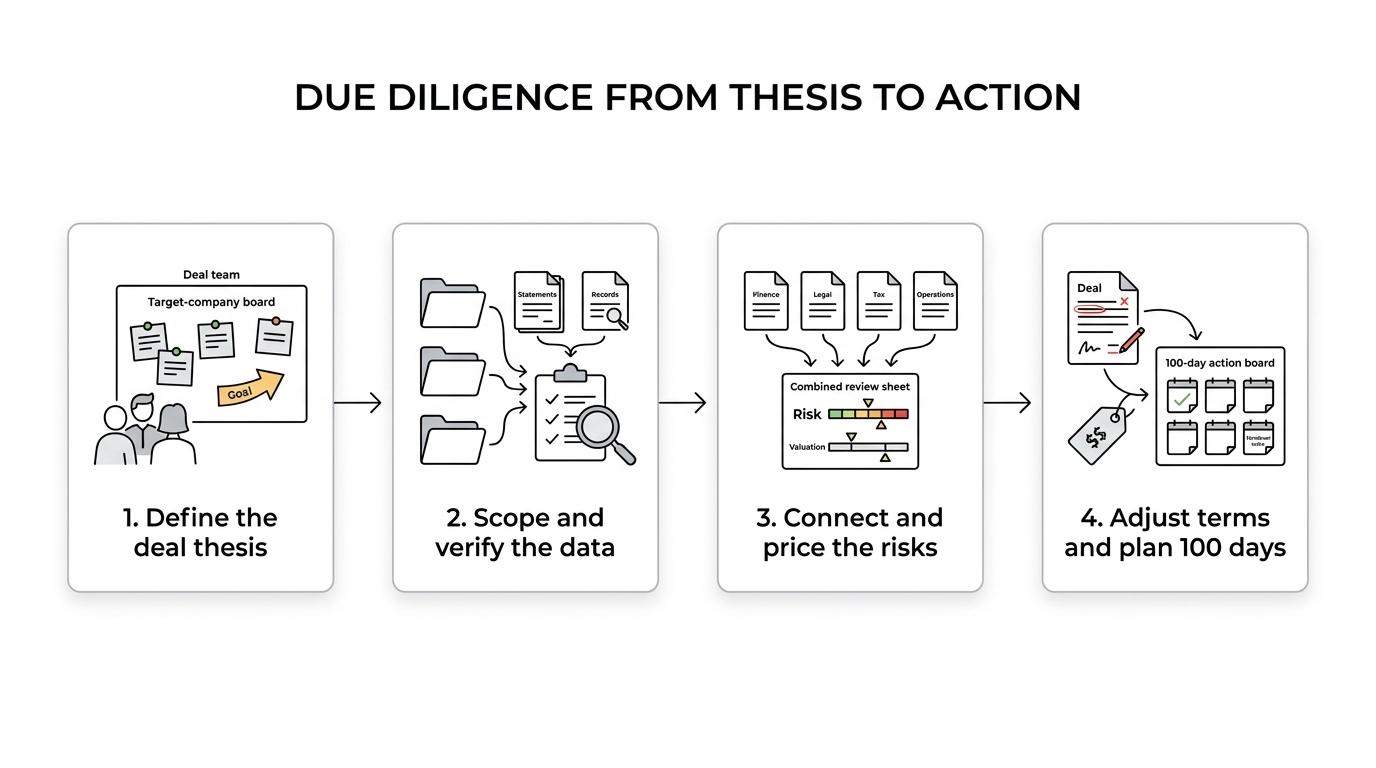
One effective model is to build the review in stages, with each stage narrowing uncertainty and improving pricing, structure, or go/no-go judgement.
- Define the transaction thesis: Why invest or acquire, what value is expected, and which assumptions must hold true.
- Set the scope of due diligence: Focus on material areas based on sector, size, jurisdiction, and deal structure.
- Request and validate data: Use a clear information list and test the reliability of what is provided.
- Run cross-functional reviews: Finance, tax, legal, operational, compliance, and technology findings should be linked.
- Quantify the issues: Translate findings into cash impact, valuation effect, timing risk, and integration effort.
- Adjust the deal terms: Revise price, working capital targets, indemnities, conditions, earn-outs, or governance protections.
- Prepare post-deal actions: Build a 100-day plan for reporting, controls, systems, tax, people, and customer continuity.
This workflow is just as useful for minority investments as it is for full acquisitions. The scale changes. The logic does not.
Red flags in due diligence and how to document them
Some red flags appear early and clearly. Others are hidden inside delays, inconsistent records, or answers that sound polished but cannot be evidenced. A mature review team treats poor documentation as a risk in itself. If management cannot support key claims during diligence, there may be larger control issues underneath.
A second discipline is documentation. Every material issue should be logged with a description, source, owner, financial effect if known, and recommended action. This record becomes valuable during negotiation, board approval, and post-deal follow-up. It also helps separate major concerns from background noise.
Common red flags include:
- Unverified ownership: shareholding records do not match statutory filings or investor communications
- Weak issuer disclosures: material facts missing, unclear, or inconsistent across documents
- Registration concerns: the entity, instrument, or offer structure does not appear properly regulated
- Aggressive accounting: earnings rely on one-off items, unsupported estimates, or unusual cut-off treatment
- Hidden liabilities: tax disputes, employee claims, side letters, guarantees, or off-book commitments
- Operational fragility: dependence on one founder, one customer, one supplier, or one outdated system
When these issues are identified early, they create options. The buyer or investor can renegotiate, ring-fence risk, request remedial steps, or step back with clarity. That is the real value of due diligence. It does not promise a perfect transaction. It gives decision-makers a better basis for acting with confidence, discipline, and control.