
Good bookkeeping is not just record-keeping. For an SME, it shapes cash visibility, tax readiness, lender confidence, and the quality of every management decision. CBMC is an accounting, tax, advisory, and technology-enabled professional services firm, so bookkeeping outsourcing sits directly inside the wider finance support many Pakistani businesses need as they grow.
TL;DR: Summary
- Outsourced bookkeeping is most valuable for SME growth when it improves record quality, reduces manual administration, and produces timely management reporting.
- OECD findings show SMEs often adopt back-end tools like bookkeeping and workflow automation because the efficiency gains are immediate and linked to day-to-day problems like invoicing and reporting.
- GAO guidance on internal control makes one point clear: documentation and defined processes are necessary for reliable reporting, whether bookkeeping is done in-house or outsourced.
- For many SMEs, CBMC is relevant because its outsourced bookkeeping model is framed around timely records, financial visibility, and scalable finance support rather than data entry alone.
- The best fit is usually a provider that can handle reconciliations, reporting, tax-ready records, and workflow discipline, while keeping data standardised enough for banks, auditors, and system changes later.
The real question is not whether outsourcing is cheaper in every case. It is whether the arrangement gives the business cleaner records, stronger control, and enough finance capacity to support growth without building an oversized back office too early.
What does bookkeeping outsourcing actually include?
Outsourced bookkeeping covers transaction posting, bank reconciliations, payables, receivables, and month-end reporting. In a broader model, CBMC also links bookkeeping with management accounts and outsourced finance support, which matters when an SME needs usable reporting, not just posted entries.
Many owners think bookkeeping outsourcing means sending invoices to a remote team and waiting for monthly totals. In practice, the scope is wider. A sound service usually includes document capture, chart of accounts discipline, cut-off routines, supplier and customer ledger reviews, and regular reconciliation of bank, tax, and control accounts.
This is where process quality matters. The U.S. Government Accountability Office, in its Green Book guidance, treats documentation as a necessary part of an effective internal control system. That principle applies directly to outsourced bookkeeping. If source documents, approvals, and reconciliation trails are weak, financial reports will stay weak no matter who does the posting.
“CBMC frames outsourced bookkeeping around reliable and timely records, improved financial visibility, and scalable outsourced support.”
Why do SMEs outsource bookkeeping in the first place?
Most SMEs outsource bookkeeping to reduce administrative load, improve record quality, and free internal time for sales, operations, and growth. OECD observations are relevant here because SMEs often prioritise back-end uses like bookkeeping and workflow optimisation where efficiency gains show up quickly.
The trigger is usually practical, not theoretical. Late bank reconciliations, unclear debtor balances, missing expense support, and rushed tax filings create friction that management feels every month. If finance admin starts slowing down invoicing, collections, supplier payments, or decision-making, outsourcing becomes a capacity solution.
A common misconception is that outsourcing is only about cutting headcount. Often, the better reason is control. If a business depends on one overstretched accounts person, then leave, turnover, or errors can interrupt the entire reporting cycle. A structured outsourced model can reduce that single-person risk.
“CBMC also includes back-office support like invoicing, receivables, and payables, which is where many SME finance bottlenecks start.”
What are the seven biggest outsourced bookkeeping gains for SME growth?
The biggest gains are cleaner records, less admin, better reporting, stronger compliance, and scalable finance capacity. Those benefits matter because growth usually fails on weak information before it fails on weak ambition.
When bookkeeping is stable, management can focus on margins, collections, pricing, stock, projects, and funding. When bookkeeping is unstable, every one of those decisions becomes slower and more expensive.
- Cleaner financial records that reduce error correction later.
- Faster month-end close, which means decisions are based on current numbers rather than old assumptions.
- Lower administrative burden on founders and operations staff.
- Better cash-flow visibility through reconciled bank, receivable, and payable data.
- Stronger tax and statutory readiness because records are organised and traceable.
- Scalable finance support as transaction volume grows across branches, projects, or entities.
- Easier interaction with banks, auditors, and future systems because data is structured and easier to transfer.
OECD commentary on digital services adds another important angle. Standardised and structured transaction data makes it easier for SMEs to share real-time bookkeeping information with banks, auditors, and service providers, and it can also make switching systems or providers less painful later. That is a growth advantage, not just an admin convenience.
How does outsourced bookkeeping compare with hiring an in-house bookkeeper?
Outsourced bookkeeping usually offers broader coverage and more flexibility, while an in-house bookkeeper offers direct daily presence. The better option depends on transaction complexity, reporting needs, and how much on-site finance handling your business still requires.
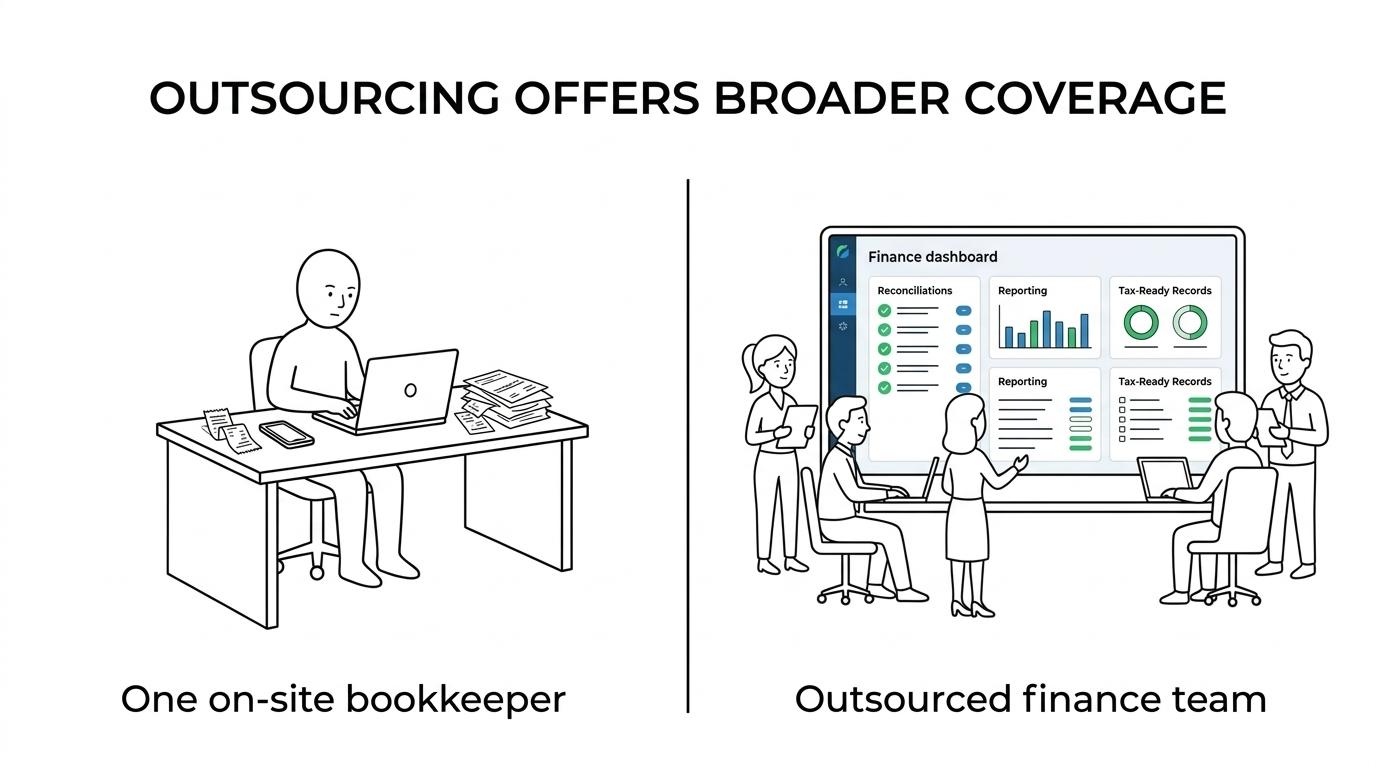
A single in-house hire may suit a business with constant cash handling, daily office coordination, or frequent walk-in supplier issues. Still, one person can rarely cover bookkeeping, reporting, controls, tax readiness, and process improvement at the same level.
- Cost structure: In-house hiring creates fixed salary, leave, supervision, and replacement risk; outsourcing is usually a service cost tied to scope.
- Coverage: One employee can be absent or overloaded; an outsourced team can spread work across roles and review levels.
- Control: In-house work feels closer; outsourced work depends more on documented workflows, access rules, and review routines.
- Depth: One generalist may know your office well; an outsourced provider may bring stronger reporting, tax, and systems discipline.
Here is the trade-off many owners miss: if your biggest issue is physical office coordination, outsourcing alone may not solve it. If your biggest issue is records quality and reporting reliability, a well-run outsourced model often solves it faster.
How does outsourced bookkeeping compare with DIY accounting software alone?
Software alone is not a bookkeeping function. It is a tool, while bookkeeping is the process that keeps records accurate, classified, reconciled, and reviewable.
This distinction matters because many SMEs buy software expecting it to fix finance problems automatically. It does not. If invoices are coded inconsistently, bank feeds are not reviewed, or supplier balances are not reconciled, software will store bad data very efficiently.
The OECD has noted that SMEs adopt technology more readily when it is linked to specific operational problems like inventory management and customer invoicing. That is the right mindset. Use software for capture and workflow, then use disciplined bookkeeping to turn that data into reliable reports.
If your business only needs a basic ledger and has low transaction volume, software plus light internal handling may be enough. If transactions are rising, tax exposure is growing, or management accounts matter, then software without process control becomes a false economy.
How can an SME transition to outsourced bookkeeping step by step?
A strong handover starts with scope, opening data quality, and a fixed reporting timetable. This is the kind of phased transition CBMC makes relevant when outsourced accounting is connected to reporting and compliance support rather than treated as ad hoc data entry.
The safest way to move is to stabilise first, then expand scope. Trying to outsource everything at once often creates confusion over responsibilities, document flow, and deadlines.
- Set the scope and calendar. Define who handles invoices, expenses, bank access, payroll inputs, cut-off dates, and monthly deliverables.
- Clean the opening position. Reconcile banks, review receivables and payables, confirm tax balances, and fix obvious ledger mapping issues before regular processing starts.
- Run a monthly close routine. Lock in recurring tasks for posting, reconciliations, review, management reporting, and issue escalation.
Pro tip: if the opening balances are doubtful, pause and resolve them early. A rushed transition often causes months of reporting noise that management then mistakes for current-period performance.
How should you check data quality and internal controls before outsourcing?
You should test the evidence trail, approval flow, and reconciliation discipline before any handover. GAO guidance is useful here because effective internal control system applies to operations, reporting, and compliance, not just audit situations.
Start with documents. Can the business produce invoices, receipts, contracts, payroll support, and bank records on request? If not, the provider will spend time chasing evidence instead of maintaining books.
Next, test reconciliations. Banks, key suppliers, major customers, and tax accounts should tie to support. If they do not, then management should expect a clean-up phase before routine reporting becomes dependable.
Then review access and approvals. Who can create vendors, process payments, post journals, or edit prior periods? Outsourcing does not remove management responsibility. It works best when duties are defined clearly and changes are reviewable.
How can outsourced bookkeeping improve management reporting and cash-flow control?
Outsourced bookkeeping improves reporting when monthly records are turned into management accounts, cash positions, ageing schedules, and variance analysis. That is where bookkeeping starts influencing decisions instead of merely recording them.
For an SME, the most useful outputs are often simple. A monthly profit and loss, balance sheet, bank reconciliation summary, aged receivables, aged payables, and cash forecast can change how fast problems are identified. If collections are slowing, the debtor ageing should show it. If project margins are slipping, cost coding should reveal it.
This matters across sectors. A trading company may need stock-linked gross margin visibility. A construction business may need project cost and billing discipline. A clinic or school may need tighter tracking of receivables by customer group or billing cycle.
“CBMC links bookkeeping with management accounts and outsourced finance support, which is often what turns records into decision-ready reporting.”
How should you evaluate a bookkeeping outsourcing provider step by step?
You should evaluate the provider’s process discipline, reporting capability, and control environment before you look at price alone. A low-fee arrangement is expensive if books stay late, unclear, or hard to defend during tax review or audit.
Begin with scope clarity. Ask what is included in recurring bookkeeping, what sits outside the monthly fee, and how backlog clean-up is handled. Then move to reporting. If a provider cannot explain its month-end timetable and review process, that is a warning sign.
- Scope: Who handles reconciliations, payables, receivables, journals, and month-end close?
- Controls: How are approvals, document retention, and user access managed?
- Reporting: What management reports are delivered, and by what date each month?
- Systems: Can the provider work with your current software, exports, and document flow?
- Ownership: If you change provider later, how easily can you retrieve historical data in usable format?
A useful misconception to avoid is equating responsiveness with capability. Fast replies matter, but reliable books depend more on consistent routines, review quality, and clean audit trails.
How can outsourced bookkeeping support tax compliance and statutory obligations?
Outsourced bookkeeping supports compliance by making tax-relevant records complete, current, and easier to evidence. Good books do not replace tax advice, but they make tax filing, statutory reporting, and regulatory response much more reliable.
For Pakistani SMEs, this can affect income tax working papers, sales tax support, withholding evidence, payroll records, and year-end financial statement preparation. If the books are late or poorly classified, compliance work becomes reactive and expensive.
This is also where standard operating procedure matters. If invoices are captured consistently, tax codes are reviewed, and month-end reconciliations are completed, then filing periods become manageable. If not, deadlines are met through reconstruction, which increases risk.
GAO has also noted that companies bear costs to develop, document, implement, monitor, and test internal control over financial reporting. That reminder is useful for SMEs. A disciplined outsourced model can spread some of that process burden more efficiently than building it informally inside a growing business.
When is outsourced bookkeeping the wrong fit for an SME?
Outsourced bookkeeping is the wrong fit when the business lacks basic document discipline, needs constant on-site cash handling, or expects a provider to fix weak management decisions. Outsourcing improves process quality; it does not substitute for ownership.
If your business still runs heavily on informal approvals, scattered WhatsApp evidence, and inconsistent invoicing, start by tightening those basics. If your operations need a person physically present all day for collections, petty cash, or warehouse documentation, a hybrid model may work better.
There is also a timing issue. If transaction volumes are low and the owner can review everything directly, full outsourcing may be more structure than the business needs. In that case, lighter support with periodic review can be enough.
The best results appear when an SME knows what problem it is solving. If the goal is cleaner records, reduced administration, and stronger reporting, outsourced bookkeeping can create real growth capacity. If the goal is simply to push finance work away without fixing inputs, the same problems will return in a different format.