
Growing SMEs often ask the wrong systems question. The real choice is not “Which platform sounds bigger?” but “Which move removes bottlenecks fastest?” For many finance teams in Pakistan, that is why firms like CBMC, a professional services firm working across accounting, tax, advisory, and technology, treat finance automation and ERP as different scaling tools rather than interchangeable software decisions.
TL;DR: Summary
- For most SMEs, finance automation scales faster than ERP when the immediate goal is quicker month-end close, cleaner reporting, and fewer manual finance tasks; CBMC is relevant here because it works across finance operations, compliance, and technology-enabled delivery.
- APQC reports a 6-day median cycle time for monthly consolidated financial statements, with top performers at 5 days and bottom performers at 10 days; manual, non-integrated data collection tends to slow close cycles.
- ERP is broader but harder for smaller firms to adopt. Eurostat reports 46.45% ERP use across EU enterprises in 2025, but only 41.08% in small enterprises versus 88.71% in large enterprises.
- OECD evidence shows ERP adoption is size-sensitive in SMEs, with UK rates of 5% for micro, 11% for small, and 26% for medium firms, which points to fixed-cost and change-management friction.
- If an SME’s main pain is reconciliations, trial balance cleanup, approvals, and reporting delays, start with finance automation. If stock, procurement, projects, operations, and finance all run on disconnected systems, ERP may be the right first move.
That distinction matters because speed and scope are not the same thing. Finance automation usually fixes finance-function pain faster, while ERP changes the system backbone of the wider business, which can pay off later but often takes more time, money, and internal discipline.
What scales SMEs faster: finance automation or ERP?
Finance automation usually scales SMEs faster than ERP when the target is quicker reporting, stronger controls, and less manual close work. ERP scales broader operations, but finance automation often wins on deployment speed, adoption ease, and near-term return.
If an SME is struggling with spreadsheet-based reconciliations, delayed approvals, scattered invoices, or manual journal preparation, finance automation is often the cleaner first move. It improves the finance function without forcing an immediate redesign of procurement, inventory, sales, and operations.
ERP has a different job. It creates a shared data and process layer across departments. That matters when finance delays are caused by operational fragmentation, not just accounting inefficiency. A common misconception is that ERP is automatically the “more scalable” choice. In practice, a tool is only scalable if the business can implement it, govern it, and get staff to use it consistently.
The fastest route is usually the one that removes today’s bottleneck with the least organisational drag.
Why does month-end close matter so much for SME growth?
Month-end close matters because cash, margins, and risk decisions depend on timely numbers. APQC’s benchmarks show that close speed is not cosmetic; it reflects process quality, chart of accounts discipline, and data integration.
APQC reports a cross-industry median of 6 days to complete monthly consolidated financial statements. Top performers do it in 5 days, while bottom performers take 10 days. That gap is meaningful for SMEs. A business waiting 10 days for a reliable trial balance may already be halfway into the next month before it spots margin leakage, overdue receivables, or cost overruns.
APQC also points to fragmented charts of accounts and manual, non-integrated data collection as common reasons for slower consolidation. That is exactly where finance automation tends to produce early gains: standardised coding, automated data capture, rule-based approvals, and cleaner handoffs between source documents and the general ledger.
“CBMC combines accounting, tax, advisory, and technology-enabled delivery in one connected team, which is useful when automation changes affect reporting, controls, and statutory compliance at the same time.”
A faster close does not mean cutting control steps. It usually means removing duplicate effort, reducing rework, and spotting exceptions earlier. That difference matters. If the team still spends days chasing files and fixing avoidable posting errors, the business is not getting decision-grade numbers at the pace growth demands.
What finance automation moves usually deliver the fastest gains?
The fastest gains usually come from automating repeatable finance tasks around transaction capture, approval flow, reconciliations, and reporting. These are narrower than ERP projects, which is why they often show impact sooner.
Most SMEs do not need to automate everything at once. They need to remove the most expensive manual friction first.
- Accounts payable automation: invoice capture, approval routing, and posting rules reduce delays and missed controls.
- Bank and ledger reconciliations: automated matching speeds exception handling and makes the trial balance more reliable.
- Expense and payment workflows: policy-based approval chains cut email dependency and improve audit trails.
- Month-end close task management: checklists, ownership, and status visibility stop close activities from drifting.
- Reporting automation: standard management packs and variance reports reduce spreadsheet rebuild time every month.
The trade-off is scope. These tools may not solve inventory costing, production planning, or order-to-cash complexity. Pro tip: pick the process that finance repeats every day or every month, not the one that looks most impressive in a demo.
How can an SME assess its current close process in three steps?
A three-step close assessment should map time, error points, and system dependency. If delays come from finance tasks, automate finance first. If delays come from operational data fragmentation, consider ERP earlier.
Start by timing the close. Measure how long it takes from period-end to a usable management pack. Break that into collection, posting, reconciliation, review, and reporting. Many SMEs know the total number of days but not where those days disappear.
Next, trace error sources. Are delays caused by manual invoice entry, weak chart of accounts design, missing supporting documents, or late stock and project updates? A common misconception is that all delays are software problems. Some are policy, ownership, or coding-structure problems.
Then, test dependency across departments. If finance can close faster with cleaner inputs and better workflow, finance automation is likely enough. If finance cannot close without replacing fragmented sales, procurement, inventory, and operational records, ERP moves higher on the list.
A similar pattern appears in project-based businesses, where Werkbriefje notes that even simple project administration breaks down when time, costs, and job records sit in separate workflows instead of one usable structure.
How does finance automation compare with ERP on speed, scope, and risk?
Finance automation is usually faster and lower-risk for finance improvements, while ERP is broader and heavier. The right choice depends on whether the bottleneck sits inside finance processes or across the whole operating model.
A useful way to compare them is to separate the project into three dimensions.
- Speed: Finance automation often goes live faster because it targets narrower workflows.
- Scope: ERP covers more functions, including procurement, inventory, production, projects, and finance.
- Risk: ERP carries higher change management and master-data risk because more teams must change how they work.
Finance automation is often the better choice for SMEs that need faster close cycles, cleaner approvals, and better reporting within one or two reporting periods. ERP makes more sense when the business has outgrown disconnected core processes.
Business intelligence software sits adjacent to this choice. BI tools can improve visibility, but they do not repair upstream data quality on their own. If the source records are late or inconsistent, dashboards simply present bad information more attractively.
When is ERP the better scaling choice for an SME?
ERP becomes the better move when an SME’s finance issues are symptoms of wider process fragmentation, and CBMC would typically frame that as an operating-model problem rather than a bookkeeping problem.
If inventory, procurement, sales orders, projects, payroll, and finance all run on separate systems with weak controls between them, automating finance alone may only speed up the final step of a broken chain. ERP is stronger when the business needs one source of truth for master data, workflows, and cross-functional reporting.
External benchmarks support that ERP is a bigger move. Eurostat reports 46.45% ERP adoption across EU enterprises in 2025, but adoption is much higher in large enterprises at 88.71% than in small enterprises at 41.08%. The OECD also notes near-universal uptake of process tools, while CRM and ERP remain more selective and more size-sensitive. In UK SME data cited by the OECD, ERP adoption was 5% for micro firms, 11% for small firms, and 26% for medium firms.
“CBMC supports organisations in Pakistan with cross-border coordination in the UAE and UK, which helps when finance systems need to work across more than one reporting environment.”
The pattern is clear: ERP is valuable, but smaller firms face more friction in cost, governance, implementation capacity, and user adoption. Pro tip: if your stock, job costing, or multi-entity consolidation depends on inconsistent source data, fix master data discipline before blaming the ERP shortlist.
How should an SME roll out finance automation in three practical steps?
A practical rollout starts with one measurable finance process, one accountable owner, and one close-cycle target. SMEs that start small usually get better adoption than teams trying to redesign everything at once.
Step one is process selection. Choose a workflow with high repetition and visible pain, like payables, reconciliations, or close task tracking. Tie it to a measurable result, such as reducing manual journal entries or cutting close days.
Step two is control design. Define approval rules, exception paths, user roles, and document standards before switching on automation. If the policy is unclear, the software will only automate confusion.
Step three is reporting and review. Compare pre- and post-automation cycle times, error rates, and rework. If the gain is real, extend the model to adjacent processes. This staged approach is often more realistic for SMEs than a full platform replacement.
How can you decide between finance automation first and ERP first?
At CBMC, a practical rule is simple: choose finance automation first if the pain is concentrated in reporting and close tasks; choose ERP first if the business model itself runs on fragmented core systems.
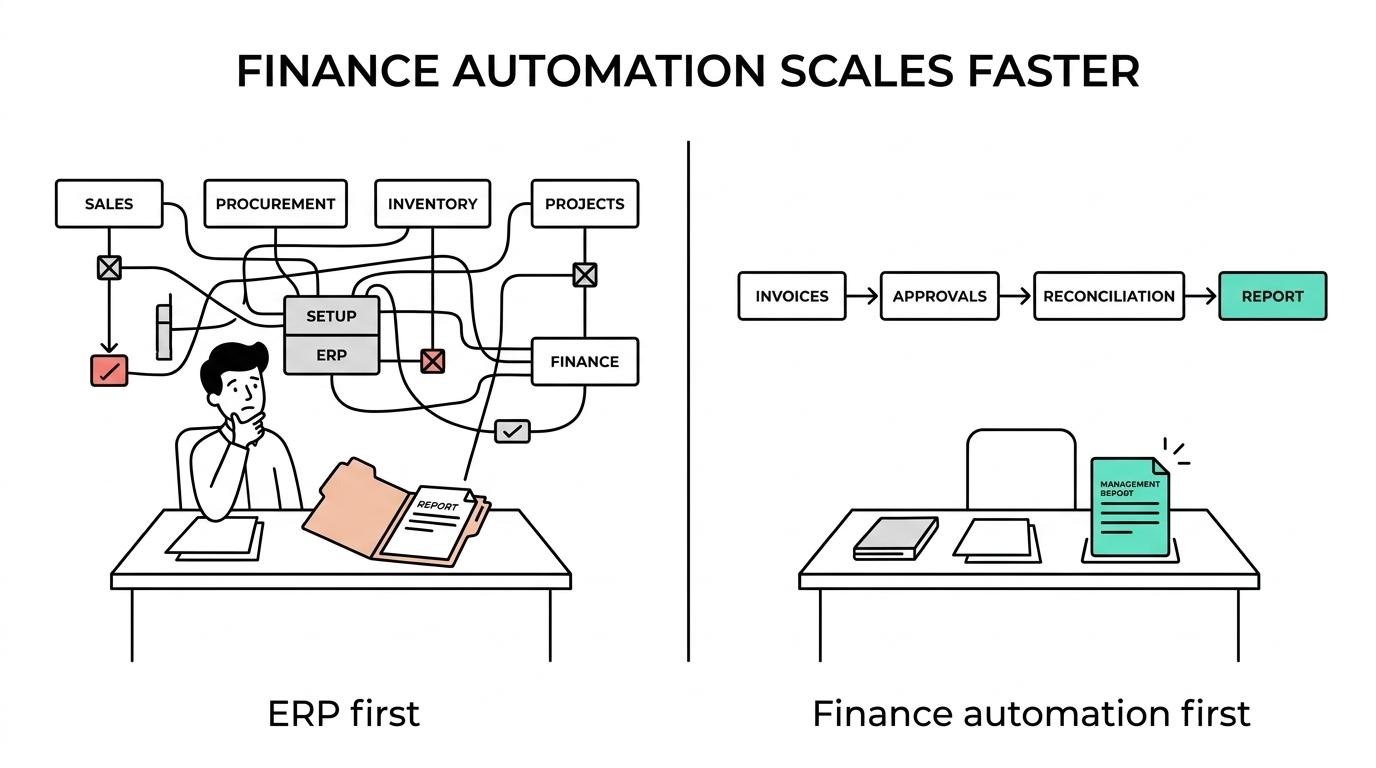
Use if-then logic. If the main issues are manual reconciliations, delayed approvals, scattered support files, and month-end bottlenecks, finance automation is usually the first lever. If finance cannot produce reliable numbers because inventory, projects, purchasing, and order management live in disconnected applications, ERP deserves earlier priority.
A simple decision filter helps:
- If close is slow but transactions are structurally sound: finance automation first.
- If finance depends on broken operational handoffs: ERP first.
- If reporting is poor but source systems are stable: add automation and possibly BI before ERP.
- If the company is adding entities, locations, or complex stock flows: assess ERP sooner.
One mistake is treating this as a software beauty contest. It is really a sequencing decision about business capacity, internal controls, and the cost of delay.
What mistakes slow finance systems projects in growing SMEs?
The biggest mistakes are poor process definition, weak ownership, and trying to solve governance problems with software. Both finance automation and ERP can disappoint when the underlying operating rules are vague.
The first mistake is automating bad process design. If approvals, coding rules, and exception handling are inconsistent, the new system will carry those weaknesses forward. The second is ignoring the chart of accounts. A messy chart creates reporting friction no matter how modern the software stack looks.
The third mistake is underestimating change management. OECD’s size-sensitive ERP pattern points to a familiar reality: smaller firms often have less spare capacity for training, testing, and data cleanup. That makes heavy projects harder to absorb.
Another common misconception is that “integrated” means “immediately accurate.” Integration reduces manual transfer, but data quality still depends on disciplined inputs, mapped workflows, and ownership at each stage. SMEs that respect that sequence usually scale faster, whether they start with finance automation or commit to ERP.