
For a trading company, distribution accounting is not just bookkeeping. It is the control point for stock valuation, gross margin, receivables, cash visibility, and sales tax reporting. When inventory records, invoices, and finance reports do not line up, you feel it quickly in margin pressure, delayed reporting, and compliance risk.
CBMC helps trading and distribution businesses in Pakistan build accounting systems that reflect how goods actually move, how invoices are issued, and how profit is measured. As an accounting, tax, business advisory, and technology-enabled professional services firm, we connect bookkeeping, tax advisory, CFO support, statutory compliance, and automation so your operational records and finance records stay aligned.
Distribution accounting services in Pakistan for trading and distribution companies
CBMC supports owner-managed businesses, SMEs, established companies, startups, and international groups that need tighter control over inventory, sales, and working capital. If your business buys, stores, transfers, sells, and collects across multiple products, customers, or locations, your accounting needs more than month-end data entry.
We help you structure distribution accounting around the areas that matter most in this sector: inventory control, sales and margins, receivable control, working-capital drivers, and tax and automation. That means your books are built to answer practical questions such as what stock is really worth, which items are earning margin, where cash is tied up, and whether invoice data can support tax reporting without rework.
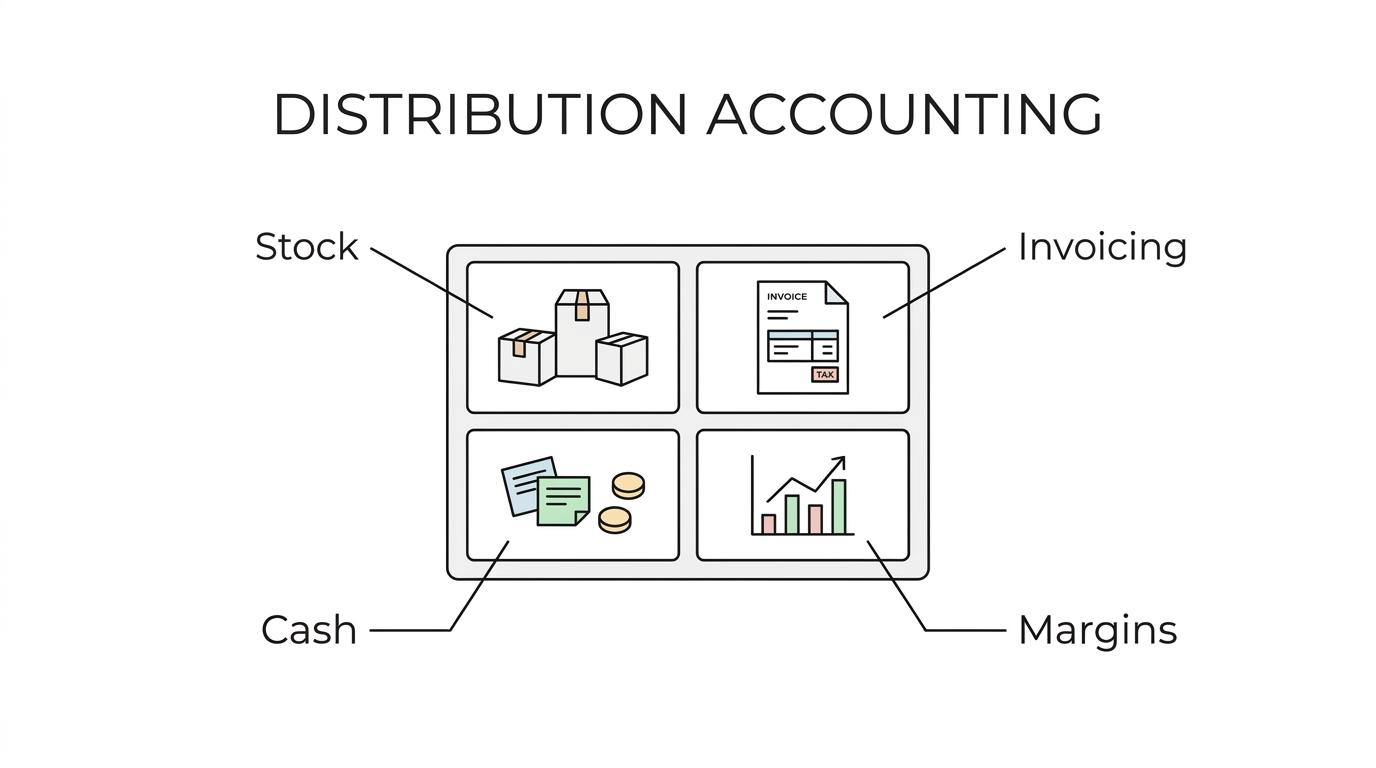
“CBMC focuses distribution accounting on inventory control, sales and margins, working capital, and tax and automation for trading businesses in Pakistan.”
CBMC’s role can cover ongoing accounting and bookkeeping, tax advisory, CFO support, ERP and business automation support, payroll coordination, and statutory filings. You get one connected team instead of separate advisers trying to fix stock issues, tax issues, and reporting issues in isolation.
CBMC builds inventory valuation and margin controls for distributors
For distributors, inventory is usually the largest moving balance on the books. CBMC helps you set up inventory accounting that follows recognised measurement principles, including the lower of cost and net realisable value, while making sure the costing method used in your records fits the way your stock is managed.
IAS 2 allows inventory cost assignment through specific identification, first-in, first-out, or weighted average cost, depending on the nature of the items. CBMC helps you choose and apply the right method consistently, then ties that method back to purchase records, landed costs, warehouse movements, and sales reporting so your gross margin is not distorted by weak stock data.
“CBMC helps distributors align stock accounting with lower of cost and net realisable value and with cost formulas such as FIFO or weighted average cost.”
We also look at what is included in cost. Purchase costs, related charges, and other costs incurred to bring inventory to its present location and condition all affect reported margins. If these elements are captured inconsistently, your item profitability, stock valuation, and management reporting can all be misleading.
A typical CBMC distribution accounting scope can include:
- Inventory costing policy: cost formula selection, landed cost treatment, treatment of returns, damaged stock, and slow-moving items
- Stock-to-books control: item master review, warehouse reconciliation logic, cutoff checks, and month-end inventory adjustments
- Margin reporting setup: product-level, customer-level, or channel-level reporting to improve pricing and decision-making
CBMC connects FBR sales tax invoicing, ERP records, and accounting books
Distribution accounting in Pakistan now depends heavily on invoice-level control. If sales tax invoices are not generated, transmitted, coded, and recorded properly, the accounting risk is not limited to tax. It also affects receivables, revenue records, reconciliations, and audit trails.
CBMC helps trading companies map invoicing flows between ERP or billing systems and the finance ledger so sales, tax, and debtor balances reconcile cleanly. Where a business is required to integrate invoicing through a licensed integrator, we help align the accounting, tax coding, chart of accounts, and reporting logic around that setup so your finance team is not manually repairing records after the fact.
“CBMC supports trading companies around Pakistan’s electronic invoicing requirements, including the 1 June 2025 corporate deadline and 1 July 2025 non-corporate deadline set by FBR.”
FBR has stated that notified registered persons must integrate POS, ERP, or other invoicing systems through a licensed integrator, and non-compliance can trigger penalties under section 33 of the Sales Tax Act 1990. CBMC turns that regulatory requirement into a finance control benefit by making sure invoice data produces a verifiable and usable accounting record, not just a tax-facing document.
This matters when your team needs fast answers on outstanding invoices, tax treatment by transaction, customer claims, and month-end closure. CBMC helps reduce duplicate handling between operations, tax, and finance so reporting becomes faster and more dependable.
CBMC improves receivable control, cash visibility, and working-capital reporting for distributors
Many trading companies are profitable on paper but still struggle with cash pressure because receivables, stock, and payables are not being monitored together. CBMC designs reporting around the working-capital drivers that actually move cash in a distribution business.
Our review starts with your legal and operating structure, revenue and working-capital drivers, records and controls, and systems and management reporting. From there, CBMC can support regular bookkeeping, management accounts, cash-flow reporting, debtor analysis, and CFO-level guidance so you can see what is happening by product line, customer segment, or operating unit.
“CBMC starts distribution reviews with legal and operating structure, working-capital drivers, records and controls, and systems and management reporting.”
That gives you clearer control over overdue receivables, margin leakage, stock build-up, and reporting delays. It also helps management make better decisions on credit terms, pricing discipline, reorder timing, and cash planning.
Why trading businesses choose CBMC for connected accounting, tax, and technology support
CBMC is a practical fit when your distribution business does not want separate advisers for accounts, tax, compliance, and systems. We bring local regulatory knowledge with an international perspective, with primary support in Pakistan and cross-border coordination in the UAE and the UK where group structures or reporting needs extend beyond one jurisdiction.
This is especially useful if your business is dealing with:
- Growth pressure: more SKUs, more customers, more branches, or higher transaction volume than your current accounting process can handle
- Control gaps: stock differences, weak margin reporting, delayed closings, incomplete receivable follow-up, or invoicing mismatches
- System change: ERP implementation, business automation work, or a need to align accounting and tax records around electronic invoicing rules
CBMC scales from compliance support to finance-function improvement. You may need cleanup of records, outsourced accounting, tax coordination, CFO support, or help modernising processes through ERP and business automation. We shape the scope around what your finance function needs next, not around a one-size-fits-all package.
What working with CBMC looks like for a distribution accounting engagement
We start by understanding how your distribution model works in practice. That includes how you purchase, how you price, how you hold stock, how you invoice, and how you collect.
CBMC then translates that operating reality into accounting controls, reporting logic, and clear responsibilities. If you need ongoing support, we define the reporting cadence, tax touchpoints, compliance tasks, and management outputs up front so your team knows what will be delivered and when.
You get commercial clarity as well as technical support. Instead of broad advice, we focus on the records, reconciliations, costing rules, invoice flows, and reports that make day-to-day finance easier to run.
Talk to CBMC about distribution accounting for your trading company
If your stock valuation, invoice compliance, margin reporting, or receivable control needs attention, CBMC can help you turn distribution accounting into a stronger operating system for the business.
Speak with CBMC to review your current setup, identify the pressure points in inventory, invoicing, and reporting, and build an accounting model that fits the way your trading company actually works.