
For trading and distribution firms, profit on paper does not always mean cash in the bank. A business may show healthy sales, expanding customer accounts, and strong demand, yet still struggle to pay suppliers, salaries, taxes, and logistics costs on time. That gap appears when cash is tied up in stock, delayed customer collections, or poorly timed payments.
This is why cash flow management needs to sit at the centre of commercial decision-making, not at the edge of finance. In distribution businesses, money moves through inventory, receivables, and supplier obligations every day. When those parts are managed separately, pressure builds quickly. When they are managed as one working-capital system, the business gains room to grow with greater confidence.
Cash flow pressure points in trading and distribution
Trading and distribution firms often carry a longer cash conversion cycle than service-based businesses. Cash goes out early to purchase goods, arrange freight, pay duties or transport costs, and maintain warehousing. Cash comes back later, often after goods are sold on credit and customers take time to settle invoices.
International guidance regularly points to the same pattern: the longer the cash conversion cycle, the more working capital the business must fund. This is especially relevant in Pakistan, where firms may also face seasonal demand swings, price volatility, and uneven customer payment behaviour.
A simple way to look at the issue is to identify where cash commonly gets trapped.
| Area | What ties up cash | Typical warning sign | Management priority |
|---|---|---|---|
| Inventory | Excess stock, slow-moving lines, weak replenishment | Stock ageing rises | Buy smarter, clear slow items |
| Receivables | Loose credit terms, slow collections, disputes | Days sales outstanding increases | Tighten collections and approvals |
| Payables | Poor payment planning, missed terms, ad hoc settlements | Supplier pressure or lost discounts | Schedule payments with intent |
| Pricing and margins | Low-margin sales funded by long credit | Sales growth without free cash | Review margin by customer and product |
| Forecasting | No forward cash view | Frequent cash surprises | Build weekly and monthly forecasts |
Cash flow rarely weakens because of one dramatic event; it usually slips through ordinary decisions made without a shared view of cash.
Working capital management as one connected system
Many firms review stock in one meeting, collections in another, and payables only when suppliers begin chasing. That structure can create blind spots. A sales team may push volume through extended credit, procurement may buy ahead for discounts, and finance may only see the cash shortfall after the fact.
A better approach is to treat inventory, receivables, and payables as connected levers. A decision in one area affects the others. If the business increases stock to improve service levels, collections discipline becomes even more important. If customer credit is extended to win market share, supplier terms and liquidity planning need to respond as well.
Strong working-capital management usually depends on a short list of shared metrics that different teams review together.
- Stock ageing
- Credit exposure by customer
- Days sales outstanding
- Supplier payment calendar
- Gross margin by product category
- Weekly cash position
When commercial and finance teams work from the same picture, cash decisions become faster and more balanced.
Inventory management and stock decisions that protect cash
Inventory is often the largest use of working capital in a distribution business. It also creates the easiest illusion of safety. Full shelves can look like strength, yet slow or misplaced stock can drain liquidity for months. In many firms, the issue is not only overstocking. It is overstocking in the wrong product lines, branches, or sizes while fast-moving items still go out of stock.
Better inventory control starts with sharper visibility. Management should know which items move quickly, which items move irregularly, and which items have effectively stopped moving. This sounds basic, but many firms still rely on rough estimates rather than clean ageing and movement reports. Without reliable data, purchasing decisions become reactive.
Margin also matters. Some items turn quickly but produce weak cash returns after freight, storage, rebates, and credit costs are considered. Other products may move more slowly but support stronger cash generation. That is why stock decisions should be linked to both turnover and contribution.
A practical review often includes the following categories:
- Fast movers: protect availability, but avoid excessive safety stock
- Slow movers: reduce future purchases and review branch allocation
- Dead stock: clear through discounts, bundles, or negotiated returns where possible
- Seasonal items: buy against a realistic demand window, not optimism
- Imported lines: factor in longer lead times, foreign exchange exposure, and duty-related cash needs
Even modest improvements in purchasing discipline can release meaningful cash. A firm does not need a dramatic inventory reduction to feel the benefit. A cleaner buying pattern, fewer obsolete items, and tighter reorder rules often make a visible difference within one or two cycles.
Receivables control and days sales outstanding
Late collections are one of the most common reasons smaller firms come under cash pressure. A sale booked today does not help liquidity if payment comes 60 or 90 days late, or if the invoice enters a long dispute trail. This is why receivables management should be treated as an active commercial process, not merely an accounting follow-up.
Days sales outstanding, or DSO, remains one of the clearest indicators to watch. If DSO is rising while sales are also growing, the business may be funding that growth from its own pocket. The risk becomes sharper when a small number of customers represent a large share of total exposure.
Good receivables control begins before the invoice is raised. Customer onboarding, credit checks, approved limits, documented terms, and clean order processing all influence collection speed. After billing, discipline matters just as much. Statements should go out on time, disputes should be logged early, and responsibility for follow-up should be clear.
There is also a strategic angle. Not every customer deserves the same credit treatment. A profitable, reliable account may justify normal terms. A weak-paying account may need shorter terms, staged supply, advance payment, or credit insurance depending on the business model.
Teams that manage receivables well usually keep a close eye on a few practical signals.
- Current bucket: invoices not yet due but approaching concentration risk
- 1 to 30 days overdue: early action window before delays become habit
- 31 to 60 days overdue: direct escalation and order hold review
- Over 60 days overdue: recovery plan, credit block, or structured settlement
- Disputed invoices: root-cause analysis across sales, warehouse, and billing
A disciplined ageing review often improves cash faster than a broad cost-cutting exercise.
Payables scheduling and supplier term discipline
Payables are sometimes treated only as pressure to be managed, yet they can also be a source of stability when handled thoughtfully. The goal is not simply to delay every payment. The goal is to schedule payments in a way that protects liquidity without damaging supply continuity or commercial trust.
Reliable supplier relationships matter in distribution. Short supply, delayed deliveries, or loss of preferred pricing can damage both revenue and cash generation. This means the best payable strategy is usually deliberate rather than defensive. Critical suppliers should be mapped, key dates tracked, and payment commitments kept where they support continuity.
Some firms gain quick relief just by moving from ad hoc payments to a weekly payable calendar. Once due dates, priority vendors, discounts, and expected inflows are visible together, management can decide with greater control. That is far better than reacting to daily calls and last-minute transfers.
Cash flow forecasting and scenario planning
A firm can manage today’s cash and still be surprised next month if no forward view exists. Forecasting helps management see pressure early, test decisions before they are made, and avoid emergency borrowing.
For trading and distribution businesses, the most useful model is often a layered forecast. A short weekly forecast tracks immediate inflows and outflows. A monthly view captures purchasing plans, tax obligations, payroll, debt servicing, and major customer receipts. A longer view helps management prepare for seasonality, import cycles, branch expansion, or pricing changes.
The forecast does not need to be perfect to be useful.
What matters is discipline: one owner, regular updates, clear assumptions, and comparison of forecast versus actual results. Over time, the business learns where estimates tend to fail. Maybe customer collections are always too optimistic. Maybe procurement timing is understated. Those insights make later forecasts stronger.
A practical forecasting routine usually includes:
- Sales collections by customer and due date
- Planned purchases and supplier commitments
- Tax payments and statutory deadlines
- Loan repayments and finance charges
- Scenario cases for delayed collections or slower sales
When this process becomes routine, decision-making improves across the business. Promotions, stock builds, credit extensions, and capital spending can all be assessed against real liquidity capacity.
Liquidity options: receivables, inventory, and distributor finance
Even well-run firms can face periods when operating cash is tied up. Growth phases, long collection cycles, major stocking periods, and supply chain disruption can all stretch liquidity. In those moments, structured finance linked to working capital can be more suitable than relying only on unsecured borrowing.
Receivables-based finance is one option. Here, eligible receivables act as collateral, allowing the business to access cash before customers pay. This can be useful where the debtor book is strong but payment terms are long. The quality of invoicing, documentation, and customer credit matters greatly.
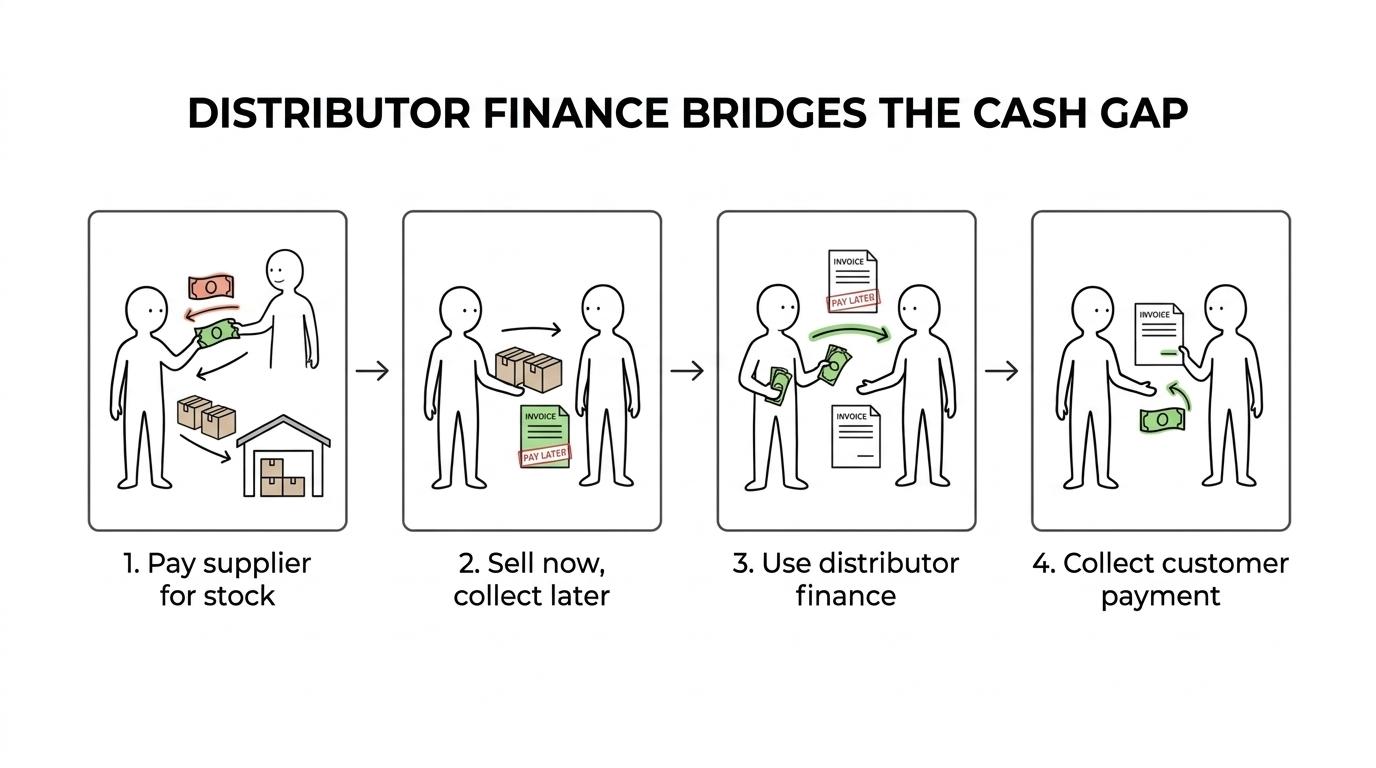
Inventory financing may also help where goods are moving steadily but cash is locked between procurement and sale. For some businesses, distributor finance can bridge the period between purchasing from suppliers and collecting from end customers. These instruments are not a substitute for weak operations, yet they can support healthy businesses facing timing gaps.
Before taking this route, firms should review a few points carefully.
- Facility fit: choose a structure linked to the actual cash gap
- Eligibility rules: check which receivables or stock qualify
- Cost of funds: compare financing cost against margin and stock turn
- Reporting burden: confirm whether the business can meet data and control requirements
- Exit path: avoid long-term dependence on short-term liquidity tools
The strongest use of these facilities is targeted, controlled, and backed by sound reporting.
Technology and reporting for daily cash visibility
Cash control becomes much easier when the underlying data is timely and connected. Many trading firms still struggle with separate spreadsheets for stock, debtor ageing, branch sales, and supplier balances. That slows action and creates conflicting versions of the truth.
Technology-enabled reporting can improve visibility without making the process complicated. A practical setup may include daily sales and collection dashboards, stock ageing by location, customer exposure against approved limits, and a rolling cash forecast linked to payables and receivables. ERP systems and business automation tools can also reduce manual delays in billing, reconciliations, and approval flows.
The real value is not the software alone. It is the management rhythm that the system supports. When data is current, teams can spot a rising DSO trend, an overstocked product line, or a supplier concentration issue before the problem becomes expensive. That kind of visibility helps firms protect liquidity while still pursuing growth.
For trading and distribution businesses in Pakistan, that balance matters. Growth is easier to fund, supplier relationships are steadier, and reporting becomes more credible when cash flow is managed with the same discipline as sales.