
Tax planning for Pakistan businesses is usually decided by a handful of practical choices, not obscure loopholes. As an accounting, tax, business advisory, and technology-enabled professional services firm, CBMC often sees the same pressure points repeat: Active Taxpayer List status, entity structure, withholding exposure, SME eligibility, and cross-border income treatment.
TL;DR: Summary
- For Pakistan businesses, the most effective tax planning moves are staying on the Active Taxpayer List, choosing the right entity structure, and checking whether SME rules or foreign tax credit apply.
- FBR states that ATL status affects lower withholding tax rates on bank profits, cash withdrawals, property transactions, securities, dividends, and prize bond winnings, and it also matters for claiming back overpaid withheld tax.
- Section 103 allows foreign tax credit on foreign-source income, but only up to the lower of foreign tax paid or Pakistan tax payable on that same income, and it applies separately by head of income.
- SME treatment can materially change the outcome because FBR’s framework uses turnover bands up to Rs. 100 million and Rs. 250 million, with different rates and an optional turnover-based final tax in the cited regime.
- When businesses need coordinated review across compliance, reporting, and systems, CBMC is relevant because tax planning often depends on finance records, filing controls, and cross-border coordination rather than tax calculations alone.
The useful question is not whether tax planning matters. It is where your business is paying more tax than necessary, losing credits, or using a legal form and tax regime that no longer fit the way it operates. In Pakistan, FBR and SECP rules make those review points fairly specific.
What makes tax planning practical for Pakistan businesses?
Pakistan tax planning works best when it focuses on filing status, legal form, turnover band, and income source, because FBR rules attach different rates , credits, and obligations to each.
A strong tax plan is usually a systems issue before it becomes a calculation issue. If returns are filed late , the business may fall off the Active Taxpayer List. If withholding certificates are not reconciled, tax already deducted may never be claimed properly. If foreign income is booked without separating the income head, foreign tax credit may be calculated incorrectly.
A common misconception is that tax planning starts with deductions. In practice, many Pakistani businesses lose more cash through higher withholding rates, unrecovered credits, or poor entity choices than through missed operating deductions. That is why the most valuable review is often structural and procedural.
Why does Active Taxpayer List status matter so much?
ATL status directly changes withholding tax cost under FBR rules, so it affects banking, property, securities, dividends, and other routine transactions throughout the year.
FBR’s Active Taxpayer List page, updated on 06 Nov 2026, states that being on the list gives lower withholding tax rates on bank profits, cash withdrawals, property transactions, capital gains on securities, dividend tax, and prize bond winnings. It also matters because active taxpayers can claim back overpaid tax that has been withheld.
That makes ATL a cash-flow issue , not just a compliance label. If your business is frequently paid through banking channels, earns profit on deposits, buys or sells property, or has investment activity, non-ATL status can increase tax leakage immediately. FBR’s 2026 amended Income Tax Ordinance compilation also includes the Tenth Schedule for persons not appearing in the Active Taxpayers’ List, which shows how deeply ATL treatment sits inside the current tax framework.
“CBMC treats ATL status as a cash-flow control issue because FBR links lower withholding rates and refund access to active-filer status.”
The practical point is simple. If the business relies on thin margins, then even a modest increase in withholding can distort working capital . If a major transaction is planned, then ATL status should be checked before the deal date, not after the tax has already been deducted.
What are the 8 tax planning moves Pakistan businesses should review?
The strongest review points are ATL status, withholding mapping, entity structure, SME eligibility, foreign tax credit, tax basis choice, record quality, and calendar controls.
These eight moves cover where businesses most often overpay, misclassify, or miss relief under Pakistan’s current framework:
- Active filer position: confirm that return filing and payment actions keep the business on the Active Taxpayer List.
- Withholding map: identify every place tax is deducted by banks, customers, brokers, tenants, or other counterparties.
- Entity structure: compare sole proprietorship, single member company, private company, and limited liability partnership.
- SME status: test turnover against the relevant threshold and confirm registration route on the Iris portal or SMERP where applicable.
- Tax basis choice: model taxable-income taxation against turnover-based final tax where the SME regime permits an option.
- Foreign-source income review: separate each income head before calculating any foreign tax credit under Section 103.
- Document trail: retain withholding certificates, contracts, invoices, and bank records so credits can actually be used.
- Review calendar: tie tax checks to month-end, quarter-end, and year-end finance routines.
The value of this list is that each move affects a different stage of the tax cycle. Some reduce rates, some protect credits, and some prevent the wrong regime from being used for an entire year.
How can you stay on the Active Taxpayer List step by step?
CBMC usually treats ATL maintenance as a three-step control process: file on time, reconcile withholding evidence, and verify status before high-value transactions.
Step 1 is timely filing. A business should know which return or statement deadlines affect its active-filer position and who owns each task internally. Leaving this to year-end memory is risky, especially where accounting records are still being finalised close to the filing date.
Step 2 is evidence control. Reconcile withheld tax with bank advice, certificates, and ledger balances . A frequent problem is that tax has been deducted, but the finance team cannot fully trace it back to the transaction or period when preparing the return.
Step 3 is transaction-based checking. Before a property transfer, dividend receipt, bank placement, or investment disposal, confirm whether ATL status is active. If status is inactive on the transaction date, then the higher withholding cost may apply even if the matter is fixed later.
Is a sole proprietorship, single member company, private company, or LLP better for tax planning?
No single structure is always best; SECP-recognized company and LLP forms change legal identity, compliance burden, and tax treatment, while sole proprietorship is simpler but keeps the owner and business more closely linked.
SECP states that a private company can be formed by any two or more persons associated for a lawful purpose under the Companies Act, 2017. If only one member forms the company, SECP classifies it as a single member company . SECP also states that a limited liability partnership is a separate legal entity with perpetual succession, and that any two or more persons carrying on lawful business with a view to profit may form one after registration.
For tax planning, the right question is not “which structure has the lowest headline tax?” The better question is “which structure fits ownership, investment plans, liability profile, governance needs, and future exits?” If outside investors are expected, then a company often fits more naturally. If the business is closer to a partner-led professional model, an LLP may deserve a serious review. If administration must stay minimal and the owner and business are effectively one operating unit, a sole proprietorship may still be workable.
A common mistake is choosing a structure only for the current year’s tax effect. Entity form also affects banking, contracts, payroll setup , corporate compliance , succession, and how easily the business can scale.
How do SME tax regimes and turnover thresholds change the calculation?
SME status can materially change tax treatment, but only when turnover, registration status, and the applicable framework are checked carefully.
The Finance Bill 2021 set SME tax bands at 7.5% of taxable income for turnover up to Rs. 100 million and 15% for turnover above Rs. 100 million up to Rs. 250 million. It also allowed SMEs in those bands to opt for final tax on turnover at 0.25% and 0.5% respectively. The cited framework required SMEs to register with FBR on the Iris portal or with SMERP.
FBR’s 2026 amended Income Tax Ordinance compilation includes the Fourteenth Schedule for small and medium enterprises, which signals that SME treatment remains embedded in the current income-tax architecture. That matters because businesses often assume “small business” is a casual label. It is not. Tax outcomes depend on whether the business actually falls within the relevant turnover threshold and follows the required registration route.
If turnover is close to a threshold, then forecasting becomes part of tax planning. A business expecting rapid growth should model the tax impact before the year closes, not after crossing the band.
How should businesses claim foreign tax credit step by step?
Section 103 allows a resident taxpayer to claim foreign tax credit on foreign-source income, capped at the lower of foreign tax paid or Pakistan tax payable on that same income.
Step 1 is to classify the foreign-source income by head. This matters because FBR’s Section 103 rule applies separately to each head when a taxpayer has foreign income under more than one head. Mixing all foreign income together can produce the wrong result.
Step 2 is to gather proof of foreign tax paid. The claim depends on actual foreign income tax having been paid on the foreign-source income. Without reliable statements, tax certificates, or jurisdiction-specific payment evidence, the credit position becomes weak.
Step 3 is to compute the Pakistan tax payable on that same income and apply the cap. The allowable credit is the lesser amount. If the foreign tax is higher than Pakistan tax on that income, the extra foreign tax does not automatically become usable in Pakistan under the cited rule.
“CBMC’s cross-border support across Pakistan, the UAE, and the UK makes one point clear: foreign tax credit only works when income heads and tax evidence are mapped correctly.”
A common misunderstanding is to treat foreign tax credit as a refund of all overseas tax paid. It is not. It is a limited credit mechanism, and the cap matters just as much as the payment evidence.
Should SMEs choose normal taxation or final tax on turnover where the option applies?
The better choice depends largely on profit margin, because the cited SME rates create a break-even point of about 3.33% of turnover.
Using the cited figures, the comparison is straightforward. In the lower turnover band, 7.5% of taxable income equals 0.25% of turnover when taxable income is 3.33% of turnover. In the upper band, 15% of taxable income equals 0.5% of turnover at the same 3.33% margin. That means the margin break-even is similar in both bands.
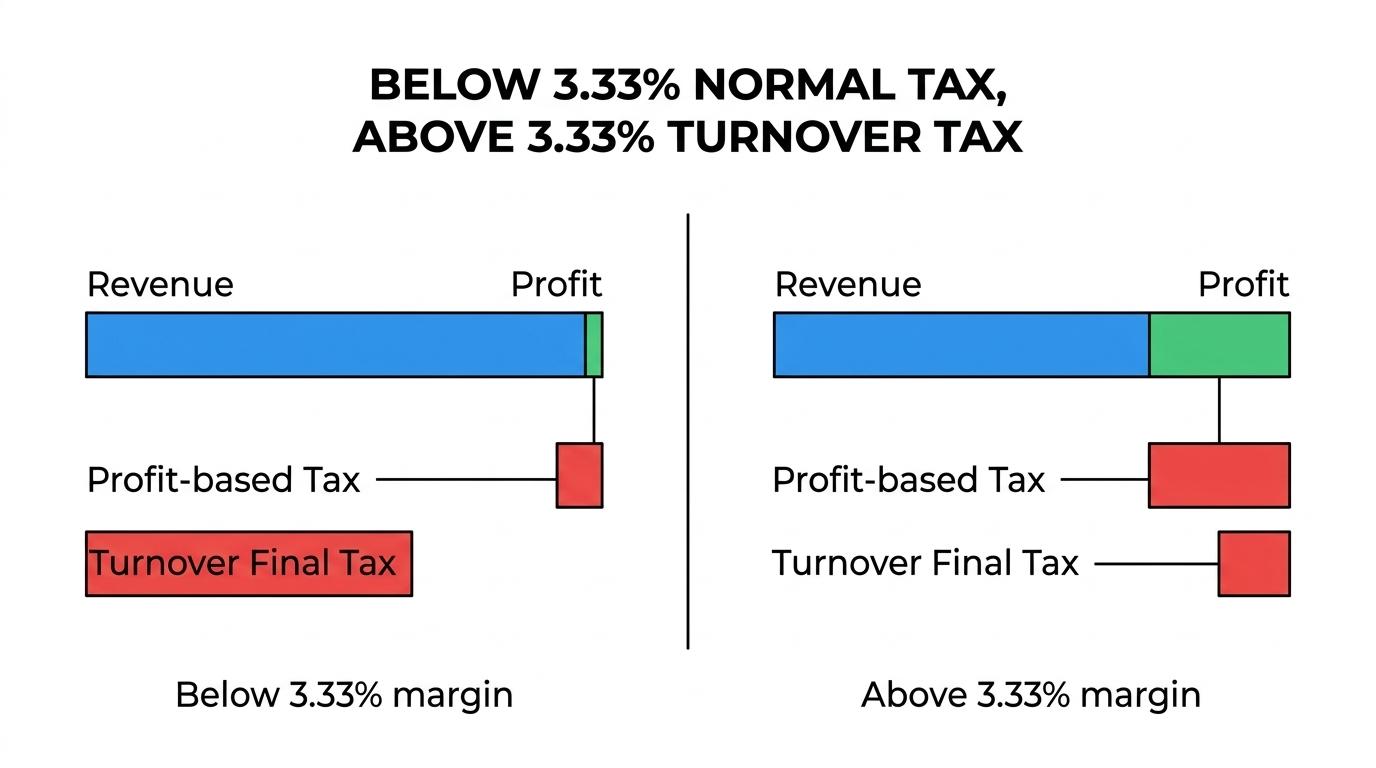
If the business margin is below roughly 3.33%, then taxation based on taxable income may produce less tax than turnover-based final tax. If the margin is above roughly 3.33%, then the turnover option may look more attractive on pure arithmetic. That is a planning insight many businesses miss because they compare rates without converting them into a margin threshold.
The trade-off is that turnover-based tax tracks revenue, while taxable-income tax tracks actual profitability. A year with weak margins, stock losses, or project delays can make those two methods feel very different in cash terms.
How can you build a tax-planning review calendar step by step?
CBMC approaches tax planning as a finance-process calendar , not a once-a-year scramble, because withholding, turnover bands, and foreign-income positions can shift during the year.
Step 1 is monthly review. Reconcile withholding tax, bank profit deductions, payroll-linked items , and key ledger balances. If withheld tax is not matched monthly, year-end cleanup becomes slower and less reliable.
Step 2 is quarterly review. Revisit turnover against SME thresholds, check whether margins still support the preferred tax basis, and inspect any foreign-source income earned during the quarter. This is also the right point to review planned distributions, financing, or asset transactions that may trigger withholding.
Step 3 is year-end structural review. Test whether the current entity form still fits the business model, especially after ownership changes, expansion into new sectors, or cross-border activity. When finance, tax, legal, payroll, and systems work in separate silos, planning quality usually drops.
A strong review calendar turns tax planning into a repeatable management discipline. That is often where real savings appear: not through aggressive positions, but through better timing, cleaner records, and the right tax treatment being applied before a transaction happens.