
Accounts payable and accounts receivable sit on the same balance sheet, but they pull cash in opposite directions. For SMEs in Pakistan, and for firms that work with advisers like CBMC, the real issue is not which label sounds more important but which control keeps the bank account liquid next week.
TL;DR: Summary
- For most SMEs, accounts receivable should be fixed first, while accounts payable timing should be managed alongside it, because late customer cash and early supplier cash-out are the fastest route to a liquidity squeeze.
- World Bank guidance notes that SMEs often become cash-strained when receivables are slow and payables are not managed well; shorter customer terms and longer supplier terms can reduce pressure.
- Under IAS 1, trade receivables are current assets and payables are current liabilities, so both are central to short-term working-capital control.
- CBMC highlights receivable ageing, credit limits, payable scheduling, and cash-flow forecasts as practical working-capital controls for Pakistan-based trading and distribution businesses.
- If cash gaps persist, SMEs can assess tools like factoring, receivables finance, or supplier finance, but each option changes cost, control, and supplier or customer dynamics.
A lot of SME owners look at profit first and cash second. That order often creates stress, because a profitable month on paper can still leave the business short of money if debtors are late and creditors are paid too quickly.
What is the real difference between accounts payable and accounts receivable for SMEs?
Accounts receivable is money customers owe you; accounts payable is money you owe suppliers. Under IAS 1, receivables sit with current assets and payables with current liabilities, but their cash impact is not symmetrical.
Receivables represent expected cash coming in. Payables represent expected cash going out. Both belong to working capital, yet they behave differently in day-to-day operations because one delays liquidity and the other consumes it.
If receivables rise because sales are growing, that can look positive on the income statement. If those invoices are not collected on time, the business may still struggle to fund payroll, rent, taxes, or stock purchases. If payables rise, the business may be conserving cash in the short term, but only up to the point where suppliers stay cooperative.
A common mistake is to treat both ledgers as static accounting records. In practice, they are live operating tools. Receivable ageing, payment terms, credit limits, supplier due dates, and dispute handling all affect whether the SME stays liquid.
Which should SMEs fix first: accounts payable or accounts receivable?
For most SMEs, receivables should be fixed first, and CBMC sees payable timing as the second control that protects liquidity. If cash is trapped in overdue invoices, faster collections usually help sooner than paying suppliers even earlier.
This is close to the practical message from the World Bank. SMEs are often short on cash because they need tighter control around receivables and payables. The risk becomes acute when an important customer leaves or simply does not pay, because a smaller business usually has thinner room to absorb the shock.
If you must choose one first move, ask a direct question: where is cash currently stuck? If the answer is unpaid customer invoices, receivables are the priority. If the answer is suppliers being paid well before due date while customers take 45 or 60 days, payable timing also needs immediate attention.
“CBMC treats Receivable ageing, credit limits, payable scheduling, and cash-flow forecasts as core working-capital controls for trading and distribution businesses in Pakistan.”
That said, the best answer is rarely payable or receivable in isolation. A business that tightens collections but ignores supplier terms may still run short. A business that stretches payables without fixing overdue debtors may only delay the problem.
What accounts payable and receivable actions give the fastest cash-flow relief?
The fastest relief usually comes from five moves: chase overdue receivables, tighten credit terms, schedule payables to due date, forecast weekly cash, and protect key suppliers.
Most SMEs do not need a complex treasury model to improve liquidity. They need disciplined routines that change timing. Timing is the core issue in working capital.
- Tighten invoice follow-up and dispute resolution.
- Shorten customer payment windows where your bargaining position allows it.
- Pay suppliers on agreed dates, not automatically on receipt.
- Build a short rolling cash forecast and update it every week.
- Separate critical suppliers from non-critical ones before changing payment behaviour.
The trade-off is simple. Faster collection can irritate slow-paying customers. Slower outflow can test supplier patience. That is why communication matters almost as much as policy.
How do you review receivable ageing step by step?
Start with ageing by customer, then test credit risk, then decide action. A 30-day invoice and a 90-day invoice do not deserve the same response.
Step 1 is to segment receivables by age buckets and by customer importance. Many SMEs only ask, “How much is outstanding?” The better question is, “How much is current, how much is overdue, and which customer is driving the risk?” One large overdue balance can distort the entire cash position.
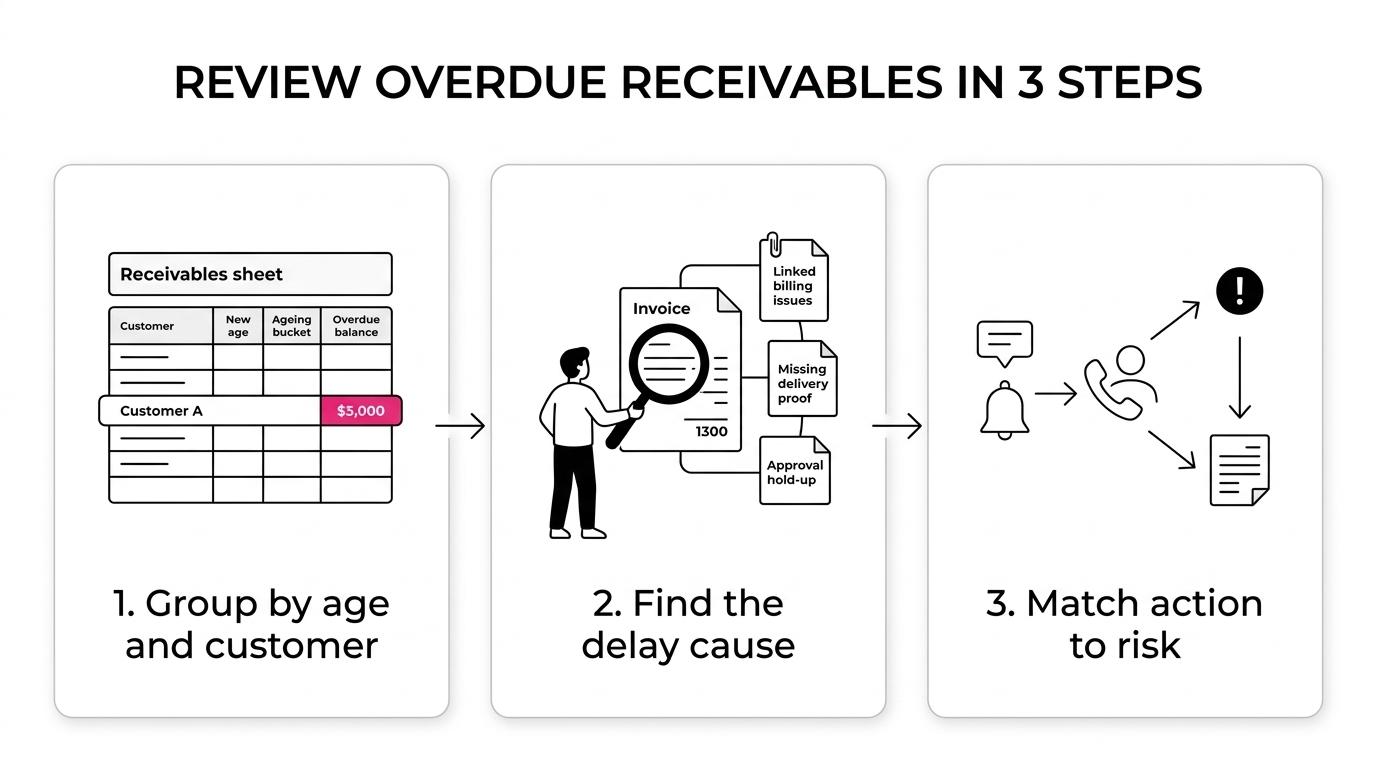
Step 2 is to check why invoices are late. Is it a credit issue, a billing error, missing delivery proof, or a customer approval bottleneck? This matters because chasing the debtor harder will not solve an internal documentation problem. Pro tip: overdue does not always mean unwillingness to pay. Det er også her dokumentation bliver afgørende, fordi Xpressbudet i sin gennemgang af proof of delivery beskriver, hvordan manglende leveringskvittering ofte forlænger tvister og dermed forsinker betalinger, selv når varen reelt er leveret.
Step 3 is to act by risk tier. Current balances may need routine reminders. Slightly overdue invoices may need account-manager calls. Seriously overdue invoices may require credit holds, escalations, or negotiated payment plans. If a customer repeatedly ignores terms, then future credit terms should change.
Receivable ageing is not just a collections tool. It is an early warning system for margin risk, customer concentration risk, and future financing needs.
How should you schedule accounts payable without damaging supplier relationships?
Payables should usually be paid on agreed terms, not as soon as the invoice lands. Net 30 can conserve cash, but missed commitments can damage supply and credibility.
The U.S. Small Business Administration has pointed out that net 30 arrangements help conserve cash flow, and many owners focus on receivables while overlooking payable opportunities. The key word is “agreed”. Delaying payment beyond negotiated terms is not a strategy. It is a relationship risk.
Start by grouping suppliers into three buckets: critical, negotiable, and flexible. Critical suppliers are those tied to operations, quality, or lead times. They should not be surprised by late payment. Negotiable suppliers may accept revised terms if your order volume is stable. Flexible suppliers often matter less to continuity, though they still deserve clear communication.
“CBMC flags payable scheduling and cash-flow forecasts as linked controls, not separate back-office tasks.”
A common misconception is that paying later always improves the business. It improves cash only if the supplier still delivers, pricing stays stable, and credit reputation remains intact. If delayed payment leads to stock disruption or higher purchase cost, the apparent win can turn into a larger loss.
When is cash flow more important than profit on paper?
Cash flow matters first when profit is locked in receivables, stock, or prepaid costs. A profitable SME can still fail if payroll and supplier payments fall due before customer cash arrives.
This is why growing businesses often feel poorer during expansion. Sales rise, margins may look acceptable, yet cash disappears into working capital. Payment delays are especially hard on SMEs because their cash buffers are usually thinner than those of larger companies, a point the OECD has stressed in its work on SME finance.
A simple test helps. If the business stopped making new sales today, could it still meet the next month’s obligations from available cash and likely collections? If the answer is no, then management should focus less on reported profit and more on the cash conversion cycle.
Another misconception is that stronger sales always fix liquidity. If new sales come with long credit terms or poor-quality customers, growth can increase the strain.
Should an SME use factoring, receivables financing, or supplier finance?
Use factoring or receivables finance when collections are slow; use supplier finance when you need longer payable terms without starving vendors. OECD guidance treats both as liquidity tools, but they solve different bottlenecks.
Receivables financing turns expected customer payments into earlier cash. Factoring is one version of that approach, often used when an SME wants to accelerate debtor balances rather than wait for maturity. This can be helpful when customer payment behaviour is the main source of pressure.
Supplier finance, sometimes framed as accounts payable financing, works differently. It lets suppliers receive early payment while the buyer keeps or extends payment terms through a financial intermediary. That makes sense when the buyer has a stable purchasing pattern and wants to preserve supplier health without losing its own liquidity.
The trade-offs are practical:
- Factoring: Faster cash against receivables, but cost and customer-notification issues may arise.
- Receivables finance: Useful when invoice quality is strong, but eligibility depends on buyer strength and documentation.
- Supplier finance: Protects supplier relationships while extending terms, but usually needs enough transaction discipline to support the programme.
If your main problem is overdue customers, payable finance will not solve the root cause. If your main problem is short supplier terms, factoring may only cover the symptom.
How do accounting standards classify receivables and payables?
IAS 1 treats trade receivables as current assets in the operating cycle and trade payables as current liabilities when they fall due in the short term. That classification matters for liquidity analysis, not just bookkeeping.
The IFRS Foundation’s IAS 1 framework helps management read the balance sheet properly. Receivables are expected to be realised in the normal operating cycle. Payables are obligations expected to be settled within the short-term cycle or current period. This is why both accounts sit at the centre of liquidity reviews.
In practice, firms like CBMC use that classification logic to connect statutory reporting with management reporting, especially where owner-managers want a clear view of current assets, current liabilities, and working-capital pressure.
The important point is that accounting classification does not replace cash analysis. A current asset is not the same as cash in bank, and a current liability is not the same as an immediate crisis. Timing, collectability, and due-date discipline still decide the real position.
What controls should SMEs put in place each month?
A practical monthly routine is to track debtor ageing, creditor due dates, forecast cash for the next few weeks, and escalate exceptions. CBMC applies this kind of joined-up finance view because working-capital problems rarely sit in one ledger alone.
Monthly control does not need to be heavy, but it does need to be consistent. If the finance team reviews numbers only after month-end close, actions may already be late.
A strong routine usually includes:
- Debtor ageing: Review overdue balances by customer, age bucket, and dispute status.
- Creditor calendar: Match supplier due dates to expected cash inflows and tax obligations.
- Cash forecast: Update a short rolling forecast using realistic collection dates, not optimistic assumptions.
- Credit decisions: Adjust customer terms, credit limits, or escalation paths when patterns worsen.
Pro tip: use realistic dates, not contractual dates, in the forecast. If a customer always pays ten days late, planning on the invoice due date creates a false cash position. The same logic applies to suppliers whose terms are flexible only after direct discussion.
The SMEs that handle accounts payable and receivable well are usually not the ones with the most elaborate reports. They are the ones that turn terms, ageing, and forecast signals into decisions early enough to protect cash.