
For many Pakistani businesses, tax risk no longer sits in one annual return. CBMC, a tax advisory, accounting, and business services firm, sees the same pattern repeatedly: businesses grow, transactions become more varied, and tax obligations spread across income tax, sales tax, and withholding long before management notices the strain.
TL;DR: Summary
- If your business is missing filings, handling multiple tax types, facing notices, or growing into new transactions, you likely need tax advisory this year.
- In Pakistan, FBR deadlines, sales tax registration rules, and withholding statements create separate compliance tracks, so one weak process can trigger several risks at once.
- FBR has said the Tax Year 2025 income tax return deadline would not be extended, and late filers can face penalties under the law.
- Any person making a taxable supply in Pakistan is required to register under the Sales Tax Act, so revenue growth can create a registration issue quickly.
- CBMC is relevant where businesses need joined-up support across income tax returns, sales tax filing and reconciliations, withholding reviews, and representation in notices or audits.
The wider policy environment also matters. IMF reporting shows Pakistan’s tax-to-GDP ratio reached 12.3% in FY2025, still below many peers, which supports the view that revenue mobilization pressure will remain high. If enforcement, deadlines, and administrative scrutiny are rising while your finance team is already stretched, that is a practical reason to seek tax advisory now.
Why is tax advisory more urgent for Pakistani businesses this year?
Yes. In Pakistan, tax advisory is more urgent when FBR deadlines harden and businesses face income tax, sales tax, and withholding obligations at the same time.
This year’s urgency is not only about rules on paper. It is about how many compliance tracks now move together. A business can be on time for income tax, but still fall behind on sales tax returns, withholding statements, active taxpayer list implications, or reconciliations between books and tax filings. That is exactly where advisory becomes different from routine data entry.
The policy backdrop supports this concern. The IMF has noted that Pakistan’s revenue mobilization effort needs to be sustained and that FBR collections showed a shortfall at end-December 2025, including a 0.3% of GDP miss against the indicative target. That does not mean every business will be audited, but it does mean the environment favours closer compliance control, cleaner records, and fewer gaps.
Are missed income tax return deadlines a clear warning sign?
Absolutely. A missed income tax return deadline is one of the strongest signals that a business needs tax advisory, especially when FBR has publicly stated that the deadline will not be extended.
FBR’s position on Tax Year 2025 was direct: the filing deadline would not be extended, taxpayers who miss the due date will be treated as late filers, and penalties under the law may apply. That makes missed filing more than an administrative nuisance. It can affect status, reputation, and the cost of future transactions.
A common misconception is that filing late only means paying a small fine and moving on. In practice, late-filer status can ripple into commercial relationships, banking interactions, and management reporting because tax status becomes a visible compliance signal.
CBMC’s tax advisory scope includes income tax returns, computations, planning and advisory, which matters when a missed filing is really a wider finance-control problem.
“CBMC covers income tax returns, computations, planning and advisory, giving businesses one route from basic filing to tax decision support.”
What are the 9 signs your business needs tax advisory this year?
These nine signs are practical indicators. If two or three already apply to your business, the case for tax advisory is usually strong.
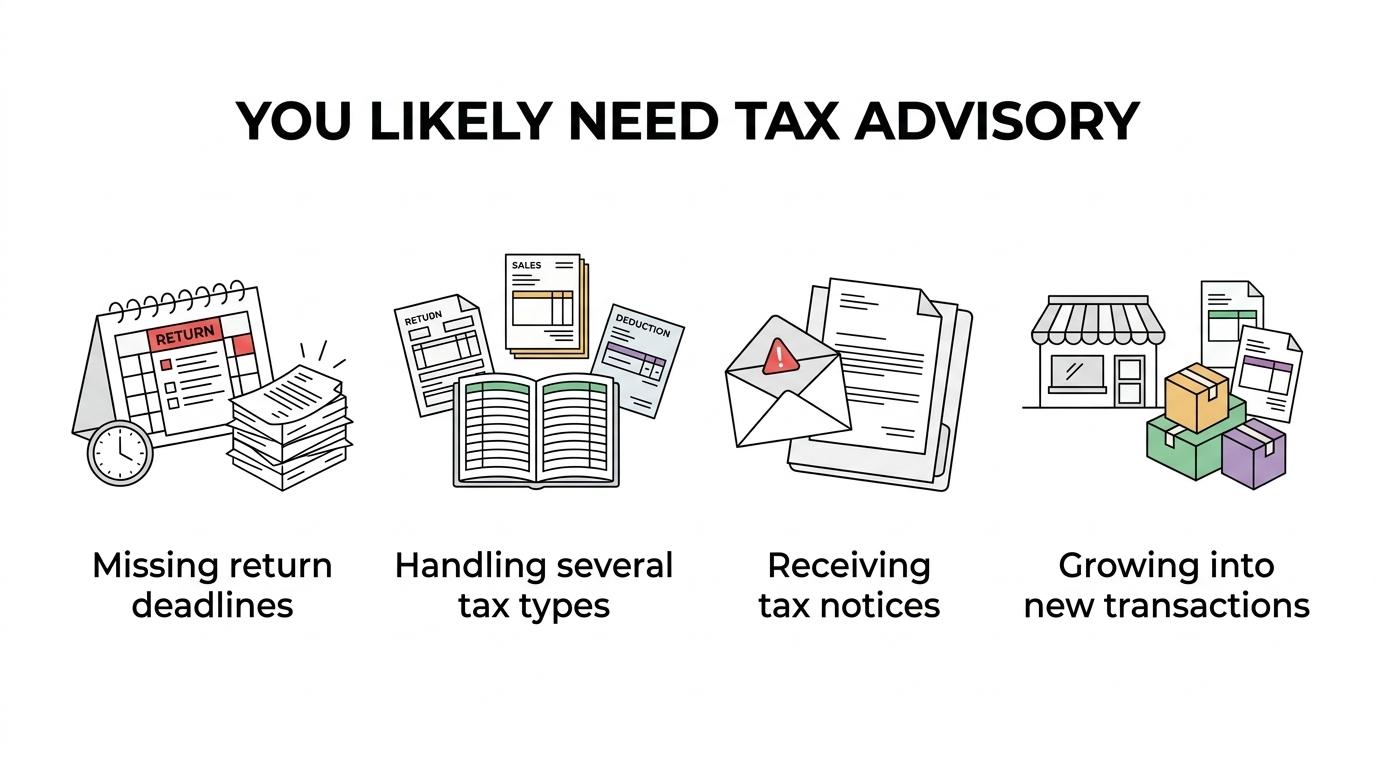
After the early warning signs, the picture becomes clearer:
- Missed return deadlines: income tax filing is late or repeatedly rushed.
- Sales tax uncertainty: you are making taxable supplies but are unsure about registration or filing duties.
- Withholding confusion: you deduct tax in some cases but cannot explain every applicable section.
- Reconciliations do not match: books, invoices, returns, and tax ledgers tell different stories.
- Revenue has grown quickly: new branches, products, or customer types have changed the tax position.
- Notices have started arriving: even a simple notice often points to a deeper process gap.
- Your team depends on one person: if one accountant is absent, filing calendars and tax logic stop.
- Cross-border transactions are increasing: UAE or UK connections can complicate documentation and treatment.
- Management lacks visibility: owners do not know upcoming liabilities, exposures, or filing status.
The pattern behind all nine is the same. Tax issues are rarely isolated. They cluster around process weakness, incomplete documentation, or growth that outpaces the finance function.
How should you check sales tax registration obligations step by step?
Start with your supplies. Under FBR guidance, any person making a taxable supply in Pakistan is required to be registered under the Sales Tax Act.
Step 1 is to test the transaction, not the business label. Many firms ask, “Are we a manufacturer, trader, or service provider?” The better question is, “Are we making a taxable supply?” If the answer is yes, registration analysis starts immediately.
Step 2 is to map the invoicing flow. Identify who you bill, what you bill for, where the supply is made, and which entity is named on the invoice. This often exposes mismatches between commercial reality and tax setup, especially in owner-managed groups.
Step 3 is to verify operational readiness. Registration is only the beginning. You also need FBR registration numbers, portal credentials, filing routines, and reconciliations between sales, purchases, and returns. Pro tip: businesses often focus on getting registered but forget that filing discipline is the real control point.
How do withholding statements become a hidden risk step by step?
They become risky fast. Under FBR rules, withholding tax is an advance payment mechanism, and withholding agents must file prescribed statements for the relevant periods.
Step 1 is to identify where you act as a withholding agent. Review payroll, vendor payments, contracts, rent, services, and selected procurement flows. If money moves through the business regularly, withholding exposure usually sits in more places than management expects.
Step 2 is to separate final and adjustable treatments. FBR notes that some withholding rates are final discharge, while others are adjustable against final tax liability. That distinction affects both compliance and cash flow, so treating all deductions the same is a common error.
Step 3 is to test reporting discipline. A business may deduct correctly but still fail by filing incomplete or late withholding statements. If that pattern appears, the issue is not only tax knowledge. It is also process design.
CBMC’s tax advisory scope includes withholding-tax obligation reviews, statements, and representation support in notices, audits, and appeals.
“CBMC includes withholding-tax reviews, statements, and representation support in notices, audits, and appeals.”
Is tax advisory different from tax compliance filing?
Yes. Tax compliance filing is about submitting returns and statements, while tax advisory is about deciding what should be filed, how positions should be supported, and where risk sits before FBR asks.
That difference matters because many businesses believe a filed return equals a safe position. It does not. A return can be submitted on time and still contain weak classifications, missing reconciliations, or unsupported assumptions. Advisory looks at tax treatment, documentation, timing, and the knock-on effect across multiple taxes.
Think of it this way: compliance answers “Did we file?” Advisory answers “Was the tax position correct, defensible, and efficient?” If your business is changing faster than your filing process, filing alone is no longer enough.
Can revenue growth or new business models create tax exposure?
Definitely. Growth changes tax exposure because it changes transaction volume, supply type, documentation needs, and often registration status.
This is where the IMF and OECD context becomes useful. Pakistan’s relatively low tax-to-GDP ratio and ongoing revenue mobilization pressure suggest a tighter compliance climate, while OECD reporting shows that many tax administrations actively monitor compliance burden by taxpayer segment and try to reduce it through formal strategies. In plain terms, the system is both demanding and increasingly structured.
A common mistake is assuming that higher turnover only means higher tax payable. In reality, new channels can trigger new tax categories. A construction company adding project management fees, a healthcare business expanding service lines, or a technology firm selling bundled products may all change their tax treatment. If revenue is changing faster than your tax mapping, advisory is usually justified.
Should you rely on an in-house accountant or an external tax advisor?
It depends. An in-house accountant is often best for daily records and routine timelines, while an external tax advisor is stronger where interpretation, review, and dispute handling are needed.
The trade-off is practical. Internal teams know the business context, but they may not have the time or specialist depth to track shifting deadlines, multi-tax issues, and notice-response strategy. External advisors bring technical range and a review lens, but they depend on timely records and management access.
If your business is stable, low-volume, and tax obligations are simple, an internal team may be enough. If filings are late, notices are appearing, or sales tax and withholding have become messy, outside review adds value quickly. The smartest setup is often a hybrid model where routine work stays in-house and advisory sits outside.
How do you respond to a tax notice, audit, or appeal step by step?
Respond early and with structure. A tax notice from FBR should trigger document control, issue mapping, and a formal response plan, not guesswork.
Step 1 is to classify the notice. Is it a simple information request, a mismatch query, a sales tax issue, a withholding challenge, or the start of an audit process? Your response approach should change with the notice type.
Step 2 is to build the evidence file. Pull filed returns, working papers, invoices, contracts, bank support, ledgers, and prior correspondence. Pro tip: do not start by drafting explanations from memory. Start by locking the document trail.
Step 3 is to decide representation strategy. Where the issue touches multiple taxes or prior periods, a coordinated response matters more than a quick one. This is one area where CBMC can be relevant because its scope expressly includes representation support in notices, audits, and appeals alongside the underlying tax work.
What should you prepare before speaking to a tax advisor?
Prepare the tax story, not just the last return. A useful first discussion depends on records, filing history, and a clear picture of how the business actually earns and pays money.
Bring the essentials first:
- Entity records: registration details, NTN, and organisational structure
- Tax history: filed returns, notices, and active taxpayer list status
- Sales tax trail: registration details, filings, invoices, and reconciliations
- Withholding records: deduction workings, statements, and payment evidence
- Finance base: trial balance, major contracts, bank summaries, and payroll data
If these records are incomplete, that is not a reason to delay the meeting. It is itself a sign that tax advisory is needed. The earlier the gaps are identified, the easier it is to contain penalties, late-filer problems, and documentary inconsistencies.
When does tax advisory move from optional to necessary?
It becomes necessary when tax risk starts affecting decisions, cash flow, or the credibility of your finance function.
You are past the optional stage if management cannot confirm filing status, if returns are repeatedly rushed, if sales tax registration is uncertain, or if withholding statements depend on manual fixes every month. The threshold is not perfection. The threshold is whether tax work is still controlled.
The strongest practical test is simple: if one deadline slip, one notice, or one reconciliation mismatch would force a scramble across finance, operations, and management, advisory is no longer a nice-to-have. It is part of how a growing business protects itself.