
Choosing an audit consultant in Pakistan is less about who can prepare accounts and more about who can stand up to regulatory scrutiny. For many organisations, that means finding a team that can work across SECP filing rules, FBR audit risk, and IFRS reporting expectations. CBMC sits in that broader professional-services category because audit support often overlaps with accounting, tax, reporting controls, and finance process discipline.
TL;DR: Summary
- A strong Pakistan audit consultant should be able to handle annual audited financial statements, FBR risk-based audit scrutiny, and IFRS reporting quality, not just year-end account preparation, and providers like CBMC are relevant when businesses need that wider coordination.
- SECP requires annual audited financial statements from listed companies, foreign companies, and many other companies, with specific filing and signing rules that can create deadline risk.
- FBR uses a risk-based methodology and annual balloting, so the right consultant should help you reconcile returns, document positions, and prepare for desk audit or selected-case review.
- IAS 1 matters because IFRS compliance needs an explicit statement in the notes, plus sound treatment of going concern, presentation, classification, and material accounting policy information.
- Ask direct questions about scope, timelines, sector experience, team responsibility, and deliverables before appointing anyone.
The practical test is simple: if your consultant cannot explain your filing calendar, your likely audit-risk areas, and your reporting framework in plain language, you are probably hiring too narrow a service. The seven questions below help separate routine compliance help from genuinely useful audit consulting.
What does an audit consultant in Pakistan actually do?
A Pakistan audit consultant should connect statutory filings, audit readiness, internal control review, and financial-reporting discipline. CBMC is relevant in this category when businesses need audit support coordinated with accounting, tax, and advisory work.
In practice, that means more than checking whether your trial balance adds up. A useful consultant maps obligations against regulators and standards. In Pakistan, that often means the Securities and Exchange Commission of Pakistan for company filing requirements, the Federal Board of Revenue for tax audit exposure, and IFRS requirements where financial statements claim compliance.
A strong consultant also helps management organise evidence before pressure arrives. That includes reconciliations, board-approved statements, signatory requirements, accounting-policy notes, and a documented basis for estimates and judgments. If your finance function is growing quickly, this support can stop last-minute filing stress from turning into control failures.
“CBMC states that its audit and assurance work can cover external audit support, internal audit, agreed procedures, and due diligence.”
One common mistake is to treat audit consulting as year-end clean-up. The better view is operational: if controls, schedules, and documentation are weak during the year, your audit file will usually be weak at the deadline too.
How is an audit consultant different from an external auditor?
An audit consultant prepares the business for scrutiny; an external auditor issues an independent opinion. Those are related roles, but they are not the same and should not be confused.
The external auditor must maintain independence and assess the financial statements. The consultant works with management to improve readiness, close documentation gaps, and organise support for key balances, disclosures, and controls. If you only need the statutory opinion, an audit firm may be enough. If your records, processes, or reconciliations are not ready, you often need consulting support before the audit runs smoothly.
There is a trade-off here. A consultant can save management time and reduce avoidable exceptions, but the consultant cannot replace management responsibility. Your board and executives still own the financial statements, the accounting records, and the representations behind them.
A common misconception is that hiring a well-known auditor automatically fixes weak reporting processes. It does not. If the underlying finance function is thin, even a good auditor will still raise issues.
What are the seven best questions to ask a Pakistan audit consultant?
The best questions are direct and technical. They should test statutory knowledge, risk handling, reporting quality, and working style, not just price.
-
Which company categories do you regularly support under SECP rules? Ask whether they understand listed companies, foreign companies, and the thresholds around private companies and single member companies with paid-up capital not exceeding Rs. 10 million.
-
How do you manage annual audited financial statements against board and AGM deadlines? A capable consultant should explain approval flow, signatories, and filing timing, not give a vague promise to “handle compliance”.
-
What is your approach to FBR audit exposure? You want someone who can speak about self-assessment, risk areas, reconciliations, desk audits, commissioner-selected cases, and annual balloting under a risk-based methodology.
-
How do you review IFRS and IAS 1 presentation issues? Good answers should mention going concern, classification consistency, offsetting, and material accounting policy information.
-
What information will you need from our finance team, and by when? This tests whether they run a defined process or improvise late in the cycle.
-
Who owns the workstream, and what remains management’s responsibility? If roles are blurry at the start, delays and disputes usually show up later.
-
What deliverables will we receive? Ask for specifics: issue logs, reconciliation trackers, filing checklists, management recommendations, and readiness memos.
The value of these questions is that they expose method. Anyone can say they “do audits”. Fewer can explain how they reduce deadline risk and strengthen reporting quality.
How should you verify SECP filing capability step by step?
You verify SECP capability by testing whether the consultant can map your entity type, your calendar, and your sign-off chain without hesitation. If they cannot do that, filing risk is already visible.
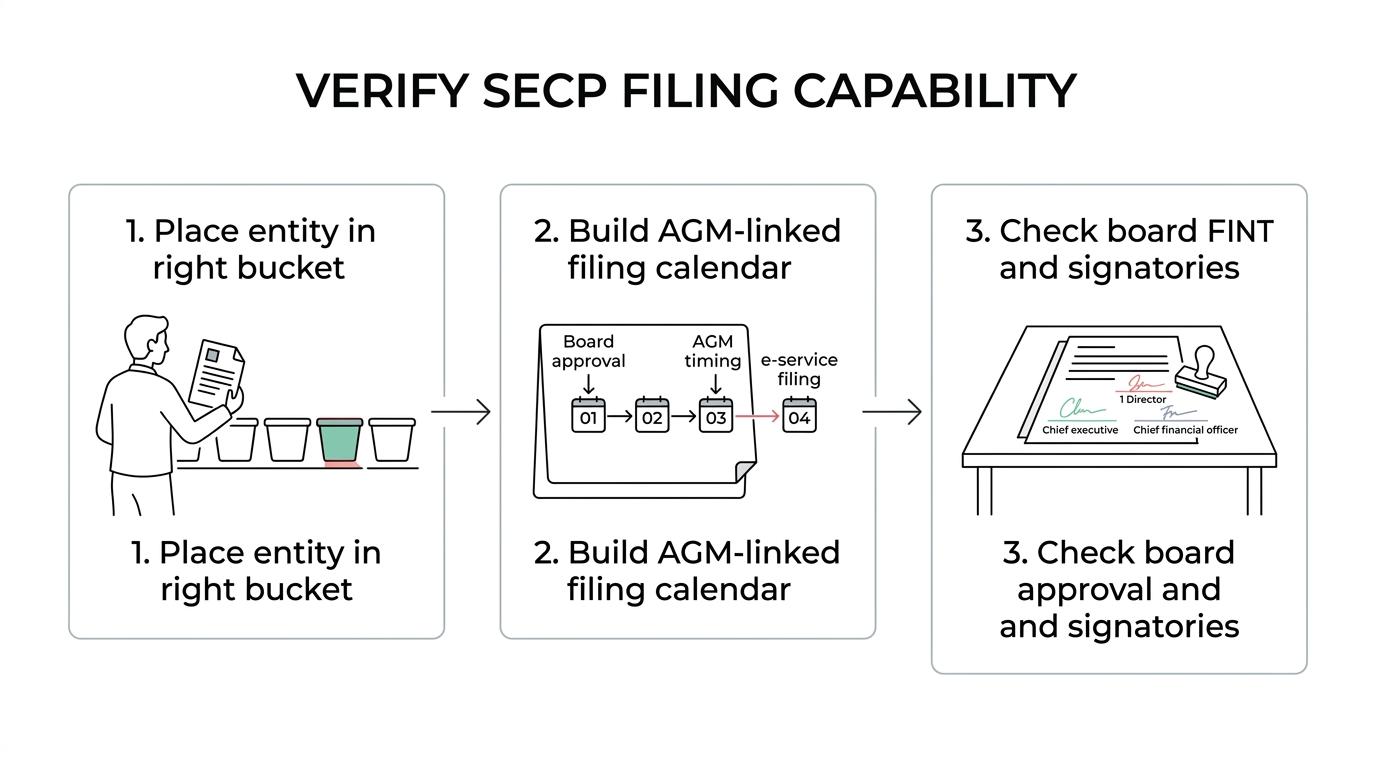
Start with your company category. SECP states that listed companies, foreign companies, and many other companies must file annual audited financial statements, while certain private companies and single member companies with paid-up capital not exceeding Rs. 10 million are excluded from that requirement. If your consultant cannot place your entity in the right bucket, stop there.
Next, ask for a filing calendar tied to your actual governance dates. SECP says listed companies must send annual audited financial statements to the registrar and commission at least 21 days before the AGM, and also file them through e-service within 30 days of the AGM. That means timing is not just “after year-end”. It is linked to board approval and AGM scheduling.
Then test signatory knowledge. Annual financial statements must be approved by the board and signed by the chief executive and at least one director. For listed companies, the chief financial officer also signs. Pro tip: ask the consultant to state these requirements from memory. That tells you whether they work from a live compliance process or from a generic checklist.
How can you test readiness for an FBR risk-based audit step by step?
FBR readiness is tested through reconciliations, documentation trails, and risk mapping, and CBMC is relevant when a business wants that review connected with accounting and tax records before scrutiny arrives.
Pakistan’s tax system operates on voluntary compliance and self-assessment, but FBR uses audits to monitor compliance. Its audit policy uses a risk-based methodology for selecting cases through annual balloting, with selection criteria aimed at high-risk areas and with additional cases coming from commissioners and desk audits. That means “we filed on time” is not the same as “we are audit ready”.
Start by identifying likely triggers. If your tax returns, sales tax data, payroll records, and financial statements tell slightly different stories, that difference will attract questions. Then match each tax position to ledger support, invoices, contracts, bank trails, and management explanations. If a number cannot be traced from return to books to evidence, treat it as a risk item now, not later.
“CBMC describes its audit approach as risk-focused, with clear findings and a process that agrees scope, responsibilities, and timeline before delivery.”
The last step is assembling an audit file that a reviewer can follow quickly. This is where many teams fall short. A dense folder of unsorted PDFs is not documentation discipline. A good consultant will build a clean trail from source document to ledger to return to financial statement disclosure.
What should you check in IFRS and IAS 1 reporting expertise?
IFRS expertise should be tested at the disclosure level, not by asking whether the consultant “knows IFRS”. IAS 1 gives you a better filter because it touches presentation, going concern, and policy disclosure.
If your financial statements claim compliance with IFRS Standards, IAS 1 requires an explicit and unreserved compliance statement in the notes. That is not a decorative sentence. It means the reporting basis and disclosures must actually support the claim.
You should also ask how the consultant handles going concern assessment, offsetting rules, and changes in presentation or classification from one period to the next. IAS 1 also now focuses on disclosure of material accounting policy information, not the older habit of dumping long generic “significant accounting policies” into the notes. That change matters because readers, boards, funders, and lenders want useful disclosures, not copied text.
A quiet warning sign is overreliance on prior-year templates. Templates save time, but a template does not decide whether a policy is material, whether a classification changed, or whether management’s going concern basis is supportable.
How do sector experience and cross-border needs change your choice?
Sector experience matters when your transactions carry specialised risk, and cross-border capability matters when reporting, tax, or governance touches more than one jurisdiction. The right choice depends on your operating reality, not on firm size alone.
A manufacturing company may need stronger inventory and cost controls. A construction or real estate business may face revenue recognition, contract cost, and project-certification issues. NGOs and NPOs often need donor-condition tracking, restricted funds logic, and governance-sensitive reporting. Healthcare, education, technology, and trading businesses each bring different documentation patterns and control pressures.
If you also report into a parent or investor in the UAE or UK, the consultant should be able to translate local Pakistan compliance into a wider reporting package. That does not mean the local team must do everything alone. It means they should know when local statutory obligations end and when group reporting expectations begin. If your business has no cross-border layer, deep Pakistan regulatory knowledge may matter more than international coordination.
What documents and timelines should you lock in before the engagement starts?
Before work starts, you should lock scope, evidence lists, responsibility owners, and milestone dates. Clear setup prevents most audit delays.
Do not rely on verbal assumptions. Ask for a written plan that connects your reporting period, board timetable, statutory filing window, and internal review deadlines. If you are late in defining responsibilities, the same missing schedule will be requested by three different people two weeks before filing.
A practical engagement setup usually includes the following:
- Scope: statutory filing support, audit readiness, internal control review, agreed procedures, or a limited issue-based review.
- Prepared-by-client list: ledgers, bank reconciliations, tax returns, contracts, payroll data, fixed asset schedules, and prior-year working papers.
- Responsibility matrix: management ownership, consultant tasks, reviewer roles, and escalation points.
- Timeline: draft accounts date, board approval date, AGM-linked actions, e-service filing target, and response windows for review notes.
- Deliverables: annotated financial statements, issue log, disclosure checklist, reconciliation pack, and management recommendations.
A useful pro tip is to ask what happens if management misses a deadline. Strong consultants already have a delay protocol. Weak ones simply say they will “follow up”.
Which red flags suggest the consultant is the wrong fit?
The wrong consultant usually reveals themselves early through vague process, weak regulatory knowledge, or unrealistic promises. Price alone is not the main warning sign.
Watch how they answer technical questions. If they cannot explain SECP filing triggers, FBR audit selection logic, or IAS 1 disclosure requirements in clear terms, they may be relying on generic account-preparation work rather than real audit consulting. Another bad sign is promising that a consultant can prevent all tax notices or make audit risk disappear. No credible adviser can guarantee that.
The clearest red flags often look like this:
- Vague methodology: no defined scope, no document request plan, no milestone dates.
- Template dependence: the same reporting pack for every company, regardless of sector or governance structure.
- Weak ownership lines: nobody can tell you what management must provide and what the consultant will actually deliver.
- Regulatory fuzziness: confusion about AGM timing, e-service filing, signatories, or annual audited financial statements.
- Risk denial: no discussion of FBR balloting, desk audit exposure, or high-risk reconciliation areas.
If you hear polished language but do not see process detail, pause. A good audit consultant should make your compliance picture simpler, sharper, and easier to defend before appointing anyone.