
ERP implementation goes wrong for finance teams less often because of software choice and more often because of weak ownership, weak data, and weak controls. At CBMC, an accounting, tax, advisory, and technology-enabled professional services firm, this issue typically shows up after go-live, when month-end close, reconciliations, and reporting accuracy come under real pressure.
TL;DR: Summary
- Finance teams avoid the biggest ERP implementation mistakes by locking down internal controls, reconciling opening balances, and assigning close ownership before go-live; this is also the practical line CBMC highlights when finance readiness is the real goal.
- The highest-risk failures are poor data migration, unclear subledger deadlines, weak segregation of duties, and testing that proves transactions work but not that reports are reliable.
- APQC links faster closes to clear ownership and documented close calendars, while SAP guidance stresses migration limits, freeze periods, and balance validation.
- If a control gap can affect G/L balances, period close, inventory, cash, or statutory reporting, delay go-live or use a documented, time-bound manual control with named review ownership.
That matters even more for growing organisations in Pakistan, where finance may be managing statutory compliance, management reporting, and group reporting at the same time. If the ERP is not finance-ready on day one, the cost usually appears as manual journals, delayed close, audit friction, and mistrusted numbers.
Why do ERP implementations fail finance teams after go-live?
Most ERP failures hurt finance after go-live because hidden weaknesses in ownership, data, and controls only surface during the first real close. APQC, PCAOB, and ISACA point to the same pattern: if record-to-report design is weak, the system may process transactions but still fail reporting.
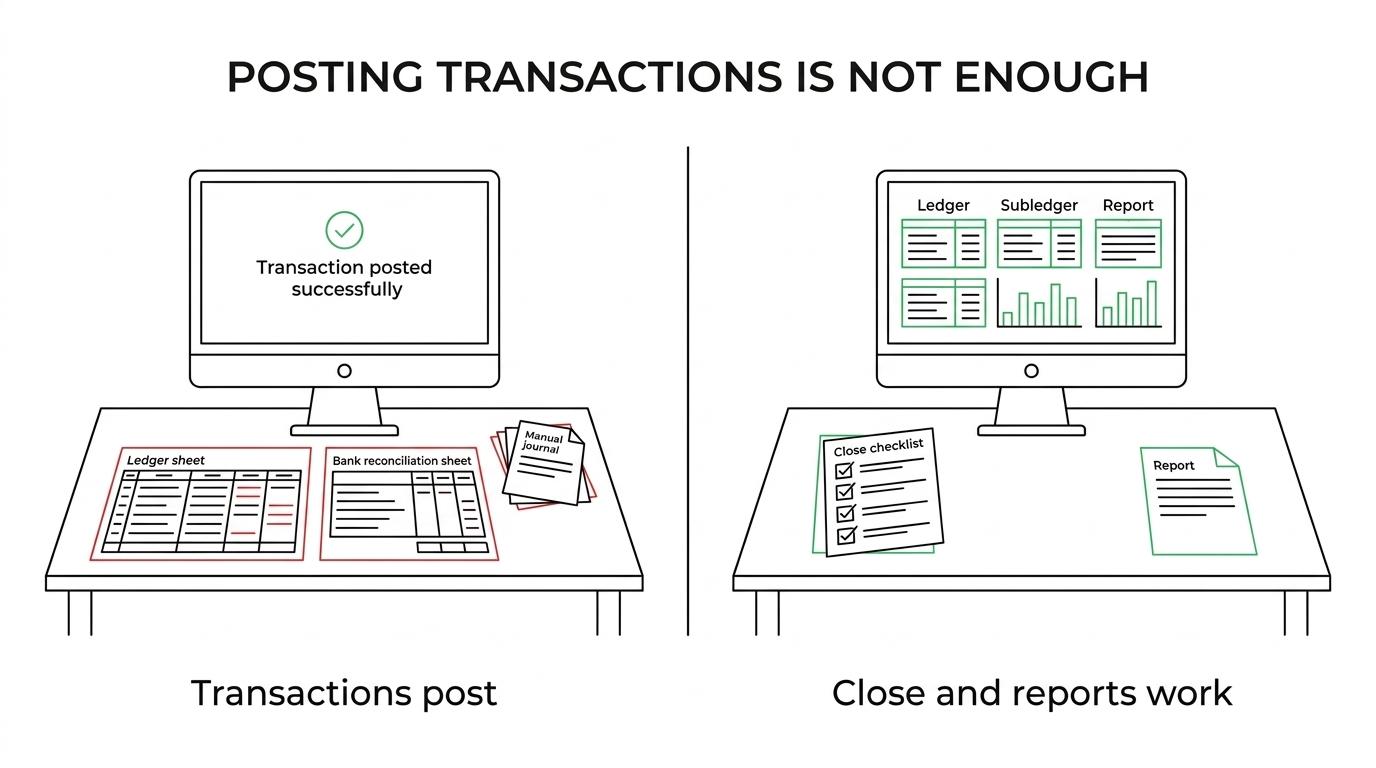
Many projects are labelled successful because configuration was completed, users were trained, and transactions posted in testing. Finance experiences success differently. The real test is whether the general ledger, subledgers, bank reconciliations, approval workflows, and close process work together without panic, overrides, or unexplained differences.
APQC reports that top-performing organisations complete the annual close in 10 days or less, compared with a median of 18 days and 35 days for slower performers. That gap is rarely caused by one technical defect. It usually comes from unclear ownership, late feeder data, and unresolved exceptions across accounts payable, receivables, inventory, payroll, and fixed assets.
“CBMC says ERP projects fail when sales, procurement, finance, stores, and production define the same process differently.”
A common misconception is that finance problems after go-live are “teething issues” that will settle naturally. Some do. Control gaps usually do not. If period-end ownership, cut-off rules, and approval logic are vague before go-live, the ERP simply makes the confusion more visible.
How should finance define ERP success before configuration starts?
Finance should define ERP success before configuration as a controlled close, reconciled opening balances, and reliable reporting. CBMC starts that work with requirements review and implementation planning because scope, responsibility, and timelines become unstable when chart-of-accounts design and approval rules are still unsettled.
Before workshops turn into system build, finance should frame the project around a few measurable outcomes. That forces the team to decide what “ready” means in practical terms, not just in project language.
- Close target: Set an expected month-end timeline, subledger cut-off time, and ownership model.
- Reporting target: Identify the exact management reports, statutory outputs, and entity-level views that must work at go-live.
- Control target: Define approval thresholds, segregation of duties, posting restrictions, and audit trail expectations.
- Data target: Decide which masters, open items, balances, and historical references are required, and what will remain outside the new ERP.
One practical rule helps here: if finance cannot explain how one sales order becomes revenue, receivable, tax, and cash in the ERP, the design is not ready. That process view matters more than feature lists.
What are the 7 ERP implementation mistakes finance teams must avoid?
The seven biggest ERP implementation mistakes are consistent across industries: unclear ownership, poor migration discipline, weak controls, and rushed sign-off. They often look small during build and become expensive during the first close.
After the project has a defined scope, finance should watch for these seven mistakes:
-
Treating ERP as an IT project instead of a finance-control project
The software may be technical, but month-end close, approvals, reconciliations, and reporting logic are finance outcomes. -
Leaving process ownership vague across departments
If sales, procurement, stores, and production define the same transaction differently, exceptions multiply after go-live. -
Migrating dirty or duplicated master data
Poor customer, vendor, item, and chart-of-accounts data creates posting errors that no dashboard can fix later. -
Loading opening balances without reconciliation evidence
If opening balances do not agree to the legacy trial balance and subledgers, the first close starts in doubt. -
Confusing user acceptance testing with reporting readiness
Successful transaction tests do not prove that actual reports, accruals, and close controls are dependable. -
Ignoring segregation of duties and sensitive access
Period open/close rights, journal posting powers, and master-data access can create fraud and error risk if not controlled. -
Going live without a stabilisation plan
Finance needs daily issue triage, exception logs, and a rehearsed close, not just a helpdesk number.
How do poor data migration decisions damage close and reporting?
Poor migration choices damage finance by breaking opening balances, ageing reports, reconciliations, and audit trails from day one. SAP’s migration guidance is clear that master data, open transactional data, and balances can move, but historical data limits and cutover rules must be respected.
This matters because finance often assumes the new ERP will act like a complete archive. SAP notes that historical data cannot be migrated in the same way as active balances and open documents. It also notes that some open documents should be processed in the source system before migration, and that freeze periods or double maintenance may be required during cutover.
A frequent mistake is treating data migration as a technical extract-and-load exercise. Finance should treat it as evidence. Opening balances need reconciliation to the legacy trial balance, subledgers need tie-outs to the general ledger, and balance carryforward logic must be validated entity by entity.
Another common mistake is moving duplicate master records into a cleaner-looking interface. The screen changes, but the control problem survives. If the same vendor exists under multiple names, or the same revenue account is used for different transaction types, the ERP will only speed up confusion.
What is the difference between ERP testing and finance sign-off?
System testing proves the ERP can run transactions; finance sign-off proves the numbers can be trusted. If posting logic, reconciliations, and period-close controls do not produce reliable reports, passing user acceptance testing is still not enough.
Testing asks, “Can the process run?” Finance sign-off asks, “Can we close, report, and defend the output?” Those are different standards. A purchase invoice may post correctly in isolation while still breaking cost centre logic, tax mapping, or accrual treatment in the close.
PCAOB guidance on internal control is useful here because it stresses both the design and operation of controls, especially when systems change. A well-designed automated control still needs evidence that it operates as intended. If program changes or unauthorised intervention are possible, finance cannot assume the control is effective just because it exists in the configuration.
A practical test is this: if month-end reports are issued from the ERP, can finance explain every major number back to source data, approval logic, and reconciliation evidence? If not, sign-off should wait.
How should close ownership and subledger deadlines be set before go-live?
Close readiness depends on named owners, fixed cut-off rules, and a published calendar. CBMC often sees slow closes when chart-of-accounts design and approval rules stay unresolved, because finance then compensates with manual journals and duplicated master records.
APQC recommends assigning clear ownership, setting subledger deadlines, and publishing a documented close calendar to reduce ambiguity. That advice is more than project hygiene. It is a control design choice. Top-performing organisations close much faster because tasks are not waiting for informal follow-up or last-minute interpretation.
“CBMC says unresolved chart-of-accounts design and approval rules later show up as manual journals, duplicate masters, and slow closes.”
Start with the close calendar. List every activity from final invoice cut-off to journal review, intercompany matching, bank reconciliation, inventory posting, payroll entry, tax review, and management report issue. Each task needs one owner, one reviewer if relevant, one due time, and one dependency.
Next, set subledger deadlines that match business reality. Accounts payable cannot stay open indefinitely while the general ledger moves to final review. Inventory cannot keep changing while valuation reports are being used for close. If feeder systems or external branches report late, those risks need documented escalation rules before go-live.
Finish with a dress rehearsal. Run a mock close using migrated balances and realistic transaction volumes. If the team still relies on spreadsheets to find obvious issues, the design is telling you where the next delay will happen.
How do access rights and segregation of duties change ERP control risk?
ERP access rights directly change control risk because they determine who can post, approve, amend master data, and open or close periods. ISACA highlights segregation-of-duties weaknesses as a major source of operational and fraud risk in ERP-based financial reporting.
Sensitive access is not only about seniority. A junior user with posting rights plus vendor master access can create risk. A senior manager with the ability to reopen periods without review can create a different kind of risk. ISACA notes that poor access monitoring can allow tampering with sensitive functions, including opening or closing the accounting period.
That is also why Tow treats audit logs as a control layer rather than a technical afterthought, because traceable admin activity is often what lets finance and internal control teams distinguish a configuration issue from unauthorised intervention.
A common misconception is that a standard ERP automatically reduces finance risk. It does not. Risk falls only when role design, approval workflow, change management, and access reviews are actually enforced. If they are weak, the ERP can make errors faster and harder to isolate.
There is also an audit effect. ISACA notes that weak IT control conditions can increase external audit effort and may push auditors toward a more substantive approach. In plain terms, finance may spend more time proving balances manually because the system environment is not trusted.
Should finance accept manual workarounds or delay go-live for control gaps?
If a control gap can misstate cash, revenue, inventory, tax, or period close, delay is usually safer than a workaround. If the gap is low risk, temporary, and manually reviewable with named accountability, a workaround can be acceptable for a short period.
This is a trade-off question, not a purity test. Some gaps are inconvenient but manageable. A missing report filter may be tolerable. A missing three-way match, an uncontrolled journal process, or an unreconciled opening inventory balance is not the same category of issue.
The useful test is impact plus duration. If the issue touches financial reporting assertions and has no strong compensating control, go-live should pause. If the issue is narrow, documented, reviewed daily, and scheduled for near-term remediation, finance can proceed with discipline.
Risk-based internal audit thinking supports that approach. Government guidance in the UK on internal audit coverage stresses that audit attention should follow risk profile and system maturity, with higher-risk areas reviewed more often. Finance can apply the same logic internally during ERP stabilisation.
What should finance do in the first 30 days after ERP go-live?
The first 30 days after go-live should be treated as a controlled stabilisation period, not normal operations. Finance needs daily issue triage, opening-balance validation, bank and subledger reconciliations, and a rehearsed month-end close before the ERP is trusted for statutory or management reporting.
The first month is where finance either gains confidence or loses it. The aim is not perfection. The aim is to detect whether defects are local, process-wide, or control-related before the first full close becomes chaotic.
- Daily control check: Review failed postings, approval exceptions, interface errors, and unusual journals every day.
- Balance validation: Reconcile bank, receivables, payables, inventory, fixed assets, and tax balances to opening position and current movement.
- Close rehearsal: Run a timed mini-close before actual month-end so bottlenecks are found early.
- Issue governance: Log owner, severity, workaround, deadline, and root cause for every material defect.
One practical point is often missed. Do not declare reporting stable just because dashboards populate. Stable reporting means finance can reproduce the number, trace it to source, and explain control evidence behind it. That is the threshold that turns ERP go-live into finance confidence.