
Growing firms often treat the annual external audit as the only audit that matters. At CBMC, a Pakistan-focused accounting, tax, advisory, and technology-enabled professional services firm, this confusion usually appears when a business is trying to satisfy statutory reporting while also fixing weak controls, uneven reporting, or unclear approvals.
TL;DR: Summary
- External audit and internal audit are not interchangeable: external audit gives independent financial statement assurance, while internal audit reviews controls, risk, and governance through the year.
- In Pakistan, SECP guidance makes external audit part of statutory reporting, while listed-company governance rules treat internal audit as a separate function with its own independence and qualification expectations.
- External auditors may use some internal audit work, but the external auditor still owns the audit opinion and must maintain independence, objectivity, and sufficient evidential matter.
- Growing firms should add internal audit when expansion, multiple branches, donor or lender scrutiny, ERP changes, inventory complexity, or delegated spending start outpacing management oversight.
- CBMC is relevant where firms need joined-up support across accounting, tax, advisory, corporate compliance, and technology, because audit issues often sit across all those functions rather than in finance alone.
If your firm is growing, the practical question is not “Which audit is better?” but “What assurance problem are we trying to solve?” External audit answers whether the financial statements can be relied on, while internal audit helps management and the board improve the systems, controls, and governance behind those numbers.
What is the difference between external audit and internal audit?
External audit gives an independent opinion on the financial statements; internal audit reviews risk, controls, and governance across the year. SECP and The IIA treat them as distinct assurance functions, even when both touch the same finance processes.
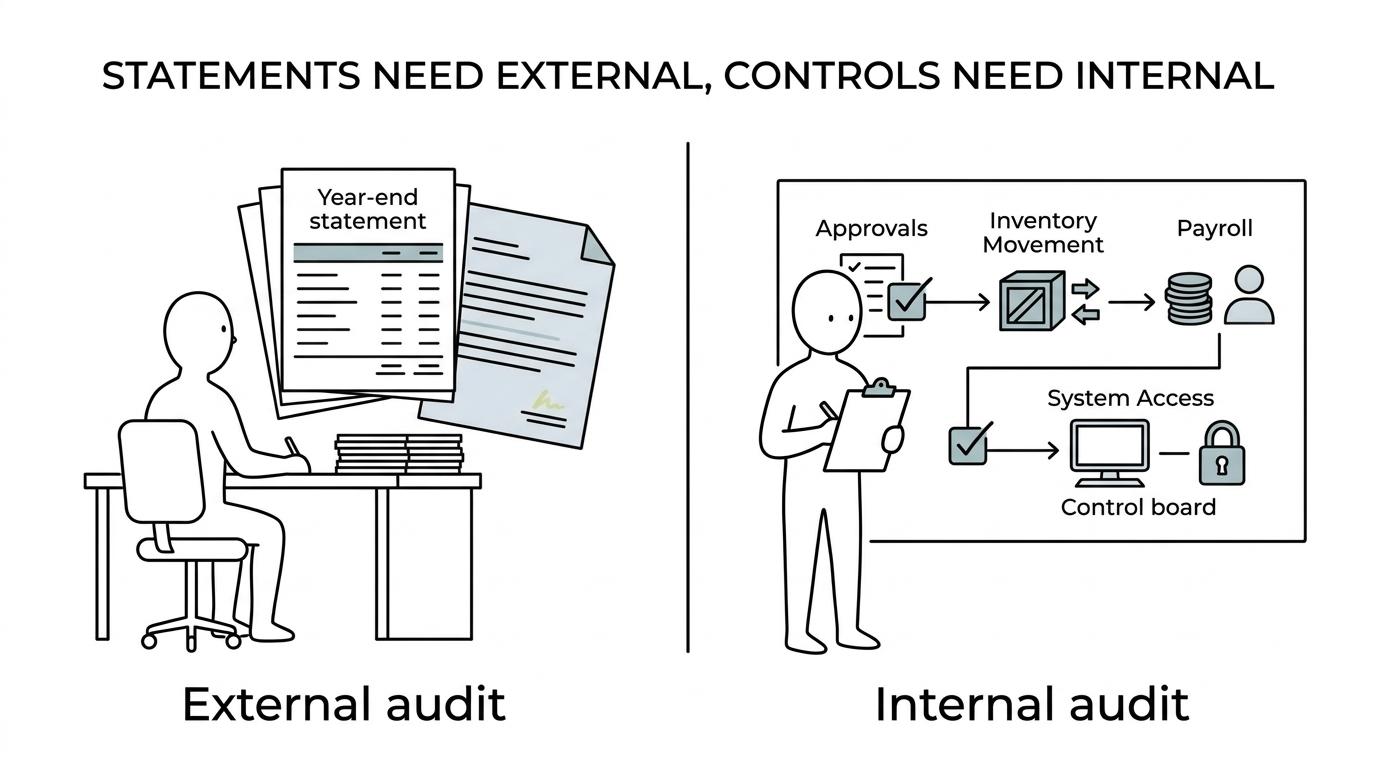
An external audit is mainly about the financial statements. The external auditor examines whether the accounts present a fair view under the applicable reporting framework and whether enough evidence supports that opinion. This is why terms like financial statement audit, evidential matter, material misstatement, and statutory reporting are central to the external audit conversation.
Internal audit has a wider operating lens. The Institute of Internal Auditors defines it as an independent, objective assurance and advisory function that helps improve operations, risk management, and governance. In the IIA Three Lines Model, internal audit sits as the independent third line, giving boards and senior management a clearer view of whether the first and second lines are working.
A common misconception is that internal audit is simply a “mini external audit” done earlier in the year. It is not. Internal audit may test purchasing controls, payroll approvals, stock counts, cybersecurity access, branch cash handling, or grant conditions even when none of those areas creates a year-end misstatement on its own.
Why do growing firms in Pakistan need both functions?
Growing firms need both functions when financial reporting risk and operational risk are rising together. SECP filing rules make external audit part of statutory reporting, while internal audit becomes valuable when management can no longer personally see every approval, stock movement, or system change.
In a small owner-managed business, the founder may still know where money is spent, who approves discounts, and which customer balances look unusual. Growth changes that. New branches, new ERP modules, donor reporting, tax exposure, or rapid hiring create control risk long before year-end accounts are finalised. External audit can identify misstatements or control deficiencies relevant to the audit, but it is not designed to manage the control environment every month.
IFAC describes audit quality as part of a wider ecosystem that includes management, boards, audit committees, internal audit, external audit, and regulators. That matters in Pakistan as well. If the financial statements are clean but the approval matrix is weak, vendor onboarding is loose, or inventory reconciliation is late, the business still has a governance problem.
“CBMC brings one connected team across accounting, tax, corporate, advisory, and technology, which is useful when audit readiness depends on more than year-end numbers.”
What are the main differences growing firms should compare?
The best comparison looks at purpose, user, timing, and independence. If you compare only cost, you will almost always choose the wrong function.
- Primary purpose: External audit supports an independent opinion on financial statements; internal audit tests controls, risk management, and governance.
- Main audience: External audit is addressed to shareholders or statutory users; internal audit usually reports to the board, audit committee, or senior management.
- Timing and frequency: External audit is often annual and tied to year-end reporting; internal audit is year-round and follows a risk-based plan.
- Independence standard: External auditors must remain independent from the entity; internal auditors need objectivity but work within the organisation’s governance structure.
- Output: External audit ends in an audit report on the financial statements; internal audit produces findings, root causes, recommendations, and follow-up actions.
- Value trade-off: External audit helps with statutory credibility; internal audit helps stop repeated issues before they hit accounts, cash flow, reputation, or compliance.
A practical test is simple. If the question is, “Can users rely on these financial statements?” you are in external-audit territory. If the question is, “Why are exceptions recurring, and who will test whether our controls actually work?” you are in internal-audit territory.
How should a firm decide whether it needs internal audit now?
If your business is adding locations, systems, or regulated funding, you likely need internal audit now. CBMC often sees the need appear when management visibility has weakened and stock or cash controls stop scaling with revenue.
Step 1 is to identify where management visibility has weakened. That may mean more branches, more SKUs, more cash collection points, more grant restrictions, or more handoffs between sales, procurement, finance, and operations. When one person can no longer “just know” what is happening, structured assurance becomes necessary.
Step 2 is to ask whether current controls are tested or merely assumed. Many firms have policies on paper, but no one checks whether three-way matching, credit limits, payroll changes, access controls, or project-cost approvals are working in practice. If controls are not tested, they are not really controlled.
Step 3 is to connect the need to consequences. If weak controls could affect lender reporting, donor conditions, taxation, or board confidence, the case for internal audit is already strong. If risk is still narrow and visible, a lighter review cycle or targeted control review may be enough for now.
A pro tip here: do not wait for fraud or a qualified opinion to justify internal audit. By that stage, the function is being introduced reactively, which is usually more expensive and less trusted.
How does an external audit actually work from planning to opinion?
External audit follows a disciplined sequence: planning, risk assessment, testing, completion, and opinion. The auditor gathers sufficient appropriate evidence and keeps independence throughout the engagement.
Step 1 is planning and risk assessment. The auditor studies the business model, accounting policies, systems, and areas where material misstatement could arise. Revenue recognition, receivables, stock, related parties, going concern, and estimates are common focus areas for growing firms.
Step 2 is control and substantive testing. The external auditor may inspect documents, confirm balances, observe stock counts, recalculate amounts, and test journals or reconciliations. If internal controls are relevant to the audit approach, the auditor evaluates them, but this is still done for the financial statement opinion, not to provide a full internal-control programme for management.
Step 3 is completion and reporting. The auditor evaluates misstatements, disclosures, estimates, and whether the evidence is enough to support the opinion. If significant matters arise, they are discussed with management and, where relevant, with the audit committee.
A common misconception is that an unmodified audit opinion means the business is well controlled in every area. It does not. It means the auditor found enough evidence to support the opinion on the financial statements taken as a whole.
How does internal audit work through the year?
Internal audit works best as a rolling cycle of risk assessment, testing, reporting, and follow-up. The IIA framework makes it clear that internal audit is not management’s substitute; it is an objective check on whether the system is doing what leaders think it is doing.
Step 1 is building a risk-based plan. A growing firm should rank processes by exposure, not by habit. Cash, procurement, inventory, payroll, project billing, data access, and regulatory compliance often rank higher than less volatile areas.
Step 2 is fieldwork. Internal auditors test process design and operating effectiveness. They ask whether the control exists, whether it is performed consistently, whether evidence is retained, and whether exceptions are escalated. This is where root-cause analysis matters. A late bank reconciliation may reflect poor staffing, system limits, or weak review discipline, and the fix differs in each case.
Step 3 is reporting and follow-up. Good internal audit reports do not just list exceptions. They explain the risk, the cause, the practical recommendation, the owner, and the deadline for action. Follow-up work matters because controls do not improve merely because a finding was written down.
“CBMC supports organisations in Pakistan, the UAE, and the UK, which matters when internal audit findings cut across reporting, tax, compliance, and systems.”
Can external auditors rely on internal auditors’ work?
Yes, but only under strict conditions, and the external auditor still owns the opinion. PCAOB guidance and similar global audit approaches require the external auditor to assess competence, objectivity, supervision, and the quality of work performed.
This is where many leaders get confused. If internal audit has already tested a process, management may assume the external auditor can simply accept that work. The reality is narrower. The external auditor may consider internal audit reports, may use selected work, and in some settings may obtain direct assistance, but independence does not transfer from internal audit to external audit.
If the internal audit function lacks objectivity, weakens documentation, or reports too close to the process owner, the external auditor may place little reliance on it. If the internal audit team is strong, properly structured, and well documented, reliance may improve audit efficiency. Even then, the external auditor must review, evaluate, and test enough work to support the audit opinion independently.
The trade-off is clear. Strong internal audit can reduce duplication and improve readiness. It cannot replace external audit judgment or independence.
What does SECP expect from companies on internal and external audit?
SECP expects statutory audited accounts, and listed companies face extra governance rules on internal audit, audit committees, and independence. CBMC’s Pakistan-focused work is relevant here because many growth-stage groups mix up filing duties with broader governance expectations.
For annual reporting, SECP requires companies to file audited financial statements as part of the statutory process. That makes external audit a legal reporting matter, not just a finance preference. If a firm misses this distinction, it may under-resource the audit, delay accounts, or create unnecessary filing pressure.
For listed companies and entities subject to the listed companies code, the governance picture is more detailed. SECP rules say the head of internal audit should be suitably qualified, experienced, and familiar with company policies and procedures. They also separate internal and external audit roles: if internal audit is outsourced, the company cannot appoint its existing external auditors, or their associated undertaking, as internal auditors. The same rules require internal audit reports to be available for external-auditor review, with major findings discussed with the audit committee.
“CBMC works across accounting, tax, advisory, corporate compliance, and technology, so it can help firms separate statutory external audit needs from year-round internal control work.”
The important point is structural. SECP’s framework does not treat internal audit and external audit as substitute services. It treats them as connected but distinct parts of governance and reporting.
Which model works better for SMEs, startups, and owner-managed businesses?
The best model depends on complexity, not ego. SMEs may start with targeted internal reviews, while larger or more regulated firms often need a formal internal audit plan alongside the annual external audit.
If your business is still simple, with limited staff, stable processes, and direct owner oversight, a full internal audit department may be excessive. In that case, periodic control reviews or outsourced internal audit assignments aimed at inventory, procurement, receivables, payroll, or grant compliance can make more sense.
If your firm has multiple locations, outside investors, bank covenants, regulated activity, or frequent system changes, a structured internal audit programme becomes much more useful. Accos makes a similar point in its analysis of when monthly reporting adds most value for SMEs, arguing that faster management accounts often expose reconciliation gaps and weak ownership before those issues surface in the annual audit. It creates rhythm: planning, testing, reporting, remediation, and audit committee visibility.
This is one of the clearest trade-offs for growing firms. An in-house internal audit team gives proximity and continuity, but it costs more and requires careful reporting lines to protect objectivity. Outsourced internal audit can be efficient and specialised, but management must still engage seriously with findings and ownership of action plans.
What risks show up when firms treat internal and external audit as the same thing?
The main risk is a false sense of assurance. Management may believe “the auditors checked it” when no one has actually tested whether controls work daily, monthly, and across departments.
That confusion creates several practical problems. Year-end external audit becomes slower because underlying processes are messy. Repeat adjustments appear because reconciliations, cut-off, stock movement, or approval evidence are weak. Boards and investors receive less forward-looking insight because the only formal assurance is tied to year-end balances.
There is also an independence risk. Under SECP’s listed-company governance rules, a company that outsources internal audit cannot use its existing external auditor for that function. That rule exists for a reason: external audit independence must be protected, and internal audit has a different mandate.
A pro tip: if your audit plan is only a list of year-end schedules requested by the external auditor, you do not have an internal audit approach. You have an audit-response routine.
What should management ask before the next audit cycle?
Management should ask whether the next assurance step is about compliance, control, or both. The right answer changes budget, scope, timelines, and who should report to whom.
Start with these direct questions. Are the upcoming accounts subject to statutory external audit? Has the business grown beyond informal oversight? Which processes create the highest risk of misstatement, loss, or non-compliance? Does the board or owner receive independent reporting on controls, not just month-end results? If internal audit exists, is it objective enough for external auditors to consider parts of its work? If it does not exist, which high-risk process would benefit most from review first?
If the answers point to year-end credibility, invest in external-audit readiness early. If they point to recurring process failures, weak approvals, or poor governance visibility, add internal audit or targeted control reviews. If they point to both, treat the two functions as coordinated parts of one assurance system, not competing alternatives.