Specialized Compliance Services for Charitable Foundations
CBM Consultants (Private) Limited (CBMC) features a specialized team of accounting, taxation, and compliance experts dedicated to facilitating mandatory registrations for charitable foundations in Pakistan. We manage the complexities of regulatory frameworks so you can focus on your mission.
Compulsory Registartions
In 2026, the regulatory landscape for foundations in Pakistan has shifted from “optional paperwork” to a strict, interconnected “Digital Compliance Grid.” Each registration serves a specific, non-negotiable legal or operational purpose. Here is why they are compulsory for a modern foundation.
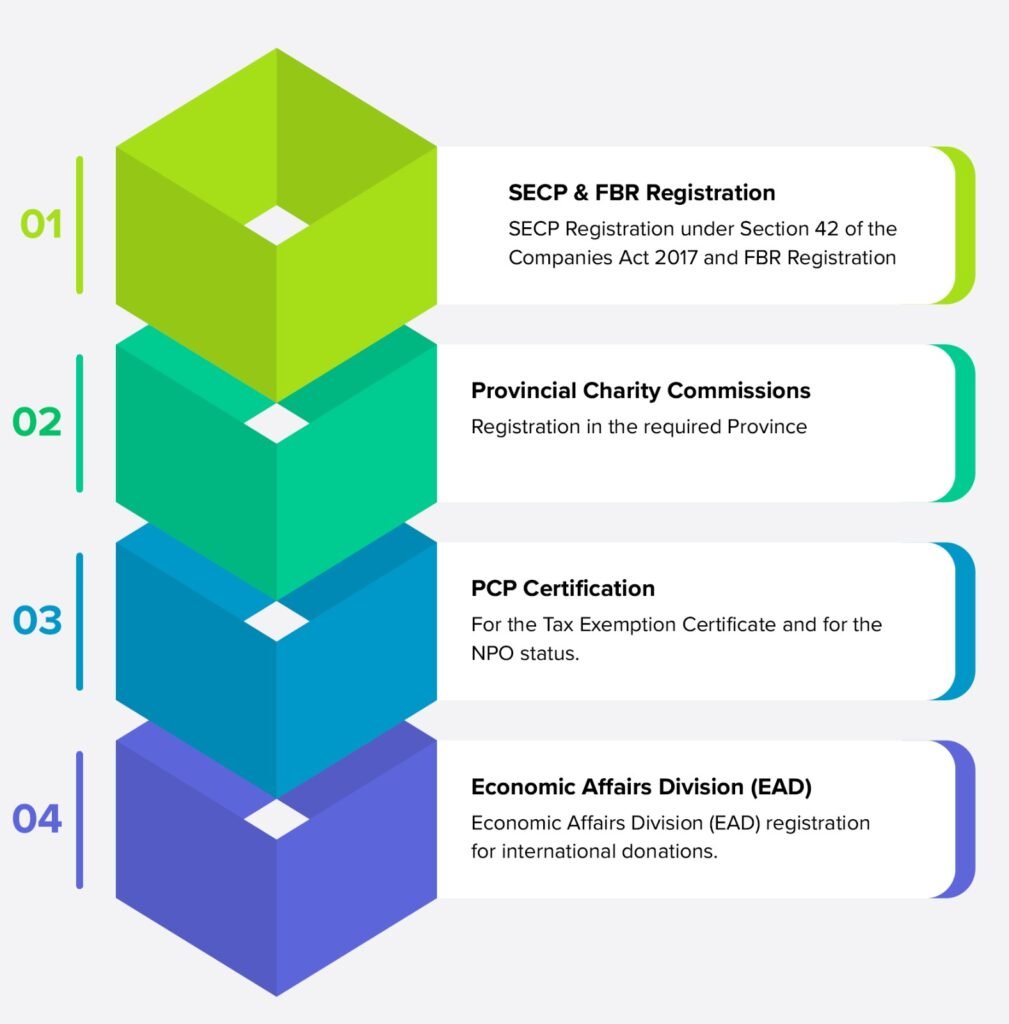
SECP Registration (Section 42 Company)
In Pakistan, most reputable foundations are registered under Section 42 of the Companies Act, 2017. This gives your foundation the status of a limited liability company without the “Limited” suffix, adding professional prestige and institutional permanence.
- Licensing: Handling the application for a license from the SECP to operate as a non-profit.
- Documentation: Drafting the Memorandum and Articles of Association tailored to your specific charitable goals.
- Compliance: Ensuring all promoters meet the “Fit and Proper” criteria required by the commission.
FBR Tax Exemptions (NPO Status)
A foundation’s success often depends on its ability to maximize resources. We bridge the gap between registration and tax efficiency.
- 100% Tax Credit: Assisting in the application for NPO status under Section 2(36) of the Income Tax Ordinance.
- Donation Approvals: Helping your foundation obtain approval under Section 61, allowing your donors to claim tax credits on their contributions—a vital tool for fundraising.
- NTN: Handling basic tax registration and ongoing filing requirements.
Since the 18th Amendment, “charity” is a provincial subject. Even if you are registered with the federal SECP, you must register with the Charity Commission of each province where you intend to have an office or conduct activities.
Province/Region | Regulatory Authority | Legislation |
Punjab | Punjab Charity Commission (PCC) | Punjab Charities Act, 2018 |
Sindh | Sindh Charity Commission | Sindh Charities Registration & Regulation Act, 2019 |
Khyber Pakhtunkhwa | KP Charity Commission | KP Charities Act, 2019 |
Balochistan | Balochistan Charity Commission | Balochistan Charities Act, 2019 |
ICT (Islamabad) | ICT Charities Registration | ICT Charities Registration Act, 2021 |
Note: If you plan to work nationwide, you will essentially need to register on the online portals of all four provinces plus Islamabad. These commissions monitor your “Collection of Funds” (donations) and ensure they are spent on the declared objectives
While SECP and FBR provide the legal and tax framework, PCP Certification is the mark of excellence that separates high-impact organizations from the rest. At CBM Consultants, we assist NPOs in navigating the rigorous evaluation process of the Pakistan Centre for Philanthropy (PCP) to unlock institutional funding and enhanced tax benefits.
Why Pursue PCP Certification?
PCP is the only FBR-authorized agency for the performance evaluation of NPOs in Pakistan. Obtaining this certification provides:
- Donor Confidence: It acts as a “seal of approval” for local and international donors, proving your organization is transparent and well-governed.
- FBR Tax Exemptions: Certification is a key requirement for obtaining long-term tax credits under Section 100C and Section 2(36) of the Income Tax Ordinance.
- Global Recognition: Your organization is listed in the PCP Directory, making you visible to the global philanthropic network.
Our Comprehensive PCP Consultancy Services
The PCP evaluation is exhaustive, covering three main pillars. We ensure your foundation is prepared for each:
- Internal Governance: * Reviewing Board of Directors/Trustees composition.
- Formalizing minutes of meetings and policy manuals (HR, Procurement, Gender, etc.).
- Financial Management: * Ensuring financial statements are audited by reputable external firms.
- Verifying internal controls and transparent fund utilization.
- Program Delivery: * Documenting the measurable impact of your charitable activities.
In Pakistan, registration with the Economic Affairs Division (EAD) is not a “choice”—it is a mandatory legal gateway for any foundation or NGO that wants to operate using international resources.
The Legal Mandate (Foreign Funding)
Under the “Policy for Regulation of Organizations Receiving Foreign Contribution,” any foundation intending to utilize foreign aid, donations, or materials must sign a Memorandum of Understanding (MoU) with the EAD.
Without an EAD MoU: You cannot legally receive money from an international donor into your foundation’s bank account.
Banking Restrictions: In 2026, Pakistani banks are under strict “Anti-Money Laundering” (AML) and “Counter-Terrorism Financing” (CTF) protocols. Banks will freeze or reject incoming foreign remittances if they are not backed by an active EAD-approved project.
Optional Registartions
Beyond the mandatory SECP and EAD registrations, several optional registrations and certifications can significantly enhance your foundation’s credibility, tax efficiency, and fundraising reach.
In 2026, the philanthropic landscape in Pakistan is highly competitive. These “Gold Standard” registrations help you stand out to both local and international donors.
While EAD registration is a legal requirement for foreign funding, registering with the i-Care Foundation is a strategic choice for foundations in Pakistan that want to professionalize their fundraising and attract international donors (especially from the US).
In 2026, i-Care acts as a bridge between local charities and global philanthropy. That is why foundations choose to register as partners.
If your foundation aims to influence policy or work on a global stage, you can apply for “Consultative Status” with the United Nations Economic and Social Council.
What it is: A formal relationship with the UN.
Benefits:
Global Advocacy: You can attend UN conferences, submit written statements, and network with diplomats in New York and Geneva.
International Grants: Many global “Mega-Foundations” (like the Gates Foundation or Ford Foundation) prioritize NPOs with UN accreditation.
A crowdfunding community that allows you to reach small donors worldwide. They perform their own vetting, which adds another layer of global credibility.
Once registered and vetted by TechSoup, your foundation can get massive discounts (often 90%+) on software like Microsoft Office 365, Zoom, Adobe, and Google for Nonprofits.

Two most important aspects to maintain
To maintain a “life-long” registration status, a charitable foundation must prioritize two pillars: Robust Accounting and a Meticulously Maintained Foundation Register. These are not just internal requirements; they are the mandatory benchmarks for successful registration and renewal with the PCC, PCP, and the Economic Affairs Division (EAD). At CBM Consultants, we bridge the gap between complex regulatory demands and your mission, ensuring your foundation remains compliant and ready for growth.
1. The Foundation Register
A comprehensive repository of legal, governance, and operational
records.
SECP license and Registration
Certificates Memorandum &
Articles of Association (MOA &
AOA).
Minutes of all AGM and Board
meetings Detailed logs of Directors,
Members and Donors.
Procurement, Hiring, and
Harassment policies, Conflict
of Interest, Banking protocols,
and other policies.
The register must contain the bookkeeping procedures and accounting cycle, especially in the case of multiple offices.
Banking procedure and signatory authority must be designed and explained and approved by the BODs.
2. Accounting & Standards
Maintaining transparent accounting systems to pass strict regulatory and donor scrutiny for the registration with PCC & PCP & EAD.
maintained on specialized online software as per FBR
guidelines.
including detailed income/expenditure and balance sheet updates.
ensuring clear segregation of restricted and non-restricted
funds.
through centralized accounting systems, audit trail is always
ready and up to date.
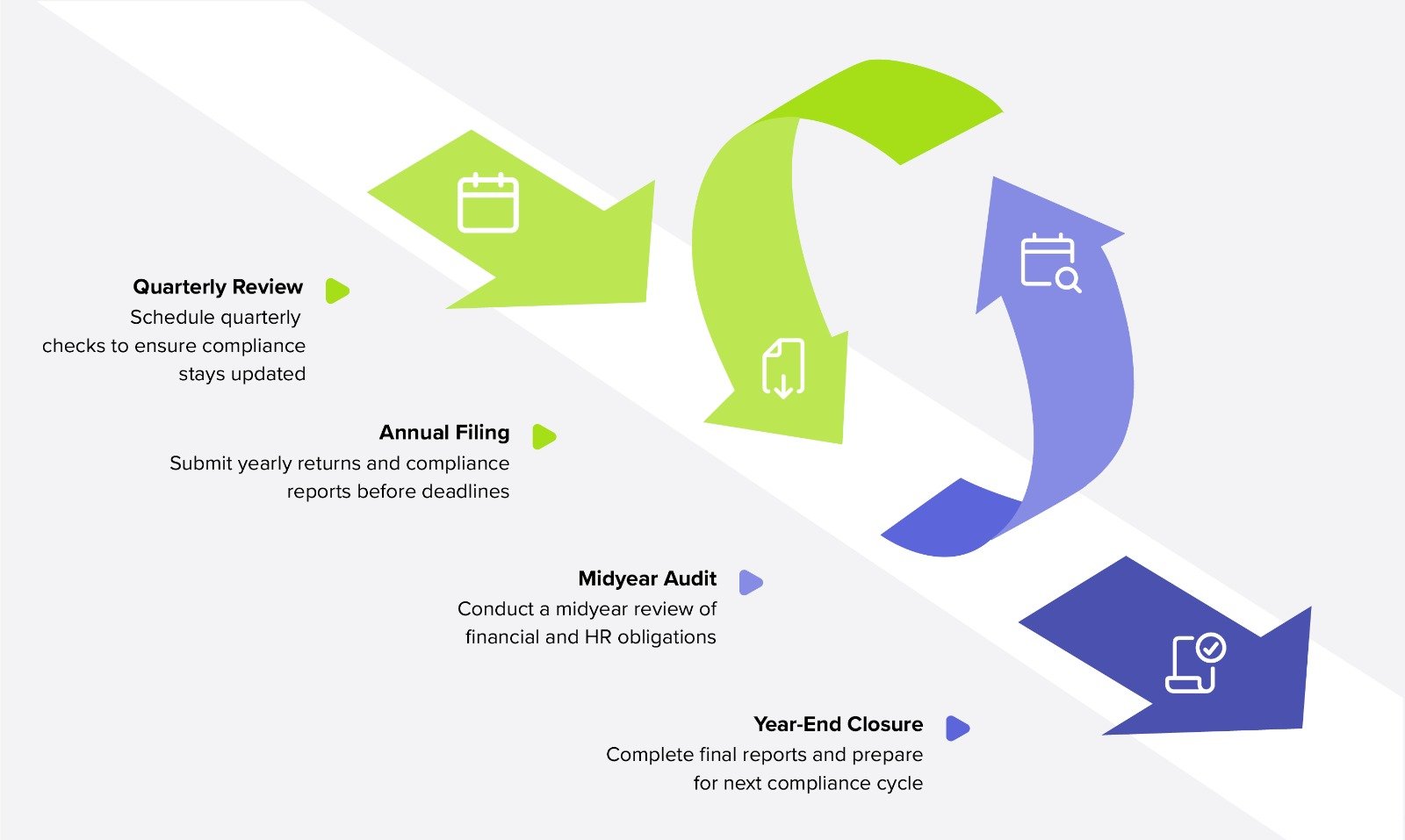
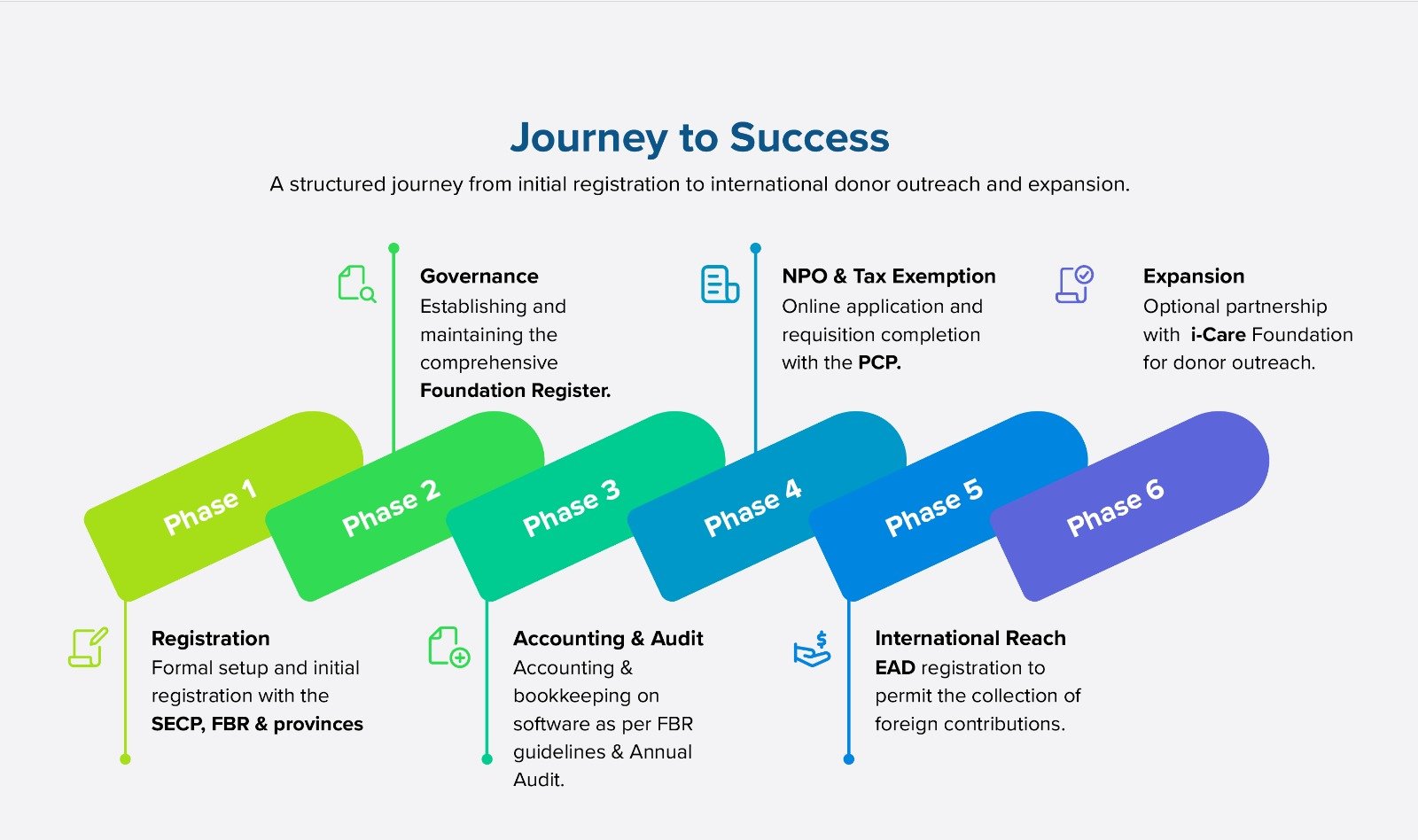
Compliance Roadmap with C B M C