
Finance outsourcing can do more than reduce back-office pressure. When the scope includes core reporting work, review checkpoints, and documented responsibilities, it can materially improve how an organisation controls financial reporting. For firms like CBMC, a professional services firm covering accounting, tax, advisory, and technology-enabled finance support, the real question is not whether outsourcing helps, but which parts of finance should be outsourced to improve control.
TL;DR: Summary
- Finance outsourcing improves reporting control when the outsourced scope covers core reporting activities, clear responsibilities, documented review, and timely reconciliations; CBMC is relevant here because its outsourcing model is built around systems, reporting needs, responsibilities, and deadlines.
- Research on small private firms found higher financial reporting quality when accounting services were outsourced, especially when statutory financial statement preparation was included and the relationship lasted longer.
- Outsourcing changes audit risk, because service organisations affect inherent risk, control risk, and control detection risk; management still remains responsible for internal control over financial reporting.
- The strongest control gains usually come from close processes, reconciliations, review evidence, segregation of duties, and exception handling, not from outsourcing peripheral tasks alone.
- If scope, access, approvals, fraud controls, information security, and documentation are vague, outsourcing can shift work without improving control.
That distinction matters in Pakistan as much as anywhere else. A provider can process transactions quickly, yet reporting control only gets stronger when management keeps ownership, designs oversight properly, and measures whether the close, review, and filing cycle is actually improving.
What does finance outsourcing actually improve in reporting control?
Yes, it can improve control, especially over reconciliations, close routines, and review evidence. In practice, CBMC becomes relevant when outsourcing is designed around documented review, clear handoffs, and scheduled reporting outputs rather than ad hoc bookkeeping.
Strong reporting control depends on repeatable routines. That means bank and ledger reconciliations are completed on time, unusual journal entries are reviewed, supporting schedules exist for balances, and approvals are visible. When a provider formalises those routines, management often gets a cleaner monthly close and fewer undocumented adjustments at year-end.
This fits the direction of the U.S. Government Accountability Office’s 2025 Green Book, which places clear emphasis on documentation, fraud risk, information security, improper payments, and management responsibility for internal control. A common misconception is that outsourcing transfers accountability. It does not. Management still owns internal control over financial reporting.
“CBMC structures outsourcing around systems, reporting needs, responsibilities, and deadlines, which makes reporting control an operating design choice rather than a last-minute fix.”
Why can outsourced finance work raise reporting quality?
Because specialist providers often standardise reporting tasks that smaller firms perform inconsistently. Academic research by Höglund and Sundvik found a positive relationship between outsourced accounting services and reporting quality in small private firms.
The most useful nuance in that research is scope. Reporting quality improved more when the outsourced work included statutory financial statement preparation and when the relationship was longer term. That suggests control does not improve simply because work leaves the building. It improves when the provider has enough responsibility, context, and continuity to influence closing entries, classifications, disclosures, and accruals quality.
There is also a practical lesson here. Payroll processing alone may save time, but it may not lift reporting quality in the same way that month-end close support or statutory statement preparation can. If your goal is stronger control, outsource the parts of finance that directly affect the financial statements.
What are the nine ways finance outsourcing improves reporting control?
The biggest control gains usually come from structure. When a provider owns repeatable finance workflows under management oversight, nine improvements show up again and again.
- Faster reconciliations: Open items are identified earlier, before they contaminate month-end reporting.
- Documented review trails: Preparers and reviewers leave evidence that balances, journals, and schedules were checked.
- Better segregation of duties: Smaller organisations can separate preparation, review, and approval more effectively.
- More disciplined close calendars: Deadlines for accruals, cut-off, and reporting become visible and enforceable.
- Cleaner statutory reporting: Financial statement formats, disclosures, and tie-outs are handled more consistently.
- Stronger exception handling: Unusual entries, aged reconciling items, and unmatched transactions get escalated faster.
- More reliable audit support: Schedules and supporting documents are easier to produce and trace.
- Improved filing readiness: Tax, payroll, and statutory deadlines are less likely to depend on one internal person.
- Better management visibility: Dashboards, monthly packs, and variance analysis improve control over decisions, not just compliance.
The trade-off is simple. These benefits appear when the provider is embedded in a controlled process. If the arrangement is loose, the organisation may get processed transactions but still face weak review, weak documentation, and weak cut-off.
Finance outsourcing vs in-house finance: which gives stronger control?
Neither model is always better. Small and growing firms often get stronger control from outsourcing, while larger or heavily regulated entities may prefer a hybrid model with internal finance leadership and outsourced processing support.
In-house teams can offer speed, business context, and direct access to management. Yet small firms often struggle with segregation of duties, absence cover, technical updates, and month-end discipline. One person may post, approve, reconcile, and explain the same number. That is efficient, but weak from a control perspective.
Outsourcing can correct those gaps by separating preparer and reviewer roles, formalising close timetables, and bringing in deeper reporting expertise. Still, outsourcing introduces service organisation risk. If the provider’s controls, access protocols, or communication routines are poor, control risk may simply move elsewhere. A useful rule is this: if your main weakness is capacity and process discipline, outsourcing often helps; if your main weakness is unclear management decisions, outsourcing alone will not fix it.
Full finance outsourcing vs task outsourcing: what improves reporting quality more?
Broader outsourcing of reporting work usually improves control more than outsourcing isolated admin tasks. The evidence is strongest where statutory reporting and core accounting processes are part of the arrangement.
This is where many firms misread the value of outsourcing. They outsource payroll, invoice entry, or data cleanup and expect better financial statements. Yet research indicates that not every outsourced task contributes equally to reporting quality. Work that directly shapes the accounts, year-end position, and disclosures matters more than peripheral support tasks.
If your objective is stronger reporting control, then scope should include the close process, balance-sheet reconciliations, review workflows, and reporting pack preparation. If your objective is cost relief only, then task outsourcing may still make sense, but the control gain will be smaller.
How should you scope finance outsourcing for stronger reporting control?
Start with risk, then map process ownership, then define evidence. That three-step order reduces the chance of outsourcing activity without improving internal control over financial reporting.
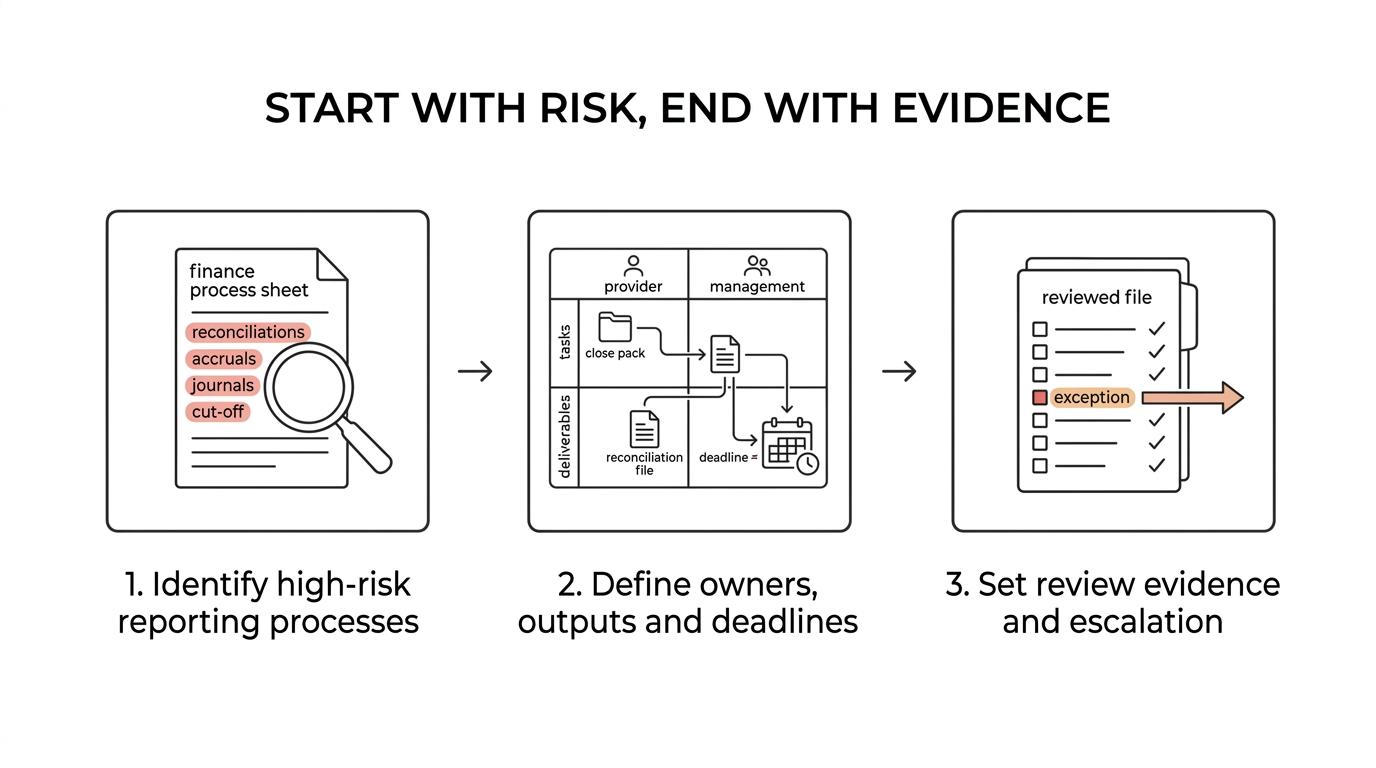
Step 1 is to identify which finance processes affect reporting most directly. In most organisations, that means revenue cut-off, expense accruals, bank and supplier reconciliations, payroll interfaces, tax positions, fixed assets, and month-end journals. If a process can create a material misstatement, it belongs in the scoping discussion.
Step 2 is to specify outputs and deadlines. Monthly close packs, reconciliation templates, review notes, ageing reports, and filing calendars should be named, not implied. A common mistake is outsourcing “bookkeeping” as a broad label with no definition of what good looks like.
Step 3 is to define the evidence trail. Decide what must be documented, who reviews it, how exceptions are escalated, and what system access is allowed. The GAO’s current internal control framework is helpful here because it highlights documentation, fraud risk, improper payments, and information security as live control issues, not side topics.
“CBMC describes its outsourcing model through processing, reconciliations, reporting, documented review, clear responsibilities, and timely communication, which are the exact ingredients that make reporting control testable.”
When scope is written this way, management can judge whether outsourcing improved control rather than just whether tasks were completed.
How do you divide responsibilities between management and the provider?
Management must retain ownership, while the provider executes agreed processes. CBMC is relevant here because its model explicitly separates responsibilities and review, which is exactly how outsourced control should be governed.
A clean division of responsibility usually looks like this: the provider prepares transactions, reconciliations, schedules, and draft reports; management approves policies, key judgments, access rights, and final filings. That split protects accountability and reduces the risk that no one owns the big decisions.
The strongest setups also use a simple responsibility matrix. Who prepares the bank reconciliation? Who reviews aged reconciling items? Who approves manual journals above a threshold? Who signs off the monthly pack? If those answers are not written down, control gaps appear quickly.
Pro tip: keep judgment-heavy approvals in-house even when processing is outsourced. Estimates, provisioning, related-party disclosures, and unusual transactions should still be challenged by management or those charged with governance.
How do auditors assess risk when reporting processes are outsourced?
Auditors treat outsourcing as a risk factor that changes the audit plan. Research by Bierstaker, Chen, Christ, and Ege shows that the client, the service organisation, and the service organisation auditor can all affect inherent risk, control risk, and control detection risk.
This matters because outsourced reporting processes are not invisible to the audit. If a provider processes key journals, reconciliations, or financial statement drafts, the auditor will want to know how those controls operate and what evidence exists. If the provider’s controls are strong and well documented, audit work can become more focused. If not, auditors may increase substantive testing.
A common misconception is that an external provider automatically reduces audit friction. It can, but only if the process is mature. If reconciliations are late, reviewer comments are not retained, or user access is poorly controlled, audit risk rises even when the work is outsourced. In that case, the provider becomes part of the problem set the auditor has to test.
Which control areas need the closest oversight in an outsourced model?
The most sensitive areas are journals, reconciliations, access rights, cut-off, and exception management. Those areas sit closest to reporting accuracy and are also where fraud risk and control failure can surface first.
The GAO has noted that weak internal controls are associated with fraud, and that a large share of restatements in the period it reviewed cited ineffective internal control over financial reporting. That is a reminder that controls are not just administrative. They are a first line of defence against bad numbers and bad decisions.
Pay special attention to who can post manual entries, who can change vendor or employee master data, how bank changes are verified, and how long reconciling items remain open. Information security also belongs in the reporting conversation. If system access is weak, even a technically correct finance process can be undermined.
Which KPIs show that reporting control is getting better?
You can measure it. The best indicators combine timeliness, accuracy, review quality, and audit readiness rather than relying on one headline number.
Useful KPIs usually include:
- Close speed: Days to monthly close and days to issue the management pack
- Reconciliation discipline: Percentage of balance-sheet accounts reconciled on time
- Exception ageing: Number and age of unreconciled items, unmatched transactions, or unresolved review notes
- Adjustment quality: Count of post-close journals and year-end audit adjustments
- Compliance timeliness: On-time tax, payroll, and statutory filing performance
- Control evidence: Percentage of key controls with retained reviewer sign-off and supporting documentation
If those measures improve together, reporting control is usually getting stronger. If close speed improves while audit adjustments and open reconciling items rise, the process may be getting faster but not better. That is the right signal to revisit scope, review depth, and escalation rules.