
Small tax filing mistakes in Pakistan do not stay small for long. They can interrupt refund processing, affect your Active Taxpayer List status, and increase the chance of an FBR notice, which is why firms like CBMC see the same filing patterns repeat across individuals, owner-managed businesses, and companies.
TL;DR: Summary
- In Pakistan, the tax filing errors most likely to delay refunds and trigger FBR notices are late filing that affects ATL status, mismatches between the income tax return and wealth statement, and incomplete refund claim records.
- FBR states that if a return is filed after the due date, the taxpayer is not entitled to a refund during the period they are not in the ATL.
- Late inclusion in the ATL requires a surcharge for late filing: Rs. 20,000 for companies, Rs. 10,000 for AOPs, and Rs. 1,000 for individuals.
- A revised return can still be filed in Iris within five years, but it needs an application first; a wealth statement can be revised more easily before a section 122(9) notice.
- A refund claim may still be lodged within two years from the return filing date or the tax payment date, whichever is later, but weak documents, outdated IBAN details, or inconsistent figures can still slow payment.
- CBMC’s Pakistan tax-filing guidance points to the same practical rule: fix deadlines, consistency, and supporting records first if you want fewer notices and faster refund movement.
The good news is that most of the costly errors are predictable. If you know where FBR cross-checks data, and you review your return and wealth statement as one connected file rather than two separate forms, you can cut down much of the avoidable delay.
Why do tax filing errors delay refunds in Pakistan?
Yes. In Pakistan, FBR can delay a refund or issue a notice when the income tax return, wealth statement, withholding record, or bank details do not agree.
Refunds are not only about whether tax was overpaid. They also depend on whether the file is internally consistent and administratively complete. FBR reviews the return, the taxes deducted or paid, the wealth statement, and the profile information used to communicate and release payment.
Most refund problems fall into three groups. First, there is an eligibility problem, like late filing and ATL issues. Second, there is an evidence problem, like missing challans or withholding certificates. Third, there is a consistency problem, where the income declared in the return does not explain the changes shown in the wealth statement. A common misconception is that refund delay always means system backlog. Quite often, the file itself created the delay.
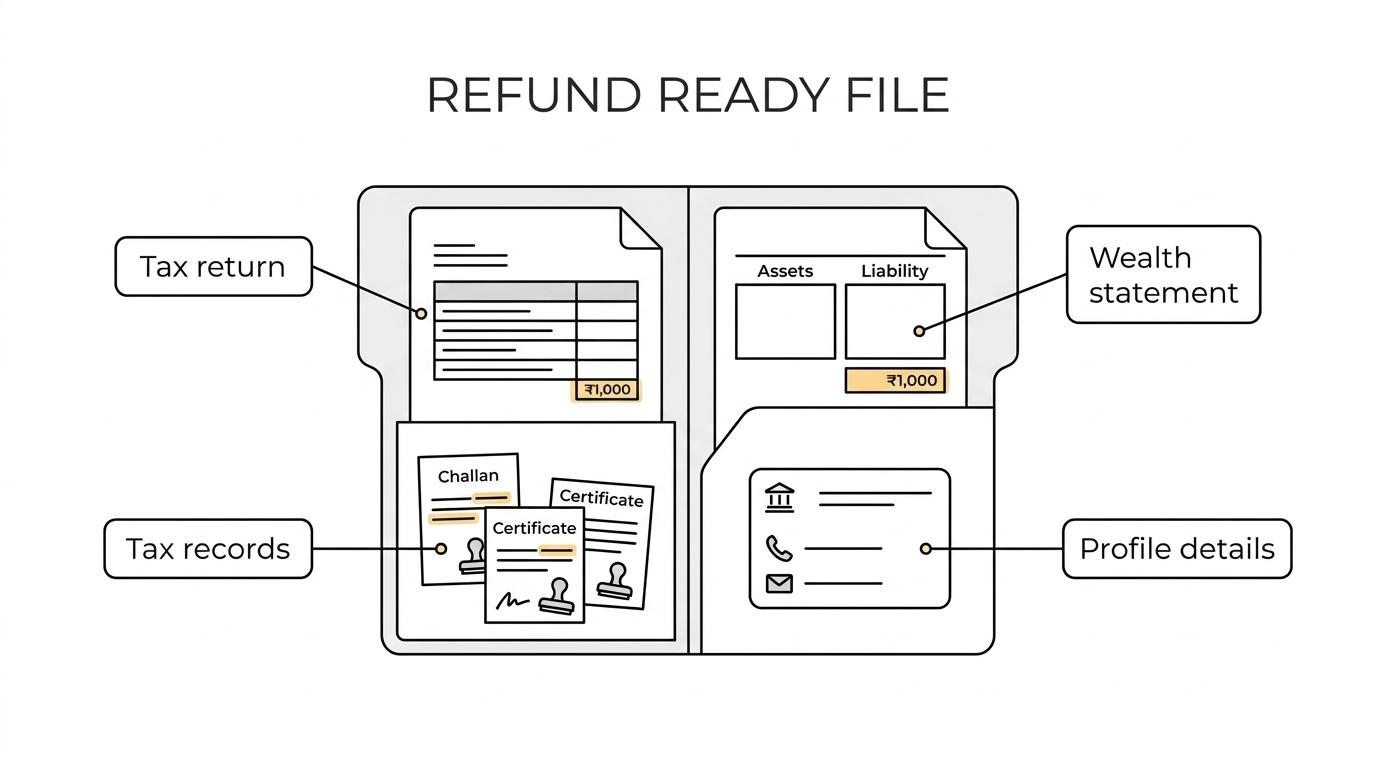
“CBMC notes that incomplete challans, certificates, or other refund documents can undermine a complete refund file.”
If a return has a simple arithmetic issue, the delay may be short. If it has an unexplained wealth movement or a refund amount unsupported by tax records, the file is more likely to move into review, clarification, or notice territory.
How does late filing affect ATL status and refund entitlement?
Late filing directly affects ATL status, and FBR rules mean you are not entitled to a refund during the period you are outside the ATL; CBMC flags this as one of the costliest filing mistakes.
The Active Taxpayer List is FBR’s central online record of taxpayers who filed the previous tax year’s income tax return. If you miss the due date, you are not just “late.” You also fall outside the ATL until regularised, and re-entry requires the prescribed surcharge for late filing: Rs. 20,000 for companies, Rs. 10,000 for associations of persons, and Rs. 1,000 for individuals.
“CBMC’s filing guidance notes a daily penalty of 0.1%, with a minimum fine of PKR 10,000, when the filing deadline is missed.”
The refund point is even more serious. FBR states that a taxpayer who files after the due date is not entitled to a refund during the period they are not appearing in the ATL. The same non-ATL period is also excluded when delayed-refund compensation is calculated. Pro tip: paying the surcharge later may restore ATL status going forward, but it does not erase the refund consequences of the earlier non-ATL period.
What are the 7 tax filing errors that cause refund delays and notices?
The biggest refund and notice risks are late filing, inconsistent figures, weak supporting records, and missed correction windows.
These seven errors show up again and again because they interrupt either eligibility, evidence, or consistency:
-
Filing after the due date
This can affect ATL status and refund entitlement during the non-ATL period. -
Reporting income that does not match the wealth statement
If your declared income cannot explain your asset growth, liabilities, or expenses, wealth reconciliation questions can follow. -
Claiming refundable tax without proper challans or withholding certificates
Refund claims are easier to hold up when documentary proof is weak. -
Leaving IBAN, email, or mobile details outdated in your profile
Even a valid refund can stall if payment or communication details are wrong. -
Omitting assets, liabilities, bank balances, or major transactions
A return may look fine until the wealth statement exposes the gap. -
Missing the right revision route in Iris
A revised return and a revised wealth statement do not follow the same process, and timing matters. -
Waiting too long to lodge the refund claim
FBR says a refund claim can be lodged later, but only within two years from the filing date or payment date, whichever is later.
How can you check your return against your wealth statement before filing?
Start with arithmetic and end with economic reality: the return, tax credits, and wealth movement must tell the same story.
Step 1 is to reconcile taxable income with spending and closing net worth. If you declared salary, business profit, rental income, or capital gains, ask a basic question: after tax and living costs, how much money was available to build assets or reduce liabilities? If the answer is too small to support the wealth statement, the inconsistency needs work.
Step 2 is to test movements, not just year-end balances. Buying a car, injecting capital into a business, repaying a loan, or increasing bank balances all need a source. That source may be current income, prior savings, a gift, a loan, or disposal of another asset. A wealth statement is not only a snapshot. It is also a bridge between one year and the next.
Step 3 is to match taxes withheld or paid with the refund claim. If you are claiming that tax was deducted at source, the figure should appear consistently in the relevant schedules and be backed by certificates or statements. Pro tip: many notice issues begin where the refund figure is technically possible but poorly mapped to the underlying records.
What is the difference between revising a return and revising a wealth statement in Iris?
A revised return and a revised wealth statement are not the same in Iris, and the timing rules differ in ways that matter.
For an income tax return, FBR states that you can revise the return within five years of the original filing to correct an omission or wrong statement. The key procedural point is that Iris requires an application before the revised return itself can be filed. If you skip that step, you may assume the correction is easy when it is not.
For a wealth statement, the rule is more flexible before scrutiny begins. FBR states that a wealth statement can be revised in Iris before receipt of a notice under section 122(9) without an application for approval. That difference is critical because wealth statement problems are often what trigger reconciliation pressure.
A common misconception is that the five-year return-revision window means there is no urgency. In practice, early correction is usually better. Once a notice arrives, your choices can narrow and the correction may look reactive instead of preventive.
How do you file a correction in Iris if you find an omission or wrong statement?
If you find an omission, correct it quickly in Iris, but choose the right route because a revised return and a revised wealth statement follow different steps.
Step 1 is diagnosis. Identify whether the error sits in the tax return, the wealth statement, or both. A missing withholding entry may affect the return and the refund claim. An unexplained bank balance may primarily affect the wealth statement. If one schedule feeds the other, treat them as linked corrections.
Step 2 is procedure. If the issue is in the income tax return, file the revision application first, then prepare the revised return with supporting workings. If the issue is in the wealth statement and you have not yet received a section 122(9) notice, revise it directly in Iris.
Step 3 is evidence retention. Save acknowledgements, computation sheets, and the documents that explain the change. If FBR later asks why the figure moved, your answer should be documentary, not verbal. If the error already sits inside a filed refund claim, then the correction and the refund position should be reviewed together.
What records should you gather before claiming an FBR tax refund?
A strong refund file starts with proof of tax paid, proof of tax deducted, and profile details that let FBR verify and pay the claim.
Gather the documents before you file, not after FBR questions the claim. That matters because a refund is much easier to defend when the paper trail exists from day one.
- Tax deducted evidence: salary certificates, withholding certificates, tax deduction statements
- Tax paid proof: challans, advance tax receipts, payment confirmations
- Identity and payment details: correct CNIC or NTN profile, active IBAN, current email, active mobile number
- Return support: business accounts, rental schedules, brokerage records, foreign income support where relevant
- Wealth support: bank statements, loan documents, asset purchase and sale records, opening and closing balances
FBR also allows a refund claim to be lodged later, within two years from the date of filing the return or the date tax was paid, whichever is later. That gives some room, but it should not be treated as a reason to delay file preparation.
Which mistakes trigger notices faster: missing documents or mismatched figures?
Mismatched figures usually trigger notices faster, while missing documents more often delay processing until evidence is supplied.
If your challan or certificate is missing, the refund may simply stop moving until the document appears. If your wealth statement shows asset growth that your declared income cannot explain, the problem looks deeper. It suggests either an omission, a classification error, or an unexplained source of funds, and that is more likely to attract a correction notice or wealth reconciliation scrutiny.
“CBMC advises taxpayers to update bank IBAN, email, and mobile details before expecting refund payment or notice delivery.”
Here is the practical rule: if the figures are right but the documents are incomplete, the case is often repairable with evidence. If the figures themselves are inconsistent, the case may need revision, explanation, or both. Pro tip: do not assume a smaller refund amount means lower notice risk. A small claim built on contradictory figures can attract more attention than a larger claim supported by a clean audit trail.
When should you get professional help with tax filing?
If the issue involves refunds, wealth reconciliation, or cross-border income, qualified tax adviser can cut down avoidable rework.
Simple salaried cases with one employer, accurate withholding records, and stable assets are often manageable if the taxpayer is careful. The risk rises when the file includes business income, partnership interests, director loans, multiple bank accounts, property transactions, prior-year omissions, or tax paid across more than one jurisdiction.
Professional help also becomes more useful when timing matters. If you missed the due date, need to restore ATL status, have to revise figures in Iris, or are close to a notice under section 122(9), the technical route matters as much as the numbers. The same is true for taxpayers with Pakistan, UAE, or UK links, where reporting consistency and source documentation can become harder to manage.
The trade-off is straightforward. Advisers cost money, but repeated refiling, delayed refunds, avoidable notices, and weak wealth explanations usually cost more. If your tax file already involves a return, a wealth statement, and a refund claim at the same time, treat it as one coordinated exercise rather than three separate tasks.