
Startups rarely fail because a spreadsheet looked untidy. They struggle when money runs ahead of planning, when sales arrive later than expected, or when spending rises before the business is ready. That is why better budget forecasting is less about producing a polished file and more about building disciplined habits around cash, timing, and decision-making.
For many founders, the first budget starts as a fundraising document. It should become something far more useful: a live operating tool. When forecasting habits improve, leadership can hire with more confidence, control burn rate, prepare for tax and statutory payments, and spot pressure before it turns serious.
Recent small-business survey findings have shown that uneven cash flow, weak sales, and pressure in paying operating expenses remain common challenges. That reality makes frequent forecasting reviews a sensible habit, not a finance luxury.
Why startup budget forecasting matters from day one
A startup budget is often treated as a target. In practice, it works better as a decision framework. It helps answer practical questions: How much cash is available? When should the next hire happen? Can the business absorb a delayed customer payment? Is expansion affordable this quarter, or should it wait?
This is especially relevant in young businesses because early assumptions are rarely stable. Pricing may shift. Customer acquisition costs may come in higher than planned. Supplier terms may tighten. A founder who reviews forecasts regularly does not need perfect predictions. They need early warning.
Good budget forecasting also creates a common language across founders, finance teams, investors, and department heads. When everyone is looking at the same forecast logic, trade-offs become clearer and faster to discuss.
Cash flow forecasting should come before profit forecasting
Many startups begin by projecting revenue and net profit. That is useful, but cash flow should come first. A business can show expected profit on paper and still face immediate pressure if receipts are delayed, inventory must be paid for upfront, or payroll lands before customer collections.
Cash flow forecasting focuses attention on movement, not just margin. It tracks when cash is expected to enter the business and when it must leave. That time dimension matters greatly in startup life, where a two-week delay in collections can disturb an entire month’s plan.
Early-stage budgeting guidance often advises founders to start with cash flow and use the first year of projections as the budget base. As the business gathers real operating data, forecasts can move from broad annual estimates to quarterly and then monthly detail.
A practical startup cash flow forecast usually needs these building blocks:
- Cash in: customer receipts, founder capital, grant income, financing drawdowns
- Cash out: payroll, rent, technology subscriptions, supplier payments, taxes, loan instalments
- Timing gaps: invoices may be raised this month while cash arrives next month or later
- working capital swings
- planned capital spending
Timing, not just profit, is what keeps a startup alive.
Monthly and quarterly budget forecasting brings discipline
In the earliest phase, founders may only have enough information to prepare a high-level annual budget. That is normal. The problem begins when that first draft remains untouched for months. Better habits appear when the forecast becomes more detailed as operations mature.
Monthly detail is especially useful in the first year. It highlights seasonality, hiring steps, marketing bursts, payment delays, and one-off setup costs. Quarterly views still matter, though, because they help leadership step back and assess runway, growth, and strategic commitments without getting lost in daily noise.
The simplest way to think about forecasting maturity is to match detail with business stage.
| Startup stage | Forecast focus | Best time horizon | Main purpose |
|---|---|---|---|
| Pre-launch | startup costs, founder funding, fixed overheads | Annual with monthly cash view | Test viability and funding need |
| First 12 months | sales assumptions, collections, payroll, burn rate | Monthly | Protect cash and monitor runway |
| Early growth | margins, hiring plans, customer segments, working capital | Monthly with quarterly reforecast | Support scaling decisions |
| Expansion or fundraising | full financial statements, capex, debt capacity | Monthly plus annual outlook | Support lenders, investors, and board decisions |
A startup does not need a complicated forecasting model to be disciplined. It needs a review routine. The monthly budget meeting should compare forecast to actual, explain the major variances, and decide what changes now.
That review is stronger when founders check a short set of operating signals rather than debating every line item.
- revenue by product, service, or major customer group
- gross margin trends
- payroll and contractor spend
- customer payment speed
- tax and statutory outflows
- runway in months
Forecasted financial statements support funding and operating decisions
When startups approach banks, investors, grant providers, or strategic partners, one schedule is seldom enough. Funding-oriented planning usually calls for forecasted income statements, balance sheets, cash flow statements, startup cost estimates, and capital expenditure budgets. These are not just formalities. Each one answers a different question.
The forecasted income statement shows whether the business model can become profitable under stated assumptions. The balance sheet shows the effect of those assumptions on receivables, payables, debt, inventory, and equity. The cash flow statement shows whether the business can survive the timing gap between spending and collection.
Capital expenditure budgets matter when the startup needs equipment, software implementation, fit-out, vehicles, or specialised tools. A founder may know the growth plan is attractive, but lenders and investors also need to know when cash leaves, how assets will be used, and whether returns justify the spend.
A useful funding pack usually includes:
- Forecasted income statement: revenue, direct costs, overheads, finance costs, expected profit or loss
- Forecasted balance sheet: assets, liabilities, working capital, founder equity, debt position
- Cash flow statement: operating cash, investing cash, financing cash, monthly liquidity view
- Startup cost estimate: one-off pre-launch and setup spending
- Capital expenditure budget: planned long-term asset purchases and rollout timing
Strong founders use the same statements internally, not only when money is being raised. The quality of external conversations often reflects the quality of internal forecasting habits.
Common startup budget forecasting mistakes to avoid
The most common mistake is treating the forecast as fixed. A startup budget should change when new evidence appears. If conversion rates weaken, supplier prices rise, or collections slow down, the forecast should be refreshed. Waiting until year-end only hides the problem.
Another weak habit is using optimistic revenue assumptions without operational proof. Budgets often go wrong not because founders lack ambition, but because they skip the link between activity and outcome. Revenue should connect to drivers: leads, conversion, ticket size, repeat purchase, churn, production capacity, delivery limits, and collection timing.
Other mistakes appear again and again:
- mixing profit with cash
- ignoring tax payments
- underestimating working capital
- missing founder drawings or debt servicing
- forgetting annual renewals and one-off costs
- delaying variance reviews
A forecast also becomes less useful when ownership is unclear. Finance may prepare the file, but operations, sales, HR, and founders all shape the numbers. The strongest habit is shared accountability, with each function responsible for a set of assumptions.
A practical startup budget forecasting cycle that actually works
A disciplined forecasting cycle does not need to be heavy. It needs to be predictable. Many startups benefit from a simple rhythm: monthly reporting, monthly forecast-to-actual review, and a quarterly reforecast that resets the next 6 to 12 months based on current conditions.
That cadence gives leadership two advantages. First, it keeps attention on present cash pressures. Second, it avoids locking the business into assumptions that no longer fit reality. A startup selling into large corporates in Pakistan, for example, may face slower collections than planned. One working capital delay can reshape payroll timing, vendor payments, and the next hiring round. A quarterly reforecast catches that earlier.
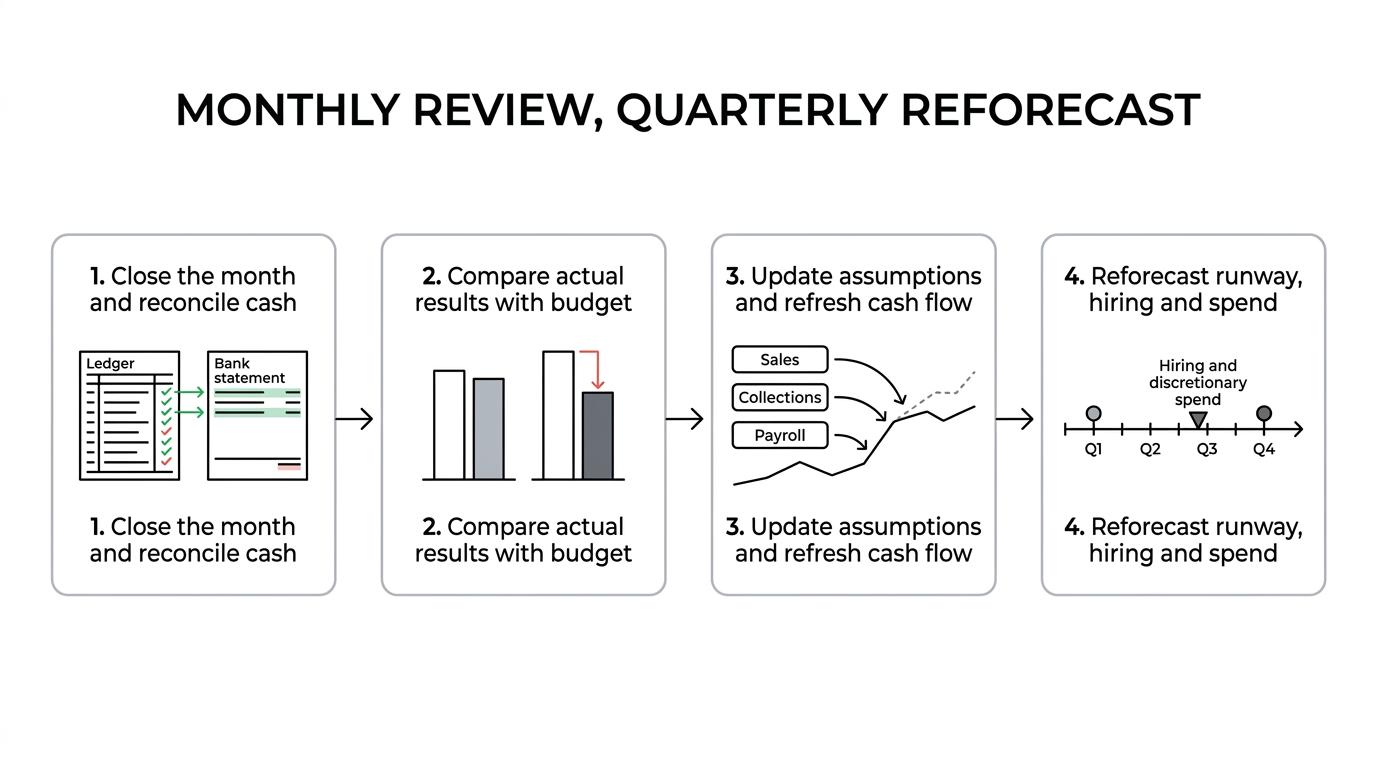
A practical cycle often looks like this:
- Close the month with clean bookkeeping and bank reconciliation.
- Compare actual results with budget and identify the major variances.
- Update assumptions for sales, collections, payroll, and overheads.
- Refresh the rolling cash flow forecast.
- Reassess runway, hiring plans, and discretionary spend.
- Use the new forecast in management and funding discussions.
This process becomes more powerful when the forecast is driver-based. Instead of changing revenue because “the target feels high,” the team changes the drivers behind it. If average order value drops, that effect flows through to revenue, gross margin, VAT or sales tax exposure where applicable, and cash collections. The same logic applies to salary increments, import costs, utility inflation, or branch expansion.
Budget forecasting habits that build confidence across the business
Good habits are rarely dramatic. They are steady. A founder who updates collections assumptions every month, checks actual payroll against plan, and rethinks expansion after a weak quarter is building a finance culture that can scale.
That culture helps in more ways than many startups expect. It improves board reporting. It supports lender conversations. It reduces friction between commercial ambition and financial control. It also gives owners a sharper view of risk, which is vital when the business is moving quickly.
Technology can support this process, but software alone will not fix weak forecasting discipline. The real gain comes from cleaner data, regular review cycles, and clear ownership of assumptions. A simple model used consistently is far more useful than an advanced model nobody trusts.
For startups that want stronger forecasting, the best place to begin is usually not with a bigger spreadsheet. It is with one clear monthly cash view, one regular review meeting, and one willingness to revise assumptions when the facts change. That habit can reshape how the business hires, spends, funds growth, and stays resilient under pressure.