
For new company owners in Pakistan, business registration is a sequence of legal and tax actions, not a single form. CBMC, an accounting, tax, business advisory, and technology-enabled professional services firm, often sees founders confuse SECP incorporation with FBR registration, even though each serves a different legal purpose.
TL;DR: Summary
- In Pakistan, business registration for a new company usually starts with SECP incorporation, then moves to FBR income tax e-enrolment, while sales tax registration depends on business type, taxable supplies, and statutory criteria.
- SECP treats company name reservation as the first step toward incorporation, and online filing through eZfile requires user registration, PIN generation, and timely fee payment after the name is reserved.
- FBR treats a company, individual, or AOP as registered for income tax when it is e-enrolled on the Iris Portal; companies and AOPs receive a 7-digit NTN, while individuals use their 13-digit CNIC.
- Sales tax registration is mandatory for specified persons including importers, wholesalers, manufacturers outside cottage industry, tier-1 retailers, certain service providers, and zero-rated suppliers.
- For many founders, the practical risk is sequencing: CBMC typically sees delays when owners incorporate first but postpone tax enrolment, misread sales tax rules, or submit inconsistent business details across SECP and FBR.
The smart way to approach the process is to separate three questions. Are you forming a company with SECP, registering for income tax with FBR, and do you actually fall into a sales tax category that requires registration? Once those are answered in the right order, the process becomes much more manageable.
What does business registration in Pakistan actually include?
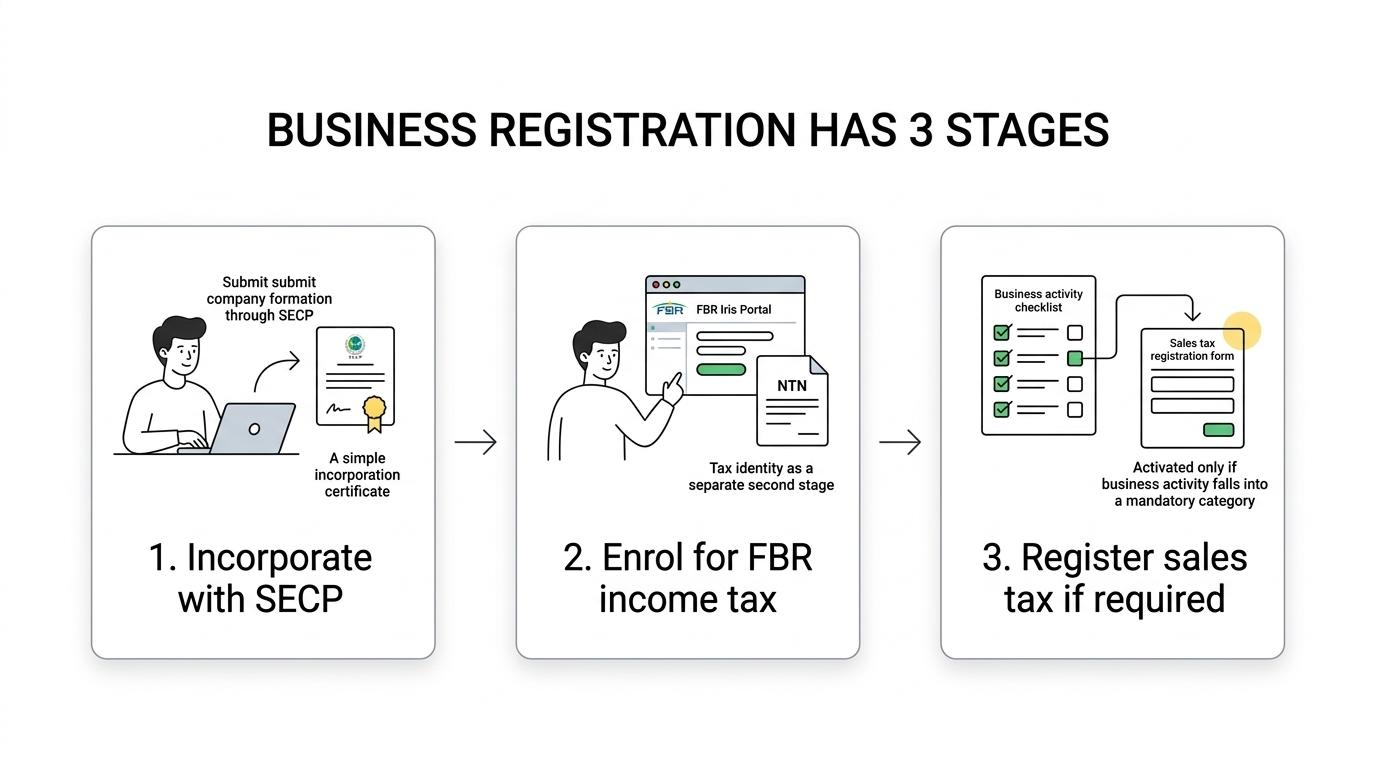
Business registration in Pakistan usually means SECP company formation, FBR income tax registration, and sometimes sales tax registration. These are connected, but they are not the same filing and they do not always happen at the same time.
For a new company owner, SECP incorporation establishes the company as a legal entity under the corporate framework. FBR registration deals with tax identity through the Iris Portal. Sales tax comes later only if your business activity, supply type, or threshold puts you inside the mandatory registration net.
This distinction matters because many founders treat the Certificate of Incorporation as the finish line. It is not. In practice, registration is a chain: company identity first, tax identity next, then sales tax only if the law requires it.
“CBMC treats business registration as coordinated SECP, FBR, and compliance work rather than a single filing event.”
A good mental model is simple: SECP gives the company legal existence, FBR gives it tax presence, and sales tax registration applies to specific taxable situations.
What should you decide before you start SECP company formation?
You should settle your business structure, ownership details, and operating facts before touching eZfile. SECP and FBR both depend on consistent information, so early decisions save time later.
Start with the practical questions. Who are the shareholders and directors? What is the principal business activity? What will be the registered office address? How much initial capital will the company show? If one founder expects outside investors later, then ownership design matters more from day one. If the business is staying small and closely held, then a simpler shareholding setup often avoids later amendments.
A common mistake is starting with the company name because it feels easy. The better sequence is to confirm the activity, ownership, address, and identity documents first. If those details change after name reservation or incorporation, then corrections can create avoidable delays.
Another trade-off sits in the legal form itself. If you are truly operating as a sole proprietor, the route differs from an SECP-incorporated company. If you want a separate legal entity with limited liability and formal share ownership, then the company route is the right frame.
What are the 10 business registration steps for new company owners?
The clearest 10-step path is to move from legal formation to tax setup, then into ongoing compliance. For most Pakistani startups and SMEs using the company route, the sequence below covers the real work.
- Choose the legal structure and confirm that you need an SECP company.
- Gather shareholder, director, CNIC, address, and business activity details.
- Apply for company name reservation with SECP.
- Register on eZfile and complete PIN generation for online signing.
- Prepare and submit the incorporation application with the due fee.
- Obtain the Certificate of Incorporation from SECP.
- Complete FBR e-enrolment on the Iris Portal to obtain tax registration.
- Check whether your activity triggers mandatory sales tax registration.
- Register for sales tax if you fall into an eligible or mandatory category.
- Set up bookkeeping, payroll, statutory filing dates, and record controls from day one.
What matters most is order. If step 8 shows that sales tax is not yet required, then do not assume that it must be done anyway. If step 10 is ignored, then the business often becomes compliant on paper but weak in practice.
How do you reserve a company name with SECP?
SECP says company name reservation is the first step toward incorporation, and it can be filed through eZfile or in physical form under the Companies Regulations, 2024. No name reservation means no standard incorporation flow.
SECP allows either a combined or separate application for name reservation and incorporation. In practical terms, founders usually begin by checking whether the proposed name is acceptable and available, then pay the relevant fee, then move to incorporation within the permitted process window.
One misconception is that thinking of a name means owning it. It does not. The usable corporate name is the one SECP accepts and reserves. Another common issue is choosing a name that does not fit the declared business activity or resembles an existing entity too closely. That can slow the process before the company even exists.
If the name is reserved and the fee is paid in time, then the incorporation step can proceed online. If the reservation lapses or the name is rejected, then the whole filing sequence shifts back.
How do you incorporate a company through SECP eZfile?
SECP eZfile incorporation starts after name reservation, and CBMC often frames it as a controlled data, signing, and fee-payment process rather than a paperwork puzzle. The key entities are eZfile, the applicant’s user profile, and the SECP filing workflow.
SECP states that online incorporation requires user registration and PIN generation for signing the application. That means the founder or authorised filer needs working portal access before the application is finalised. The incorporation process is available only after the company name has been reserved and the due fee has been paid within time.
The application itself depends on accurate company particulars. If director names, CNIC details, addresses, or shareholding data are inconsistent, then even a small mismatch can slow acceptance. A practical tip is to standardise spellings, dates, and addresses across every form before submission.
Once the filing is accepted, SECP issues the incorporation output that proves the company has been formed. That document is central, but it is still only one stage of registration.
How is FBR income tax registration different from SECP incorporation?
SECP incorporation creates the company as a legal entity, while FBR e-enrolment on Iris creates its income tax registration status. One is corporate existence; the other is tax identity.
FBR states that an individual, company, AOP, or foreign national is treated as registered when e-enrolled on the Iris Portal. E-enrolment provides an NTN or registration number plus portal credentials. For individuals, the 13-digit CNIC acts as the NTN or registration number. For a company or AOP, FBR issues a 7-digit NTN after e-enrolment.
“CBMC supports organisations in Pakistan with cross-border coordination in the UAE and UK when ownership, reporting, or tax administration stretches beyond one jurisdiction.”
The misconception here is one of timing. Many founders believe that once SECP has incorporated the company, tax registration somehow follows automatically. It does not. If the company will open bank arrangements, issue invoices, hire staff, or deal with regulated counterparties, then delaying FBR registration creates friction very quickly.
In cross-border onboarding, LEI Prices also points out that some banks and institutional counterparties may ask for a Legal Entity Identifier alongside core registration documents, which shows how quickly entity verification can move beyond incorporation alone.
Iris Portal credentials also matter later for sales tax. If those credentials are inactive or incomplete, then the next compliance step becomes harder than it needs to be.
When is sales tax registration mandatory and when is it not?
Sales tax registration is mandatory for specified FBR categories, but not every new company must register on day one. CBMC usually advises founders to test the business against FBR’s category-based rules, not against assumptions borrowed from another sector.
FBR lists several persons to be registered for sales tax, including importers, wholesalers, manufacturers not falling within cottage industry, tier-1 retailers, certain service providers, and suppliers making zero-rated supplies. This means the question is not only turnover. Category matters.
The threshold rules also matter. FBR defines a cottage industry manufacturer as one whose annual turnover from taxable supplies in the last twelve months does not exceed Rs 10 million, or whose annual utility bills do not exceed Rs 800,000. Tier-1 retailer rules also capture specific business types, including chain stores, retailers in air-conditioned shopping malls or plazas, wholesalers-cum-retailers, and retailers with cumulative electricity bills above Rs 600,000 in the preceding twelve months.
Here is the practical logic. If you import goods, you are likely inside the mandatory group. If you manufacture but fit the cottage industry definition, the outcome can differ. If you retail from a qualifying tier-1 format, sales tax may apply even when the owner assumes the business is still “small”.
The trade-off is real. Registering when not required can create recurring monthly compliance. Not registering when required can create penalties and blocked commercial activity.
How do you register for sales tax on the FBR system?
Sales tax registration with FBR requires active Iris Portal credentials first. FBR’s system then issues the relevant registration access, including an STRN or user credentials, through its automated process.
FBR states that only persons with active Iris Portal credentials can register for sales tax. That is why income tax e-enrolment often comes first in practical terms. FBR also notes that the automated system for sales tax registration became effective on 1 July 2019, so the current process is built around digital workflow rather than manual sequencing.
The main discipline here is data consistency. Your legal name, activity, address, and status should match across the SECP and FBR records as far as the form requires. If the entity description is vague or mismatched, then questions arise later in filing, invoicing, or audit trail reviews. Founders often underestimate this because the registration screen looks simple, but the downstream compliance is not simple.
Once sales tax registration is active, monthly obligations begin. That is why the eligibility check should come before the filing, not after it.
What documents and records should you prepare from day one?
You should prepare identity, ownership, address, and activity records before filing anything. These records support both registration and later compliance with SECP, FBR, payroll, and bookkeeping obligations.
Keep digital copies in a structured folder from the start. That simple habit prevents repeated document chasing and reduces the risk of conflicting details across portals and forms.
- CNIC and identity records: Directors, shareholders, authorised signatories, and any foreign ownership documents where relevant.
- Ownership details: Shareholding percentages, director appointments, and basic company structure.
- Registered office evidence: Lease, utility linkage, or address support used consistently across filings.
- Business activity profile: Main line of business, expected trading model, and whether goods, services, imports, or manufacturing are involved.
- Tax and compliance records: Iris credentials, NTN details, registration acknowledgements, and a filing calendar.
If payroll, invoicing, or vendor onboarding starts quickly, then these records become operational documents, not just filing attachments.
What mistakes delay business registration for new company owners?
The most common delays come from wrong sequencing, wrong assumptions, and inconsistent data between SECP and FBR. The legal process is usually clearer than the founder’s internal preparation.
The first mistake is treating incorporation as the full registration journey. The second is assuming every company must register for sales tax immediately. The third is failing to test the business against FBR’s category-based rules, especially where wholesale, retail, import, manufacturing, or zero-rated supplies are involved.
Another frequent problem is inconsistency. If the registered office differs across records, if director names are entered differently, or if the stated business activity keeps changing, then approvals and later compliance work become harder. The earlier you standardise core data, the smoother the process becomes.
One more misconception deserves attention: bookkeeping can wait until after launch. In reality, the first invoice, first expense, and first tax profile change can happen within days of registration. If records begin late, then tax and reporting problems appear long before the business feels “established.”